
v0.95 Author Review Master
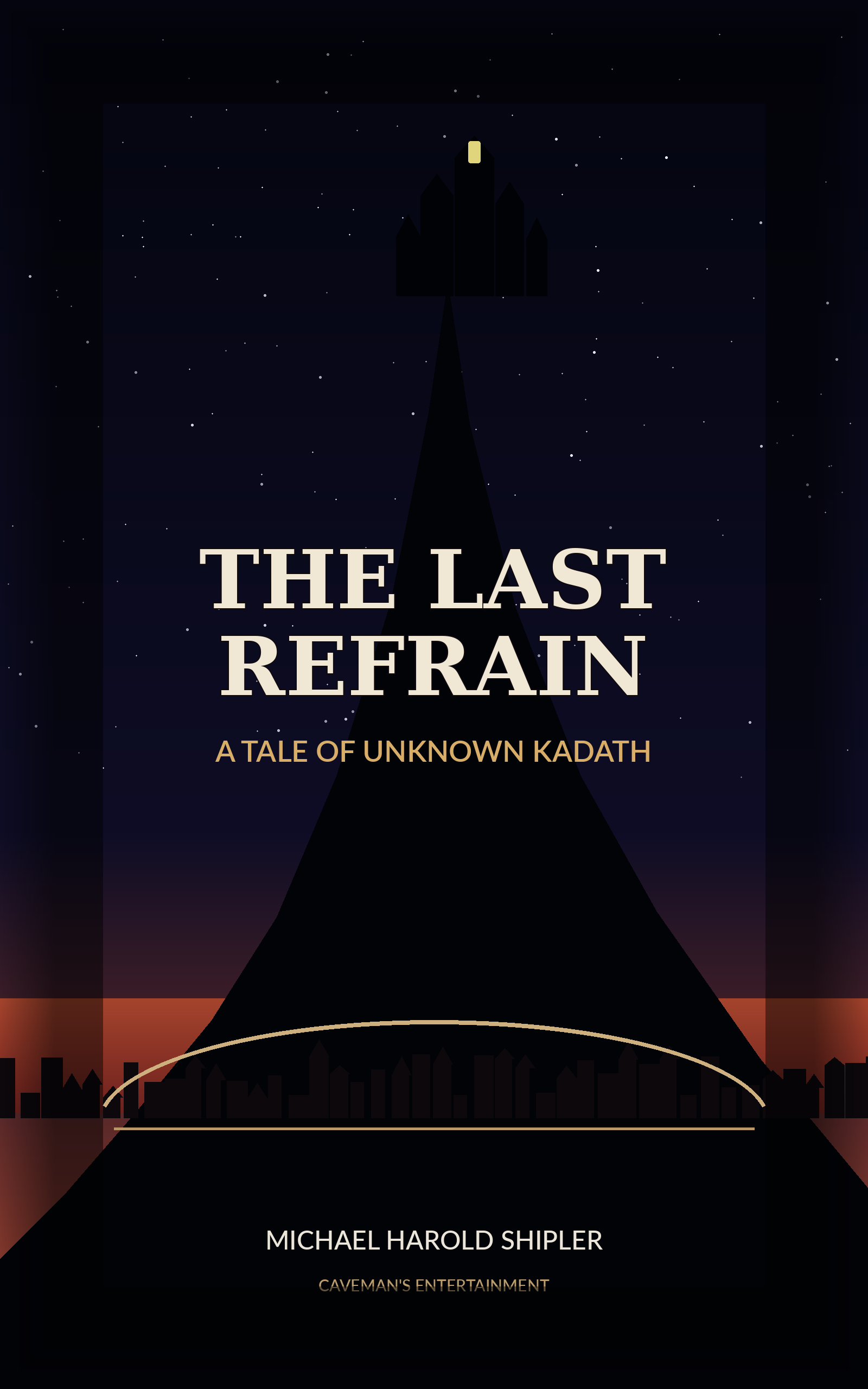
The Last Refrain
This online reader is the current selected-reader edition for feedback.
Reader note: This page is for test reading only. Use the feedback form for pacing, clarity, character, typo, formatting, and ending notes. Current edition: v0.95 Author Review Master.
THE LAST REFRAIN
A Tale of Unknown Kadath
A novel for Caveman's Entertainment
Author Review Master July 15, 2026
PART I
DEAD AIR
Chapter 1
The Reliquary
The room was listening badly.
Eli Vane knew the difference between silence and attention. Attention leaned forward. It tightened the air between the stage and the first row. It made the pause before a downbeat feel like a held breath.
This silence wandered.
A woman at the bar scrolled through her phone beneath the red EXIT sign. Two men in patched denim talked over the bass cabinet as though Graven Static were a jukebox they had not selected. Near the back wall, a cluster of black-clad regulars moved with enough loyalty to make the emptiness around them look larger.
Eli hooked two fingers beneath the guitar strap where it bit his shoulder and stared into the dark beyond the stage lights.
"You still alive out there?"
A few people shouted. Omar struck a low note that made the beer bottles tremble on their shelves. Rafe clicked his sticks over his head, four sharp knocks, and the band crashed into "Dead City Halo."
For three minutes, Eli forgot the missing bodies.
The guitar tone hit him in the sternum. Rafe's kick drum pushed against his spine. Omar's bass turned the scarred wooden stage into a single resonating plate beneath their boots. Eli threw himself into the first verse, not because the room had earned it, but because the song had. He had never learned how to play halfway. Halfway felt more humiliating than failure.
The Reliquary had once held four hundred people shoulder to shoulder. Back then the warehouse walls had sweated. The line had wrapped past the loading dock and around the chain-link fence. Fire marshals had appeared with clipboards and left with shirts stuck to their backs. Eli remembered the smell of fog fluid, hot cables, perfume, leather, and bodies that believed something important might happen before last call.
Now seventy people made the place feel abandoned.
He sang anyway.
By the final chorus, the loyal cluster had pushed to the stage. A shaved-headed woman screamed every word back at him. Someone raised both hands in the old horned salute. Eli stepped onto the monitor, leaned over them, and let the last note tear itself raw.
The applause was real. It was also brief.
Omar came close while Rafe counted off the next song.
"Don't look at the door," he said.
"I wasn't."
"You were counting people leaving."
"I was checking the room."
"Sure."
The next song was "Saints in Static," one of the tracks that had almost changed their lives. A label representative had once called it the missing bridge between industrial metal and something radio could sell. Three weeks later the label folded into another label, the representative stopped answering calls, and Graven Static spent the next decade pretending the bridge still led somewhere.
Mara stood beside the soundboard.
She did not dress for Eli's shows anymore. No lace gloves, no silver chains crossing her ribs, no black paint drawn from her eyes in ritual lines. She wore a long black cardigan over a faded shirt and kept her dark hair pinned up with a pencil. The white streak above her left temple caught the red booth light.
She watched him with the calm attention the room lacked.
That should have helped.
Instead, he wondered what she was measuring.
The set moved through songs old enough to have accumulated different meanings. "Skin of the Night" had once been about hunger. Now it sounded to Eli like rent. "No God Above" had been defiance; now it was a song he sometimes played while replacing cables at wedding venues for cash. Between tracks, he joked about age, bad decisions, and the smell coming from the men's room. The audience laughed. Performance remained the one form of lying he could make honest.
Then Omar stepped back and changed instruments.
Eli looked toward the soundboard.
Mara had gone still.
The opening of "The Last Refrain" was only four notes, played clean and low. Eli had written them in a motel outside Barstow fourteen years earlier while Mara slept with her head against the passenger window. He had played the notes at soundchecks, rehearsals, and shows in eleven states. The song had never been released. Every version felt unfinished, though nobody could say what it lacked.
Mara used to come onstage for the middle passage.
Her voice had entered beneath his, not harmonizing, exactly, but widening the song until it seemed to contain a room behind the room. She had stopped performing six years ago. Eli had never replaced her part.
He struck the four notes.
The Reliquary disappeared.
Not all at once. The black brick wall behind Rafe first became pale stone. The old catwalk above the dance floor stretched and curved into an arcade supported by slender columns. Red stage light spread across the room like sunset pouring through windows too high to see.
Eli missed the next chord.
Omar glanced over.
Eli found the progression again and kept playing.
Beyond the lights, where the empty half of the room should have been, a terrace descended toward a city.
Walls and temples burned gold beneath a sky fixed at the last moment before dusk. Arched bridges crossed between towers of veined marble. Fountains flashed in broad squares, their spray breaking the sunset into colors no stage light could make. Red roofs climbed a northern slope in crowded tiers, and narrow lanes twisted between peaked gables older than any city Eli had seen.
The vision possessed no haze. It was not a memory laid over the club. It waited with the complete confidence of a place that had existed before he looked at it.
At the far end of the central square stood a theater.
Its doors were open. Light spilled from within. Even at that impossible distance, Eli felt the weight of the audience waiting inside.
He sang the first line of "The Last Refrain" and heard thousands of voices answer.
The actual room held seventy people.
The city held him.
He moved toward it without moving, leaning over the monitor as the marble stairs seemed to rise beneath his boots. The scent of hot dust and spilled beer vanished beneath night flowers and cold water. Somewhere below, bells sounded in a pattern almost identical to Rafe's toms.
Then Mara's voice entered the song.
Not through the speakers. Not through any microphone.
It came from the city.
Eli turned toward the soundboard.
Mara stood with one hand pressed to her mouth.
The theater vanished.
The Reliquary slammed back around him in black walls, red lights, and startled faces. Feedback shrieked from the monitors. Rafe stopped playing. Omar's final note rolled through the room and died.
For a second, nobody moved.
Then someone near the stage cheered as if the breakdown had been intentional. The rest followed. Eli laughed into the microphone, because that was what he did when reality failed in public.
"That's one way to end a set."
The applause rose. He bowed with the band. Rafe threw a stick into the crowd. Omar unplugged his bass before the last echo was gone.
Eli found Mara beside the booth.
Her face looked bloodless beneath the red light.
"You heard it," he said.
She glanced toward the stagehands beginning to coil cables.
"Not here."
"Mara."
"After they clear the room."
Tessa Wynn, owner of the Reliquary, climbed onto the stage with a clipboard tucked beneath one arm. She had managed the club long enough that every expression she wore looked like an answer to a problem nobody else had noticed.
"Before everybody disappears," she said into the microphone, "I need staff in the office after load-out. Band too."
Omar looked at Eli.
"That sounds healthy."
Tessa's gaze found Eli and held.
He knew before she said anything.
Maybe he had known when he saw the fresh survey marks outside. Maybe when the upstairs office stopped ordering liquor more than a week ahead. Maybe when the landlord replaced the lock on the unused loading bay.
"What's going on?" Eli asked.
Tessa set the microphone back in its clip.
"Building sold," she said. "We close in four months."
The room seemed to empty a second time.
Eli looked toward the stage, toward the place where the marble terrace had opened. A faint line of gold still lingered along the edge of the black curtain.
Mara followed his gaze.
"I've seen it too," she said quietly.
Eli turned to her.
"The city?"
"Three nights. Same terrace. Same sunset."
A stagehand dragged a road case across the floor between them. Its wheels rattled over the boards like something descending a long flight of steps.
Mara lowered her hand.
"But there wasn't a theater," she said.
Chapter 2
After the Set
Mara had learned that empty venues kept the shape of noise.
The Reliquary after closing was not silent. It held compressed remnants: a bass note caught in the sheet metal above the stage, laughter clinging to the bar mirrors, the small electric whine of amplifiers cooling in the dark. Bottles dropped into bins behind the bar with the distant violence of breaking windows.
She waited in their usual booth while Eli helped Omar load cabinets through the rear door.
Usual booth was generous. It had been theirs once, in the years when the club reserved it with a handwritten card and strangers asked to sit nearby. Now nobody wanted the table beneath the broken air-conditioning vent. The black vinyl seat had split open and been repaired with silver tape.
Tessa's closing announcement sat between Mara's ribs like swallowed ice.
Four months.
She should have felt grief first. Instead she calculated.
Four months of booked shows. Four months before Eli lost the stagehand shifts Tessa gave him between gigs. Four months before the rent on the rehearsal room became impossible without the club's storage arrangement. Four months before another temporary crisis became Mara's spreadsheet.
She hated that her mind did this. She hated more that it had to.
Eli returned carrying two glasses of water.
"Bar's closed," he said.
"Good."
He slid into the booth opposite her. Sweat had dried dark beneath the collar of his shirt. Without stage light, the silver at his temples showed more clearly. He looked energized and exhausted, which was the closest he came to looking young now.
"Tell me exactly what you saw."
Mara wrapped both hands around the water glass.
"You first."
"Why?"
"Because you've already heard one difference. I don't want your description changing mine."
His mouth tightened.
"You think I'm going to contaminate the evidence?"
"I think people complete patterns without realizing it."
"You mean I do."
"I mean people."
"Sure."
There it was: the tiny turn by which a question about method became a judgment about him. Mara felt the familiar temptation to soothe it before it grew.
She did not.
Eli looked away first. "Fine. Marble terrace. Sunset. City below. Big square with fountains. Bridges. Red roofs going up a hill on the north side. Statues along the main streets. Everything looked old, but not ruined."
"The trees?"
"Thin. Pale trunks. Dark leaves. Flowers in stone pots."
"The water?"
"Silver basins. The spray broke into colors."
Mara's fingers tightened on the glass. "The stairs?"
"They went down forever."
"And you couldn't descend them."
Eli studied her.
"In the dreams, no. Tonight I thought I could."
That matched.
The city had come to Mara three times, always at the instant before night. She stood on a high terrace behind a carved railing, unable to take the first step. The place below filled her with the pain of remembering something that had never happened. It was not nostalgia. Nostalgia had edges. This was the certainty that a complete portion of her life had been removed and the wound had healed over empty space.
"What was in the square?" she asked.
"A theater."
"Describe it."
He did. Wide stairs. Bronze doors. A facade shaped like overlapping wings. Light inside. An audience waiting.
Mara had seen no theater.
At the same place stood a walled garden.
She could picture its black iron gate, though the rest of the city used no iron. Beyond it rose a narrow house with tall windows and a room built into the roof. She had known, with dream certainty, that the upper room belonged to her. Shelves covered every wall. A press stood beneath the window. No unopened bills, no equipment cases, no temporary furniture rescued from alleys. Nothing waiting for a better life to begin.
She had not told Eli about the house.
"What did you see?" he asked.
"A garden."
"Just a garden?"
"A house behind it."
His face changed too quickly for her to name the expression before he hid it.
"Our house?"
"I don't know."
"Were we there?"
"I was on the terrace."
"That's not what I asked."
"I didn't see us inside it."
He leaned back. "But it felt like ours."
Mara looked toward the stage. Tessa had shut off most of the lights. A single work lamp burned above Rafe's drum riser, turning the hanging dust into a slow fall of ash.
"It felt like a place I knew," she said.
"Same thing."
"No."
Eli rubbed both hands over his face. "Okay. Different landmarks. Same city. We both saw it three times, and tonight it showed up while we were awake. That is not nothing."
"I didn't say it was."
"You sound like you're trying to make it small."
"I'm trying to make it accurate."
"Mara, we saw the same impossible place."
"Mostly the same."
"You're doing it again."
"Doing what?"
"Finding the difference first."
She almost laughed. It would have sounded cruel.
For years Eli had accused her of finding differences whenever she refused to call a compromise temporary. The tour that would last six weeks became four months. The borrowed money that would be repaid after merch sales became a line on a credit card balance. The apartment they would leave after the next break became home because rent everywhere else rose faster than hope.
"The difference matters," she said.
"Why?"
"Because if this were only a shared dream, our minds should not have built the same city independently. If it is a place that exists, the different structures mean it is showing us something personal."
"Or we entered from different sides."
"Maybe."
"You don't sound convinced."
"I'm not convinced of anything."
The rear door opened. Omar came in backward, dragging a coil of cable. He dropped it beside the stage and called, "You two leaving tonight, or are you moving into the booth?"
"Five minutes," Eli said.
Omar looked from him to Mara. "That's what you said after the Phoenix show in 2014."
"And we left."
"At sunrise."
The door banged shut behind him.
For a moment the memory warmed the space. Phoenix, 2014. A packed club. Mara still performing. Eli with black hair falling into his face and no fear that time could close a venue before he conquered it. They had sat in a booth after the show while the promoter counted cash. Eli drew a floor plan on a napkin for the house they would buy when the record came out. Mara added a roof studio and a garden wall.
The plan had vanished before morning.
Apparently the city had kept it.
"Did you hear your voice tonight?" Eli asked.
Mara looked up.
"During the song."
She had.
It had not sounded as she remembered. Her younger voice had been thin with effort, reaching for mystery. The voice from the city was lower, stronger, stripped of performance. It had sung no words, only the descending phrase she once used beneath the bridge of "The Last Refrain."
"Yes."
"You weren't at the microphone."
"I know."
"It came from the city."
"I know."
He leaned across the table. The excitement in his face frightened her more than the vision.
"What if it's real?"
"Then we should be careful."
"What if it's a place we can reach?"
"Then we should be more careful."
"You felt it. Don't tell me you didn't."
She had felt it. The garden gate had stood open tonight. For the first time, she had smelled paper, rain on stone, and the resinous ink she mixed for prints. A lamp glowed in the roof room. Something moved behind the window.
Not something.
Someone.
She thought it had been herself.
"I felt it," she said.
Eli smiled, and for one terrible second he looked exactly as he had when the label representative asked for a private meeting after their set.
Mara had loved that smile.
She still did.
That was the problem.
Tessa killed the work lamp. The only light left came from the EXIT signs and the city beyond the high loading-bay windows.
Las Vegas had begun to pale toward morning. The eastern sky was not yet bright, but the darkness above the roofs had thinned.
Eli reached across the table and covered Mara's hand.
"We find out what it is," he said.
Not a question.
Mara looked at his hand over hers. A small crescent scar crossed his knuckle from a broken string in Reno. She had bandaged it in a motel bathroom while he insisted the bleeding looked metal enough to leave alone.
"We find out," she agreed.
She did not agree to go.
She knew he would hear the difference later.
Chapter 3
The Terrace
Eli dreamed the city before he fell asleep.
He lay beside Mara in the dark apartment, listening to the refrigerator rattle through the kitchen wall and watching sunset burn across the ceiling.
There should not have been sunset. It was after four in the morning. The blinds were closed.
Gold light spread through the room anyway.
The water stain above the closet became a continent of veined marble. The ceiling fan slowed until each blade resembled a bridge casting a shadow across a distant square. The hum of traffic on Charleston Boulevard deepened into bells.
Eli closed his eyes.
When he opened them, he stood on the terrace.
The city waited below with greater detail than before. He could see carved animals crouching beneath the fountain rims and fine chains of water running from one silver basin to another. Trees bent over the avenues as if listening to footsteps. The air held roses, cold stone, and something mineral that reminded him of the moments after lightning struck desert dust.
Mara stood beside him.
She wore the black dress from their first tour, the one she had cut and resewn in a motel because the sleeves restricted her arms. Her hair fell loose down her back without the white streak.
"You look twenty-seven," Eli said.
She touched her hair. "You don't."
He laughed.
She did not.
Eli looked down at himself. Same worn black jeans, same boots, same shirt from the show. The city had restored Mara and left him alone.
"That's rude," he said.
"Maybe I'm remembering myself."
"Maybe I'm already perfect."
That earned the beginning of a smile.
The balustrade ended at a flight of white steps. In the earlier dreams, an invisible force had held Eli behind the first riser. Now nothing resisted when he placed his boot on it.
The city changed.
The theater doors opened wider. A roar came from within, muffled by distance but unmistakable. Audience noise. The sound hit him like heat.
Mara gripped the stone rail.
"Wait."
"We can go down."
"Look at the square."
The walled garden stood where Eli's theater had been.
No. Both existed.
The theater occupied the western side of the square. The garden filled the east. Between them, the fountains drew two curving avenues that should have intersected but did not. Streets bent away from each other while remaining side by side, as though the city had accepted contradictory geometry rather than choosing.
"That wasn't there before," Eli said.
"It was for me."
"The theater was there for me."
"I know."
"Maybe we were looking in different directions."
Mara stared at him.
"We were standing here."
He descended another step.
The stone vibrated beneath his boot with the low pulse of a bass note.
Mara remained on the terrace.
"Come on."
"I don't think we should separate."
"We're five feet apart."
"Not physically."
He wanted to tell her she was making fear sound intelligent. The words formed and stopped. The city had no people in its streets, yet he felt watched from every window. Not hostile. Expectant.
The audience inside the theater began chanting.
At first the sound was too distant to understand. Then the syllables aligned.
E-li. E-li. E-li.
His name rolled through the square.
Mara heard it. He saw that in her face.
"It's not subtle," she said.
"I didn't make them do that."
"I know."
"Do you?"
The chant grew. Eli felt every small room he had ever played open inside him: bars where the band performed beside dartboards, outdoor stages at noon, clubs with broken monitors, festivals where their name appeared in letters too small to read. He remembered driving overnight through snow for a twenty-minute set and pretending the promoter's handshake was enough. He remembered Mara asleep against a merch box because there was no hotel money. He remembered the label man saying, There is something here, if you don't lose your nerve.
He had not lost his nerve.
He had lost almost everything else.
"Eli," Mara said.
He descended.
The first ten steps passed beneath him easily. The terrace rose behind. Music leaked from the theater--one of his riffs, but transformed into an orchestral weight no guitar could hold. Black banners unfurled from the facade. In gold letters they bore the Graven Static symbol Mara had designed.
He turned to show her.
Mara was gone.
The terrace stood empty.
"Mara?"
Her voice came from the garden.
Not singing. Calling.
Eli ran down the stairs. The city stretched each flight as he moved. Ten steps became thirty. Thirty became a white descent without end. The chant inside the theater accelerated, his name breaking apart into rhythm.
"Mara!"
He vaulted the rail.
For one suspended instant he hung above the city. The marble avenues spread beneath him, impossible and radiant. On the roof of the garden house, a woman in black stood beneath a narrow chimney and looked up.
Mara.
Older, not younger. White streak bright in her hair. A key hung from one hand.
Then something enormous moved behind the northern hills.
The red roofs shuddered. Birds lifted from the trees in black spirals. Beyond the city, clouds gathered around a mountain that had not been visible before. Its summit pierced the upper dark, crowned by towers of polished night.
A face formed in the clouds.
It had no stable features. A man smiling. A faceless mask. A narrow black head crowned with horns. Each appeared long enough to deny the last.
Eli fell.
He woke on the bedroom floor with Mara shouting his name.
The apartment was dark. True dawn leaked grey around the blinds.
His right hand hurt.
He opened it.
Black grit covered his palm. Not dirt. The grains were glossy, sharp-edged, and colder than the floor.
Mara crouched beside him.
"You stopped breathing."
Eli looked at the grit.
"I went down the stairs."
"I know."
"You were in the garden."
Her face closed.
"What did you see?"
"You tell me."
"I saw you go toward the theater. I called you back. Then the city split."
"Split how?"
"Like two drawings on the same paper being pulled apart."
He pushed himself upright. His shoulder ached from the fall out of bed.
"There was a mountain."
Mara nodded.
"Black towers on top."
"Yes."
"And something watching."
She looked toward the window, though the blinds remained closed.
"Yes."
Eli held out his palm.
The black grains gleamed.
Mara did not touch them.
"I have seen that material," she said.
"Where?"
"At work."
"Onyx?"
"No. Something sold as onyx because the dealer didn't know what else to call it."
"You have a piece?"
"A fragment. It came inside a damaged folio Lenora bought last month."
Eli closed his hand around the cold grit.
"Then we start there."
Mara stood slowly.
"We start by not sleeping again until we understand what happened."
"That could take a while."
"Then make coffee."
He followed her toward the kitchen.
Behind them, a thin line of golden light remained beneath the closet door.
Neither saw it.
Chapter 4
The Black Folio
Black Lantern Books did not open until noon, but Mara had a key and Lenora Crane had insomnia.
At seven fifteen, Mara found the old woman in the rear archive wearing a wool coat over her nightdress and examining a sixteenth-century funeral sermon beneath a magnifying lamp.
"You look terrible," Lenora said without looking up.
"Thank you."
"Not criticism. Documentation."
Eli closed the door behind them. The shop remained dark beyond the workroom, its aisles crowded with books, framed devotional prints, wooden masks, records, and objects Lenora described as culturally interesting rather than haunted.
Mara placed a folded receipt on the central table and opened it carefully.
The black grains rolled into the paper crease.
Lenora turned off the magnifying lamp.
"Where?"
"Bedroom floor."
"Try again."
"In a dream."
Lenora looked at Eli.
"Drugs?"
"Coffee so far."
"Before the dream."
"No."
"Alcohol?"
"One beer during load-in."
"Mara?"
"Nothing."
Lenora took a pair of bone tweezers from a drawer and lifted one grain. Under the lamp it showed a curved surface that no broken mineral should have possessed, as though it were a shaving from a much larger polished object.
"It matches," she said.
She crossed to a flat archival box marked with three catalog numbers and one handwritten warning: UNSTABLE BINDING - DO NOT LIFT BY BOARDS.
Inside lay a folio bound in leather gone almost grey. The front cover had pulled away from the spine, exposing layers of cord and old adhesive. Several pages were warped by water. Others bore dark stains at their edges.
Lenora lifted a sheet of inert film protecting a loose fragment near the back.
A black sliver rested in a channel cut into the paper.
Eli leaned over it. "That's the same stuff."
"Visually," Mara said.
"It's the same."
Lenora ignored them both. "This arrived from an estate in Massachusetts. The bookseller who handled the lot thought the fragment was a bookmark. It had fused to the page."
Mara had catalogued the folio two weeks earlier. Most of it contained Latin commentary on sleep, planetary influences, and religious visions. The final gatherings were older than the binding and written in at least three hands. She had identified Greek, Arabic, and a cipher based on musical notation.
At the time, the cipher had seemed decorative.
Now she saw seven repeating intervals drawn beside a column of stair-like marks.
"I need the ultraviolet lamp," she said.
Lenora's gaze sharpened. "No."
"Why?"
"Because you have not told me the dream."
Eli shifted impatiently. Mara touched his wrist before he could speak.
She described the terrace, the city, the inability to descend, the shared waking vision at the Reliquary, and the mountain beyond the northern roofs. She kept her account clinical until she reached the garden. There, language resisted.
"There was a house," she said. "I knew the upper room was mine."
Lenora glanced toward Eli.
"His?"
"He saw a theater."
"Of course he did," Lenora said.
Eli folded his arms. "What does that mean?"
"It means you are a singer."
"You said it like an insult."
"I said it like a profession."
Mara continued before he could answer. She described the city dividing, the distant mountain, and the shifting face in the clouds.
Lenora listened without interruption.
When Mara finished, the old woman covered the black fragment again.
"The folio calls the place Kadath."
Eli's attention changed. The word seemed to catch inside him.
"You've translated it?"
"Pieces. Not enough to publish, enough to be irritated. The text is a copy of a copy of something claimed to be older than the language containing it. That usually means fraud. Occasionally it means religion."
"And this time?" Mara asked.
Lenora opened a drawer and removed Mara's preliminary transcription.
"This time it names places from several unrelated dream narratives. Ulthar. Celephais. Inganok. A cold waste. An onyx castle on a mountain called Kadath."
Eli looked at Mara. "The mountain."
"Possibly."
"You know it is."
"I know the word appears in a damaged book and we dreamed a mountain."
Lenora made a sound that might have been approval. "Good. Keep at least one hand on the railing."
She positioned the folio beneath the ultraviolet lamp and switched it on.
Faded marks rose from the page.
The musical cipher was not music. Or not only music. The seven intervals formed a pattern around two vertical lines, each marked with a symbol for breath. Beneath them, hidden ink revealed a sentence in cramped Greek.
Mara translated aloud.
"Two sleepers may pass where one is refused, if neither dreams alone."
Eli bent closer. "Pass where?"
More text emerged near the gutter. Mara adjusted the lamp.
"Through the place beneath waking. It says the descent begins where performed sound has died but remains remembered."
"A club after closing," Eli said.
"A church. A theater. A battlefield. Any place shaped by repeated sound."
"The Reliquary."
Lenora watched him. "You hear destination in every riddle."
"Because it fits."
"Many traps fit the foot designed to enter them."
Mara traced the cipher without touching the page. The intervals resembled the middle passage of "The Last Refrain," though not exactly. The first four rose in the same sequence. The final three descended beneath the range Eli normally used.
Her range.
She felt the room contract.
"This isn't from our song," Eli said.
He had seen it too.
"No," Mara answered.
"But it's close."
"Close enough that one may have influenced the other."
"I wrote that progression in Barstow."
"After I bought the first set of books from Lenora's old location."
"You think you hummed it?"
"I don't know."
Lenora turned another page. A diagram appeared under ultraviolet: two human figures standing above a stair. At the bottom, shapes crowded among trees. Beyond them rose a city drawn in thin gold pigment that had survived water, age, and neglect.
Mara's breath stopped.
The city was crude compared with their dream, but the arrangement was unmistakable. Broad square. Bridges. Northern roofs. High terrace.
Above it, a second line of writing appeared.
Mara translated more slowly.
"Do not seek the city through the gods who covet it. Seek the gods through the city they have abandoned."
"That makes no sense," Eli said.
"It might if the gods left Kadath for the city."
"Why would gods want our dream?"
Mara looked at the drawing.
Because it was beautiful, she thought.
Because they had made longing into architecture.
Because gods might be no wiser than people about wanting what belonged to someone else.
Lenora shut off the lamp.
The hidden city vanished.
"No," Eli said. "Turn it back on."
"You've seen enough to become reckless. More will not make you careful."
"This could be proof."
"Of what?"
"That the place exists."
"Existence is not permission."
Mara gathered her transcription. "I need copies of the hidden text."
Lenora's expression softened, which made the warning more serious.
"Mara, texts like this survive because each reader believes the previous reader misunderstood the danger."
"And sometimes they survive because nobody tested them correctly."
"That is what every dead occultist says in the first chapter."
Eli laughed once. Mara did not.
She looked at the black fragment beneath its film. One edge was polished smooth. The other appeared torn, not broken, from something larger.
"We already crossed part of the distance," she said. "It came back with us."
Lenora followed her gaze.
"Then the safest conclusion is that something crossed toward you."
The front bell rang though the shop door remained locked.
All three turned.
A second ring sounded, gentle and precise.
From the dark aisle outside the archive came the soft scrape of something moving between the shelves.
Eli reached for a metal book weight.
Mara switched off the work lamp.
In the darkness, far beyond the closed archive door, a voice began humming the first four notes of "The Last Refrain."
Chapter 5
Dead Air
The humming stopped when Eli opened the archive door.
The shop beyond was empty.
He knew that before he searched it. Empty rooms had a pressure. Occupied rooms bent around whoever stood inside them, even if that person held still. Black Lantern's aisles felt straight and cold.
Mara checked the front lock. Still thrown. Lenora examined the narrow windows at the back. None were open.
"Could be pipes," Eli said.
Mara looked at him.
"Pipes that know the bridge?"
"I didn't say good pipes."
His joke failed, but it kept his hands from shaking.
They copied the hidden text, sealed the black grit in a specimen envelope, and left Lenora with three promises none of them believed. They would not perform the rite without further research. They would not return to the Reliquary alone. They would call before sleeping.
By noon Eli had broken the first two.
The club smelled different in daylight. Without people and smoke, the black paint looked thin. The stage was a platform with staples in it. The skull relief above the bar had a crack through one eye. Everything that became myth at night reverted to labor by morning.
Eli unlocked the rehearsal room behind the stage and switched on the fluorescent strips.
Omar sat on an amp case eating noodles from a paper carton.
"Tessa told me you were coming," he said.
"Tessa needs a hobby."
"Apparently hers is preventing you from dying in her building."
"Good news. I'm not planning to die."
"Nobody plans that gig."
Rafe was absent, which meant he was either asleep or driving for the courier company. Eli preferred rehearsing with the full band, but today he wanted sound without witnesses.
He took his guitar from the rack and plugged directly into the practice amp. No pedals. No effects. Clean signal.
The first four notes entered the room.
Nothing happened.
Omar watched him over the carton. "You going to tell me why Mara called at eight in the morning asking whether the service door under the freight elevator was always sealed?"
Eli played the phrase again.
"Was it?"
"Yes."
"You sure?"
"I helped Tessa stack broken chairs in front of it ten years ago."
"It's open."
Omar set down the noodles.
They crossed the backstage corridor to the freight elevator. The service door stood behind a row of folded tables. Its rusted hasp hung loose. Beyond it, nineteen concrete steps descended to a landing and a wall.
At least, that was what the building plan showed.
Eli moved the tables. Omar found the switch. A bare bulb illuminated the stair.
Nineteen steps. Landing. Cinder-block wall.
"Terrifying," Omar said.
Eli crouched beside the hasp. The metal had not been cut. It had opened without breaking.
He touched the wall at the bottom.
Cold travelled through his fingertips.
Not basement cold. The smooth, dry cold of the black grains.
"Play the song," he said.
"No."
"You don't even know what I'm asking."
"You want to stand in a cursed stairwell and play the song that made you stop breathing onstage."
"It didn't make me stop breathing."
"Mara said you fell out of bed."
"That was later."
Omar stared at him.
"Do you hear yourself?"
Eli returned to the rehearsal room and carried the small amp into the corridor. Omar followed, swearing in Spanish under his breath.
"If the wall opens," Omar said, "I am leaving."
"Fair."
"You are leaving too."
"We'll discuss it."
"No discussion."
Eli sat on the top step and balanced the guitar on his thigh.
He played "The Last Refrain" from the beginning.
The song had no lyrics in the first minute. Guitar and bass built a slow machine out of descending intervals. Rafe's recorded drum track entered through the amp's auxiliary input, thin but precise. Eli closed his eyes and followed the progression to the bridge.
The room changed acoustically before it changed visually.
The stairwell gained depth. Notes returned a fraction of a second late, carrying harmonics that did not belong to the guitar. The concrete walls seemed to breathe around the sound.
Eli opened his eyes.
The landing remained.
The wall did not.
Beyond the nineteenth step, another flight descended through darkness.
Omar dropped the extension cord.
The amp continued playing on battery. Its small green light shone into a space that had no business existing beneath a slab-on-grade warehouse.
The new steps were not concrete. They were dark stone, worn hollow at the center. Moisture gleamed on the walls. The air rising from below smelled of mushrooms, leaves, and wood smoke.
Eli stopped playing.
The passage vanished.
Cinder block returned.
Neither man spoke.
Omar picked up the cord with deliberate care.
"We're bricking that door."
"It already has a wall."
"Another wall."
Eli looked at the guitar.
The interval from the folio had opened the way, but only partly. The final three notes were missing. Mara's notes.
He remembered the sound of her voice from the city and the audience chanting his name.
Not a hallucination. Not exhaustion. A place.
Proof did not bring relief. It brought appetite.
"I need Mara," he said.
"You need a priest."
"She knows more than a priest."
"That is not comforting."
Omar took Eli by the shoulder and turned him away from the stairwell.
"Listen to me. Tessa is losing the club. Rafe is working seventy hours a week. I have two daughters who think this band is a strange illness I caught before they were born. We still show up because we love the songs. That is enough. It has to be enough."
Eli pulled free.
"For you."
Omar's face hardened. "Yes. For me. I stopped asking my family to starve for a possibility."
The sentence landed where it had been aimed.
"Mara isn't starving."
"That is your defense?"
"I didn't ask for a lecture."
"You never do."
Eli carried the amp back to the rehearsal room. His hands shook now, and anger gave the shaking a useful name.
"You think I don't know what this costs?"
Omar followed. "I think you know exactly what it costs and keep paying with things that aren't yours."
The fluorescent lights flickered.
For an instant, the rehearsal room became the motel in Barstow.
Mara slept against the window. Omar was younger and snoring in the rear seat. Rafe drove with both hands white on the wheel. The desert outside was black and endless. Eli held a cheap acoustic guitar and played four notes so quietly nobody woke.
Then Mara opened her eyes.
"Play it again," she whispered.
He did.
She hummed three notes beneath his phrase.
The memory widened before it vanished.
Barstow, fourteen years earlier. They had been one hundred dollars short of the next motel and too tired to continue. Mara woke when Eli repeated the phrase and moved into the front seat. She did not ask whether it was a new song. She listened, then sang the descending notes.
"That is the door," she said.
"To what?"
"The part after the chorus."
Eli laughed and wrote the intervals on the back of a gas receipt. At the next show, they performed the fragment without lyrics. Nobody in the crowd reacted differently. Yet afterward, a woman neither recognized left a black flower on the stage and told Mara, "Do not finish it where the sky can hear."
They had treated the warning as excellent merchandise language.
The memory vanished.
Eli stood in the rehearsal room with his fingers resting on the strings.
He had remembered the song as his.
The final interval had always been hers.
The rear door opened. Mara entered carrying the folio copies in a black envelope.
She looked from Eli to Omar and read the argument without asking.
"You opened it," she said.
Eli nodded.
Omar picked up his bass case.
"I am going home before the building grows teeth."
At the door he paused beside Mara.
"He thinks the place is an answer."
Mara watched Eli.
"I know."
Omar left.
Eli expected her to begin with caution, consequence, or the promises made to Lenora.
Instead Mara placed the envelope on the amp.
"Show me."
Chapter 6
Seven Notes Below
Mara had imagined the threshold as a mistake.
That would have been easier. A wrong syllable, an accidental harmony, an old building responding to vibration. Something they could approach as a problem and correct.
Instead the stair waited for them.
At two in the morning, after Tessa had gone home and Omar had texted three variations of DON'T, Mara stood beside Eli in the service corridor beneath the Reliquary. The club above had been empty for hours. No amplifiers cooled. No staff crossed the floor. The building had entered the condition named by the folio: performed sound had died but remained remembered.
Eli carried an unplugged electric guitar. Mara carried a flashlight, a coil of rope, two bottles of water, a first-aid kit, the copied text, and a kitchen knife she did not expect to help.
"We should leave the door open," Eli said.
"It may not remain a door from the other side."
"Optimist."
"I brought water."
"That is your version of optimism."
He smiled at her. The expression did not ask forgiveness for the argument with Omar, and she did not offer it.
Mara wore the black guitar-pick necklace beneath her shirt. She had not put it on in years. Before their first tour, Eli had drilled a hole through the pick and threaded it onto a chain because they could not afford rings and did not want them anyway.
At the top of the steps, she removed it.
"Hold this."
Eli accepted the necklace. "Why?"
"Because if we become separated, I want one thing to remain with both of us in mind."
"That's not how objects work."
"Neither is the stair."
He put the chain over his head.
Mara opened the copied folio page.
The rite contained no invocation in the theatrical sense. No blood, candles, or names shouted into darkness. Two people matched breath. One created the rising interval. The other completed the descent. Between them, a spoken line established that neither dreamed alone.
"Ready?" Eli asked.
"No."
"Good."
He played the first note.
Unplugged, the guitar should have sounded thin in the concrete corridor. The note emerged full and sustained, vibrating through the stair rail. He played the next three.
Mara inhaled on the count indicated by the cipher.
Her first note resisted. She had not sung in public for six years, and even here, with no audience but Eli and whatever listened below, the old constriction returned around her throat.
Eli waited.
He did not encourage her. Did not say she still had it, did not promise nobody could hear. He simply held the silence open.
Mara sang.
The note descended beneath his last chord. Two more followed. Her voice entered the concrete and returned from impossible depth.
The cinder-block wall vanished.
The dark-stone stair appeared.
This time it did not end within the flashlight beam.
Mara spoke the line in English.
"Neither of us dreams alone."
The bulb above them burst.
Darkness rose from below as if poured upward.
Eli switched on his flashlight. "Still want to do this?"
Mara looked at the passage.
The air carried the smell of wet leaves and something sweetly rotten. Far below, small things moved through brush. She thought of Lenora's warning and Omar's refusal. She thought of the garden gate standing open in the sunset city.
"We go far enough to confirm the threshold," she said. "We do not commit to the whole descent."
Eli nodded too quickly.
"Agreed."
They descended.
After nineteen new steps, Mara looked back.
The service corridor remained above them, but it appeared impossibly distant. The open door framed a rectangle of red emergency light no larger than a playing card.
After seventy steps, the concrete smell was gone.
The walls widened into a cavern. A pillar of pale fire burned at its center without consuming fuel. Beside it sat two bearded men wearing crowns shaped like nested bands of metal and cloth. Their robes pooled around them in colors that changed when Mara tried to name them.
Eli stopped.
"Those in the book?"
"Possibly."
One of the men opened his eyes.
"Not possibly," he said.
His voice carried the fatigue of someone who had delivered the same warning through several civilizations.
The second man studied Mara and Eli in turn.
"Two descend where one was denied," he said. "The old error discovers a new arrangement."
Mara stepped closer to the flame. It gave no heat.
"Are you Nasht and Kaman-Thah?"
"Those are among our names," said the first.
Eli looked past them. On the far side of the cavern, another stair descended into a darkness crowded with green points of light.
"Does that lead to the city?"
The priests exchanged a glance.
"All roads lead to a city if travelled long enough," said Kaman-Thah. "Few lead to the city intended."
"We dreamed it," Eli said. "Both of us."
"That is why you should wake."
Mara unfolded the copied page. "The text says mild gods have abandoned Kadath for a city they covet."
Nasht's expression changed at the name.
"The text should have burned."
"It didn't."
"Neither did many things that should not have survived."
Eli stepped toward the lower stair.
"Where is Kadath?"
"Unknown," Kaman-Thah said.
"Helpful."
"The word is a warning, not a failure of cartography."
Mara moved between Eli and the stair without making the gesture obvious.
"Can we return from here?"
Nasht looked toward the distant rectangle of red light above.
"Now, yes."
"Later?"
"Later is a country with poor roads."
The flame bent though no air moved.
Within it, Mara saw the sunset city. The garden wall. The roof room. A figure standing behind the window.
The figure raised one hand and pressed it to the glass.
Mara's own hand lifted before she stopped it.
Kaman-Thah watched her.
"You do not dream the same city," he said.
Eli's shoulders tightened. "We saw the same streets."
"Streets are not purposes."
"Then we go there and find out."
Nasht rose. He was taller than he had appeared seated.
"The gods of earth are small beside what protects them. Their messenger wears need as a mask. He will tell each of you the truth that most effectively becomes a lie."
"Nyarlathotep," Mara said.
The name dimmed the flame.
Far below, something fluttered among trees.
Eli looked at Mara. "We can still turn around."
She heard sincerity beneath the challenge. He would go if she refused. He might hate her for refusing. He might not return. All the old machinery of their relationship assembled itself around the choice.
Mara stepped toward the lower stair.
Not for him, she told herself.
Not only for him.
"We confirm the next gate," she said.
Eli almost smiled.
"Still not committing?"
"Don't ruin it."
They passed the priests.
Kaman-Thah spoke behind them.
"At seven hundred steps, the way closes until one of you knows what waking means."
Mara looked back.
The cavern of flame had already receded.
"How will we know?"
Nasht answered from a great distance.
"You will disagree."
They descended through a darkness alive with small green eyes.
At the seven hundredth step, the floor became soil.
The Enchanted Wood opened around them.
The door to the waking world closed without a sound.
PART II
THE DREAMING COUNTRY
Chapter 7
The Enchanted Wood
The trees were too large to understand from the ground.
Eli's flashlight climbed one trunk until the beam thinned into nothing. The bark folded in ridges deep enough to conceal a person. Branches interlocked overhead, shutting away any sky. Pale fungus spread across roots and fallen timber, giving the forest a drowned green light.
Mara stood beside him, listening.
"What?" he whispered.
"Everything stopped when you spoke."
He listened too.
The forest had been full of movement: tiny feet, leaves rubbing, wings or membranes stirring. Now the silence concentrated around them.
A pair of luminous eyes opened in a hollow trunk.
Then another.
Then dozens.
"Zoogs," Mara said.
"You sound excited."
"I am identifying the threat."
"Same tone you use for mold."
Something small brushed Eli's ankle.
He swung the flashlight down. A brown shape vanished behind a root. It moved on more than four limbs but fewer than he could count. A thin appendage curled around the edge of the bark, and two bright eyes watched him from above it.
A fluttering noise passed through the trees.
Others answered.
The sounds came in short bursts, rising and falling in repeated groups. Not random. Language.
Mara unfolded the copied notes. "The folio doesn't include Zoog speech."
"Good thing I speak rodent."
"Do not provoke them."
A shape dropped from a branch onto Eli's shoulder.
Cold fingers explored his ear.
He slapped at it. The creature sprang away, chittering. The forest erupted in fluttering laughter.
"Great," he said. "We found critics."
The pattern of the laughter struck him as familiar. Four quick sounds, pause, three low. The same division as the threshold interval.
He tapped it on the guitar body.
The forest quieted.
Eli repeated the rhythm.
A Zoog elder emerged from a hollow beneath an immense root. It was little larger than a house cat, brown and slick, its outline difficult to hold in sight. The eyes were disproportionately bright. A cluster of flexible feelers framed its mouth.
It tapped one claw against a stone.
Three. Two. Two.
Eli answered on the guitar.
Two. Two. Three.
Mara leaned close. "Do you know what you're saying?"
"Not remotely."
The elder made a longer fluttering sequence.
Eli listened for accents, not meaning. It had cadence. Question at the end. He played the opening notes of "The Last Refrain," then stopped.
Every eye in the forest shifted toward the guitar.
"Maybe don't advertise the supernatural song," Mara said.
"It was already supernatural before we got here."
The elder approached. It sniffed the strings, then touched the black pick necklace hanging from Eli's throat.
Around its neck hung objects taken from other travelers: a brass button, a child's milk tooth, a watch face with no hands, and a strip of faded concert wristband. Eli recognized the material before he understood the implication. It was Tyvek from the waking world, printed with half a date and the word ALL-ACCESS.
"Other people came through," he said.
Mara crouched without moving closer. "Or pieces of them did."
The elder followed her gaze and made a low, almost respectful flutter. It pointed toward one of the deeper hollows. For a moment Eli saw shapes arranged in the green light: shoes, spectacles, bones, a cell phone grown over with fungus, and a rusted microphone whose cable disappeared into the earth.
The Dreamlands were not a private discovery. People had entered before them, carrying plans, equipment, and the same belief that arrival made them exceptional. The forest had kept what remained.
Eli tapped a slower question against the guitar body and pointed first at the relics, then upward toward the vanished gate.
The elder's reply ended with both forelimbs crossing over its chest.
"Dead?" Eli asked.
Mara watched the gesture. "Or unable to wake."
The possibility changed the shape of the wood. Every green eye became evidence rather than atmosphere. Eli touched the pick at his throat, the one object Mara had deliberately made their anchor.
Mara tensed.
The Zoog made a sound like dry paper shaken rapidly.
From the surrounding roots came answering murmurs.
One creature darted forward and pulled at Mara's satchel. She caught it by instinct. The Zoog twisted, showing a mouth too large for its head.
Eli struck the guitar body hard.
The elder snapped toward him.
He repeated the rhythm, louder. Four and three. Four and three. Then pointed at Mara, pointed at himself, and drew the outline of a mountain in the air.
"Kadath," Mara said.
The name travelled through the wood.
Zoogs vanished into burrows. Eyes blinked out. The elder remained, but its body flattened close to the earth.
A new pattern came from it: one long flutter, three short, one long.
Mara watched its gestures. "I think it wants us to leave."
"Useful. Which direction?"
Eli pointed around the forest.
The elder rotated one flexible limb toward a gap between roots where the fungus grew brighter. Then it pointed to Mara's satchel.
"Payment," she said.
They had little to offer. Water, first aid, a cheap flashlight, paper copies, Eli's guitar. Mara removed a small tin of clove lozenges from the satchel.
The elder sniffed one and recoiled.
"Discerning," Eli said.
Mara tried a wrapped protein bar. Three Zoogs lunged before the elder restrained them with a shriek.
She broke the bar into pieces and placed them on a flat stone.
The creatures descended in a blur.
While they fed, the elder traced lines in luminous fungus. A river. A bridge. Clustered roofs. It scratched a cat shape beside the roofs and crossed its throat with one claw.
"Ulthar," Mara said. "The town where no one may kill a cat."
The elder made an approving flutter.
Then it drew a circle of stones and pressed both forelimbs flat, as though holding something down.
Behind Eli, metal shifted.
He turned.
Half hidden beneath fungus and roots lay a stone slab large enough to roof a room. An iron ring rose from its center.
The ring moved.
Only an inch. A slow upward strain from below.
Every Zoog fled.
The elder struck Eli's boot twice and vanished after them.
The slab settled.
Mara grabbed Eli's arm. "We go now."
They followed the bright fungus path between the roots.
Something scraped beneath the stone behind them.
Eli did not look back until the forest swallowed the sound.
For hours they walked through aisles of trees. Time had no visible measure. The fungus brightened and dimmed in cycles that might have been day and night or breathing.
At last the trunks thinned.
Beyond them spread green fields under a violet dawn. Chimney smoke rose from cottages. A river shone in the distance.
Eli stopped at the edge of the wood.
The open sky made him dizzy.
Mara took his hand.
The gesture was practical. The ground sloped. They were tired. Neither mentioned that she had not reached for him in weeks.
Behind them, the Zoog elder fluttered once from the shadows.
Eli answered by tapping four and three against Mara's knuckles.
The path toward Ulthar began beneath their feet.
Chapter 8
A Law in Ulthar
The first cat appeared before the first house.
It sat on a stone wall with its tail wrapped around its feet, grey fur silvered by the new sun. It watched Mara and Eli approach with the grave attention of an official deciding whether their documents were in order.
A second cat emerged from tall grass. Then a black one from beneath a cart. By the time they reached the outskirts of Ulthar, at least twenty followed at varying distances.
"They like you," Eli said.
"They are evaluating us."
"You say that about everyone."
"Most people are."
Ulthar climbed a gentle hill above the river Skai. Its cottages had green doors, steep red roofs, and gardens contained by low fences. Near the center, buildings leaned over narrow cobbled lanes. Chimney pots crowded the skyline. Bells sounded from a round stone temple wrapped in ivy.
After the Enchanted Wood, the town felt almost painfully safe.
Mara did not trust the feeling.
People noticed their clothes but did not stare long. Dreamers came through Ulthar often enough to be categorized, if not welcomed. A woman selling bread accepted one of Mara's silver rings in exchange for food, a room, and directions to the temple.
Near the market, a public board listed missing dreamers. Some notices had remained for centuries. Portraits showed people in clothing from different waking eras: a Roman soldier, a Victorian child, a woman in a 1980s denim jacket, a man wearing a modern hospital bracelet. Beside several names, someone had drawn a small open eye indicating the person had awakened elsewhere and never returned.
Mara searched the newest notices for faces from the relics in the Zoog wood. Eli watched her without asking why.
"Keep your doors unlatched after moonrise," the woman said.
"Why?" Eli asked.
"For the cats."
"What do they need doors for?"
The woman looked offended by the question. "Privacy."
They ate in a small square beneath trees hung with blue blossoms. The bread was dark, sweet, and still warm. Mara had not realized how hungry she was until the first bite made her hands tremble.
A disturbance began near the mouth of an alley.
Cats hissed. Something fluttered beneath a vegetable cart.
Mara recognized the brown slick movement.
A Zoog darted out with a black kitten clamped between its forelimbs.
The kitten screamed.
Mara moved before thought. She kicked the cart wheel, knocking the Zoog sideways, and seized the kitten by the loose skin at its shoulders as the creature released it. The Zoog turned on her with its mouth open.
Every cat in the square rose.
The change was absolute. Lazy bodies became aligned weapons. Backs arched. Claws entered wood and stone. A sound began low in dozens of throats.
The Zoog looked around once and fled up a drainpipe.
Cats pursued across roofs in a flowing wave.
Mara held the kitten against her chest. It was small enough to fit beneath her chin, all black except for a white mark shaped like a comma under one foreleg.
Eli touched its head. "You okay, monster?"
The kitten bit him.
"Good."
An elderly woman approached from the temple lane. A heavy bronze key ring hung at her waist.
"Sable," she said. "You have embarrassed your mother again."
The kitten purred against Mara as though incapable of embarrassment.
"Yours?" Mara asked.
"Nobody's. Everyone's. Ulthar does not confuse affection with ownership."
The woman accepted Sable, who immediately climbed onto her shoulder.
"The patriarch will hear of this," she said.
"The cat patriarch?" Eli asked.
"Naturally."
She walked away.
Eli examined the bite on his finger. "I like this town."
At the temple, they found Atal seated on an ivory chair beneath a painted dome. He looked less like a three-hundred-year-old priest than a bundle of white robes and beard arranged around two alert eyes.
"Two waking souls," he said when they approached. "One threshold. One city. Two centers."
Mara stopped.
"How do you know about the city?"
"The cats speak quickly when pleased. The Zoogs speak quickly when frightened. Priests survive by hearing both."
Eli sat on the lowest step of the dais without invitation. "We need to find Kadath."
Atal closed his eyes.
"No."
"We haven't asked the question yet."
"You have crossed seven hundred steps, traded with Zoogs, and brought the name into Ulthar. Your question has been walking ahead of you."
Mara showed him the copied folio text.
Atal did not touch it. "A waking copy of a dreaming text. Dangerous in both directions."
"It says the gods left Kadath for our city," Mara said.
"It says a city."
"We have both dreamed it."
"That makes it less likely to belong to either of you and more dangerous to both."
Eli leaned forward. "Where is Kadath?"
"In the cold waste."
"Where is the cold waste?"
"Beyond lands whose people refuse to name what lies north."
"Which lands?"
Atal sighed. "You mistake persistence for a key."
The words struck Eli visibly. Mara expected him to argue.
He only said, "Sometimes it is."
Atal studied him, then Mara.
"Long ago I climbed Hatheg-Kla with a man who believed wisdom made warning unnecessary. He saw the gods dance. The sky took him. I came down because fear is occasionally wiser than courage."
"We are not climbing Hatheg-Kla," Mara said.
"Not yet."
He directed an acolyte to bring a wrapped tablet from the archives. Its surface held a charcoal copy of an immense face carved into a mountain.
Long eyes. Narrow nose. Pointed chin. Ears drawn with elongated lobes.
"Ngranek," Atal said. "On the isle of Oriab. The gods shaped their likeness there. Those who bear traces of the same face come from a twilight land called Inganok. If Kadath can be approached, the path lies beyond them."
Eli looked at Mara. "Then we go to Ngranek."
"You go first to Dylath-Leen," Atal said. "All southern roads gather at its wharves. That city trades with every shore it should avoid."
Mara studied the tablet. "What did you mean by two centers?"
Atal's eyes returned to her.
"A private dream can build a room. A powerful longing can build a house. A lifetime may build a city. But two dreamers do not double the foundation. They pull it."
"We saw different buildings in the same square."
"Then the city has begun declaring its fault line."
Eli stood. "Or it is showing us both what we want."
"Those statements are not opposites."
Atal handed Mara a small disk of polished bone marked with a cat's eye.
"Show this at the southern gate. A caravan leaves at dawn."
"Why help us if you think we should stop?" Mara asked.
"Because you will not stop in Ulthar. Better that you carry a road than spread your search into every house."
As they turned to leave, Atal spoke again.
"The gods of earth are not the greatest danger. They are children who found a beautiful abandoned home and refused to leave. Fear the one who comes to retrieve them."
Outside, evening had gathered over the roofs. Lamps glowed behind small windows. Cats filled the lane.
Sable sat on the temple wall, though the kitten had been carried away in the opposite direction minutes earlier.
Mara approached.
Sable touched one paw to the bone disk in her hand.
The temple bells began to ring.
For a moment, the narrow streets of Ulthar widened into marble avenues beneath a golden sunset. At the far end, Mara saw her garden gate.
Eli saw something else. She knew by the way his face opened.
The vision passed.
"The theater?" she asked.
"Full house," he said.
Mara looked down at Sable.
The kitten's eyes reflected neither street nor temple, but a black mountain crowned with stars.
Chapter 9
The City They Remember
The inn room smelled of lavender, old wood, and cats.
Eli counted seven before giving up. One slept in the washbasin. Two occupied the foot of the bed. A broad orange animal had claimed Mara's folded coat and regarded any attempt to move it as a breach of local law.
Mara lay beside Eli beneath a quilt stitched with crescent moons. Neither intended to sleep.
They slept anyway.
The sunset city received them on the terrace.
This time the stairs waited open and the northern mountain remained visible above the roofs. Kadath, Eli thought, though Atal had described it as beyond the cold waste, not behind their city. Dreams had never respected geography when symbolism could do the work.
Mara stood near the balustrade wearing the clothes in which she had entered the Dreamlands. She looked tired. Real. The city no longer restored her youth.
"Did you do that?" Eli asked.
"Do what?"
He pointed toward the square.
The theater facade had been covered in climbing vines. The black banners were gone. Its bronze doors remained open, but the audience chant had ceased.
Across the square, Mara's garden had expanded. Trees rose above the walls. Lamps glowed in the upper windows of the narrow house.
"No," she said.
"Your part is taking over."
"My part?"
"The garden."
"The city is not a rehearsal room, Eli. We don't each have a side of the stage."
"Then why is mine disappearing?"
"It isn't."
He descended three steps. The theater seemed farther away than before.
"You don't want it there."
Mara's expression sharpened. "You think I can erase buildings by resenting them?"
"You said the city might be personal."
"Personal is not obedient."
He knew that. He also knew the theater had been the clearest thing he had ever wanted.
They descended together.
The marble steps ended after forty risers and released them into the central square. No force prevented them. No crowds appeared. Water moved through the fountains with a sound like whispered conversation.
Eli crossed toward the theater.
Mara walked beside him until the avenue divided.
The left path curved toward the garden. The right climbed to the theater. Between them stood a statue neither had seen before: two figures back to back, each holding one half of a broken circular object. Their faces had been left unfinished.
"That's new," Mara said.
"Helpful city."
They chose the right path.
The avenue carried them past shops whose windows displayed objects from their waking years transformed into treasures. A cracked cassette from Graven Static's first demo rested beneath crystal. Mara's motel sketchbook lay open on a velvet stand, every unfinished drawing completed by a hand more skillful than hers. A record shop displayed an album that had never existed, its cover bearing both their names in equal type.
Eli stopped before it.
The track list contained twelve songs. Some he recognized as fragments abandoned years earlier. Others were titles he had dreamed and forgotten. The final track was "The Last Refrain," credited to E. Vane and M. Kline.
"That is what should have happened," he said.
Mara studied the cover. The photograph showed them standing together, but their eyes looked in different directions.
"It is one version."
"You always reduce hope to a filing category."
"And you promote it to evidence."
The shopkeeper behind the glass had no face. It lifted the record and broke it cleanly in two.
The window went dark.
Neither mentioned it as they continued.
The stones tilted beneath Mara's feet. She stumbled. Eli caught her elbow.
The avenue corrected itself.
"It wants us to split," she said.
"Or it wants you to go home."
"Which home?"
He regretted the words before she turned.
"You know what I mean."
"No. I don't think you do."
The theater doors stood ten yards away. Music sounded within. The opening of "Saints in Static," performed with the force of an arena system.
Eli released Mara's elbow.
"Just look."
"At what?"
"The reason it's here."
He entered.
The theater contained every crowd he had ever wanted and none he recognized. Thousands filled steep balconies and a floor that descended farther than architecture allowed. Their faces were turned toward the empty stage. No one looked at Eli as he came through the doors.
Onstage stood a younger version of him.
Twenty-nine. Shirtless beneath an open coat. Hair falling across his eyes. The black guitar Mara had helped him buy hanging low at his hips. He played with no concern for rent, pain, or what happened after the last chord.
Mara entered behind Eli.
Her younger self walked onto the stage.
The audience rose.
She wore the cut black dress from their first tour. Silver symbols crossed her arms. When she sang, the entire theater leaned toward her.
Eli looked at the real Mara.
Her face held no pleasure.
"We were good," he said.
"We were exhausted."
"Both can be true."
"Yes."
Onstage, the younger Eli crossed to the younger Mara and kissed her as the song ended. The crowd erupted.
Eli felt the sound inside his bones.
"We could have had this."
Mara looked at him then.
"We had that moment."
"Not enough of it."
"For you."
The audience vanished.
Theater seats stood empty beneath layers of dust. The stage lights dimmed. Younger Eli remained alone, playing to darkness.
Mara walked out.
Eli followed her into the square.
"You changed it."
"I left."
"Same result."
She stopped beside the statue. "You want me to say the dream was worth everything because then I never get to ask what everything was."
"I didn't force you to stay."
"No. You made leaving mean I had betrayed the best part of us."
"You never left."
"Exactly."
The city trembled.
Cracks raced through the marble beneath the statue. One half of the broken circle fell from the stone figure's hand and shattered.
Mara stepped backward.
The northern mountain grew larger. Above its summit, stars appeared in the sunset sky.
A man stood at the far edge of the square.
Tall. Dark. Dressed in a suit too modern for the city and too precise for any ordinary tailor. His face remained in shadow beneath the brim of a narrow hat.
He applauded once.
The sound crossed the square like a gunshot.
"Who are you?" Eli called.
The man inclined his head.
"An admirer of honest division."
Mara took Eli's hand.
The city went black.
They woke in the Ulthar inn with every cat in the room standing on the bed.
All seven stared at the window.
Outside, something tall passed along the moonlit street without making a sound.
Chapter 10
Road to Dylath-Leen
The caravan master accepted Atal's token, looked at Mara and Eli's boots, and charged them double.
"Waking leather," he explained. "Blisters sooner. Complaints louder."
The caravan consisted of six mule carts, three mounted guards, twelve merchants, bundled wool, painted pottery, cabbages, smoked fish, and a cage of birds that sang only when nobody looked directly at them. It followed the Skai south through country so calm that Mara distrusted each hedgerow.
Ulthar fell behind beneath a clear morning.
Sable watched from the bridge parapet. The kitten raised one paw as they passed. Mara returned the gesture.
By noon, the dream within the inn had become difficult to discuss. Daylight reduced it to symbols and accusations neither wanted to repeat beside strangers.
Eli walked near the first cart, guitar across his back. Mara rode on a sack of wool until the motion made her ill, then joined him.
"You think that was Nyarlathotep," she said.
"Tall guy with the applause?"
"Atal warned us about a messenger."
"Could be anybody. Dream city has strange nightlife."
"He used the word division."
Eli watched the river. "Maybe he heard us."
"That is not better."
They walked in silence.
The landscape rolled gently toward the south. White cottages appeared among orchards. Children waved from stone walls. At night they slept at inns where the beds were narrow and the roofs crowded with cats that seemed to track their route.
On the third evening, the caravan camped beside the river.
Earlier that day they had passed a roadside shrine built around a rusted waking-world road sign. The green metal still read BARSTOW 23 beneath layers of offerings. Eli had stood before it until the caravan master called him forward.
"That sign cannot be here," he said when Mara joined him.
"Neither can we."
"I wrote the song twenty-three miles outside Barstow."
Mara looked back at the shrine shrinking behind them. "Maybe the Dreamlands collect places where people are between destinations."
"Or the sign came because we did."
They had argued over interpretation until both became tired of hearing themselves. Yet the sign followed Eli in memory all afternoon, a waking landmark made sacred by distance. He began to understand how easily the Great Ones could mistake personal importance for worship.
Eli helped a merchant repair a broken wheel brace. Mara traded a sketch of Ulthar's temple for a bowl of stew and a place near the fire. The normality of labor settled them. Nobody asked what future they wanted. Problems had sizes and tools.
After dark, one of the guards produced a three-stringed instrument with a body shaped like a narrow boat. He played a river song. Others joined in.
Eli listened for a while, then took out his guitar.
The instrument had entered the Dreamlands with him despite every rule of matter. It stayed in tune. Its pickup and controls had become decorative, yet the body projected sound as though connected to an unseen amplifier.
He played along with the guard's melody.
The musicians smiled. The song turned. Eli followed. For ten minutes he was not trying to lead.
Mara sat across the fire and watched his face loosen.
When the river song ended, someone asked for music from the waking world.
Eli played "Skin of the Night."
Without drums and distortion, the song became something older. Its riff fit the three-stringed instrument. The caravan singers entered on the chorus despite not knowing the words. Mara heard the shape of the song beneath the production they had wrapped around it years ago.
Eli looked at her during the bridge.
He did not ask her to sing.
Mara joined anyway.
Her low note moved beneath his voice. The fire bent toward the sound. The birds in the covered cage began singing.
A memory opened.
They were in a motel courtyard in Albuquerque, performing acoustically because the venue had lost power. Forty people stood beneath rain gutters while lightning moved over the city. Mara sang barefoot on wet concrete. Eli had looked at her then with astonishment, as if he had not known the song contained her until the electricity failed.
The memory hurt less than Mara expected.
When they finished, the caravan applauded. No stage. No promises. No one asked where the band would be in five years.
Eli came around the fire and sat beside her.
"Thank you," he said.
Not you sounded good. Not you should come back. Thank you.
Mara rested her shoulder against his.
Across the camp, a merchant in a glossy red hood watched them.
His clothing differed from the others: dark layered robes, short boots, and a hood rising into two stiff points above his brow. Rings covered his long fingers. A ruby bottle rested beside him.
When Mara met his gaze, his mouth widened beyond a comfortable smile.
She sat upright.
"Do you know him?" Eli asked.
"No."
The merchant lifted the ruby bottle in salute.
By the time Eli turned, the place beside the fire was empty.
The next morning Mara asked the caravan master about him.
"Ruby Broker," the man said. "Comes and goes from Dylath-Leen. Trades with ships whose crews do not eat."
"Where did he join us?"
"He did not."
Mara looked back along the road.
No footprints left the camp toward the north. A single line of narrow tracks led south, beside the river, though the merchant had seemed to wear boots.
The caravan master made a sign over his chest.
"Do not drink what he offers."
On the sixth day, smoke darkened the horizon.
Dylath-Leen rose where the Skai met the Southern Sea, its thin basalt towers leaning over a forest of masts. The road descended through crowded outskirts toward a city the color of cooled ash.
Mara smelled salt, tar, spices, animals, and a sweetness near rot.
Black sails moved beyond the harbor wall.
Chapter 11
Black Sails
Dylath-Leen gave Eli the immediate sense that every door charged admission twice.
The streets narrowed between basalt buildings. Upper stories leaned close enough for people to trade objects across alleys without descending. Sailors, merchants, pilgrims, and beings Eli chose not to classify filled the market roads. Languages collided beneath hanging signs.
He loved it.
Mara did not.
"We find passage to Oriab and stay together," she said.
"Yes."
"No drinking from strangers."
"I learned that in Cleveland."
"You learned nothing in Cleveland."
They found rooms above a sea tavern called the Bent Mast. The innkeeper confirmed that a ship from Baharna would depart in nine days. Until then, Eli asked questions in every bar along the wharves while Mara studied maps and recorded descriptions.
Dylath-Leen changed by the hour. At dawn, fishmongers washed blood into the gutters. At noon, jewelers opened shutters armored with iron and displayed rubies that seemed to pulse when clouds crossed the sun. At night, sailors from incompatible worlds drank at neighboring tables and pretended not to notice one another.
Mara marked the black galleys on a harbor map. They arrived without signal, remained for weeks, and purchased only gold and living cargo. No food went aboard. No crew appeared above the lowest hatches. The city tolerated them because the rubies supported half the jewelers' quarter.
"Everybody knows," she said in their room. "Nobody wants the knowledge to cost them anything."
Eli sat on the windowsill watching a black hull below. "That's not unique to Dylath-Leen."
"No."
The answer made him think of venues that ignored dangerous promoters, bands that ignored broken people as long as the shows continued, and every compromise he had renamed temporary because truth threatened the next booking.
Nobody knew Kadath. Everyone knew Ngranek. Nobody had seen the carved face. Everyone knew someone whose dead uncle had.
On the third night, the Bent Mast's house musicians failed to appear.
The innkeeper noticed Eli's guitar.
"Play and your room is free."
Mara said, "No."
Eli said, "Done."
She took him aside near the kitchen.
"We are being watched."
"We've been watched since the wood."
"The Ruby Broker is in the corner."
Eli looked without turning his head. The red hood showed between sailors near the rear wall.
"Good," he said. "We watch back."
"By performing?"
"A room looks at the stage. We can see who doesn't."
Mara hated that the logic was good enough to use.
Eli climbed onto the low platform beside the hearth. A drummer from a western caravan joined him with a skin drum. A woman carrying a horn offered to follow if he kept to simple modes.
He began with "Dead Signal," a Graven Static song fast enough to quiet conversation. The guitar adapted to the room, projecting with impossible force. The drummer found the beat. By the second verse, sailors pounded tables.
Mara stood near the wall where she could see the Broker.
He watched Eli with indulgent amusement. Around him sat three figures in orange head coverings shaped like his red hood. Their mouths seemed too wide when they whispered.
The second song became "Saints in Static."
Eli changed the lyrics where they referenced highways, radios, and motel ice machines. The Dreamlands audience accepted the rest: false gods, broken signals, bodies moving under machinery. Music crossed worlds more easily than nouns.
The Broker did not move.
During the instrumental break, one of his companions left the room.
Mara followed.
Outside, fog had entered the wharf lanes. Bells sounded from unseen buoys. The orange-hooded figure moved toward a black galley moored beyond the ordinary ships.
Three banks of oars extended from its hull. None moved. No deck crew showed beneath the folded sails.
Mara kept to the shadows.
The figure spoke to someone aboard. A wet clicking answered from below the deck.
Then a hand closed around Mara's wrist.
She drove her elbow backward.
The Ruby Broker released her before she struck.
He stood close enough that she smelled cloves and stagnant water.
"Your caution is admirable," he said.
His voice was smooth, almost kind.
"Your disguise is not."
His smile widened. "Which part troubles you?"
"The assumption that it works."
The Broker laughed softly.
Inside the tavern, the song ended to applause.
"Your singer has been expected," the Broker said.
"By whom?"
"An audience greater than the one he deserves."
Mara pulled free. The skin beneath his fingers had gone numb.
"Stay away from him."
"You have said that to the world for years. It has not listened."
The tavern door opened. Eli emerged, flushed from the performance.
"Everything good?"
The Broker bowed.
"I was admiring your companion's vigilance."
Eli came to Mara's side. "She has plenty."
"And you have appetite. A productive arrangement."
He produced the ruby bottle.
Mara stepped between it and Eli.
"No."
The Broker looked wounded. "A toast only. To Oriab. To Ngranek. To the cold waste beyond Inganok."
Eli's gaze fixed on him. "You know Kadath."
"I know those who know the roads around it."
"Then talk."
"Upstairs. This fog has ears."
Mara said, "We are not going anywhere with you."
The Broker turned his attention fully to her.
For an instant his face changed. Not dramatically. The mouth remained. The eyes remained. But the person using them stepped aside, revealing an abyss of amused attention behind the mask.
"You already are," he said.
The wharf tilted.
Eli caught Mara as her knees failed.
He looked down at his own hand. A smear of red liquid shone across his knuckles.
The Broker had never uncorked the bottle.
Eli understood too late that he had accepted the conversation before he accepted the drink. Every answer had moved him closer, each question a step onto the gangplank. The drug was only the final courtesy.
He tried to reach Mara. His hand crossed the fog and found her fingertips for one second. The black pick necklace tightened between them where she had caught the chain.
Then the clasp broke.
The pick remained around Eli's neck. Mara fell away into white.
Music continued inside the tavern, though Eli's guitar leaned against the stage with nobody playing it.
The four opening notes of "The Last Refrain" repeated.
Mara tried to warn him.
Her tongue did not move.
The fog filled the lane.
When she could see again, she lay behind stacked fish crates near the tavern wall. Morning light greyed the roofs. Her wrist burned where the Broker had touched her.
Eli was gone.
On the black galley, three banks of oars entered the water at once.
The ship moved from the quay without raising a sail.
Mara ran.
She reached the end of the pier as the galley passed the basalt mole. Eli stood beneath an awning on the rear deck, held between two orange-hooded figures. He saw her.
He shouted something the wind tore away.
The Broker stood beside him and lifted one hand in farewell.
The black sails opened.
The galley turned west toward the Basalt Pillars and the edge of the world.
Chapter 12
The Far Side of the Moon
Mara did not chase the ship.
The decision cost her more will than running would have. Every part of her wanted movement: steal a boat, threaten a captain, dive into the harbor if necessary. Action had always been her defense against helplessness.
Instead she returned to the room above the Bent Mast and opened Atal's token.
The polished bone disk separated along a seam she had not noticed. Inside lay a curl of black fur and three words scratched in the language of Ulthar's temple.
Call from height. Wait.
Dylath-Leen's tallest accessible structure was the lighthouse on the basalt mole. The keeper refused entry until Mara gave him two silver rings and the truth edited to sound like madness rather than conspiracy.
At the lantern gallery she faced the western sea.
The black galley had vanished beyond the pillars.
Mara held the fur beneath her tongue, as the inscription directed, and made the call Atal had taught her. It did not resemble a human imitation of a cat. The sound began in the chest and broke upward into a cry that hurt her throat.
Nothing answered.
She called again.
Below, every cat in the harbor stopped moving.
Heads lifted from fish stalls, roofs, ropes, window ledges, and ship decks. One by one, they repeated the cry.
The sound spread through Dylath-Leen.
It crossed the river, moved inland, and returned from distances no ordinary sound could travel. Mara heard Ulthar's bells beneath it.
The sky above the lighthouse darkened.
Cats descended.
They did not fall. They stepped from points in the air where rooftops should have been. Black, grey, white, striped, long-haired, scarred, sleek. Hundreds landed on the gallery rail and lighthouse roof without displacing one another.
The final cat was black with a white comma beneath one foreleg.
Not a kitten.
Sable had grown into a long-bodied animal with torn ears and a narrow bronze collar.
Dreamlands time, Mara thought.
Or cats.
Sable approached and pressed its forehead to her hand.
"They took Eli beyond the western pillars," Mara said. "The ship was black. The crew is hidden below deck."
Sable looked toward the sea.
A grey cat with one blind eye made a low sound. The assembled cats answered.
The lighthouse keeper opened the trapdoor, saw the gallery, and closed it again.
Sable leapt onto the rail.
Mara understood the command only when every cat crouched.
"No," she said. "I can't do that."
Sable looked back.
The cats jumped into the sky.
Mara seized the rail as wind struck upward. Sable bit her sleeve and pulled.
"This is a terrible plan."
The cat pulled again.
Mara climbed onto the rail.
Below, the harbor looked painted onto dark stone. Beyond it, the sea curved toward the Basalt Pillars. The last cats hovered in the air, waiting in a dense moving formation.
Mara stepped off.
The world dropped, then turned.
Bodies closed around her. Fur pressed against her arms, face, and ribs. Hundreds of paws struck nothing and found purchase. The cats carried her not by lifting but by including her in their leap.
They crossed the pillars.
The sea ended.
Water poured over a black edge into stars.
The cats leapt through the spray, and Mara saw the Dreamlands hanging behind them like a curved island of night. Shapes moved in the void--blind, soft, enormous. The cats hissed as one extended a limb toward the formation. Sable changed direction. The entire army moved as one body.
Ahead, the moon grew.
They landed on its hidden side beneath a black sky and a white sun.
The ground flexed under Mara's boots like dense flesh. Grey windowless buildings leaned along a shore of oily liquid. Fields of pale fungus spread between them. The air smelled of stagnant water, decay, and chemicals that made her eyes flood.
Sable led the cats into the hills above the city.
Below, a procession emerged from the streets.
Torch-bearing figures marched in two lines. Between them waddled moon-beasts: grey-white, eyeless, their blunt faces ending in clusters of pink feelers. They moved with obscene softness despite their size.
Eli walked among them.
His hands were bound. Blood darkened one side of his face. He looked upward once, perhaps hearing the cats, but the procession guards forced him forward.
Mara's fear became clean.
She crouched beside Sable. "We take the torchbearers first. Separate the front and rear. The large ones don't seem to see. They may sense vibration."
Sable blinked.
"I am giving tactics to cats."
The cat touched one paw to her wrist.
The numb mark left by the Broker burned.
Sable hissed at it, then raised its head and gave a cry.
The hills answered.
More cats poured from caves and ruins: the moon clans, larger and leaner, their eyes reflecting the earth as a blue-white disk above the horizon.
The procession reached a plain of fungus.
Sable sprang.
The army followed.
Mara ran downhill inside a storm of fur.
The first torchbearer never saw her. Cats struck its face and shoulders. Mara caught the falling torch and swung the iron shaft into the knees of the next. The figure screamed with a voice almost human. Its hood fell away, revealing a wide mouth, small horns, and no place where human disguise could begin.
The moon-beasts made no sound. Their feelers vibrated. One extended long forelimbs and seized three cats from the air.
Mara drove the torch into its soft side.
Green fluid burst over her sleeve. The creature folded around the wound without crying.
Eli knocked one guard down with his bound hands. "Mara!"
She reached him as cats overwhelmed the center of the procession.
"Hold still."
"I am extremely still."
She cut the rope with the kitchen knife. It took too long. A moon-beast lunged behind him.
Eli turned, caught the chain between his wrists around its feelers, and pulled. The creature convulsed. Sable landed on its blunt head with claws extended.
The rope parted.
Eli grabbed Mara and dragged her beneath the arc of another creature's limb.
They fell together into the pale fungus.
For one second their faces were inches apart.
"You came to the moon," he said.
"Don't make it romantic."
"Little late."
The battle moved over them.
Cats tore through torchbearers. Moon-beasts collapsed beneath layered bodies, green fluid soaking the ground. Above, the earth watched from the black sky.
The Ruby Broker stood on a distant ridge.
His red hood moved in the solar wind. He observed the destruction without anger.
Mara pointed. "There."
Eli saw him.
The Broker bowed and stepped backward into empty air.
He did not fall.
His shape lengthened, thinned, and vanished among the stars.
Sable returned with green ichor on its whiskers.
The cat army gathered around Mara and Eli in expanding circles.
No bodies remained inside the circles. Mara chose not to ask.
Eli sat in the fungous dust, breathing hard.
"I thought you escaped," he said.
"I did."
"You should have stayed escaped."
Mara looked at him.
He meant it.
Not as accusation. Not as performance. The terror in his face had nothing to do with being rescued and everything to do with finding her in danger.
"I considered it," she said.
"Liar."
"Briefly."
Sable climbed into Mara's lap.
The black cat looked up at the earth and gave a low command.
The armies crouched.
Eli stared at the sky. "We're doing the jump again?"
"Apparently."
"I hate cats."
Sable bit him.
The moon fell away beneath them.
PART III
THE FACE IN STONE
Chapter 13
Return to Dylath-Leen
The cats deposited Eli and Mara in their room above the Bent Mast at dawn.
Not on the floor. In the bed.
Eli opened his eyes beneath a quilt he did not remember pulling over himself. Mara lay beside him, still wearing clothes stiff with dried green ichor. The room's window stood open. Cats flowed through it in a final silent stream.
Sable remained on the sill.
Eli sat up too quickly. The walls moved.
"How long?"
Mara checked the small clock the innkeeper had left on the mantel. Dreamlands numerals turned in their faces, but she had learned their relation to hours.
"Six days since the galley left."
"It felt like one."
"The moon may have its own accounting."
Eli touched the cut above his eyebrow. It had closed into a tender ridge. His ribs hurt where a moon-beast had carried him. The waking-world first-aid kit had survived in Mara's satchel, though the antiseptic now smelled faintly of cinnamon.
She cleaned his face without speaking.
"You were right," he said.
"About which disaster?"
"The Broker."
"That narrows nothing."
"I wanted him to know something. So I made it easy."
Mara applied the cloth more gently.
"He drugged the air."
"After I walked toward him."
"Yes."
Eli looked at her. He had expected absolution or argument. Her agreement hurt less than either.
"I am sorry."
She nodded.
"I know."
"That's it?"
"Do you want me to make you earn the apology while your head is open?"
"It is barely open."
"Then I can wait."
Sable made a sound from the sill.
Mara crossed to the cat. The bronze collar carried a small bell that had not rung once during the battle. Sable lowered its head. Mara unfastened the bell and found words engraved inside.
Once, when called in friendship.
"A gift?" Eli asked.
Sable rubbed against her wrist. The burned mark from the Broker had darkened into a thin red circle.
Mara fastened the bell to a cord and put it in her satchel.
"Thank you," she said.
Sable stepped onto the outer ledge. Eli held out his bitten finger.
"No hard feelings."
The cat bit a different finger and jumped.
Eli leaned out the window. Sable landed on a roof two stories below and vanished among chimneys.
"Consistent," he said.
They went downstairs after washing as well as the inn's basin allowed. The tavern fell quiet when Eli entered. Several patrons had seen the black galley depart. Rumor had already supplied endings involving slavery, sacrifice, and consumption.
The innkeeper set bread and broth before them without charge.
"You came back from beyond the pillars," he said.
"Cats," Eli answered.
The man nodded as though that explained everything.
Mara spent the morning warning sailors, merchants, and harbor officials about the moon-beasts. Some believed her. Others asked whether the black galleys would still bring rubies.
One jeweler said, "Trade is never clean."
Mara placed a moon-ruby shard on his counter. She had found it inside the fold of her sleeve after the battle. The stone glowed from within like frozen blood.
"Neither are the holds," she said.
The jeweler did not touch it.
At the harbor office, they confirmed the Baharna vessel would depart in two days.
Eli stood on the basalt quay watching ordinary ships rise and fall. The black galley had carried him beyond the edge of the sea. It should have made the quest impossible. Instead it had made Kadath feel closer.
That disturbed him.
Mara joined him.
"We can go back," he said.
She studied his face, perhaps checking for performance.
"To Ulthar?"
"To the wood. The stairs. Waking."
"Do you want to?"
The honest answer divided before he could say it.
He wanted to leave the moon-beasts, the Broker, and the knowledge of shapes moving outside the world. He wanted their apartment, the refrigerator noise, Omar's disapproval, the ordinary ache after a show.
He also wanted the theater.
Worse, he wanted to know why the gods had taken it.
"Not yet," he said.
Mara looked across the Southern Sea.
"Neither do I."
He had expected relief. Instead a new fear entered him.
"Why?"
"Because the city is ours in some way. If we wake now, we do not know whether it stops reaching for us."
"That isn't the only reason."
"No."
He waited.
She did not continue.
A bell rang from the harbor mouth. A painted barque with yellow sails entered past the lighthouse, bearing the resin and pottery of Oriab.
Ngranek rose in Eli's mind: a mountain with a god's face carved into it, the next step toward Inganok and Kadath.
"Two days," he said.
Mara held out her hand.
He took it.
They stood on the quay while the city's black towers cut the morning into narrow strips.
Above the harbor office, reflected in a window that faced the wrong direction, a man in a red hood watched them from a room that did not exist.
The moon-ruby shard burned in Mara's pocket.
Chapter 14
The Southern Sea
The barque Evening Star smelled of cedar, salt, and the sweet resin stacked beneath its forward deck.
Before departure, Eli returned alone to the pier where the black galley had vanished. He expected no revelation. He wanted the physical location of his mistake: the wet stone, the mooring ring, the distance between the tavern door and the point where Mara had fallen.
A dockworker was scrubbing a dark stain from the boards.
"Wine?" Eli asked.
"Memory," the man replied.
The stain disappeared under the brush and returned after each pass.
Eli knelt and touched it. For an instant he heard the Ruby Broker promising an audience greater than he deserved. Beneath that voice he heard Mara saying no.
He withdrew his hand.
"Leave it," he told the worker.
"City pays me to clean."
"It isn't coming out."
The worker shrugged and continued. Eli understood the dignity and futility of the act better than he wanted to.
Its captain was a broad woman named Senra who wore six thin braids tied with copper wire. She accepted Dylath-Leen coin, Atal's token, and the promise that Eli would play for the crew on the fifth night.
"Why the fifth?" Eli asked.
"First four, the sea listens. Fifth, it grows bored."
Mara did not ask whether this was a joke.
They sailed east along green coasts where fishing towns climbed steep hills from narrow beaches. At night, red roof lights reflected on the water. By the third day, land vanished.
The sea changed color with no relation to sky. Blue became green, then violet-black. Schools of luminous fish moved beneath the hull in geometric formations. Once, a line of silver bodies formed an arrow pointing south. Captain Senra ordered the helmsman north without comment.
Mara slept badly in the shared cabin. When she closed her eyes, the sunset city appeared through narrow cracks, never complete. A garden wall behind the wardrobe. Marble steps beneath the bunk. A lamp reflected in Eli's sleeping eyes.
On the fifth day, the crew grew quiet.
The Evening Star crossed above a drowned city.
The water was clear enough to reveal streets far below. Domes and columns lay beneath moving light. An avenue of stone creatures led toward a central square. Their bodies resembled lions, but their heads were human only in the way a mask resembles a face.
Eli leaned over the rail.
"How deep?"
"Enough," Captain Senra said.
No wind moved. The sails hung slack. The ship drifted above the ruins as though held.
Mara saw movement inside a submerged temple.
Not fish.
A door opened where no door had been visible. Darkness poured out but did not rise. It spread across the seafloor like ink, covering the steps and columns.
"Below deck," Senra ordered.
The crew obeyed immediately.
Eli remained at the rail.
Mara pulled him back.
"I saw someone," he said.
"You saw something."
"On the hill. Building with four towers."
Mara looked despite herself.
A dark square structure stood on the drowned city's highest point. Small round windows glowed with phosphorescent life. In its central courtyard rose a monolith.
Something had been tied to it upside down.
The shape wore the silk clothing of an Oriab sailor.
Its face turned upward through the water.
There were no eyes.
A breeze struck the sails.
The Evening Star moved.
The drowned city passed beneath the stern. Dolphins appeared around the hull, leaping and chattering with manic brightness until the water became too deep to see the bottom.
That night Eli played for the crew.
He chose "Black Lantern," a slower song Mara had written most of and never received enough credit for. Its original lyrics concerned a light kept burning for someone who did not return. Eli had changed some lines over the years until the song became about surviving darkness.
Before he began, he looked at Mara.
"Your version," he said.
The crew waited.
Mara sat on a coil of rope. "I don't remember all of it."
"You do."
He played the old opening.
She did remember.
Her first verse came quietly. The ship's timbers carried the note. Eli entered on the chorus, not over her but beneath. The sea remained dark and calm. Crew members gathered without speaking.
By the final verse, Mara remembered the night she wrote it.
A truck stop outside Flagstaff. Eli asleep in the van after promising he would drive. Mara alone beneath a yellow lamp, watching snow erase the parking lot. She had imagined walking away into the storm and becoming someone who could not be found.
She had stayed.
After the song, Captain Senra poured small cups of clear liquor.
"Now the sea knows you are not dead," she said.
Eli raised his cup. "Useful distinction."
Later, in the cabin, Mara told him.
"I planned to leave once."
He was unlacing his boots. His hands stopped.
"When?"
"Flagstaff. After the transmission went out."
"That was twelve years ago."
"Thirteen."
"You never said anything."
"I didn't go."
"That isn't the point."
"It was then."
He sat on the edge of the bunk. The ship creaked around them.
"Where would you have gone?"
"I didn't know."
"Were you going to tell me?"
"I had a note."
He laughed once, without humor. "A note."
"I tore it up."
"Why are you telling me now?"
Mara looked at the cabin wall, where the faint outline of her garden gate had appeared in the wood grain.
"Because the city already knows."
Eli followed her gaze but saw nothing.
"Do you still want to leave?"
The question had no safe tense.
"I don't know what leaving means anymore."
"It means not being with me."
"That is one meaning."
He stood.
"You always do that. Turn one thing into six definitions until nobody can accuse you of choosing."
Mara felt the old anger rise and then fall away. They were on a ship above drowned cities, headed toward a mountain carved by gods. She had no patience left for repeating an apartment argument with better scenery.
"I chose you for fourteen years," she said. "The problem is you keep calling that the beginning of the choice."
Eli looked as if she had struck him.
The ship bell sounded once.
Outside, something scraped along the hull from bow to stern.
Neither moved until the sound faded into the sea.
Then Eli sat again.
"I don't want the theater if you're not there," he said.
Mara believed he meant it.
She also knew he had not yet imagined what he would choose when the theater was real.
"Then remember that," she said.
On the tenth night, Captain Senra showed Mara a chart of currents that did not move water but dreams. One stream carried forgotten childhood places toward Zar. Another drew unfinished desires toward the westward cataract. A thin northern current connected Oriab, Celephais, and the twilight ports of Inganok.
"Kadath?" Mara asked.
Senra drew her finger away from the chart. "Maps end where fear becomes hereditary."
On the eleventh evening, Oriab rose from the Southern Sea.
Ngranek towered above the island, black and white against the sunset, its upper face hidden by cloud.
Chapter 15
Baharna
Baharna climbed out of the harbor in terraces.
Porphyry wharves supported warehouses painted with sea creatures and stars. Streets became stairways beneath arches connecting one building to another. A canal entered the city through granite gates and disappeared beneath entire districts before emerging at the inland lake of Yath.
At dusk, lamps kindled in thousands of windows until the port seemed suspended between stars above and their reflections below.
Eli understood immediately why people spent their lives in the Dreamlands.
No waking city had ever wanted to be beautiful this badly.
Captain Senra lodged them in a narrow house near the lake. Her family treated waking dreamers as inconvenient weather. They offered spiced fish, fruit with blue flesh, and a room overlooking water without asking for stories.
For three days Eli and Mara questioned lava gatherers, image carvers, sailors, and tavern keepers about Ngranek.
They also learned Baharna's ordinary life. Mara visited the image makers' quarter, where children practiced carving small gods from black lava and apprentices argued over whether a mouth could express mercy without becoming human. Eli helped unload resin at the wharf and earned enough coin to replace their ruined coats.
In the canal district, they found a public bath built above warm springs. For an hour they washed away grave mold, moon ichor, and the smell of Dylath-Leen. The simple privacy of clean water affected them more than the city's terraces.
Mara saw the bruises along Eli's ribs from the moon-beasts. Eli saw the rope burns around her ankles from the Vale of Bones, injuries she had not mentioned.
"We keep asking whether we want the same future," he said. "We should probably ask whether we can survive the same week."
"So far, barely."
He touched one bruise on her shin, careful and wordless. The gesture contained no request.
That night they slept without dreaming.
Everyone knew the face. Nobody had seen it.
"Wrong side of the mountain," said an old carver whose hands were black with stone dust. "No road. Caves above. Night-gaunts take anyone who climbs after sunset."
"What are night-gaunts?" Eli asked.
The man covered his ears.
"Don't improve their memory of you."
At a tavern built into one of Baharna's oldest brick terraces, Eli saw his first Dreamlands stage.
It occupied a corner beneath a vaulted ceiling, no higher than a step. Musicians played lutes, drums, reed pipes, and a bronze instrument that produced low electrical-sounding pulses without power. The room was crowded with image makers and resin workers.
The owner recognized Captain Senra's name and demanded a waking song.
Mara looked tired. Eli intended to refuse.
Then the bronze instrument played the opening rhythm of "Dead City Halo."
Not the notes. The rhythm.
Eli looked at the musician, a thin woman with tattooed eyelids. She smiled without surprise.
He took out the guitar.
The song became a negotiation between worlds. The Dreamlands musicians did not follow Eli; they surrounded him with structures the original track had never possessed. Hand drums turned the industrial beat into something ceremonial. The reed pipe climbed above the chorus like a voice crossing mountains.
People moved closer.
Eli sang.
No one knew his name. No one cared whether Graven Static had once nearly signed. The room responded to the sound occurring now.
For the first time in years, Eli did not count heads.
He found Mara near the back.
She watched him with tears on her face.
The sight frightened him. He almost stopped.
She shook her head and pointed at the stage.
Continue.
He did.
After the set, the tattooed musician handed him a strip of black cloth embroidered with seven silver notes.
"Your song has walked here before you," she said.
Eli looked at Mara.
"Which song?"
The woman touched the first four notes on the cloth.
"The unfinished one."
"Who played it?"
She pointed toward Ngranek, visible through the tavern's high window.
"The mountain remembers what passes beneath it."
Outside, Baharna's lamps reflected across Yath. The far shore was lined with the ruins of a city whose name nobody remembered. Broken walls and columns extended into the water like black teeth.
Mara examined the embroidered notes.
"This doesn't mean the song came from here," she said.
"I know."
"It may mean patterns repeat."
"I know."
"You sound disappointed."
"I am trying not to make it an answer."
She folded the cloth and returned it.
"Good."
Eli laughed. "You could pretend growth is attractive."
"I am observing it cautiously."
They walked along the lake.
Across the water, a light moved among the nameless ruins. It stopped whenever they stopped.
"Someone following us?" Eli asked.
Mara touched the moon-ruby shard in her pocket.
It remained cold.
"Not the Broker."
They returned to Senra's house and prepared for the climb. Food, rope, blankets, charcoal, a local map, and two hired zebras. Mara drew Ngranek from the window, trying to understand its ridges.
Eli sat beside her.
"At the show," he said. "Why were you crying?"
She kept drawing.
"You looked happy."
"That's bad?"
"No."
"Then what?"
Mara set down the charcoal.
"I remembered when I could be happy that you were happy without wondering what it would cost tomorrow."
He looked toward the mountain.
"Tonight didn't cost anything."
"I know."
The simplicity of that answer stayed with him.
At dawn they rode inland along the shore of Yath. Seven-colored birds flashed through resin groves. The city fell behind. Ngranek grew until it occupied half the sky.
Near the nameless ruins, Mara's zebra stopped.
A pillar beside the road bore a fresh red handprint.
The fingers were too long.
Beneath it, in waking-world English, someone had written:
THE FACE IS NOT THE GOD.
Chapter 16
Ngranek
Mara did not tell Eli the handwriting resembled hers.
Not exactly. The letters slanted at the same angle and the capital G closed too tightly, but the message had been written with a hand longer than any human hand. Mentioning the resemblance would give the mountain another way inside their conversation.
They passed the ruins before noon.
The road climbed through resin groves, then scrub forest. Camps of lava gatherers appeared near the lower slopes. Workers warned them not to ascend beyond the last ash trees.
"Night-gaunts," one said.
"Caves," said another.
A third only looked at Mara's wrist where the Broker's mark had faded to a red ring.
They tethered the zebras at the final camp and continued on foot.
Ngranek's lower path wound through abandoned villages. Roofless brick houses stood among trees. Doorways opened onto rooms filled with leaves. In one, a child's stone toy rested beside a cold hearth as though the family had left between one breath and the next.
Above the tree line, the mountain became bare lava and wind.
The climb forced conversation out of them. Hands and feet mattered more. They followed old cuts in the stone, then narrower ledges carved by gatherers who had died before Baharna's oldest living residents were born.
By late afternoon, the island spread below: resin forests, Yath's dark water, Baharna's terraces, the Southern Sea without boundary.
Eli looked once and pressed himself against the rock.
"You okay?" Mara asked.
"Perfect."
"You hate heights."
"I hate falling. Heights haven't done anything yet."
The path curved toward Ngranek's hidden side.
Caves opened in cliffs above and below them. The mouths were smooth, almost polished. No birds nested near them.
Mara felt watched without eyes.
"We need to reach the face before dark," she said.
"Encouraging."
They climbed faster.
The ledge ended beneath an overhanging mass of stone. Handholds continued around it, shallow and widely spaced. Beyond lay empty air.
Eli tested the first hold.
"I go. Rope to you."
"You have the longer reach."
"That's what I said."
He moved around the overhang, body pressed flat to the mountain. Wind pulled at his coat. Mara watched each placement and refused to imagine failure.
He reached the far side, anchored the rope, and signaled.
Mara followed.
Halfway across, something brushed the back of her neck.
Cold. Soft. Deliberate.
She did not turn.
A second touch moved down her spine.
"Mara?" Eli called.
"Keep the rope tight."
She crossed the final holds and threw herself onto the ledge beside him.
Above them, a black shape folded into a cave.
No wingbeat. No face.
"We are not alone," she said.
"I saw."
The slope eased beyond the overhang. Snow appeared in shaded cracks. The sun lowered toward the western sea, lighting the mountain in red.
Then the face emerged.
At first Mara saw only a cliff bulging above the snow line. Shadow became an eye. A ridge became a nose. The entire upper mass of Ngranek resolved into features carved at a scale that made human architecture seem accidental.
Long narrow eyes looked over the southern waste. Ears descended in extended lobes. The nose was thin, the chin pointed. The expression was stern without anger, beautiful without kindness.
Mara forgot the wind.
No human hand had made it. Tool marks existed, but each was broad enough to contain a building. The polished lava held sunset within its surface.
Eli stood beside her, breathing as though he had run.
"That's the face from Atal's tablet."
"Yes."
Mara drew with numb fingers. Lines first. Proportion. Eye to nose. Chin. Ear. The act of recording gave her somewhere to place awe.
Recognition arrived slowly.
She had seen faces like this in Baharna.
Not exact, but related: sailors in dark clothing who traded onyx carvings at the eastern quay. Their eyes, ears, and narrow chins carried softened echoes of the mountain.
"Inganok," she said.
Eli understood. "The people from the twilight land."
"They were in the harbor. Senra said their ships sail north from Celephais."
"Then that's the route. Back to Dylath-Leen, Ulthar, the wood--"
"Or west by the garden lands. There may be a faster road to Celephais from the forest."
The face darkened as the sun touched the horizon.
Mara finished the sketch and realized the proportions formed the same seven intervals as the threshold music: eye to ear, ear to chin, chin to crown. The song had not copied the face, nor the face the song. Both expressed a relation embedded in the Dreamlands, a geometry capable of becoming sound or stone.
She almost told Eli the pattern proved his song special. Then corrected herself. It proved the song participated in something larger than them. Specialness and belonging were not the same.
A voice entered the wind.
Mara's voice.
The face is not the god.
She turned.
A figure stood on the ledge behind Eli.
It had her height and clothing. Her white-streaked hair. Its face was smooth skin without features.
Mara reached for the knife.
The figure lifted one hand and pointed upward.
Black shapes poured from the caves.
Night-gaunts unfolded against the red sky: lean rubbery bodies, inward-curving horns, long tails, silent wings. Where faces should have been, there was only blankness.
One seized Eli's wrists. Another caught his ankles.
He shouted and kicked. The creatures lifted him from the ledge.
Mara cut at the arm closing around her waist. The blade slid across skin like wet stone and flew from her hand.
Cold paws caught her throat and knees.
The mountain dropped away.
The faceless copy of Mara remained on the ledge, watching them descend.
As darkness swallowed the carved face, the copy developed a mouth.
It smiled with the Ruby Broker's lips.
Chapter 17
Night-Gaunts
Eli had imagined being carried through the air as a kind of falling.
It was worse.
The night-gaunts held him securely. One gripped his wrists, another his ankles, their cold paws kneading whenever he struggled. The security made the speed intolerable. There was no possibility of impact to end it, only continuous descent through the mountain.
The caves did not contain tunnels. They contained distances.
Ngranek vanished above. Black stone rushed past, then grey vapor, then an open gulf lit by pale fires floating without fuel. Peaks rose from below, sharp and enormous, their summits lost in the same twilight through which the night-gaunts plunged.
Mara flew twenty feet to his left, held by another pair.
"You okay?" he shouted.
A night-gaunt squeezed his ribs and tickled beneath one arm.
The sensation was so absurdly precise that panic broke into helpless laughter. His captors responded by doing it again.
"Don't fight them," Mara called.
"Excellent timing."
Her night-gaunts rolled her in the air.
She swore. The creatures remained silent.
Below the peaks spread a valley of absolute darkness. The pale fires ended at its rim. Bone dust rose in white clouds where unseen things moved.
The night-gaunts released them.
During the descent, Eli had seen structures cut into the Peaks of Thok: balconies without doors, chains hanging across miles of empty air, and pale fires arranged in symbols visible only from above. Something had once inhabited those depths with enough patience to build for no witness.
He carried that image into the fall. The Dreamlands had civilizations beneath civilizations, each believing its level was the world. The realization should have made his ambition small. Instead it made smallness feel universal and therefore less shameful.
Eli fell six feet into a mound that shifted under his weight. Long bones rolled. A skull struck his shoulder and disappeared into the black.
Mara landed nearby with a cry.
The wings receded without sound.
"Light," Eli said.
Mara found the flashlight in her satchel. The beam weakened after ten feet, swallowed by the valley. It illuminated bones layered in every direction: human, animal, and structures too large to belong to either.
"Pnath," Mara said.
"You know this place?"
"The folio mentioned a vale beneath the Peaks of Thok. Refuse of the ghouls falls here."
A rustling moved far to their right.
Not footsteps. Something sliding through the bones, lifting and settling them in a spreading wave.
"Ghouls sound better than that," Eli said.
"Bholes."
"You know those too?"
"Only that nobody describes them because nobody sees them."
The rustling turned toward them.
They ran.
Bone fields resisted speed. Eli sank to his knees, climbed over ribs like curved fences, slipped on skulls. Mara's flashlight swung wildly. Behind them, the moving wave grew louder.
Something touched Eli's boot.
A slick surface pressed along the sole, enormous and flexible. It withdrew before the light reached it.
"Left," Mara said.
A dark wall rose ahead. As they approached, objects began falling from above: bones, scraps, a broken stone plaque. One struck the ground near Eli and split.
"Ghoul cliff," Mara said. "They dump remains from the top."
"How considerate."
She shouted upward.
No answer.
The bhole moved closer. Bones lifted twenty yards away in a long rolling ridge.
Mara made a sound Eli had never heard from a human throat--wet, broken, rising at the end.
A call answered from far above.
"What was that?"
"Something Atal taught me from the folio notes."
"You saved it?"
"I did not expect to need ghoul."
A rope ladder dropped out of the darkness and slapped across the bones.
Mara caught it. "Go."
"You first."
"You have the guitar. It will slow you behind me."
The bone ridge accelerated.
Eli climbed.
The ladder swayed against the unseen cliff. Rungs were made from braided material he refused to identify. Mara followed close beneath him.
They had climbed twenty feet when the bhole reached the ladder.
Something vast pushed through the bones below. The ladder snapped taut. Mara cried out as a slick length brushed her legs.
Eli locked one arm around a rung and reached down.
"Give me your hand."
"Climb."
"Mara."
The flashlight fell from her grip. Its beam spun into the dark, briefly illuminating a surface like pale segmented flesh extending beyond sight.
Then the light vanished inside a mouth or fold.
Mara climbed with desperate speed.
The creature followed along the cliff. The ladder bowed outward. A wet nuzzling touched Eli's boots.
He kicked and felt no impact, only depth.
Hours seemed to pass. His shoulders burned. The guitar caught against the cliff until he moved it across his chest. Mara's breathing became a ragged count beneath him.
At last grey light appeared above.
A head leaned over the edge.
Canine muzzle. Pointed ears. Grey rubbery skin. Eyes with too much human comprehension.
Eli nearly released the ladder.
The ghoul reached down and caught his coat.
It pulled him onto the plateau with one arm.
Mara emerged after him. Two more ghouls dragged the ladder up as the unseen bhole struck the cliff below with a sound like a building settling.
Eli lay on cold ground, gasping.
The ghouls gathered around.
They were naked, lean, and slumped, with hands made for digging and mouths stained dark. One sniffed Eli's boot. Another examined Mara's hair.
She sat up slowly.
"We need Pickman," she said.
The ghouls stopped.
A murmur passed through them.
Eli turned to her. "Who?"
"A painter. From Boston. Stories say he disappeared."
"And became one of these?"
One ghoul smiled.
Mara looked directly at it. "Yes."
The creature pointed toward a burrow.
Eli retrieved the black pick necklace from beneath his shirt. The chain had cut into his neck but remained intact.
"Next time we climb a mountain," he said, "we use an elevator."
Mara looked toward the dark valley.
"There cannot be a next time."
The ghoul waiting at the burrow made an impatient meeping sound.
They followed it underground.
Chapter 18
The Vale of Bones
The burrow smelled of wet earth, old stone, and meat.
Mara crawled behind the ghoul for what might have been hours. The passage widened, narrowed, turned downward, then rose without regard for the geography outside. Eli followed close enough that his guitar occasionally struck her boots.
No light guided them. The ghouls saw in darkness. Mara navigated by touch and the sound of Eli breathing.
At intervals side tunnels opened. Soft chewing stopped as they passed.
"Still with me?" Eli whispered.
"Yes."
"Just checking."
His voice made the blackness smaller.
The tunnel opened onto a grey plain strewn with stolen grave markers, broken statues, funeral urns, and pieces of monuments from the waking world. Some bore dates Mara recognized. Others carried alphabets not yet invented or long forgotten.
Among them stood a weathered stone from a Las Vegas cemetery. Mara recognized the mountain silhouette engraved across its base. The name had been scraped away, but a metal memorial photograph remained: a young woman wearing stage makeup, one hand raised in a horned salute.
A ghoul had placed fresh charcoal beside the stone.
Mara wondered whether the dead dreamed, whether some portion of the woman had crossed here, or whether the object was merely stolen through a grave. The Dreamlands offered no comforting distinction. Memory, body, and possession overlapped without becoming identical.
She touched the stone once and moved on. Eli did not ask why.
Ghouls squatted in circles among the debris.
At the center, on a weathered New England tombstone, sat Richard Upton Pickman.
Little of the painter remained visible. His skull had lengthened. His posture slumped forward. Grey skin stretched over moving muscle. Yet he wore a strip of black cloth around one wrist, stained with old pigment, and held a charcoal stick between two claws.
He was drawing.
The subject was the sunset city.
Mara stopped several yards away.
Pickman looked up.
His eyes shifted from her to Eli, then to the guitar.
"Waking," he said.
The word came rough, shaped by a mouth no longer intended for English.
"Yes," Mara answered.
He pointed at her. "Know name."
"Richard Pickman. Painter. Boston. Disappeared from the waking world."
The surrounding ghouls meeped with amusement.
Pickman scratched a line across the drawing. "Did not disappear. Changed address."
Eli looked at the image. "You've seen the city?"
"Dreamers leak. Ghouls collect what falls."
The charcoal drawing showed the terrace and square. The theater and garden existed simultaneously, but the space between them was occupied by a black shape with many faces.
Mara crouched.
"Nyarlathotep?"
Pickman's ears flattened.
"Messenger. Collector. Stage manager."
Eli's jaw tightened at the phrase.
"He took the gods from Kadath?"
Pickman dragged one claw through the drawing, moving the small crowned figures from the mountain to the city.
"Gods went. Messenger allowed. Now wants return. Wants dreamers broken clean. Easier use."
"Use for what?" Mara asked.
Pickman pointed upward, toward a sky hidden by miles of earth.
"Waking songs. Waking doors."
The implication settled coldly.
Nyarlathotep was not merely retrieving the Great Ones. He was interested in a city built by two waking minds, a place capable of drawing gods and echoing music across worlds.
"We need to reach Kadath before he controls the route," Mara said.
Pickman laughed, a coughing glibber.
"Already controls route. Did not control cats. Did not control you returning for singer."
Eli looked at her.
Mara ignored him. "Can you take us back to the Enchanted Wood?"
Pickman considered.
He drew a tower, an immense door, and a symbol above it.
"Koth. Gug city. Steps up. Bad road."
"Other road?"
He drew winged lions and a ruined city.
"Sarkomand. Longer. Near Leng."
"We need Celephais first," Mara said. "Then Inganok."
Pickman made a dismissive motion. "Upper wood, river, Thran, sea."
Eli sat beside the tombstone. "Why help us?"
Pickman looked at him for a long time.
"Painter once. Knows city that wants painter more than man."
Mara studied his altered face.
"Do you regret staying?"
The ghouls around them quieted.
Pickman tapped the charcoal against the stone.
"Regret is waking measurement. Here, hunger. Work. Company."
"That is not an answer."
"Is answer you dislike."
He handed her the drawing.
Mara accepted it carefully.
The paper was a piece of a waking-world obituary page. The printed photograph beneath the charcoal showed a woman from 1923.
Pickman pointed to the garden in the city.
"Your door."
Then to the theater.
"His door."
Then the black shape between.
"Not same room."
Eli stood. "We know."
"No," Pickman said. "You know words."
A greenish elder ghoul approached carrying three bundles. Clothes taken from graves or dreamers: rough trousers, long coats, scarves. Pickman indicated that Eli and Mara should cover their human scent.
"Gugs eat dreamers," he said. "Fear ghouls. You look almost disappointing enough."
Eli held up a stained coat. "High praise."
Pickman selected three ghouls as guides. One carried a slate tombstone to use as a lever beneath the door of Koth.
Before they left, Mara looked again at the drawing.
"If someone chooses to remain in a private dream city, what happens?"
Pickman's gaze became unreadable.
"City chooses back."
"Meaning?"
"No return unchanged. Maybe no return."
Eli was speaking with one of the guides and did not hear.
Mara folded the drawing into her satchel.
She told herself the question was research.
Pickman touched her wrist, directly over the Broker's mark.
"Messenger marked door," he said. "Not prisoner. Invitation."
Mara pulled away.
The mark burned.
They entered the tunnels toward the city of the gugs.
Chapter 19
The Ghoul's Bargain
Eli had played venues with worse backstage areas, but none with graveyards large enough for giants.
The tunnel opened beneath monoliths that rose into grey twilight. At first he took them for towers. Then he saw inscriptions cut at heights no human could read and understood they were tombstones.
Beyond the cemetery stood the city of the gugs.
Round stone towers climbed beyond sight. Doorways thirty feet high opened into black interiors. From within came snoring so deep it vibrated through the ground.
The ghouls moved quickly.
One wore Mara's satchel across its chest. Another carried the slate grave marker. Eli and Mara had rubbed themselves with grave mold until their skin and clothes smelled enough like the guides to discourage casual inspection.
"How do I look?" Eli whispered.
Mara glanced at him. "Dead, tired, and badly dressed. Familiar."
"There she is."
Their guide held up one claw.
At the cemetery's edge yawned a cavern. Two red-yellow eyes opened inside it.
A ghast hopped into the twilight.
It was the size of a pony, hairless and scabbed, with long hind legs and a face that suggested a human skull assembled from incorrect instructions. It sniffed the air.
More eyes appeared behind it.
The ghouls flattened between monuments. Eli and Mara followed.
A second shape emerged from the cavern, larger than the ghasts.
The gug sentry came on four limbs, black fur hanging from arms that divided near the wrists into two forearms each. Its head wobbled above a vertical mouth lined with yellow teeth. Pink eyes projected from either side beneath bony ridges.
The ghasts attacked before the gug fully entered the open.
They leapt at its shoulders and face, biting with blunt muzzles. The gug made no voice, but its vertical mouth opened in a silent expression vast enough to contain Eli's torso.
The battle retreated into the cavern.
Their guide signaled.
The party ran.
They crossed streets between towers, each paving stone larger than the Reliquary's stage. The snoring continued around them. Eli felt the sleeping city as a pressure waiting to wake.
Mara kept pace beside him. She had not mentioned the private conversation with Pickman, but Eli had seen the way the ghoul touched her wrist and the way she hid the folded drawing.
He wanted to ask.
The first gug turned in a doorway.
Its pink eyes found them.
The mouth opened.
One of the ghouls threw a femur down a side street. The gug's head snapped toward the sound. The party ran beneath its arm as it reached.
The Tower of Koth stood at the center of a broad space. Above the entrance, a symbol cut into stone made Eli's vision blur if he looked directly at it.
Inside, stairs rose through absolute dark.
Each step was nearly three feet high.
They climbed by pulling themselves onto one ledge after another. The ghouls moved with elastic ease. Eli's arms failed after the first hundred. Mara pushed from below until the guides took turns lifting both humans.
Time became muscle pain and blackness.
A cough sounded above.
Ghast.
The guides arranged themselves across the stair. Two raised the slate tombstone between them.
Red eyes descended in bounding arcs.
At the last instant, the ghouls swung the stone.
The impact echoed down the tower. The ghast collapsed across the stair, twitching.
Then the snoring below stopped.
No signal passed through the city. No shout. Only an absence.
The gugs were awake.
The guides accelerated.
Far below, something struck the first stair. Then the next. A silent pursuer climbing with strides that required Eli's entire body.
Mara heard it too. "How far?"
No ghoul answered.
The thuds rose behind them.
Eli's right arm cramped. He missed a grip and fell backward. Mara caught his coat, but his weight pulled her from the step.
A ghoul seized both and threw them upward.
The tower shook.
A pink eye appeared far below, then vanished as the gug rounded the spiral.
At last the ceiling pressed close. The great stone door lay above them.
The ghouls lifted. Nothing moved.
They positioned the slate marker beneath one edge and strained together. A line of green light appeared.
The gug climbed closer.
Eli shoved beside the ghouls. Mara wedged both hands under the stone. The gap widened enough to admit cold forest air.
"You first," Eli said.
"No."
"Mara."
The gug's hand entered the stairwell below, four taloned forepaws spreading across the walls.
One ghoul forced Mara through the gap.
Eli pushed after her. The black guitar caught beneath the door.
He pulled.
The strap tightened across his throat.
"Leave it," Mara shouted from above.
The guitar was the last object from his waking life besides the pick necklace. The instrument had crossed every border with him. Its body carried scratches from fifteen years of rooms, roads, and hands.
The gug climbed.
Eli released the strap.
The guitar fell into darkness.
A taloned paw closed around it and crushed the body with a sound of splintering wood and strings.
Eli crawled through the gap.
The ghouls knocked the slate aside. The door slammed shut as the gug struck from below.
They lay on luminous fungus beneath the trees of the Enchanted Wood.
Eli stared at the sealed stone.
Mara touched his shoulder.
"I'm sorry."
He expected grief. Instead he felt a strange lightness.
The guitar had been valuable because it survived. Now it had ended without asking what came next.
"It was wood," he said.
Mara knew the lie and let it stand.
The ghouls prepared to leave. Their route would take them toward Sarkomand and the abyss gate. Pickman's guide returned Mara's satchel and glibbered a question.
"They want payment," she said.
"We have protein bars."
"They want a promise."
The guide pointed north, then made a shape with both claws like wings.
Mara understood. "If we reach Sarkomand or Leng, we call them. Moon-beasts have been taking ghouls near the upper roads."
Eli looked at the creatures that had carried them up the tower.
"Done."
Mara glanced at him. "That may be a dangerous promise."
"They saved us."
"I agree."
The guide pressed one claw to the silent cat bell in Mara's satchel, then pointed into the dark.
A means of calling allies, Eli thought. Cats. Ghouls. Night-gaunts. The quest gathered debts in both directions.
The ghouls disappeared among the trees.
Eli stood beneath the enormous oaks without a guitar for the first time since he was thirteen.
His hands felt empty.
Mara took one of them.
"The road to Thran follows the Oukranos," she said. "From there we can sail to Celephais."
"You memorized that?"
"Atal's map."
"Good. I was busy losing equipment."
They walked toward the eastern edge of the wood.
Behind them, the stone door lifted once against its own weight.
A narrow pink eye looked through the crack.
Then the Great Ones' curse forced it closed.
Chapter 20
Koth's Stair
Mara expected the proximity of the waking gate to tempt Eli.
She did not expect it to tempt her.
The route toward the eastern edge of the Enchanted Wood passed within sight of the upper stair. Through gaps in the enormous roots she saw the cavern of flame far above, a pale vertical glow. Seven hundred steps. Then seventy. Then the service corridor, the Reliquary, and the ordinary world.
The gate showed her more than the corridor. In the light above, Mara saw Lenora asleep at the archive table, one hand resting on the blank folio. Omar sat outside the club in his truck, watching the service door. Tessa argued with a police officer near the loading dock. Waking time had continued without them.
Eli saw the vision too. His body moved toward the stair before he stopped.
"They are looking," he said.
"Yes."
"We could tell them we're alive."
Mara felt guilt with a precision no cosmic terror had achieved. The quest was not occurring outside responsibility. Every hour here existed inside other people's fear.
That knowledge made continuing less romantic and more honest.
They could return.
Atal had not lied. The gate remained accessible before they travelled too far into the garden lands.
Eli stopped where the path divided.
"That way?" he asked.
Mara nodded.
He looked at her.
They stood without speaking while luminous fungus breathed around them.
Mara imagined the apartment. Shower water. Clean clothes. Lenora's archive. Police reports. Omar asking where they had been. Thirty-six waking hours might have passed or none. The club might still be open. Their bodies might be lying beneath the stair.
She imagined sleeping again and seeing the garden gate forever beyond reach.
"We could bring better supplies," Eli said.
"The threshold may not reopen."
"We could try."
"Yes."
He rubbed the black pick necklace between his fingers.
"Do you want to wake?"
Mara almost said no.
The answer arrived too fast and too clean. It frightened her.
"I want to know what happens if we do," she said.
"That's not the question."
Nasht's warning returned: You will know what waking means when you disagree.
"Do you?" she asked.
Eli looked toward the pale glow.
"Part of me."
"Which part?"
"The part that knows Omar is right. The part that saw you on the moon and understood I could get you killed."
Mara waited.
"And the other part?"
"The other part thinks we've come too far to spend the rest of our lives wondering if the city was one more door we walked away from before it opened."
"You have never walked away from a door before it opened."
"Exactly."
She laughed despite herself.
He took her hand.
"Your turn."
Mara looked east, where the wood thinned toward fields she could not yet see.
"The waking world feels smaller than it did."
Eli's hand tightened.
"Because this is bigger?"
"Because I know there is somewhere else."
He heard the danger. She saw it.
"Mara."
"I am not saying I want to stay."
"You asked Pickman what happens if someone does."
She turned. "You heard?"
"Enough."
The forest listened around them.
"It was a relevant question."
"Was it?"
"Yes."
"To the route?"
"To understanding the city."
"You mean the house."
Mara withdrew her hand.
"You want every question I ask to be evidence against you."
"I want you to say what you want before we're standing in front of it."
"I don't know."
"Then say that."
"I just did."
The pale flame above the waking stair flickered.
For a second, Mara heard the Reliquary: bottles, a rolling road case, Tessa's keys. Ordinary sound entered the wood and vanished.
She could choose it.
Not forever. Not necessarily. But now.
She turned away.
"Celephais," she said.
Eli looked toward the gate one final time.
Then followed her east.
The forest opened at dawn onto fields beside the river Oukranos. Golden light rested in the grass. Willow branches trailed in clear water. Flowers covered the hills in colors that seemed to hum.
After the lower gulfs, beauty struck with almost physical force.
Mara knelt beside the river and washed grave mold from her face and hands. Eli removed his coat and scrubbed at the stains left by the moon-beasts.
The black pick necklace lay against his chest.
"Give it back," Mara said.
He looked down. "You gave it to me."
"To keep us linked if we separated. We are together."
He lifted the chain over his head and placed it in her palm.
The pick was warm from his skin.
Mara closed her fingers around it, then put it back over his head.
"Keep it a little longer."
Eli searched her face.
"Why?"
"Because I chose the road. I want to remember that I did."
They followed the river toward the golden spires of Thran.
High in the sky, too distant for Eli to notice, a black figure walked parallel to them across the clouds.
PART IV
CITIES OF LONGING
Chapter 21
The Golden Spires of Thran
Thran appeared at sunset as if the day had built it from light.
A hundred gates opened through walls of seamless alabaster. Two hundred turrets rose above them. Within, white towers climbed toward clouds, each crowned by a spire of beaten gold. The river Oukranos passed beneath the southern wall and widened among marble wharves where cedar galleons rode at anchor.
Eli had no guitar.
He became aware of the absence when music drifted from the city. Lutes, pipes, bells, hand drums, and instruments he could not separate from wind and water. Every street seemed tuned to the others.
At the gate, a red-robed guard asked for three dreams beyond belief.
Mara described the drowned city beneath the Southern Sea, the cat army crossing the void, and the face carved into Ngranek.
The guard yawned.
"Those are travels, not dreams."
Eli thought of the Reliquary becoming a marble terrace.
"I dreamed a full theater," he said, "and when I entered, nobody had come to hear me."
The guard looked at him more carefully.
Mara said, "I dreamed a home that was mine, and the person I loved was not inside it."
The guard's expression softened.
"One more."
They looked at each other.
Eli said, "We dreamed the same city."
Mara finished, "And found out we did not."
The gate opened.
Thran's streets rose and curved between towers. Balconies crossed overhead. Marble fountains played in hidden courts. The city smelled of cedar, orange blossom, and rain despite the clear sky.
Near the river, they found an inn where travelers traded songs instead of coin. The proprietor asked Eli what instrument he played.
"Guitar."
"Where is it?"
"A giant crushed it."
The proprietor accepted this without surprise and brought him a narrow black instrument with six strings and a resonating metal bowl.
"No frets," Eli said.
"Do waking songs require fences?"
He tried a chord. The notes bent under his fingers and continued after he released them.
That night the inn filled with sailors and merchants. Musicians gathered on cushions near the hearth. Eli sat among them rather than on a stage.
They began with a Thran river hymn. Eli followed by ear. Then a drummer established a heavy pulse familiar enough to enter.
The first attempt failed. Eli imposed a backbeat where the song required space, and the musicians stopped together. Nobody scolded him. The drummer simply repeated the phrase until Eli heard that the missing beat was part of the rhythm.
In waking clubs, stopping a song meant embarrassment. Here it meant listening had not finished.
They began again.
He played "Saints in Static."
Without amplification, the riff should have lost weight. Instead the metal bowl filled the room with a low vibrating force. Pipes doubled the melody. A bell player struck offbeats that transformed the song into a procession.
Eli sang.
Nobody watched him as a frontman. They watched one another, adjusting, listening, entering and leaving. When Eli pushed too hard, the music did not follow. It widened around him until he returned to it.
Mara sat beside a window overlooking the river.
At the bridge, Eli left space for her old passage.
He did not look up.
Mara sang from where she sat.
Her voice crossed the room. The musicians changed key beneath it with impossible smoothness. Conversations stopped. Outside, lights moved along the wharves.
The final chord sustained until it became the river's sound.
No one applauded immediately.
The silence leaned forward.
Eli felt it.
Attention.
Then the room breathed out.
A sailor touched two fingers to his heart. The drummer smiled. Music began again without ceremony.
Eli handed the instrument back to its owner.
"You may keep it," the proprietor said.
He almost accepted.
The black body gleamed. It was beautiful, strange, and perfectly suited to the Dreamlands. A replacement offered before grief had finished naming itself.
"No," Eli said. "Thank you."
He sat beside Mara.
"You didn't take it," she said.
"I noticed."
"Why?"
"I don't need to carry every room with me."
Mara looked toward the musicians.
"Who are you?"
"Temporary condition."
They listened together.
Later, walking to their room, they passed a narrow alley paved in blue stone. At its end stood the Reliquary's rear door, complete with rusted push bar and faded band stickers.
Eli stopped.
Mara saw only a blank wall.
"What is it?"
He approached the door. Music came through it--Rafe's drums, Omar's bass, the opening of "The Last Refrain."
His hand hovered above the bar.
If he opened it, he knew he would find the stage as it had been at their largest show. Mara at the side curtain. The label representative in the balcony. A future still undecided.
He lowered his hand.
"Nothing," he said.
The door vanished.
From a balcony above, someone applauded once.
Eli looked up.
A tall man in black stood behind a lattice screen.
Then the balcony was empty.
Chapter 22
Celephais
The voyage to Celephais lasted three days and one night that repeated.
Mara noticed when the same constellation rose twice from the same point and a sailor told the same story with identical pauses. Nobody else seemed troubled. On the second occurrence, she changed one word in his opening sentence. The night released them at dawn.
Celephais rose where the Cerenerian Sea met green hills.
Marble walls shone above the harbor. Bronze statues watched from towers and gates. Minarets climbed behind them in clusters, untarnished despite ages of salt wind. A stone bridge crossed the river Naraxa where it entered the sea.
The city possessed the serenity of something time had agreed not to touch.
Mara hated it for several minutes.
Then they passed through the bronze gate and she understood why Kuranes had dreamed it into being.
Asphodel gardens climbed the hills. Markets displayed carved jade, spun gold, red singing birds, and fabrics that changed pattern with the wearer's memories. Priests in orchid wreaths crossed onyx pavements without hurry. Every object appeared maintained by affection rather than labor.
"I could live here," Eli said.
"You said that about Thran."
"I contain options."
"You contain rent avoidance."
They found lodging near the sea wall. In the courtyard stood two stone cats. The living cats of Celephais avoided the docks where ships from Inganok moored.
Mara showed Sable's bell to an old grey cat sunning itself near a butcher's arcade. The cat examined it, then led them through narrow lanes to a park east of the city.
Beyond a hedge stood an English manor house overlooking the sea.
Nothing in the architecture belonged to Celephais. Grey stone, gables, chimneys, mullioned windows. Nearby, a small fishing village descended toward the cliffs. Church bells rang across green fields.
A servant admitted them and led them to a library.
King Kuranes wore a dressing gown and sat beside a window with a book unopened on his knee. He had the tired elegance of a man who owned everything available and wanted one impossible ordinary thing.
"Waking visitors," he said. "From America, unless the accent has migrated."
"Las Vegas," Eli answered.
"A city of lights in a desert. I have heard dreamers mention it with either devotion or despair."
"Usually both," Mara said.
Kuranes smiled.
On the library table lay maps of places that existed only when remembered. Lines shifted across the paper as Mara watched. Kuranes showed her how private dream domains attached to the shared Dreamlands through emotional correspondences rather than distance.
"A city may be near Ulthar in grief and near Celephais in beauty," he said. "Travelers confuse sequence with geography because the waking mind prefers roads to meanings."
"Then Kadath may not be north in a physical sense."
"It is north enough to kill those who travel carelessly. Symbol does not eliminate weather."
Mara appreciated the correction. Too many occult texts used metaphor to excuse failed detail.
Tea appeared. Eli drank carefully after Dylath-Leen. Kuranes noticed.
The cups were mismatched and one had been repaired with a line of gold. Kuranes apologized for none of it. Mara found this more persuasive than the rose-crystal palace visible in the far distance.
"I once ordered every object around me perfect," Kuranes said. "Perfection made replacement easier than affection. I began keeping broken things to remember the distinction."
"A sensible education is generally an expensive one."
Mara described their quest and the sunset city. Kuranes listened, then asked them to describe what stood in the central square.
"A theater," Eli said.
"A garden and house," Mara said.
"Both," they added at once.
Kuranes looked toward the village he had created from memory.
"Celephais was once my perfect city. I spent my waking life longing for it. When waking life ended, I became its king."
"And you left," Mara said.
"I visit. I govern when ceremony requires. But I dreamed this little country afterward."
He gestured toward the church tower, fishing roofs, and hedged fields.
"Why?" Eli asked.
"Because perfection without origin becomes decoration. Celephais gave me wonder. It could not give me the nurse who scolded me, the wet grass of childhood, the particular disappointment of a cancelled picnic. I had confused escape with home."
Eli looked at the shelves. "So you built another dream."
"Yes. Dreamers are not cured by evidence."
Mara walked to the window.
Below the manor garden, beyond a stone wall, stood the black iron gate from her sunset city.
Her pulse changed.
Kuranes watched her see it.
"Do not open that here," he said.
"Is it real?"
"All doors are real at the moment of choosing."
Eli came beside her. "I don't see anything."
The gate stood ten yards away. A brass lock gleamed in its center.
"I do," Mara said.
Kuranes removed a small key from his pocket and held it out.
"This opened the nursery in my waking home. It has opened many other things since."
Mara did not take it.
"Why give it to me?"
"Because refusing a door from fear is not wiser than entering from hunger. A key permits deliberation."
Eli's face tightened. "You're helping her stay."
"I am helping her choose. Those are not the same."
"You don't know us."
"No. But I know cities made from longing. They are generous hosts and jealous countries."
Mara accepted the key.
It was warm and worn smooth.
Kuranes turned to Eli. "Your city will offer an audience. Ask whether it loves the song or the singer's need to be heard."
"And hers?"
"Ask her."
The answer irritated Eli because it was correct.
Kuranes poured more tea.
"A ship from Inganok arrives tomorrow. Its sailors bear the face carved on Ngranek. They do not speak of the northern desert, but silence is often a map."
Outside, the church bells rang again.
For one instant their sound became the Reliquary's closing bell at last call.
Mara looked through the window.
The garden gate had vanished.
The brass key remained in her hand.
Chapter 23
King Kuranes
Eli walked alone through Celephais after leaving the manor.
Mara remained with Kuranes to study maps. Eli said he wanted air. In a city open to the sea, the excuse made no sense, but neither challenged it.
He descended toward the harbor along the Street of the Pillars.
Celephais did not need him. That was part of its beauty and part of his discomfort. The city had existed before his arrival and would remain after he left, unchanged by whether he performed in its taverns.
At a square near the turquoise temple, a boy played a stringed instrument. The melody repeated three notes and failed on the fourth. Eli stopped.
"Your hand is too tight," he said.
The boy stared.
Eli demonstrated in the air. "Let the finger roll. Don't lift it."
The boy tried again. The fourth note sounded clean.
He grinned and continued playing without asking Eli's name.
Eli sat on the fountain rim.
Omar would have liked the moment. Mara would have pointed out that teaching one child did not invalidate years of selfishness. Both responses existed inside Eli now, irritatingly useful.
He remembered Kuranes saying perfection without origin became decoration.
The theater in the sunset city had origin. Every bad room, broken van, unpaid bill, and person who shouted a chorus back at him had built it. That did not make it false.
But it might make it a monument rather than a future.
A shadow fell across the fountain.
The man from the city stood beside him.
Black suit. Narrow hat. Features held in a calm arrangement that changed when Eli looked away.
"You improve quickly," the man said.
Eli did not move. "Nyarlathotep."
The name sounded too large in the bright square.
People crossed nearby without noticing the stranger.
"A name. One of the more useful ones."
"Why are you following us?"
"Following implies uncertainty about destination."
"You sent the Broker."
"The Broker is a charming instrument. You supplied the note he required."
Eli's hands curled.
The man sat beside him.
His presence changed minor details rather than the whole square. A bird flew backward. The fountain's reflected sky showed night. Every person passing wore, for one step, the face of someone Eli had disappointed. Omar. Mara. Rafe. His mother. A promoter he had blamed for poor attendance. Then each face returned to its owner.
Nyarlathotep did not need to invent guilt. He curated it.
"Do you dislike accurate blame?"
"I dislike you."
"You do not know me."
"I know enough."
"That phrase has killed more dreamers than ignorance."
The boy's melody continued across the square. Nobody looked toward the fountain.
"What do you want?" Eli asked.
Nyarlathotep watched the turquoise temple.
"Earth's small gods have neglected their house. Kadath stands empty. Their protectors find disorder tedious."
"You want us to send them back."
"Want is such a hungry word. I arrange."
"Why not do it yourself?"
The man's smile held genuine amusement.
"Because gods led by force return resentful. Gods led by longing return grateful. Your city teaches longing with unusual purity."
Eli felt cold despite the sun.
"Our city."
"Is that what you call it?"
"It came from both of us."
"So does a wound made by two hands."
Eli stood.
"Stay out of her dreams."
Nyarlathotep looked up at him.
"She has dreams you have never entered. That is not my doing."
The square changed.
For one heartbeat, Eli stood in the sunset theater. Every seat filled. Mara was absent from the stage, but the audience chanted his name. The sound carried no love, only perfect response.
Then Celephais returned.
"I can take you there," Nyarlathotep said. "Kadath is merely the courtesy before possession."
"Nothing you offer is free."
"Nothing she has given you was free either. You simply preferred not to price it."
The words entered with surgical precision.
Eli struck him.
His fist passed through the man's face into cold darkness.
For an instant Eli felt shapes beyond stars turn toward his hand.
He pulled back.
Nyarlathotep remained seated, unmarked.
"There," he said softly. "Honest at last."
The fountain erupted in black water.
Eli stumbled away.
When he looked again, the man was gone. The boy beside the temple continued practicing the fourth note.
Mara found Eli near the harbor at dusk.
He told her Nyarlathotep had appeared.
He repeated most of the conversation.
He did not repeat the sentence about the price of what she had given him.
"He wants us to continue," Mara said.
"Yes."
"Then stopping becomes the obvious defense."
"Unless that's what he wants us to conclude."
"He can make every choice look like his design."
"Exactly."
The dark ship from Inganok entered the harbor.
Its sails were black, but unlike the moon-beast galley it moved with visible crew and ordinary wind. Sailors stood at the rail. Their long eyes, narrow noses, and pointed chins echoed the face on Ngranek.
Mara touched the brass key in her pocket.
"We go north," she said.
Eli looked at her.
"Because he wants it?"
"Because we chose it before he asked."
The distinction felt thin.
It was enough.
Chapter 24
What Home Means
The Inganok ship would sail at morning.
Mara and Eli spent their final night in Celephais on the sea wall above the harbor. Lanterns moved among the ships. The Cerenerian Sea reflected minarets in long broken lines.
Neither wanted sleep.
Mara held Kuranes's brass key. It had changed shape slightly since leaving the manor. The teeth now resembled the pattern of her garden gate.
"Tell me the house," Eli said.
She closed her hand.
"What?"
"All of it. Not just garden, library, your room. Tell me what you see."
"Why now?"
"Because Kuranes was right. I keep asking what it means about me instead of what it is to you."
Mara watched sailors load onyx trade goods below.
The city in her dreams had always felt private, but privacy was not the same as secrecy. She had withheld it because describing desire made it vulnerable to negotiation.
"The garden wall is pale stone," she said. "Black gate. The path curves so you cannot see the house immediately. There are trees with silver bark. The house is narrow, four stories, windows taller than they should be."
Eli listened.
"The ground floor has a kitchen and a room with a fireplace. Not large. The second floor is books. The third is bedrooms. The roof room is mine. A press, drawing table, shelves, windows on three sides."
"Where is the music?"
She expected the question.
"There is a room below the garden. Soundproofed. Instruments. A small stage."
"So I am there."
"Music is there."
He absorbed the correction.
"Am I?"
Mara looked at the black water.
"Sometimes."
"Sometimes?"
"In some dreams I hear you playing below. In others the room is empty."
"And you're happy?"
"I am working."
"That's not what I asked."
"It is close."
Eli leaned against the wall.
"My theater has a room behind the stage. Your work is on the walls. There are doors from it to the garden."
Mara turned.
"You never said that."
"I didn't think it mattered."
"Of course it matters."
"I thought the theater was the point."
"For you."
"Yes. For me."
The honesty stopped the argument before it began.
He continued. "When the audience is gone, the backstage door opens into a house. I never looked closely at the house. I assumed you made it."
"I assumed you never saw one."
They sat with the error.
Their cities were not mutually exclusive in every detail. Each had placed the other nearby, but as an attachment to the central need. Eli's theater led to Mara's home. Mara's home contained a room where Eli might play. Neither had imagined entering through the other's door.
"What did we promise?" Eli asked.
Mara smiled faintly. "Which night?"
"Phoenix. The napkin."
"You promised a studio."
"You promised a roof room."
"We promised no day jobs after thirty-five."
"Ambitious."
"Stupid."
"Same family."
He reached for her hand. This time Mara gave it.
"If the city makes us choose," he said, "we do not choose there. We leave. Decide awake."
She wanted to agree.
The key warmed in her fist.
"What if leaving closes it forever?"
Eli's face changed.
"Then that's the price."
For him, Mara thought.
He had a waking-world identity beyond the city, damaged but intact. Bandmates. Stage. Work. A life whose center he resented but understood.
Mara had built a life around holding pieces together. The city offered not escape alone but authorship.
"You can't promise for both of us," she said.
"I'm asking us to promise together."
"That is still deciding now."
"What do you want me to say?"
"That if I choose differently, it does not make the fourteen years a lie."
The harbor sounds receded.
Eli released her hand.
"Are you planning to stay?"
"I don't know."
"You keep saying that like it protects us."
"It protects the truth."
"The truth is you are considering disappearing into a dream."
"The truth is you considered sacrificing our waking life to one for years."
He stood.
"That is not the same."
"No. Your dream required me to remain available in reality. Mine may not."
The sentence hurt them both.
Below, the Inganok sailors began a low chant as they worked. The melody contained four rising notes followed by three descending.
"The Last Refrain."
Eli heard it too.
He looked toward the ship.
Mara placed the key in her pocket.
"We go to Kadath," she said. "We learn what the city is. We do not demand the same answer from each other before we see the question."
Eli stared at the harbor lights.
"I don't know if I can do that."
"Then learn before we get there."
At dawn they boarded the dark ship north.
Chapter 25
The Dark Ship North
The Inganok sailors did not object to Eli and Mara's passage. They objected to questions.
The captain accepted Celephais coin, examined the Ngranek sketch, and assigned them a cabin near the stern. When Mara asked about the desert north of Inganok, he looked through her as though the sentence had been spoken by weather.
The ship left Celephais beneath a pale sunrise.
Before the harbor vanished, Mara saw Kuranes standing on the sea wall. He raised one hand, not in farewell but warning. Behind him, the old grey cat of Celephais sat with its tail around its feet.
The cat looked north and hissed.
No cats had boarded the ship. The sailors had checked every coil of rope and cargo chest before departure, not to keep them out but to prevent one from being carried unwillingly into Inganok's shadow.
For two days the Cerenerian Sea remained blue. On the third, the sun lowered southward and never fully rose again. Mist thickened overhead. The water turned black enough to reflect stars invisible in the sky.
The sailors worked quietly. Their faces carried the same divine echo as the carving on Ngranek, though softened by generations. They sang while raising sails and coiling lines. Every chant used a scale that bent toward the seven-note threshold pattern.
Eli resisted asking until the fifth night.
"Where did you learn that melody?"
The sailor beside him continued knotting rope.
"From our fathers."
"And them?"
"From theirs."
"Does it have a name?"
The sailor considered. "Returning the fire."
"What does it return to?"
The man's hands stopped.
"You ask northward questions."
"We are sailing north."
"The ship is."
He moved away.
Eli leaned on the rail.
The melody did not prove that "The Last Refrain" came from the Dreamlands. It might have entered Mara's books and then her memory. It might be a pattern human minds found because intervals had mathematics. It might be coincidence.
The uncertainty no longer felt like an insult.
Mara joined him wearing a heavy coat borrowed from the crew. The temperature had fallen steadily.
"You haven't slept," she said.
"Neither have you."
"I slept yesterday."
"That night repeated. Doesn't count."
She stood beside him.
Ahead, a nameless rock rose from the sea, jagged and steep. No lights showed on it. As they passed, howling began from its caves.
The sound was neither animal nor wind. It carried pain organized into ritual. The sailors stopped work and bowed their heads.
Mara's moon-ruby shard heated in her pocket.
"Moon-beasts," she said.
Eli watched the rock recede. "Outpost?"
"Possibly where the black galleys resupply."
The howling continued long after the island vanished.
That night Eli dreamed while awake.
The ship's deck became the stage at the Reliquary. Inganok sailors filled the audience, their narrow faces turned toward him. He held no guitar. Behind him, Mara stood at a microphone inside the black garden gate.
"Sing," the audience said.
Eli opened his mouth.
No sound came.
Mara sang instead.
The crowd rose for her. She stepped backward through the gate and closed it.
Eli struck the bars with both hands.
A man in a black suit appeared beside him.
"You could keep the gate open," Nyarlathotep said.
Eli woke against the rail with Mara shaking him.
"You were standing with your eyes open."
"I know."
"What did you see?"
He told her.
Mara did not reassure him.
"He wants you afraid of my choice."
"It's working."
"Fear is not prophecy."
"You said you might stay."
"I said I don't know."
"That is enough for fear."
The ship rolled beneath them. Mara placed one hand on the rail beside his, not touching.
"I am afraid you will choose the theater," she said.
"I told you I wouldn't without you."
"You believe that here."
"You don't trust me."
"I don't trust the city."
"Same result."
"No."
He almost argued. Then remembered the garden vines covering the theater, the crowd turning to dust, the way the city used honest desire without asking permission.
"How do we choose freely in a place built to make choices feel inevitable?" he asked.
Mara looked surprised.
"We remember what it leaves out."
"Bills?"
"Consequences. Other people. Time."
"Bad knees."
"Your bad knees."
He smiled.
On the twentieth day, the coast of Inganok appeared beneath eternal cloud. An onyx city rose above basalt quays, black towers inlaid with gold, bulbous domes and narrow spires cutting into grey twilight.
A strange bell sounded from its central temple.
The ship's crew bowed.
On the highest gallery, a row of flames ignited.
Mara's ruby shard burned hot enough to mark her skin.
At the far end of the quay, beneath an arch carved with the face of a god, the Ruby Broker waited.
Chapter 26
Inganok
Mara dropped the moon-ruby shard into the harbor before the ship touched stone.
It struck the black water and continued glowing beneath the surface. Shapes gathered around it. The light vanished.
The Ruby Broker smiled from the quay.
He wore no red hood now. His clothing matched the merchants of Inganok: layered black fabric, gold fastenings, a high collar. Only the doubled shadow at his feet distinguished him from the crowd.
"Do not acknowledge him," Mara said.
Eli watched the sailors prepare lines. "He knows we're here."
"Acknowledgment is not information. It is consent to a frame."
"Archivist combat training?"
"Booksellers. Worse."
They disembarked with the crew.
At the quay, an Inganok child dropped a carved bird. Mara picked it up. The little figure had no eyes and wings folded around a human face. When she returned it, the child's mother pulled him away and whispered a prayer toward the temple.
The city was beautiful, but its beauty required constant appeasement. Every doorway bore a small god. Every intersection included a mark meant to divert something unseen. Inganok's people did not live without horror; they had built etiquette around it.
The onyx city absorbed sound. Cart wheels, voices, bells, and footsteps returned from polished walls as softened echoes. Every facade bore scrollwork, flowers, and geometric designs in gold. Bronze lamps burned with blue-white flame.
At the city center rose a sixteen-sided temple beneath a flattened dome. Seven gates opened into its walled garden. At intervals, the great bell sounded and horns answered from lodges around the plaza.
Citizens paused for every bell. Merchants stopped counting. Children lowered toys. Even animals bowed their heads. Eli and Mara followed a half second late, their ignorance visible.
An old woman beside Mara whispered, "The rhythm keeps the city from hearing what is below it."
Before Mara could ask, the horns answered and the woman walked away.
Mara felt the rhythm in her bones.
Four rising. Three descending.
Masked priests emerged from the temple carrying golden bowls. Their legs moved stiffly, without bending at the knee. Steam rose from the bowls and drifted against the wind.
One priest turned its hood toward Mara.
No eyes showed behind the mask.
She kept walking.
The captain led them to a tavern near the northern gate. Miners and caravan drivers filled the low room. Conversation thinned when Mara displayed the sketch of Ngranek's face.
An old miner traced the long eyes with one finger.
"Our fathers' fathers," he said.
"Where do the northern roads end?" Mara asked.
The man withdrew his hand.
"Quarries."
"Beyond them?"
"No roads."
"The cold waste?"
The room became silent.
A cup cracked in someone's hand.
"There is no cold waste," the miner said.
"Then there is no danger in describing it."
He looked toward the door.
The Ruby Broker stood outside, visible through blue glass.
"The last quarry," the miner whispered. "Not ours. Blocks removed before men came. The path passes it and enters nothing. Do not enter nothing."
"Kadath?"
The miner rose and left.
Eli sat across from Mara. "We found the route."
"We found a warning."
"Same road."
The Broker entered.
No one reacted. He crossed the tavern and took the miner's empty chair.
"You discard gifts," he said to Mara.
"The ruby was not a gift."
"Everything found in a sleeve is a kind of gift."
Eli leaned forward. "Who are you today?"
The Broker's mouth curved. "Closer."
"To what?"
"The question."
Mara looked at his shadow. One half moved with him. The other remained seated when he shifted.
"You are not a servant," she said. "You are a mask."
The second shadow applauded silently.
"A mask can serve," the Broker said. "A hand can be the body when the body chooses distance."
"Nyarlathotep."
The tavern lamps dimmed.
The Broker's features flattened, then restored themselves.
"Do not spend a great name on a small conversation."
Eli stood. "Stay out of our route."
"You walk where I have placed roads."
"Then why haven't you stopped us?"
"Stopped? I have protected you from irrelevance."
Mara felt the mark on her wrist tighten.
"Why us?"
"Because the gods of earth discovered your city and mistook human longing for worship. They left their onyx halls. Their absence offends arrangements older than your species."
"Return them yourself," Eli said.
"They do not remember the path. They remember the feeling that drew them. You contain it."
Mara's stomach turned.
Their city was bait, and they were the scent.
"If we refuse?" she asked.
"The city continues to divide. Eventually one center consumes the other. The survivor remains."
Eli's face hardened. "Liar."
"Frequently. Not presently."
Mara thought of marble cracking beneath the statue, garden vines covering the theater.
"What do you get?"
The Broker smiled.
"A door rehearsed by artists. A route through waking minds. Perhaps a song people choose to repeat."
Eli grabbed his collar.
The fabric collapsed empty.
The Broker stood behind Mara.
"There is the instrument," he said softly.
Eli turned.
The tavern was empty except for them.
Tables, cups, miners, lamps--gone. Black walls extended upward into darkness. The sixteen-sided temple bell sounded from below their feet.
Mara drew Kuranes's brass key.
The Broker's gaze fixed on it.
For the first time, his smile failed.
"Where did you get that?"
"A man who remembers home."
Mara pressed the key against the mark on her wrist.
Pain flashed white.
The red circle broke.
The tavern returned. Miners shouted as Eli stumbled into a table. The Broker was gone.
Outside, the temple bell rang in frantic repetition.
Mara looked at the key. Its teeth had blackened.
"He marked me as a door," she said.
Eli took her wrist. The ring had faded to a broken scar.
"Not anymore."
She wanted to believe him.
At dawn they hired two shaggy yaks and rode north through the Gate of Caravans.
Behind them, the masked priests emerged from all seven temple doors at once.
PART V
LENG AND THE COLD WASTE
Chapter 27
The Quarry
The inhabited country ended gradually.
Fields gave way to pasture. Pasture gave way to black rock. Farmhouses became quarry camps, then lone huts, then nothing. The road narrowed between onyx cliffs whose polished faces reflected Eli and Mara as stretched dark figures.
Grey mountains remained to the east, their summits hidden above the permanent cloud.
On the third day they reached the first quarry. Workers chipped blocks small enough for human buildings. On the fifth, the last camp warned them not to continue.
"North has no trade," the foreman said.
"We're prospecting," Eli answered.
The lie satisfied nobody.
That night, quarry workers sang around the fire. Their songs contained stories of gods descending into villages, loving mortal women, and leaving children who heard music from the cold waste. Eli listened without playing.
One old worker studied his empty hands.
"You are a musician."
"Was."
"Hands do not know grammar."
The man gave him a small onyx plectrum.
"For strings you find."
Eli accepted it.
Mara watched from across the fire. Her expression was gentle and unreadable.
At dawn they rode beyond the final human quarry.
The path climbed between cliffs. No hoofprints marked the black dust. Ravens circled overhead. Their yaks grew reluctant, pulling against the reins whenever something flapped beyond the rocks.
At noon the path reached a crest.
The forbidden quarry opened on the left.
Near its rim stood a line of abandoned tools. None belonged to the beings that had removed the giant blocks. Human miners had brought picks and chisels, then set them down before beginning. Dust had collected around the handles without covering them.
Mara found an old camp ledger inside a stone box. The final entry contained one sentence repeated across six pages in different handwriting:
THE CASTLE WAS CUT DOWNWARD BEFORE IT WAS BUILT ABOVE.
She looked into the quarry and understood that the pit might not be the source of Kadath's stone alone. It could be a negative image of the castle, an architecture removed from the earth rather than constructed.
It was not an excavation but an absence cut into the world. Acres of onyx had been removed in blocks larger than houses. Square scars descended into darkness without visible bottom. The cliffs around it bore grooves wide enough to have held tools made for giants.
Eli imagined the onyx castle atop Kadath. Its walls, towers, and domes. This was where they had been taken from the earth.
"We are close," he said.
Mara sketched the quarry. "Close has killed us several times."
The yaks screamed.
Both animals tore free. Mara's ran north down the path. Eli's leapt sideways, struck him with its shoulder, and followed.
He hit the ground near the quarry edge.
Black stones skittered into the pit. No sound returned.
Mara pulled him up. "Leave them."
Hoofbeats sounded ahead.
Then behind.
The beats behind were slower, deliberate.
They ran north.
Cliffs ended around them. The path dissolved into a desert of black sand and spectral boulders. Twilight darkened without sunset.
The pursuing hoofbeats drew closer.
Eli looked back.
The Ruby Broker rode a lean white yak. Behind him moved enormous winged shapes with horse-like heads and scaled bodies. Shantaks.
Mara grabbed Eli's hand and pulled him toward a field of rocks.
The first shantak landed ahead. Its claws struck sparks. Its long head turned sideways, revealing an eye the size of a plate.
Others circled.
The Broker dismounted.
"You walk with admirable consistency," he said.
Eli threw the onyx plectrum at him.
The Broker caught it.
"A musician without an instrument. A useful emptiness."
Mara held Kuranes's key like a blade.
The Broker stayed beyond reach.
"That key opens memories," he said. "It does not lock gods out."
"Then why did it break your mark?"
"Because invitations should remain voluntary."
The shantaks closed around them. Their scales rasped. A smell of cold caves and ammonia filled the air.
Eli moved in front of Mara.
"Take me," he said. "Let her go."
Mara struck his shoulder. "No."
The Broker's smile returned.
"There. The old arrangement. Singer sacrifices with words. Companion pays in action."
Eli lunged.
A shantak's wing hit him and threw him across the sand.
Mara ran to him. The Broker caught her by the coat.
She turned with the key. It entered his chest without resistance.
For an instant she saw through him.
Not organs. Masks. Hundreds layered in darkness: pharaoh, child, merchant, priest, faceless star, black-skinned king, crawling thing, beautiful woman, column of smoke. All smiled with one attention.
Mara pulled the key free.
The Broker staggered one step.
Then laughed.
"Excellent," he said. "You are nearly ready to choose."
The shantaks seized them.
Eli fought until a scaled forelimb pinned his arms. Mara stopped when another creature's claw closed around his throat.
The Broker climbed onto a shantak behind them.
The desert fell away.
They flew east toward the impassable mountains and the plateau of Leng.
Below, the forbidden quarry became a black square in the earth.
Beyond it, at the northern horizon, mountains sat in a half circle like crouching figures with raised hands.
One of them turned its head.
Chapter 28
The Merchant's Mask
The shantak's scales were too smooth to grip.
Mara sat in front of the Ruby Broker, held by one of his arms while the other rested lightly on the creature's neck. Eli rode a second shantak between two hooded figures. Wind tore speech apart.
They crossed above the cloud layer.
The sky there was not blue. It was a dark metallic violet containing points of light visible despite the hidden sun. Mara saw shapes swimming within the cloud tops, enormous backs rising and sinking through vapor. The shantaks avoided them with the same instinctive fear they showed the night-gaunt caves.
The Ruby Broker watched the creatures below.
"Older than your gods," he said. "You would call them weather because survival prefers impersonal nouns."
The impassable mountains rose through it, their summits pierced by caves. Black shapes moved around the openings.
Night-gaunts.
The shantaks saw them and screamed.
Mara's mount veered. The Broker tightened his knees and spoke in a language like glass ground underfoot. The creature obeyed, but fear shuddered through its scales.
The night-gaunts did not pursue.
They watched.
Mara remembered the promise made to Pickman's guides: if they reached Leng or Sarkomand, call the ghouls. Sable's bell rested in her satchel. One use, in friendship.
The Broker's hand covered the bag.
"Not yet," he said near her ear.
"Can you read thoughts?"
"Only the loud ones."
"Then you must be deafened by yourself."
He laughed.
They descended over Leng.
The plateau stretched grey beneath a low sky. Stone villages clustered around weak fires. Horned, hoofed inhabitants danced to pipes and rattles. They looked upward as the shantaks passed, wide mouths opening in silent reverence.
Farther north, white hemispherical buildings stood on isolated hills. The Broker steered away from them.
"What are those?" Mara asked.
"Places where shape grows optional."
"You avoid them."
"I avoid many things I could survive. Wisdom is not cowardice merely because priests say it slowly."
A windowless monastery appeared on a high tableland, surrounded by a ring of monoliths.
The shantaks landed.
Eli was dragged down first. Blood marked his mouth. He looked at Mara and gave the smallest nod: still conscious, still himself.
The Broker removed his outer robe.
Beneath it wore another body.
Not metaphorically. The merchant shape opened along the spine like clothing. A tall dark man stepped out, elegant and bareheaded, dressed in a black suit untouched by wind. The discarded Broker collapsed into red fabric and empty skin.
Nyarlathotep regarded them with a face of impossible composure.
"A mask," Mara said.
"You sound disappointed."
"Relieved. It was ugly."
"Cruelty from an artist."
"Accuracy."
Eli spat blood into the snow. "You could have appeared any time. Why all the theater?"
Nyarlathotep turned toward him.
"You answer your own questions with professional consistency."
The monastery door opened.
A figure in yellow silk waited inside. Its face was covered by a yellow mask. Grey-white hands emerged from the sleeves, each ending in soft blunt digits.
Moon-beast.
Mara smelled the hidden side of the moon.
The high priest raised an ivory flute and played a thin sequence.
The shantaks lowered their heads.
Nyarlathotep gestured toward the doorway.
"Your route continues."
"You want us at Kadath," Eli said. "Why keep trying to kill us?"
"I have not tried. The moon-beasts wished to trade you. The night-gaunts fulfilled old duties. The bholes were hungry. You interpret every danger as personal because performance has trained you to believe the room concerns you."
Eli stepped forward despite the guards. "And the city?"
"The city concerns you. That is why it is dangerous."
Mara watched the yellow-masked priest.
"What happens at Kadath?"
"You ask the gods for passage. You remind them of home. They return. Your city becomes available."
"To both of us?"
Nyarlathotep's eyes moved between them.
"To the one who can keep it coherent."
Eli went still.
Mara felt the statement search for the fracture between them.
"You said one center would consume the other," she said.
"Unless divided by choice."
"You need one of us to abandon it."
"Need is still too hungry."
"You cannot use the city while it belongs to both."
Nyarlathotep smiled.
Mara had found the frame beneath the frame.
Their divided desire made the city powerful but unstable. Nyarlathotep wanted a single owner, a clear door through one waking mind. If both chose the same world freely, perhaps the city would collapse. If one stayed and one left, it would stabilize--and become usable.
"You marked me because you thought I would stay," Mara said.
"You asked Pickman before you asked yourself."
Eli looked at her.
Nyarlathotep continued softly. "He will return. He has people waiting, however imperfectly. You have shelves, debts, and a role in another man's unfinished story. The city offers authorship."
"Stop," Eli said.
"Why? It is true."
"Truth from you is poison."
"Poison requires a living body."
The yellow-masked priest played another phrase.
Stone doors opened along the monastery corridor.
Nyarlathotep stepped aside.
"Go. Escape, if the word preserves dignity. Sarkomand waits below. Your allies are near. The road to Kadath is almost complete."
"You are letting us go," Mara said.
"I am respecting your need to believe you earned arrival."
The hooded guards released them.
Eli moved to Mara's side.
The monastery corridors extended into darkness, their walls painted with ancient scenes.
Nyarlathotep put on the Ruby Broker's red hood.
His body narrowed beneath it until the merchant stood there again.
"Run," he said pleasantly.
Behind the yellow mask, the high priest's face began to move.
Chapter 29
Leng
Eli and Mara ran because Nyarlathotep told them to.
Knowing that did not make standing still wiser.
The yellow-masked high priest stepped from the doorway. Its silk robes dragged without the movement of legs. Grey-white hands raised the ivory flute.
The first note made Eli remember every room in which he had been humiliated. The second made each memory feel like Mara's private judgment. By the third, anger became easier than fear.
He saw the mechanism and still felt it work.
"Do not listen for meaning," Mara said. "Listen for breath."
They matched breathing as they had at the threshold, using one another as a measure while the flute tried to separate memory into accusation.
Eli grabbed one of the monastery's iron lamps from a wall hook and threw it.
The lamp struck the mask.
Yellow silk tore.
Beneath it writhed a cluster of pink feelers over a blunt eyeless face.
Mara pulled Eli into the corridor as the moon-beast folded around the impact. The flute shrieked against stone.
They passed walls painted with the history of Leng: horned people dancing around weak fires, black galleys descending from the moon, pale toad-like masters receiving kneeling crowds. Further panels showed Sarkomand before its ruin--columned avenues, gardens, six gates crowned with sphinxes, and twin winged lions guarding stairs into an abyss.
One sequence depicted the Great Ones leaving Kadath. They did not march willingly. They followed music rising from a city drawn in unfinished gold. Behind them walked Nyarlathotep, smiling as though he had discovered a useful weakness.
The final panel was newer. Two human figures stood on a terrace, one carrying a stringed instrument, the other a key. The paint remained wet.
Mara touched it. Gold pigment came away on her finger.
"He knew our shapes before we entered," she said.
"Or he paints fast," Eli replied, but his voice lacked humor.
"Those lions are the gate," Mara said.
"To the ghouls?"
"Yes."
"Then we reach Sarkomand and call Pickman."
Behind them, the flute began again.
Doors opened throughout the corridor.
Moon-beasts emerged in silence.
Eli and Mara ran deeper into the monastery.
The route should have led outward. Instead every turn sloped down. Frescoes grew older, pigments bright despite age. One showed the caves in the impassable mountains and faceless night-gaunts driving shantaks away. Another showed a black castle atop a mountain beyond stars.
Mara stopped long enough to tear the copy of the image from her memory into words.
"Kadath north of the walking mountains," she said. "The route passes the cold waste after Sarkomand."
"Good. Run."
A moon-beast dropped from the ceiling ahead.
Eli struck it with the iron lamp stand. The metal sank into its body. The creature seized the pole and pulled. Eli used the force, stepped close, and drove his shoulder into it. The soft mass folded against the wall.
Mara pressed Kuranes's key into a seam between stones.
A door appeared.
She turned the key.
The wall opened onto a steep black shaft.
"That is not a door," Eli said.
Moon-beasts closed from both directions.
"It opens."
They jumped.
The shaft became a slide of polished stone. Eli struck one wall, then the other. Mara's boot hit his shoulder. Darkness erased direction. They fell or slid for minutes, perhaps hours.
The passage spat them into cold air.
Eli rolled across cracked pavement and struck a broken column. Mara landed in thorny brush.
Above them spread a grey night sky lit by luminous cloud.
Ruins extended in every direction.
Sarkomand.
Black columns lay across avenues. Sphinx-crowned gates leaned beneath vines. Far ahead, twin winged lions rose above a circular plaza.
Eli pulled Mara from the brush.
The monastery exit opened in a basalt cliff behind them. Pink feelers appeared in the dark.
Together they rolled a fallen block across the opening. A soft body struck from inside. Dust fell. The stone held.
"We call the ghouls," Eli said.
Mara reached for Sable's bell.
A green glow rose near the ruined wharves.
Shapes moved around it. Moon-beasts, dozens, gathered beside a black galley. Between them lay bound figures.
Ghouls.
One meeped in pain as a heated spear touched its side.
Mara closed her hand around the bell.
"If we ring it, the cats come," she said. "The inscription says once."
"Cats hate moon-beasts."
"They may not reach Leng."
"Night-gaunts will."
"The bell calls cats, not night-gaunts."
A scream rose from the wharf.
Eli looked at the winged lions. The abyss stairs lay beneath them. They could descend and find Pickman, but the captive ghouls might not survive.
Mara read the decision in him.
"We rescue them," she said.
"You were going to say it first."
"I am faster."
They moved through the ruins toward the lions, keeping walls between themselves and the green fire.
At the plaza, a black well opened between the statues. Stairs spiraled downward.
Mara did not ring the bell.
She descended into the abyss and began calling in ghoul speech.
Far below, something answered.
Chapter 30
Sarkomand
The night-gaunts seized Mara halfway down the stair.
She felt paws close around her waist and shoulders. Cold wings opened in the shaft. Before she could cry out, the creatures lifted her and Eli into darkness.
Mara shouted Pickman's name in the rough ghoul language.
The night-gaunts changed course.
They carried the couple through gulfs where pale fires floated and set them on a grey plain crowded with burrows. Ghouls emerged in response to Mara's call.
She described the captives at Sarkomand as quickly as possible. Moon-beasts. Black galley. Heated spears. Green fire.
The ghouls reacted with immediate fury.
Messages travelled through burrows. Night-gaunts gathered, first dozens, then hundreds. Pickman arrived carrying the charcoal drawing of the sunset city rolled beneath one arm.
"Promise kept," he said.
"Not yet," Mara answered.
Pickman listened to the plan, then modified it with gestures. Night-gaunts would carry ghouls to the ruins. Unmounted flyers would strike the sentries and seize the moon-beasts. Eli and Mara would identify the captives and prevent them from being carried into the abyss with their captors.
"How do we control that many?" Eli asked.
Pickman pointed at his empty hands.
"Rhythm," Mara said.
Eli shook his head. "No instrument."
A ghoul brought him a hollow human femur and a stretched-hide drum.
"Of course," Eli said.
They rose in a black army.
Night-gaunts carried them upward through the lion gate. Sarkomand spread below, green fire burning near the wharves. Moon-beasts and their almost-human slaves remained focused on the prisoners.
Eli tested the drum with his palm. The sound was deep and dry.
He established four beats, pause, three.
The night-gaunts reacted. Their formation tightened.
Mara understood. The threshold rhythm had not controlled the creatures; it gave the linked humans and their allies a shared timing structure. A count. A way to act together.
Eli changed the pattern.
The first wave descended.
From the air, Mara saw the plan's vulnerability. The captives lay too close to the fire. A direct assault risked killing them. She signaled Pickman and changed the first objective: extinguish the flames. Night-gaunts tore fungal logs from the pit and carried them over the harbor. Green fire fell into black water, where unseen things fought beneath the surface.
Darkness covered the wharf. The moon-beasts, eyeless but sensitive to movement, did not need light. The almost-human guards did. Their formation broke.
Night-gaunts struck the perimeter guards from above. Ghouls landed among the ruins and rushed the fire. Moon-beasts turned, feelers vibrating.
Eli drove the beat faster.
Mara flew beside Pickman toward the captives.
A heated spear passed beneath them. The night-gaunt carrying Mara released one arm, caught the thrower, and lifted it screaming into the air.
The bound ghouls lay near the fire. Mara cut the first rope with a moon-beast blade. Pickman tore through the others.
The battle spread across the wharf.
The rhythm could not prevent chaos. A night-gaunt missed its signal and collided with a broken mast. Two ghouls attacked the same moon-beast while another passed behind them. Eli changed the pattern, correcting without stopping, the way a band recovered when a monitor failed.
For years he had treated leadership as being the person others followed. On the ruined wharf, leadership meant making enough structure for everyone else to act independently.
The realization arrived while green ichor sprayed across his coat and a spear passed close enough to cut his ear. Growth had poor timing.
Moon-beasts possessed terrible strength but no defense against the silent flyers attacking from every direction. Night-gaunts seized their feelers. Ghouls used spears, stones, and teeth.
Eli stood on a broken column, beating the drum.
The position made him visible.
A moon-beast charged.
Mara shouted. Eli changed the rhythm without looking. Two night-gaunts struck the creature from either side and carried it over the abyss gate.
He was not commanding them. Pickman had given the signals. Eli was broadcasting the sequence.
Music as coordination, not magic.
The distinction mattered.
The black galley attempted to leave the quay. Almost-human rowers pulled at three banks of oars. Mara rang Sable's bell.
No sound emerged.
Every cat in Sarkomand appeared.
They poured from broken windows, fallen temples, and points in empty air. Some wore Ulthar collars. Others were lean moon cats with eyes like white fire. Sable landed on the galley's prow.
The cats swarmed the rowers.
The galley struck the quay and stopped.
The battle ended before dawn.
Night-gaunts carried surviving moon-beasts into the abyss. Pickman directed rescued ghouls to search the ship. Eli climbed down from the column, arms shaking.
Mara met him at the fire.
"You rang it," he said.
"Once, in friendship."
Sable approached, now scarred and broad-shouldered. The cat pressed its head to Mara's knee.
"Can you come north?" Mara asked.
Sable looked toward the sky and flattened its ears.
Cats feared Inganok and the cold waste. The answer was no.
Mara removed the silent bell from its cord and offered it back.
Sable refused. Instead the cat pushed it toward Pickman.
The ghoul accepted with solemn surprise.
A treaty, Mara thought. Or a debt transferred.
Pickman gathered the ghoul leaders.
Mara described Kadath, the moving mountains, and the shantaks' fear of night-gaunts. She asked for enough flyers to carry Eli and her north.
Pickman answered with an army.
"Moon-beasts serve messenger," he said. "Messenger takes ghouls. Ghouls return inconvenience."
Eli looked at the ranks forming among the ruins.
"We are assaulting Kadath with ghouls."
"Travelling," Mara said.
"With an army."
"Defensive travel."
He laughed, exhausted.
At the wharf, the black galley contained maps scratched onto sheets of moon-metal. One showed the cold waste and a ring of crouching mountain shapes. Beyond them, a single black peak rose beneath unfamiliar stars.
Kadath.
The Ruby Broker had delivered them to the army and the map he needed them to have.
Mara stared at the route.
"He planned this too," she said.
Pickman bared his teeth.
"Planning is not owning."
At noon, the army rose from ruined Sarkomand and flew north over Leng.
Chapter 31
Army of the Night
Eli rode between two night-gaunts with the drum strapped to his chest.
Below, Leng spread in grey plateaus and stone villages. Weak fires burned around dancing figures. The army passed too high for pursuit. Shantaks glimpsed in the distance screamed and fled.
Pickman rode near the front. Mara flew on Eli's right, held securely by two larger night-gaunts. Her hair streamed behind her. She looked toward the north with a concentration that had once belonged to stage cues and now belonged to survival.
Eli wondered how much of her had always been waiting for a world large enough to use it.
The thought did not make him proud.
At dusk they reached the mountain barrier between Leng and Inganok. Night-gaunts emerged from summit caves and joined the formation. Their gestures confirmed the map: north across the desert, past the carved sentinels, into a region of permanent night.
The army crossed the peaks.
Inganok's onyx country lay west beneath cloud. The forbidden quarry appeared as a cut of deeper black. Beyond it crouched the mountain-sentinels.
There were seven.
Mara recognized no shared culture in their carving. One bore a human face paired with a wolf. Another joined a crowned woman to a skull with antlers. A third had two identical child faces worn smooth by wind. They were not statues of one species but monuments to the idea of warning, raised by powers that expected fear to survive translation.
Each had once been a natural peak. Some titan hand had carved them into enormous double-headed beings, wolf-like and human, wearing high miters. Their right hands were raised against the north. Shantaks nested in their laps.
As the night-gaunts approached, the birds scattered.
Eli felt triumph.
Then the first mountain stood.
Stone unfolded with impossible slowness. Sand poured from its knees in avalanches. Its two heads turned toward the army. No sound accompanied the movement.
The others rose.
Miles-high bodies stepped into the desert. Raised hands lowered. Their shadows crossed the clouds.
Eli forgot the drum.
Pickman struck his night-gaunt's back and gestured upward.
The army climbed.
One sentinel reached. Fingers like mountain ridges closed beneath them. The air displaced by the hand threw ghouls from their mounts. Night-gaunts dove and caught some. Others vanished into the dark.
"Beat!" Mara shouted.
Eli struck the drum.
Four and three. Climb. Four and three. Turn east. The rhythm travelled through the formation. Night-gaunts aligned, banking between the stone hands.
The mountains walked after them.
No footstep sounded, but the desert buckled beneath each stride. One sentinel's double head rose through the cloud layer. Its carved eyes contained stars.
The army climbed higher.
Air thinned. Cold entered Eli's lungs like glass. The drum skin tightened until each strike cracked.
The mountains fell below.
Their miters still reached toward the army.
Then the wings of the night-gaunts stopped moving.
Every creature folded its membranes and went rigid.
The army accelerated north.
"What happened?" Eli shouted.
Mara's answer vanished in the wind.
A current had seized them. Not air. Direction itself.
Stars appeared above. Their familiar patterns bent toward one point in the north, every line and curve becoming an arrow. The army moved faster, powerless.
Eli beat the drum. No formation change came. The sound flattened behind them.
Mara reached across the gap. Their fingertips touched, then separated as the current pulled their mounts apart.
Ahead, a pale light rose above the horizon.
Blackness gathered beneath it.
At first Eli thought it was another mountain range. The shape grew without revealing distance. Clouds formed a thin band around its lower slopes. Stars vanished behind its summit.
Kadath.
The mountain rose beyond scale, a bridge from earth into regions where the sky no longer belonged to the world. At its top, towers and domes crowded beneath unknown constellations. A single arched window shone in the onyx castle.
The current pulled the army upward along the mountain face.
Walls passed beside them, smooth and black, made from blocks cut in the forbidden quarry. Each block was larger than the Reliquary.
A gate opened.
The army flew through into a courtyard without visible boundaries.
Eli caught one final glimpse of Mara.
She held Kuranes's key in one hand and reached for him with the other.
Then darkness separated them.
Chapter 32
The Mountains Walk
Mara heard Eli's drum after she could no longer see him.
The beat arrived through the castle walls, four and three, slowed by immense distance. She held to it while the night-gaunts carried her through corridors of onyx.
The architecture denied proportion. A stair might be a mile wide and intended for beings with feet no larger than human. A doorway opened into a chamber whose ceiling contained stars. Bridges crossed interior abysses where winds moved upward.
Along one corridor, Mara saw closed doors labeled in no language she knew yet understood: First Fear, The Name Before Birth, Rooms Abandoned Willingly, Applause After Death. The night-gaunts refused to pass near them. The current drew the army through the center, but the doors trembled as Eli and Mara went by, each recognizing possible occupants.
The current divided the army into streams.
Ghouls and night-gaunts vanished through different passages. Pickman disappeared beneath a black arch. Mara called his name. No answer returned.
Her carriers flew toward the single lighted tower.
The room they entered was large enough to contain weather. Mist drifted beneath a ceiling beyond sight. The luminous window formed a pale shape high in one wall.
The current released her.
For several seconds Mara could not tell which direction was down. The luminous window appeared above, then beside her, then settled into one wall as the castle permitted gravity to resume. The night-gaunts adjusted without concern. Ghouls struck the floor hard, rolled, and rose snarling.
Pickman landed on his feet. He looked around the chamber and made a sound Mara had not heard from him before - not hunger, alarm, or amusement, but awe.
"Before graves," he said.
The castle predated every object by which he measured human time.
Mara fell to the onyx floor.
The night-gaunts landed around her. Ghouls dropped in scattered groups. Eli struck the ground fifty yards away, rolled, and lost the drum.
She ran to him.
Before she reached him, a trumpet sounded.
Three blasts.
The army vanished.
No flash. No movement. One instant the chamber held hundreds of bodies; the next Mara and Eli stood alone.
The drum remained where it had fallen.
Eli rose slowly. "Pickman?"
His voice crossed the room and returned minutes older.
Mara examined the floor. No tracks. No blood. The cat bell Pickman had carried lay near the place he vanished.
She picked it up.
It rang once.
The sound was small and clear.
"Sable said one use," Eli said.
"That was the cats. This may be something else now."
Mara rang it again.
No cats came. No ghouls. The note travelled upward and disappeared.
The luminous window brightened.
Music entered the chamber.
Not SKODIN. Not the threshold phrase. A low fanfare of silver trumpets, drums, and tones that changed color in Mara's mind. Incense drifted from the mist.
Figures emerged in two columns, tall and dark-skinned, carrying crystal staffs and wearing chains of gold between their ankles. Their movements were ceremonial, not enslaved; the chains regulated their pace. Each blew a narrow trumpet.
Between them walked Nyarlathotep.
He wore the form of a black pharaoh crowned with a double pshent. His face was beautiful, severe, and alive with intelligence no human nervous system should have had to confront.
Eli moved beside Mara.
"The gods?" he asked.
Nyarlathotep spread his hands toward the empty chamber.
"Absent. As advertised."
"Where is our army?" Mara asked.
"Waiting in arrangements where courage cannot inconvenience conversation."
"Release them."
"Later."
He descended from the mist without walking.
The black pharaoh form changed as he approached. Suit. Broker. Faceless figure. Beautiful woman. Child. Each folded into the next until he stood before them as the tall man from Celephais.
"Welcome to Kadath," he said.
The window behind him opened onto the sunset city.
PART VI
KADATH
Chapter 33
The Onyx Castle
The sunset city filled the window like a memory waiting to become a world.
Eli had expected triumph at Kadath. Even captured triumph, a sense that the route had ended and the audacity of arrival could not be taken away. Instead he felt the exhaustion that followed a show when lights came up and every cable still had to be coiled. Arrival revealed work.
Mara stood beside him with dried blood at one temple and grave dust still embedded beneath her nails. Whatever answer waited in the city would not restore the people who had reached it. Eli found that more trustworthy than beauty.
Eli saw the theater first.
Its facade rose above the central square, bronze doors open, black banners lifting in warm wind. Every seat inside was occupied. The sound of the audience crossed the distance without losing weight.
Beyond the theater stood Mara's garden wall.
The two structures no longer fought for space. They had separated into districts connected by a broad marble avenue. Between them, the statue of the back-to-back figures had been repaired. The broken circle was whole in their joined hands.
"You fixed it," Eli said.
Nyarlathotep smiled. "I clarified it."
Mara stood beside the window, brass key clenched in one hand. "You divided the city."
"It divided itself. I merely prevented collapse."
Below, the streets were no longer empty.
Figures moved among fountains and gardens. Tall, crowned beings with the narrow eyes, long ears, thin noses, and pointed chins of the face on Ngranek. The Great Ones walked in groups, laughing with the careless beauty of young aristocrats trespassing in a house they believed abandoned.
Some entered Eli's theater. Others wandered Mara's garden district. None looked north toward Kadath.
"They don't know we're here," Eli said.
"They know the city," Nyarlathotep replied. "They have forgotten its makers. Gods are skilled at mistaking welcome for entitlement."
"You let them take it."
"I allowed desire to reveal behavior."
Eli turned from the window. "What happens to us?"
Nyarlathotep gestured toward two doors that had appeared in the chamber.
Between them stood a third opening so narrow Eli had mistaken it for a seam. Through it he saw the apartment kitchen at three in the morning: one light over the stove, Mara repairing a book at the table, himself asleep on the couch with a guitar across his chest. Nothing dramatic waited there. No audience, no private studio. Only a night they had already lived and failed to value while it occurred.
Eli moved toward it.
The seam closed.
"That door is not offered," Nyarlathotep said.
"Why?"
"Because memory cannot be inhabited. Only understood too late."
Mara looked at the place where it had been. "Then you are afraid of it."
Nyarlathotep did not answer.
One was bronze, shaped like the theater entrance. Music and crowd noise pressed behind it.
The other was black iron set in pale stone. Warm lamplight shone through its bars.
"You enter," Nyarlathotep said. "You remind the Great Ones that the city belongs to waking minds. You lead them to the northern gate. Their own longing for Kadath will return once awakened."
"Then we leave," Mara said.
"If you desire."
"Both of us."
"If the city permits."
The answer settled over the room.
Eli approached the bronze door. Its handle was worn exactly where his hand expected to find it.
"What does that mean?"
"The city cannot be sustained by contradiction forever. One center must become primary. The other may remain as memory, annex, or ruin."
"You want us to fight over it," Mara said.
"I want nothing so simple. Conflict is common. Choice is useful."
Eli opened the bronze door a fraction.
Heat, light, and sound struck him.
He saw the stage. His black guitar waited on a stand, restored without a scratch. Omar stood at stage left holding his bass. Rafe sat behind the kit. Younger versions of them, older versions, every lineup Graven Static had ever almost become. Mara waited at the microphone in the cut black dress.
The audience chanted.
Not his name now.
The opening syllables of "The Last Refrain."
Eli closed the door.
His hand shook.
Mara touched the iron gate. Through it, Eli glimpsed silver-barked trees and the narrow house. A woman worked at a press in the roof room. She turned toward the window.
Mara closed the gate before Eli saw her face.
"These are not choices," Mara said. "They are edited temptations."
Nyarlathotep's expression warmed. "All choices are edited by attention."
The cat bell rang in Mara's satchel.
Once.
Pickman's voice came faintly from nowhere.
"Planning is not owning."
The chamber shook.
A distant chorus of ghouls answered.
Nyarlathotep looked upward.
For the first time, irritation crossed his face.
Mara drew the bell. "Release them."
"They are already releasing themselves."
Black shapes appeared against the luminous window. Night-gaunts clung to the outer tower, crawling across onyx. Ghouls rode between them. Pickman struck the glass with the slate tombstone from Koth.
Cracks spread through the window.
Nyarlathotep lifted one hand.
The army froze.
"You have mistaken accompaniment for power," he said.
Eli heard the old accusation inside the words. Singer. Center. Everyone else accompaniment.
He picked up the fallen drum.
The skin had torn, but the frame remained.
"No," he said. "We finally learned the difference."
He struck four beats and three.
Mara answered with the seven-note vocal phrase.
The sound did not attack Nyarlathotep. It reminded the army of timing. Night-gaunts moved between the moments of his control. Pickman swung the tombstone again.
The window shattered.
Dream wind entered Kadath.
The sunset city expanded beyond the broken frame.
Eli and Mara were pulled through.
Chapter 34
The Crawling Chaos
Mara landed in a fountain.
Warm water closed over her head. She surfaced beneath a golden sky and dragged herself onto marble. Eli rose nearby, coughing. Behind them, the broken window of Kadath hung in the air like a dark rectangle filled with stars.
Nyarlathotep stepped through without falling.
The city reacted to him.
Fountains reversed. Shadows turned toward the sun. Statues covered their faces. The Great Ones stopped laughing.
Their fear did not make them noble. Several moved behind statues. One abandoned a jeweled cup in the street. Another took the hand of a younger god and then released it when Nyarlathotep looked their way. They were divine and frightened, powerful and protected, capable of beauty without courage.
Mara felt some of her awe loosen. Gods could be real without being worthy of surrender.
They knew their messenger.
Not with affection.
One crowned god raised a hand. Nyarlathotep looked at him, and the god lowered it.
"Children," Nyarlathotep said. "Your house waits."
The Great Ones turned away.
They had forgotten Kadath so completely that the word held no meaning.
Mara stood between the theater avenue and the garden road. The city pulled in both directions. To her left, drums sounded and crowds roared. To her right, the garden gate opened, releasing the smell of paper, rain, and ink.
The brass key grew hot.
Nyarlathotep approached.
"Lead them," he said. "The gate north lies beyond the district that survives."
"You could show them."
"They would see command. They must feel home."
Mara looked at the Great Ones. Their beauty was unsettling because it lacked experience. Faces older than humanity held the expressions of spoiled youth.
"What happens to the district that does not survive?"
"It becomes what all abandoned dreams become. Ruin, story, or fuel."
Eli came beside her.
"We don't choose his version."
"There may not be another."
"There is always another. You taught me that every time I made one plan sound inevitable."
Nyarlathotep smiled at Mara. "He improves when improvement cannot repair the cost."
Eli flinched.
Mara took his hand.
"He is right about the cost," she said.
"Mara--"
"And wrong that naming it gives him ownership."
The Great Ones began drifting toward the theater. Music attracted them. Some entered the garden. The city stretched, trying to contain both movements.
One god entered the theater and emerged wearing Eli's younger face. Another stepped through the garden and returned carrying a book Mara had not yet written. They sampled the couple's desires without understanding privacy, delighted by identities as costumes.
Mara saw why their presence destabilized the city. The Great Ones did not merely inhabit it. They consumed possibilities and left them polished, complete, and lifeless.
A crack opened across the square.
Buildings shifted. The theater's western tower leaned. The garden wall split near the gate.
Nyarlathotep watched with interest.
"Choose quickly."
Mara closed her eyes.
The city pressed memories into her.
Phoenix napkin. Albuquerque rain. Flagstaff snow. Eli asleep in the van. The apartment balcony. Her workroom at Black Lantern. A thousand nights waiting for a future to become present. None of it was false. None of it was enough to dictate the next life.
She opened her eyes.
"We do not decide which district survives," she said. "We separate them."
Nyarlathotep's expression cooled.
"The city was made by shared longing. Separation destroys the foundation."
"Not if we stop pretending the foundation was one thing."
Eli understood first.
"Two cities."
"Two homes," Mara said. "Connected by memory, not obligation."
Nyarlathotep stepped closer. The sky darkened behind him.
"You cannot divide a dream without dividing the dreamers."
"Yes," Mara said.
The word hurt Eli. She felt it through his hand.
The Great Ones gathered around, drawn by the tension. Their narrow faces held curiosity.
Mara raised the brass key.
The black iron garden gate appeared in the center of the square.
On its other side stood not her house but a northern road climbing beneath stars. At the road's end rose Kadath's onyx towers.
The Great Ones murmured.
Recognition passed among them like wind through grass.
Nyarlathotep moved.
Eli struck the drum frame against the fountain. The sharp metallic beat caught the gods' attention. Mara sang the seven-note phrase--not as spell, but as memory. The melody the Inganok sailors called Returning the Fire.
The Great Ones answered.
Their voices shook the city.
One stepped through the gate. Then another.
They remembered Kadath.
Nyarlathotep's form expanded. The elegant man became a black column reaching into the sky, filled with faces and stars. Streets curled away from him. The sun dimmed.
"You mistake one successful gesture for freedom," he said from every surface.
Mara turned the key.
The gate locked open toward Kadath and closed to the waking world.
Nyarlathotep stopped.
The city's hidden outward-facing doors vanished: the Reliquary entrance in Thran, the apartment closet, the archive aisle, every path through which he had hoped to reach waking artists.
The Great Ones continued home.
"What did you do?" Eli asked.
"Made it a Dreamlands city only."
Nyarlathotep's many faces turned toward her.
"And trapped yourself within it."
Mara looked at the garden road.
"I know."
Eli's hand went cold in hers.
Chapter 35
Two Cities
Eli heard Mara say I know and understood that she had decided before Kadath.
Not completely. Not secretly in the way betrayal stories required. But the possibility had become a room inside her, furnished one object at a time. Pickman's answer. Kuranes's key. The garden glimpsed in every city. Her refusal to promise return.
He let go of her hand.
The Great Ones passed through the gate toward Kadath in a procession of crowns and pale robes. As each left, the sunset city settled. Cracks stopped spreading. The theater and garden district pulled apart by inches, then yards, then the width of a river.
A bridge formed between them.
Two cities joined by one span.
Nyarlathotep contracted into human form. He stood beside the fountain, no longer smiling.
"Elegant," he said. "Temporary."
Mara faced Eli.
"I did not plan to trap myself."
"You brought the key."
"To choose."
"You chose."
"Yes."
The answer contained no apology.
Eli wanted one. He wanted her to say the city had seduced her, that Nyarlathotep had manipulated her, that she would come back if he said the correct words. He wanted a problem he could solve by performing harder.
Instead she stood before him with wet hair, torn clothes, and the calm terror of someone accepting the cost of her own decision.
"Why?" he asked.
"Because I want to know who I am here."
"You know who you are with me."
"Yes. That is part of the problem."
He turned away.
The theater doors opened. Omar and Rafe waited onstage. The restored guitar gleamed beneath white light. The audience began the chant.
Eli's body responded before his mind. Pulse rising. Hands remembering weight and strings.
Mara saw.
"Go look," she said.
"You want me to choose it so your choice feels fair."
"No. I want you to know what you are leaving."
He crossed the square alone.
Inside the theater, the audience filled every seat. Faces from waking clubs sat beside strangers from the Dreamlands. Tessa stood at the soundboard. Lenora occupied a balcony. His parents, dead friends, former bandmates, label representatives, fans who had forgotten him, people who had never heard his name--all watched.
The black guitar waited.
Eli lifted it.
Perfect weight. Perfect neck. The first chord entered the theater with no feedback, no hum, no weak frequency. The audience rose.
He played "The Last Refrain."
Every note arrived exactly as intended. Rafe and Omar followed with impossible precision. The crowd knew the lyrics Eli had never finished. When he reached the bridge, Mara's voice entered from nowhere.
The performance was flawless.
Eli moved through songs beyond "The Last Refrain." "Dead City Halo" with every audience response timed to the breath. "Saints in Static" played by bandmates who never tired or disagreed. A new song arrived fully written in his hands, its chorus guaranteed to matter.
Between tracks, no crew crossed the stage. No amp failed. No stranger shouted the wrong title. Nobody chose the bar over listening. The theater had removed every irritation and, with them, every proof that other minds occupied the room.
It meant nothing.
Not nothing. That would have been easier. It meant everything he had wanted at twenty-nine. It contained no surprise, no risk, no person failing to listen or choosing to stay. The audience could not leave because it had been made from his need for it.
Attention without freedom was not attention.
Eli stopped playing.
The band continued.
He removed the guitar. The song continued without him.
The audience chanted his name.
He walked offstage.
Outside, Mara waited at the bridge.
"Well?"
"It loves the need," he said. "Not the song."
She closed her eyes briefly.
"I'm sorry."
"Don't be. Kuranes warned me. I just needed the expensive education."
Nyarlathotep watched from the fountain.
"The waking door is closed," Eli said. "How do I leave?"
Mara looked toward Kadath's broken window hanging in the sky.
"Through him."
Nyarlathotep spread his hands.
"At last, a role."
"He'll send you toward Azathoth," Mara said.
"Probably."
"Eli."
"I can't stay."
The sentence hurt her. He saw it.
"I know," she said.
They stood at the center of the bridge between theater and garden.
Eli removed the black pick necklace.
"This was yours."
Mara touched it but did not take it.
"It was ours."
"You gave it to me so we'd stay linked."
"We are not separating because the link failed."
He laughed, and the sound broke.
"Then why?"
"Because it worked long enough for us to tell the truth."
She took the pick, held it between two fingers, and pressed it back into his palm.
"Take the waking part."
"What do you keep?"
Mara showed him Kuranes's key.
"The door I chose."
The final Great One crossed the gate. It paused beside Mara and touched her forehead with two fingers. Images passed through the air: silver trees, onyx towers, cats walking on moons, the garden house with lights in every window.
Then the god returned to Kadath.
The gate closed.
Nyarlathotep approached Eli.
"Your transportation waits."
A shantak descended over the rooftops, tittering.
Mara gripped Eli's coat.
"He will lie about the route."
"He lies about all routes."
"Remember the apartment. The balcony at sunset. The refrigerator noise. Omar insulting you. Things the city left out."
"Bad knees."
"Especially those."
He touched her face.
"Come with me."
The request escaped before dignity could stop it.
Mara leaned into his hand.
"No."
He nodded because any other movement would become begging.
They kissed on the bridge while the city held one sunset around them.
It was not the kiss from the theater, polished for an audience. Eli tasted blood from a split lip and the mineral water of the fountain. Mara's hands shook against his coat. Fourteen years did not pass through them in a single perfect current. Separate moments arrived badly ordered: laughter in a laundromat, a door slammed in Tucson, the first night in the apartment, her voice through a cheap microphone, his hand finding hers beneath a hospital blanket after a car wreck outside Kingman.
When they separated, neither had been forgiven for everything. Neither required it in order to love the other.
When they separated, Mara's eyes were wet.
"Four and three," she said.
"Always."
Eli climbed onto the shantak.
Chapter 36
The Choice
Mara watched the shantak carry Eli toward Kadath's broken window.
Nyarlathotep rode behind him in the form of the Ruby Broker. Red hood bright against the golden sky. Before entering the window, the Broker looked back and smiled.
The opening closed.
Eli was gone.
The city changed around Mara.
The fixed sunset moved for the first time. The sun lowered by a measurable degree, and evening shadows lengthened across the bridge. Mara understood that her choice had introduced time. The city would no longer preserve every surface forever. Paint would fade. Gardens would require tending. Books would gather dust. A home became real by becoming vulnerable to neglect.
Relief mixed with fear. She had not chosen perfection. She had chosen responsibility in a different world.
Not into peace. Peace would have trivialized the decision. The theater district dimmed but did not vanish. Its audience dispersed into streets, becoming ordinary dream citizens with their own destinations. The garden district expanded along the river. The narrow house stood beyond the black gate, exactly as she had seen it.
Mara did not enter.
She sat on the bridge.
Grief arrived without cosmic scale.
It was the shape of Eli's coffee cup beside the sink. His boots under the kitchen chair. The way he sang fragments while searching for keys. Fourteen years reduced to objects because the mind could not hold the whole absence at once.
She bent forward and cried until the sunset blurred.
A soft paw touched her boot.
Sable sat beside her.
"You said you couldn't come north."
The cat washed one shoulder.
"Cats lie."
Sable looked offended.
Behind the cat stood Pickman and three ghouls. Night-gaunts perched along the rooftops. Nyarlathotep had released them or lost the power to hold them once the Great Ones returned.
Pickman approached.
"City chose back," he said.
Mara looked toward the garden gate. "Not yet."
"Already. You still deciding what choice means."
He gave her the charcoal drawing.
The black shape between theater and garden was gone. A bridge connected the two districts. One small figure stood at its center.
"Will he wake?" Mara asked.
Pickman turned his canine face toward the vanished window.
"If remembers weight."
"What weight?"
"Life."
Mara held the drawing against her knees.
The Great Ones were back at Kadath, but the city remained. Without their revels, she heard other inhabitants: water sellers, musicians, gardeners, people opening shutters. Had they existed before? Had the city created them from background expectation? Were they dreamers who found their way here?
A woman crossed the square carrying paper beneath one arm. She nodded to Mara as though they had passed every morning for years.
The city was not an empty reward.
It was a place whose reality she would have to learn.
"Nyarlathotep wanted a door into waking," Mara said.
Pickman nodded.
"I closed it."
"Doors grow."
"Then I guard it."
Pickman laughed. "First day, already job."
Mara almost smiled.
She walked to the garden gate.
The brass key entered the lock. Before turning it, she looked back across the bridge toward the theater. Its marquee no longer displayed Eli's name. Blank letters waited.
A distant melody moved through the city.
Four rising notes.
Three descending.
Mara answered with her voice.
Not to call him back. Not to open a gate.
To say she remembered.
The garden opened.
She entered the life she had chosen without knowing what it would become.
The house did not welcome her with servants or prepared rooms. Dust covered the long table. Several windows stuck in their frames. The printing press lacked type. Upstairs, shelves waited empty except for one volume bound in black cloth.
Mara opened it.
The first pages contained her own life written in a hand she did not recognize. The account ended with Eli climbing onto the shantak. Every page after that was blank.
She carried the book to the roof room and placed it on the desk.
Outside, the city darkened toward its first true night. Stars appeared one by one. Somewhere across the river, the theater orchestra tested instruments without an audience.
Mara lit a lamp.
Then she began writing what happened next.
Chapter 37
The Fall Toward Morning
The shantak carried Eli into space.
Kadath dropped behind, its castle a black crown on a mountain beyond scale. The Ruby Broker sat close behind him, one hand resting on Eli's shoulder with false companionship.
"Vega," the Broker said. "Then turn when the singing begins."
"Original instructions?"
"Old routes remain efficient."
Stars moved past at impossible speed. Dark shapes pawed through the void, blind and curious. The shantak tittered whenever one came close.
Eli held the black pick in his fist.
He remembered the apartment balcony.
Not romantic sunset. The view was a concrete wall, dumpsters, power lines, and one strip of orange sky. Mara grew basil in a cracked pot. Eli had complained that the wall blocked the horizon. She said the horizon was overrated and moved the chair until the strip of sky fit between buildings.
The memory had weight.
A song began ahead.
Beautiful. Older than instruments. The stars themselves seemed to vibrate. The shantak turned toward it eagerly.
The Broker's hand tightened.
"Now," he said. "Follow the music."
Eli looked ahead.
The song opened onto a region without form. Drums beat beyond time. Thin flutes threaded through darkness. Something at the center of infinity moved without waking.
Azathoth.
Eli pulled the shantak's mane left.
The creature ignored him.
"You said turn when the singing started," Eli shouted.
"I did not say away."
The Broker laughed.
Eli struck him with the black pick.
A ridiculous weapon. Plastic drilled by Mara in a motel room. Worthless except for fourteen years of touch.
The pick cut the Broker's cheek.
Black light spilled from the wound.
Nyarlathotep's form expanded behind Eli, masks unfolding across the stars.
"Memory is not power," he said.
"No," Eli answered. "It's weight."
He jumped.
The shantak vanished above.
Eli fell through sentient darkness. Shapes touched him. Stars died and returned. The song of Azathoth became Rafe's drums, then the refrigerator rattle, then Omar counting off a rehearsal.
Memory did not arrive as a montage of best moments. It came as inconvenience: carrying Mara's boxes up two flights in August; waiting outside an urgent-care clinic; replacing a tire before a show; hearing her practice one difficult note through the bathroom wall; eating cereal from a mixing bowl because every dish was dirty. The city had omitted these because they contained no grandeur. Their weight pulled harder than grandeur.
Four.
Three.
He held the rhythm.
Mara's voice entered--not from the void, not from the city, but from memory. The old bridge of "The Last Refrain." The note she had hummed in Barstow before either understood the song belonged to both.
He fell toward it.
The Reliquary appeared below as a rectangle of red light.
Nyarlathotep descended after him, a black storm filled with faces.
Cats leapt across the darkness. Sable at their head. Night-gaunts opened silent wings. Somewhere, hoary Nodens bellowed from the abyss, a sound like oceans striking stone.
The storm recoiled.
Eli fell through the rectangle.
He struck concrete.
The service corridor smelled of dust, rust, and old beer.
Red emergency lights glowed overhead. The cinder-block wall stood at the nineteenth step.
Eli lay at the bottom of the stair.
The black pick was embedded in his palm.
Footsteps pounded above.
Omar appeared in the doorway with Tessa behind him.
"Jesus Christ," Omar said.
Eli tried to stand.
"Mara."
They searched the stairwell, corridor, stage, basement, roof, and street.
Mara was not there.
Thirty-eight hours had passed.
At the hospital, doctors documented dehydration, bruising, a dislocated finger, and injuries inconsistent with a fall down nineteen steps. Eli slept for sixteen hours and dreamed nothing. When he woke, Omar was in the chair beside the bed reading one of Mara's occult books upside down.
"Any news?" Eli asked.
Omar closed the book.
"No."
The answer became a daily object. No at the police station. No from hospitals. No from airports. No from Lenora after checking every reference in the blank folio. Eli learned that absence could be confirmed repeatedly without becoming clearer.
Her body had never been found beneath the club.
Police called it voluntary disappearance after reviewing the apartment, the shop, and the security footage. The cameras showed Eli and Mara entering the service corridor. At 4:17 a.m., every camera in the building recorded seven seconds of sunset. Then static. Eli reappeared the following afternoon.
No footage showed Mara leaving.
Lenora found the damaged folio blank from the threshold page onward.
Kuranes's key had vanished from waking history. No estate record mentioned it. No photograph showed it.
The black grit in the specimen envelope had become ordinary desert sand.
Eli did not tell the police about Kadath.
He told Omar.
Omar listened without interrupting, then asked, "Did she choose?"
"Yes."
"Then don't turn her choice into another thing you have to conquer."
Eli hated him for saying it.
Then began learning not to.
Chapter 38
The Last Refrain
Four months later, the Reliquary closed.
The final show sold out.
Tessa printed a poster using Mara's original Graven Static symbol and placed her name beneath Eli's in the design credit. Eli saw it during load-in and had to stand in the empty men's room until the first wave of grief passed.
On the backstage wall, someone had written in silver marker: VENUES CLOSE. SONGS MOVE.
Eli did not know whether it was wisdom or graffiti. He photographed it anyway.
During the months before it, Eli moved out of the apartment. Not because the rooms were haunted, though sometimes the closet held a line of gold. He could not preserve Mara by leaving her books exactly where she had placed them. Lenora took the archive volumes. Omar stored the instruments. Eli kept one box of Mara's sketches and donated the rest according to notes she had written years earlier for an emergency neither had imagined correctly.
He began working regular sound shifts at another venue. The first time a young singer blamed the monitor for forgetting lyrics, Eli heard himself and had to leave the room to laugh.
He did not become cured. Some mornings he woke furious that Mara had chosen a world he could not verify. Some nights he searched the service wall until his fingers bled. Then he stopped. Not once forever, but repeatedly.
People came because endings created the importance they had refused to notice during continuation. Former regulars returned in old shirts. Bands that had broken up rehearsed one last set. Photographs covered the walls. Tessa stood at the door and accepted embraces with the expression of someone checking identification.
Graven Static played last.
Before their set, Eli watched the other bands from the side curtain. Young musicians played too fast and believed volume could protect them. Older musicians tuned carefully and photographed one another because memory had become part of load-out. A singer who once treated Graven Static as competition hugged Eli without mentioning the past.
The scene had continued while he pursued proof that it should have crowned him. It would continue after the Reliquary became offices or luxury storage. Eli found that comforting rather than insulting.
Eli almost refused.
Then Omar said, "The club is ending whether you perform or not. Stop making participation a referendum on destiny."
Rafe took the night off from delivery work. Tessa found Eli a black guitar borrowed from a local band. It was not his old instrument. The neck felt different. One knob crackled.
He liked it.
Backstage, Eli wore the black pick on its chain.
No marble terrace appeared when he looked at the curtain. No golden light entered beneath doors. The city remained closed.
He was grateful and disappointed.
The crowd roared when Graven Static walked onstage.
Eli did not count them.
They opened with "Dead City Halo," moved into "Saints in Static," "Skin of the Night," and songs from years when every chorus had been a promise. Omar played with his daughters watching from the balcony. Rafe missed one fill, laughed, and recovered. The borrowed guitar went out of tune during "No God Above." Eli stopped, tuned in front of everyone, and made a joke about mortality.
The room leaned forward.
Attention.
Near the end, the lights lowered.
Eli played the first four notes of "The Last Refrain."
The audience recognized them. The room quieted.
He had finished the lyrics during the months after Mara disappeared. Not because the song demanded completion. Because he had something true to say and no promise that saying it would change anything.
The first verse belonged to roads.
The second belonged to rooms people outlived.
The chorus did not ask anyone to return.
At the bridge, Eli left the old space for Mara's voice.
Silence entered.
He held it.
No recorded track. No substitute singer. No trick.
Then Eli sang her descending notes himself, lower than his comfortable range, rough but recognizable.
The audience joined the final chorus.
When the song ended, he did not extend the chord.
He let it stop.
For their old ritual, Eli sat alone in the repaired booth while staff cleared the room. Omar joined him after load-out and placed the soundboard drive on the table.
"Tessa says you keep the multitracks."
"Why?"
"Because she is sentimental and has poor judgment."
They listened in the office before sunrise.
The recording was imperfect. Crowd spill in the vocal mic. Guitar crackle. Rafe rushing the second chorus. Real room, real night.
At the bridge, Eli's rough low notes entered.
Beneath them was another voice.
Mara.
Not the younger stage voice. The voice from the sunset city--strong, low, and unforced. She sang a line no microphone had captured and no waking person had heard.
Four words.
Neither dreams alone now.
Omar stopped the playback.
"Was that in the track?"
Eli's hands had gone cold.
"No."
"Can it be bleed from an old file?"
"No."
Omar waited.
Eli looked toward the office window. Dawn spread over the loading yard, turning broken glass and parked cars gold. For an instant, a marble bridge crossed the space between two warehouse roofs.
A woman stood at its center.
White streak in her hair. Brass key at her waist. Sable beside her.
Mara raised one hand.
Eli did not run to the window.
He raised his hand in return.
The bridge faded.
The city beyond it remained.
Omar restarted the recording.
Mara's voice entered the song again, not asking to be rescued, not promising to return.
Eli listened to the full take. Beneath the final chord came sounds the crowd had not made: fountain water, distant bells, the soft mechanical strike of a printing press. For seven seconds the waveform continued after every waking microphone had fallen silent.
He saved the file under its proper title and added both names to the credits.
Written by Elias Vane and Mara Kline.
The correction was small, late, and real.
Only answering.
Outside, the Reliquary's sign went dark for the final time.
Morning filled the room.