
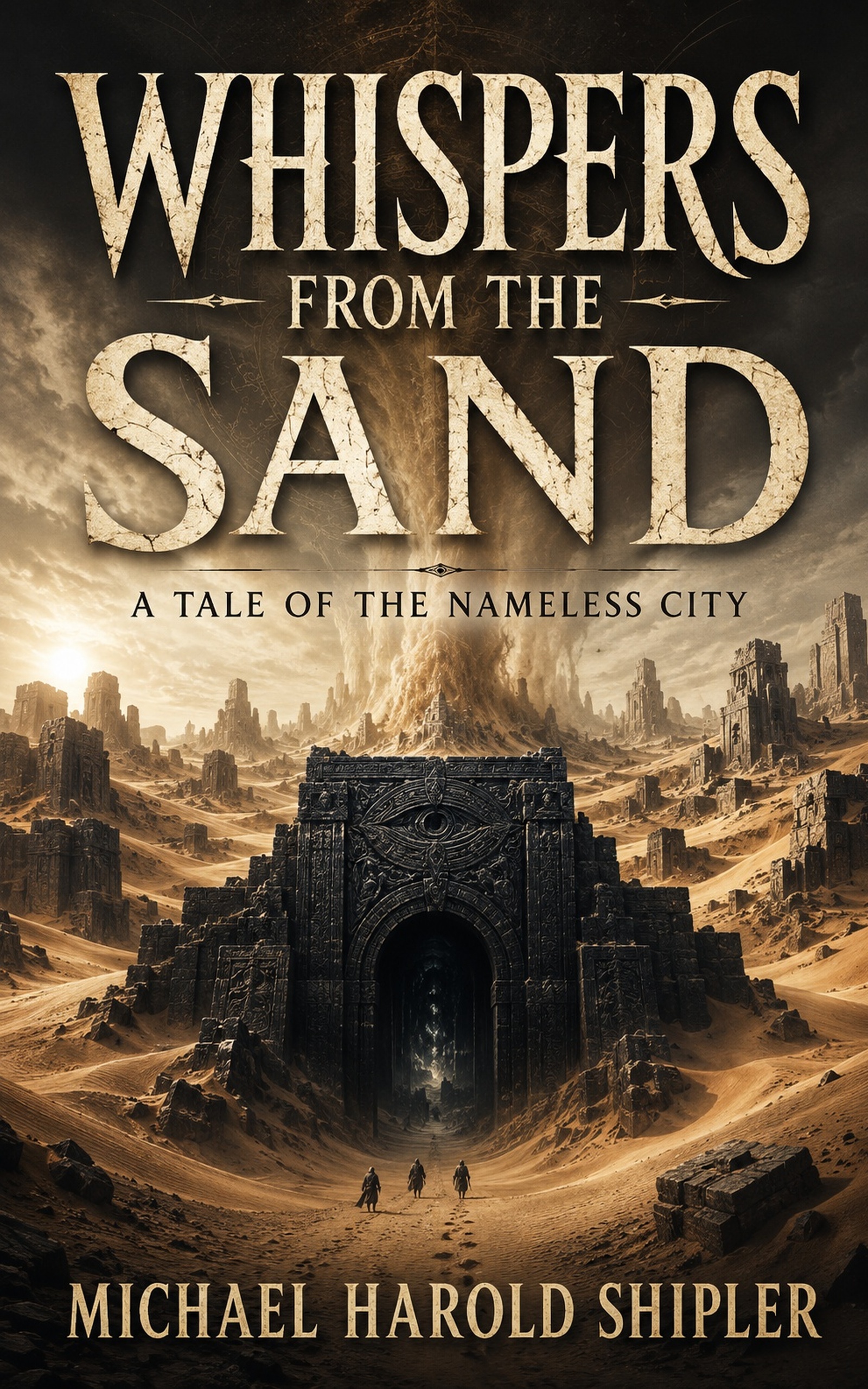
Test Reader Edition v0.9.1
Whispers from the Sand
This online reader replaces the older book page copy. It is the current controlled test-reader edition.
Reader note: This page is for test reading only. Use the feedback form for pacing, clarity, character, typo, formatting, and ending notes. The current version is v0.9.1.
Whispers from the Sand
A Tale of the Nameless City
Michael Harold Shipler
Copyright © 2026 Michael Harold Shipler
All rights reserved.
This novel is an original work inspired by H. P. Lovecraft’s “The Nameless City” (1921), a public-domain work in the United States. The original characters, dialogue, structure, scenes, and narrative expression in this edition are protected by copyright.
Test-group editorial edition v0.9.1, 2026.
Part I — The Book of Warnings
Chapter 1
The Man Who Called It Fiction
People believe a ruin becomes mysterious when its name is forgotten, but most ruins become mysterious when a writer discovers that uncertainty sells better than stone.
I used that line often enough to know where the laughter would come.
The students near the front gave me the quick, relieved response of people grateful that a public lecture had not begun with ceremonial thanks to the faculty. The older audience laughed a moment later, after deciding I had insulted writers rather than archaeology. Professor Daniel Harrow, seated at the edge of the stage beneath a projected title announcing THE UNMAPPED PAST, smiled with the disciplined patience of a man who had invited a fox to discuss the management of a henhouse.
Four hundred seats rose before me in Halden University’s newest lecture theater. Most were filled. That was still possible then.
My name occupied more space on the event poster than the title of the lecture. The university had used a photograph of me taken twelve years earlier, before the gray at my temples had spread and before publishers began adding words like controversial and provocative to introductions that had once settled for bestselling. I had objected to the photograph in principle and approved it in practice.
Behind me, a slide showed an expanse of Arabian desert beneath a white sky. There were no ruins in the image. That was the point.
“A good lost city,” I told them, “is never placed where no one can find it. It is placed where anyone might almost find it.”
The next slide presented a map crowded with circles, dotted routes and names written in several alphabets. I had assembled it from nineteenth-century travel accounts, disputed surveys, satellite anomalies, monastery legends and three books whose authors had later admitted they had never visited the countries they described. The circles overlapped wherever the evidence weakened.
“Irem has been identified here, here, here, and—depending on how generously one translates a caravan day—somewhere beneath a modern airport. Atlantis has occupied most of the Atlantic, part of the Mediterranean and at least two locations in Bolivia. Human beings dislike blank spaces so intensely that we will fill the same one several times.”
The laughter came more easily now.
I knew the movement of such rooms. Give an audience permission to feel clever, and they will follow you into almost any argument. Skepticism has its own seductions. It allows people to mistake dismissal for immunity.
The lecture was titled Burials of the Imagination: Why Humanity Keeps Inventing Lost Cities. I had delivered versions of it in universities, festivals, museums and once in a converted brewery where the questions were better and the lighting worse. The structure was dependable. Begin with romance. Introduce evidence. Show how stories migrate. Explain why bad maps survive good corrections. End with the comforting suggestion that wonder does not require belief.
That afternoon I had added the Nameless City.
I did not call it that immediately. I described a city in the Arabian desert older than Memphis and Babylon, a place of squat black temples whose entrances admitted human beings only on their knees. I spoke of painted histories, preserved reptilian forms and a descent toward a brass door beyond which a hidden world glowed without sunlight.
The room grew quieter.
Stories of lost cities are most effective when their details resist grandeur. Gold can be dismissed as greed. Towers can be dismissed as vanity. A doorway less than a meter high is harder to explain because it implies a body.
I changed the slide.
An illustration appeared: a low stone opening beneath an impossible weight of masonry. It was not evidence. It was an artist’s reconstruction commissioned for one of my television appearances, but I let it remain on the screen long enough for the audience to feel that it might be.
“The architecture,” I said, “is a staircase designed to carry the reader downward from curiosity to insignificance.”
Harrow shifted in his chair. I had used the line during rehearsal and he had warned me that architects might consider it an evasion. I had told him architects were welcome to buy tickets.
“In the upper city, the human visitor crawls. In the passage below, his light fails. In the final gallery, he discovers that humanity is not the first intelligence to preserve its dead, write its history or retreat from a dying world. The story does not merely place monsters beneath civilization. It places civilization beneath us and asks how much older it must become before our importance disappears.”
That part I believed.
It was possible to disbelieve every event in a story and still envy its architecture.
The next slide showed the couplet attributed to Abdul Alhazred. I read it without theatrical emphasis.
“That is not dead which can eternal lie,
And with strange aeons even death may die.”
A few people recognized it. Recognition moved through the hall as a soft rearrangement of attention.
“Alhazred,” I continued, “is useful because he gives invented antiquity a witness. He is not evidence. He is a signature placed at the bottom of a nightmare.”
A student in the third row photographed the slide although the couplet could be found on shirts, mugs, tattoos and the walls of more than one student flat.
“The dead do not need to rise,” I said, “if the living keep rebuilding them.”
That earned the strongest applause of the first half.
I let it settle before moving from the story to the history surrounding it: Irem, the City of Pillars; travelers’ accounts of ruins revealed only under rare conditions; the old habit of mapping moral danger onto empty land; the way a tale could borrow Chaldea, Meroë, Sarnath and Ib until invention gained the weight of citation.
I did not say that citations had made my career.
I said that accumulation creates authority. A reader sees enough names and assumes someone, somewhere, has verified the road between them. The same principle works in scholarship, journalism and fraud. I had spent twenty years explaining the difference while making a living from the resemblance.
The questions began after fifty-three minutes.
Harrow stood, thanked me and asked the audience to keep their contributions brief. No one who gives that instruction has ever believed it will be obeyed.
The first question concerned Atlantis. The second concerned whether governments suppressed discoveries that contradicted accepted chronology. The man asking it wore a camera around his neck and gave the impression that he had arrived prepared to document his own removal.
I answered gently. Ridicule rarely cures conviction; it only gives conviction a persecutor.
A woman asked whether oral traditions could preserve accurate environmental memory across thousands of years. That was a better question. I spoke about coastlines, floods, vanished springs and the usefulness of treating stories as evidence of memory rather than transcripts of events.
Then Harrow called on a graduate student near the center aisle.
She introduced herself as Naomi Bell. Twenty-six, perhaps, with a notebook open on her knee and none of the nervous apology young researchers are trained to place before difficult questions.
“You said the low architecture functions symbolically,” she began.
“I said it functions symbolically in the story.”
“Yes. But the proportions are consistent. Doorways, chambers, altars, viewing height, even the descent. If a real ruin were found with those dimensions repeated across separate structures, would you still treat the architecture as literary?”
The room changed.
It was not a hostile question. Hostility would have made it easier.
I glanced back at the projected doorway. The artist had added a standing human silhouette for scale. Without it, the opening might have been a drainage channel, an animal pen or a crack beneath fallen stone. With it, the image made an argument.
“If a real ruin were found,” I said, “the first obligation would be to establish that the dimensions were intentional rather than the result of collapse, reuse, sediment or selective reporting.”
Naomi waited.
“And if they were intentional?”
There are moments in public speaking when the honest answer arrives too late to be useful.
“I would accept,” I said, “that someone had built a very expensive argument.”
The room laughed, but not everyone did.
Naomi wrote something down.
Harrow looked at me over the top of his glasses. He knew I had not answered. So did I.
I reached for the water on the lectern and saw Leila Haddad standing at the rear of the hall.
She had chosen a place beneath the exit light where she could leave without passing the stage. Her arms were folded. Her dark hair was shorter than when I had last seen her, and the years had sharpened rather than softened the stillness with which she watched people say things they had no right to say.
Everyone else had applauded the Alhazred line.
Leila had not.
For several seconds I stopped hearing the question being asked.
The last time we had occupied the same room, it had contained two lawyers, one publisher and a document bearing my name above conclusions built from her work. I had apologized afterward, in private, which is the form of apology preferred by people who wish to preserve the public benefit of the harm.
She had accepted nothing.
Harrow repeated the question.
I answered something about evidence thresholds. The words were competent. I had used them before. Even while speaking, I watched Leila remove a flat archival envelope from the bag at her side.
She did not hold it up.
She only made certain I saw it.
The envelope was the color of old bone. A black notation crossed one corner in handwriting too small to read from the stage.
Then she touched two fingers to the exit door.
Not farewell.
Instruction.
I finished the answer, thanked the audience and left the stage to applause that sounded, for the first time that afternoon, like something happening in another building.
Harrow intercepted me behind the curtain.
“You know her,” he said.
“Yes.”
“Should I remain nearby?”
“No.”
He considered this, glanced toward the corridor where Leila had disappeared, and said, “That was not the reassuring answer.”
After the lecture, the university arranged a signing table beneath a banner that enlarged my face beyond any proportion the subject deserved. Students queued with copies of books in which I had converted uncertainty into clean chapter endings. Naomi Bell waited until the line thinned.
She opened Kingdoms Beneath the Dunes to the photograph of a low rock-cut chamber. “The caption says ritual submission architecture.”
“It was the excavator’s interpretation.”
“You repeat it as fact.”
The question carried Leila’s influence even before I saw Leila standing behind her.
I gave the answer I had trained myself to give when criticism contained enough truth to threaten the room. “Popular history requires compression.”
Naomi looked at the image. “Compression changes the building.”
Leila’s mouth moved—not a smile, but recognition that the student had reached the point without help.
Years earlier, Leila had sent me an unpublished paper arguing that several disputed desert chambers were built for bodies or practices unlike those assumed by European excavators. I had borrowed the argument, removed its caution and placed it beside stories of subterranean cults. The book sold. Her hiring committee treated the resemblance between her paper and my sensational version as evidence that her work encouraged pseudohistory.
I apologized privately. Public correction would have required admitting the book’s strongest chapter rested on a distortion.
The backstage room had been arranged to suggest hospitality through bottled water, bruised fruit and coffee that had given up before the audience arrived. Leila stood beside a narrow table beneath fluorescent lights. She had placed the archival envelope in front of her but kept one hand over it.
“You used it,” she said.
There was no greeting, and for a moment I thought she meant the photograph.
Then I understood she meant the Nameless City.
“It was relevant to the lecture.”
“You used it as an example of invented architecture.”
“It is invented architecture.”
She studied me with the expression I remembered from conferences, the one that meant she had located the exact weakness in an argument and was deciding whether correcting it would improve the person making it.
“Still certain?” she asked.
I looked at the envelope.
“What do you want, Leila?”
“That is the question you asked the last time too.”
The old defense rose before I chose it. “I credited your fieldwork.”
“You credited the published paper after using the unpublished survey notes.”
“The notes supported a conclusion you later published.”
“They did not support a lost kingdom, a priesthood or your publisher’s claim that I had found evidence for a suppressed desert civilization.”
“I did not write the jacket copy.”
“No. You only approved the book beneath it.”
I had told myself this argument was more complicated than she allowed. It was. Complexity had protected me for years.
Kingdoms Beneath the Dunes had taken fragments of Leila’s research into disputed pre-Islamic settlements and placed them inside a broader argument about how real sites generated legendary cities. The scholarship had been defensible. The title had been aggressive. The marketing had been worse. Interviews reduced caution to implication and implication to claim. Leila’s department spent months answering questions about conclusions she had never made. My book sold in twelve languages.
“I supported you privately,” I said.
“Private support is the cheapest kind.”
“I spoke to your department chair.”
“You told him the publisher had overstated the case.”
“They had.”
“You controlled whether your name remained on the cover.”
There are accusations that hurt because they are false, and accusations that hurt because the sentence removes every available excuse. I looked away first.
Leila lifted her hand from the envelope.
“Professor Étienne Marot,” she said. “French archaeologist. Caravan routes, lost wells, settlement abandonment. Officially disappeared during a southern survey in 1978.”
“I know the name.”
“You know the obituary.”
She opened the envelope and slid a black-and-white photograph across the table.
The image showed pale sand cut by a line of dark stone. At first I saw a collapsed wall. Then I noticed the measuring staff planted beside a rectangular opening.
The entrance was less than a meter high.
The lintel had not fallen. The side blocks were intact. Sand had gathered against the threshold but did not account for the proportion. Along the lower edge ran a band of curved marks positioned where a crawling observer—not a standing one—would naturally see them.
On the reverse, in faded ink, someone had written:
MAROT SURVEY — FRAME 31 — SOUTH OF THE LAST WELL
I turned the photograph over twice, as though one side might expose the other as a trick.
“Where did you get this?”
“From material released by the Marot estate after the last trustee died. Most of it was never cataloged properly.”
“Has it been authenticated?”
“The paper and processing are consistent with the period. The measuring staff matches equipment listed in his field inventory. I did not come here because I found an interesting fake.”
I placed the photograph flat and bent closer.
The marks near the threshold were not writing in any form I knew. One curved line folded inward around a smaller shape. It could have been a coiled animal, a route descending through itself, a closed eye or an open mouth viewed from the wrong direction.
Leila removed a rubbing from the envelope. The same form appeared more clearly in black graphite.
“Marot copied this repeatedly,” she said. “Near the end, he stopped naming the place associated with it.”
“The place?”
“He referred to old wells, a southern line and structures he believed had been misclassified as fiction.”
I heard the word fiction as she intended it: not an academic category but a charge laid on the table between us.
“You have a route?”
“I have fragments.”
“A map?”
“I did not say map.”
The answer told me she possessed something close enough that she feared the distinction.
From her bag she produced a round metal film canister spotted with rust. An old paper label clung to the lid.
MAROT — SOUTHERN SURVEY
“Most of the reel is heat-damaged,” she said. “Some sections are fused. I was told three consecutive frames may be recoverable.”
“And you brought it to me.”
“I brought it to someone with money, access and a brother who restores damaged film.”
Marcus.
She had not come because she trusted me. She had come because she needed the one person I could reach who might recover an image without immediately turning it into publicity.
The distinction should have offended me. Instead, I was already calculating costs.
“Does he know?” I asked.
“No.”
“Does anyone else?”
“Not what I have.”
“You expect discretion.”
“I expect you to understand that the first person who explains this publicly will own it in every way that matters.”
The sentence was cruel because it used my own expertise accurately.
I lifted the film canister. Something shifted inside with a faint dry whisper.
Leila took it back at once.
“It was cleaned,” she said. “Twice.”
She worked the lid loose over the table. The metal resisted, then released with a small breath of stale air.
A few grains of pale sand fell onto the dark wood between us.
Neither of us touched them.
Outside the room, the lecture audience moved through the corridor in thinning waves. Someone laughed. A door opened and closed. London rain ticked softly against a high window.
On the table, south of the photograph’s nameless well, the sand remained perfectly dry.
For the first time since I had learned to make a living explaining mysteries, I found myself hoping that the simplest explanation was the lie.
Chapter 2
Three Frames of Sand
Marcus restored damaged images for people who believed the camera had told the truth and merely needed help remembering how.
His studio occupied the ground floor of a converted printworks in East London, behind a steel door with WARD VISUAL RECOVERY painted on it in letters too modest for the work done inside. There were no framed awards in reception, no display of famous clients, only a row of locked cabinets and a monitor showing a woman running from an apartment block while the pavement moved beneath her.
The footage had been recorded during an earthquake. The image broke every few seconds into blocks of color, but the sound was worse: clipped screams, masonry, a siren winding down and a voice buried under digital damage.
Marcus sat at the main console with one headphone pressed against his left ear. He favored that side when he needed accuracy; the right had never recovered fully from a blast on a documentary shoot years before. A white scar divided his eyebrow, and the first two fingers of his right hand did not close quite evenly around the control surface.
“Again,” he said.
Imogen Reed, his business partner, moved the playback marker back six seconds. She was younger than Marcus by several years and had the dry patience of a person accustomed to explaining that restoration was not resurrection.
The ruined audio played.
This time a woman’s voice emerged beneath the falling concrete.
“My daughter,” she said. “My daughter is still—”
The remainder vanished into noise.
Marcus lowered the headphone. “That is enough to identify what she was saying. Not enough to finish it for her.”
Imogen saved the isolated track. “The client will ask whether we can recover the rest.”
“Tell him we can recover what exists.”
He saw me in the reflection of the dark monitor before he turned.
“You usually send an assistant when you need someone else’s work made presentable.”
“I came personally because I missed you.”
“You should have sent an assistant. They lie more efficiently.”
We had inherited the same mouth from our father and put it to different uses. Marcus made statements that sounded like jokes and waited to see whether anyone laughed. I made jokes that could later be defended as statements.
Marcus’s studio preserved damaged images for people who wanted the past repaired without being changed. The contradiction amused him.
He had restored wedding films, war footage, failed documentaries and the only surviving recording of our father reading from his unfinished manuscript. He refused to improve Thomas’s voice beyond removing mechanical noise. “He sounded tired,” Marcus once told me. “Cleaning that out would be lying.”
Leila entered behind me carrying the film canister inside a padded archival case.
Marcus looked from her to me.
“This is Dr. Leila Haddad,” I said. “A former academic contact.”
“I know who she is.”
Leila’s expression did not change.
Marcus looked at the case. “You already made one book out of her work.”
“I did not steal her research.”
“That does not make you safe.”
Imogen glanced between us. “Should I put coffee on, or would a solicitor be more useful?”
Leila placed the case on the inspection table. “Coffee. No copies leave the room without my approval.”
Marcus smiled for the first time. “I like her better already.”
The canister was examined before it was opened. Imogen photographed the label, the rust, the tape around the edge and the grains of pale sand caught beneath the rim. She recorded the time, the condition and everyone present. Leila watched the process with professional approval. Marcus watched the object as though it might confess if handled correctly.
The reel inside had suffered heat, pressure and neglect. Sections were fused. Others had shrunk until the perforations no longer aligned. The stock was consistent with the late seventies. A narrow magnetic sound strip ran beside the image.
“Anything on it?” I asked.
Marcus did not look up. “Film.”
“I meant anything recoverable.”
“You asked before I had looked.”
“That is generally when questions are useful.”
“To writers, perhaps.”
Imogen placed a damaged section under magnification. “The emulsion has migrated. We can scan without running it through a transport, but there will be missing frames. Restoration cannot create what is gone.”
Leila said, “Nothing is to be interpolated.”
Marcus nodded. “No artificial frames. No generative repair. Stabilization, density correction, separation of fused images where the information is physically present. Every change logged.”
“Good.”
“You expected an argument?”
“I expected Elias’s brother.”
Marcus looked at me. “You told her stories.”
“She read the books.”
Before scanning, Marcus made us reconstruct the canister’s custody as though preparing evidence for a trial. Leila listed each person who had handled it since the estate box was opened. Imogen photographed particles from beneath the lid and sealed them separately. Marcus measured shrinkage, perforation damage and the distance between fused layers.
“You think this proves the desert,” I said.
“I think it proves the film spent time somewhere hot, dry and badly stored.”
“Which is consistent with the desert.”
“It is also consistent with an attic.”
Leila almost smiled. The two of them had discovered the professional pleasure of denying me the strongest available sentence.
The sound strip complicated the work. Magnetic material had flaked from several sections, leaving brief windows in which an event might survive between absolute losses. Marcus mapped each intact region before permitting playback. When I suggested a digital interpolation might make the sequence easier to understand, Imogen turned her chair toward me.
“Easier to understand is not the same as truer,” she said. “We can stabilize movement caused by damaged perforations. We can correct density. We can isolate sound. We cannot invent the frame that would make your argument convenient.”
Marcus added, “If we reach a site, the untouched scans travel separately from every working copy.”
“There is no site,” Leila said.
“You brought a route and a film to a man who spends his life filming places people should not enter.”
“I brought a damaged record to a restoration studio.”
“And my brother?”
“Your brother owns the introduction.”
It was an accurate description of my role and an unkind one. I had been admitted because I connected people, money and attention. Those skills are praised until someone notices they also determine who is heard first.
It took most of the afternoon to isolate a usable strip. I tried working from Marcus’s office and discovered that every sentence on my screen arranged itself around the room next door. Leila remained beside the scanner, making notes. Imogen worked without conversation. Marcus moved between the film and sound stations with an attention I had rarely seen him give to people.
At five seventeen, Imogen called us over.
Three consecutive frames stood on the screen.
The first showed an empty desert. A tripod occupied the left edge, covered by a dark cloth. A narrow survey flag stood behind it. Both hung motionless.
In the second frame, sand rose from the ground near the center. Not a wall of weather crossing the plain, but a narrow fixed column. The cloth did not move. The flag did not bend. A loose strap on the tripod remained vertical.
In the third frame, the column had opened outward. At its center appeared a black horizontal edge too straight to be a shadow. A lintel, perhaps, or the top of a wall. At the far right, part of a man entered the frame.
“Marot?” I asked.
Leila leaned closer. “Likely. The height and field clothes match other photographs.”
“It is the doorway.”
“It may be the doorway.”
“The image shows a black lintel where the sand has fallen.”
“It shows a straight dark feature. We do not know its depth or function.”
Marcus enlarged the first frame, then the second. “Look here.”
He pointed to the tripod cloth, the survey flag and the loose strap.
“No wind,” he said.
“Sand does not rise without air movement,” I said.
“Air movement, vibration, collapse, heat effect, pressure release. Evidence only stays evidence if you record what happens before people start explaining it.”
He enlarged the black edge until the grain became coarse. The line remained straight.
Leila said, “Can you recover more?”
“Possibly. Not cleanly.”
“Cleanly is not the requirement.”
Marcus glanced at her. “That is the right answer.”
I asked for working copies.
Leila said no before Marcus could respond.
“We need independent review,” I said.
“We need provenance.”
“We have provenance sufficient to begin consulting.”
“We have a canister from an estate box and three damaged images.”
Marcus said, “I keep the raw scans.”
Leila turned. “You keep a working set under the custody agreement.”
“If I am expected to restore it, I need control of the files.”
“Technical control is not ownership.”
Imogen removed her glasses. “You argue like two men who have already decided which one gets to describe the argument afterward.”
Leila looked at me.
“I believe she means us,” I said.
“She means you.”
By evening Marcus had stabilized a longer sequence assembled from fragments around the three frames. It could not be played as continuous motion without acknowledging gaps, so he displayed each surviving image at equal intervals.
The desert remained still.
The column rose.
Marot entered the edge of the frame and turned toward something outside it.
The sun broke the horizon.
A tremor crossed the image. The dark center widened. Marot’s mouth opened.
No voice accompanied it.
Then the frame burned white.
Marcus reversed the sequence and enlarged the area near the opening.
A low shape occupied the shadow beside the black edge. Broad, pale at one boundary, lower than a standing man. Between the second and third surviving images it changed position.
“What is it?” I asked.
“Insufficient information,” Marcus said.
“An animal?”
“Insufficient information remains insufficient when you offer it categories.”
Leila said, “Can you separate the sound strip?”
The magnetic track was worse than the film. It contained hiss, handling noise, breathing and fragments of damaged French. Marcus isolated one phrase that might have been restez là—stay there—or c’est là—it is there. Neither reading was secure.
Then came silence.
Not absence of signal. The strip carried room or open-air noise, but nothing moved within it.
A low metallic resonance entered beneath the hiss.
At first I thought it was machinery in the studio. Marcus stopped playback. The sound stopped.
He began again.
The note returned.
It was deep enough to feel through the desk. Above it, a higher tone shifted slowly as the sun rose in the film. The sound did not resemble a bell so much as a sheet of metal larger than any room being forced to sing along its edge.
Marot turned. His mouth opened. The higher tone sharpened.
Then an impact struck the recording.
Imogen flinched.
The sound was not an explosion. It had too much duration after the first blow, a great plate or door settling into place while stone carried the vibration outward.
Leila opened one of Marot’s copied notebooks and found a line written across a page of survey calculations.
MEMNON DID NOT SING. SOMETHING BENEATH HIM ANSWERED DAWN.
Marcus played the sequence twice more.
On the final white frame, after stabilization, a darker rectangle remained at the center. Its edges resembled the opening in Frame 31.
“Chemical retention,” Imogen said. “The bright exposure can leave an afterimage.”
“Of an object that was there,” I said.
“Or of the frame edge, damage, pressure, processing. Do not make me choose before the data does.”
Marcus leaned back from the console. “If the route exists, I go.”
Leila closed the notebook. “There is no expedition.”
“Then why bring the film?”
“To establish whether Marot photographed what he claimed.”
“And if he did?”
“We secure the archive, determine jurisdiction and involve qualified institutions.”
Marcus laughed without humor. “By the time the committees finish deciding who owns the permission, someone else will have sold the coordinates.”
“You sound like Elias.”
“That is unnecessarily cruel.”
I said, “We are discussing options.”
Marcus turned toward me. “You are discussing a title.”
I had not been, precisely. I had been considering who might fund a private survey, what level of evidence would justify contacting a publisher and whether the word Nameless had already been exhausted by bad fiction. The distinction was not worth offering.
Marcus looked again at the frozen image of Marot.
“Dad would have believed this,” he said.
Our father entered the room without sound, as he had entered most rooms after his death.
Thomas Ward taught history to adolescents who remembered him more clearly than his sons did. For twenty years he worked on a book called Before the First Kingdoms, filling cabinets with maps, quotations and abandoned introductions. He never completed a chapter to his own satisfaction.
“He would have collected it,” I said. “Belief was never his difficulty.”
“You think he failed because he did not publish.”
“He failed to finish.”
“He failed to come home while he was still living in the house.”
Imogen turned away from the console. Leila remained still.
Marcus said, “You became the version of him that finished the book.”
“You became the version that kept leaving home.”
The sentence landed harder than I intended. Marcus’s face closed.
He switched off the main monitors.
The studio fell into darkness except for equipment indicators and the street light beyond the blinds.
Before Marcus shut the system down, he isolated Marot’s body across the surviving frames. The man turned in three abrupt increments because the missing film removed whatever movement joined them. His left arm rose. His mouth opened. The survey flag behind him remained still.
“What is he looking at?” Leila asked.
Marcus traced the angle from Marot’s face beyond the right edge of the image. “Not the doorway. Something closer to the camera or behind it.”
The broad shape at the black opening shifted in the opposite direction. Its pale edge might have been sunlight on stone. It might have been the side of a body. One frame suggested a raised front limb, but the grain was too large to hold the conclusion.
I asked whether the metallic impact could be thunder.
“No atmospheric lead-in,” Marcus said. “No broad frequency spread. The onset is too hard.”
“An engine?”
“Too much sustained resonance.”
“A door.”
He looked at me. “That is a noun you brought from the story.”
Leila closed Marot’s notebook. “And from his note.”
For the first time that day, she had allowed the archive and the image to reinforce one another without immediately separating them. Marcus noticed too.
“If the route exists,” he said, “I go because the visual record cannot end with this.”
“You want to finish Renée Valois’s work,” Leila said.
“I want enough footage that no writer can turn the missing sections into whatever he needs.”
He did not look at me, which made the accusation more precise.
The metallic note continued.
For three seconds, perhaps four, it remained in the room after playback had ended.
Marcus reached for the audio interface and disconnected it.
The sound did not stop immediately.
It faded through the floor or the walls or our own bones, leaving the four of us listening to equipment that no longer had power enough to produce it.
In the darkness after the screens went black, the metal kept singing long enough for all four of us to understand that none of us had imagined it.
Chapter 3
The Words of Alhazred
Marot had spent twenty years writing like an archaeologist and his final six months writing like a man trying to leave instructions for someone he hoped would never follow them.
Halden University Special Collections occupied a temperature-controlled floor beneath the library, where history arrived in gray boxes and was permitted to decay only at an approved rate. Dr. Miriam Vale met us at the security door with three pencils, four access forms and the expression of someone who had already read my name in a context she disliked.
“Dr. Haddad has accepted responsibility for your conduct,” she told me.
“That seems an unfair burden.”
“It is the one under which you are entering.”
Miriam was in her early sixties, silver-haired and exact. She had known Marot’s reputation before his disappearance and was careful not to call his later work madness.
“Obsession does not make evidence false,” she said as she unlocked the reading room. “It makes evidence harder to separate from the person who needed it to be true.”
The Marot archive filled seven boxes, none properly arranged. His field notebooks had been mixed with hotel receipts, maps, letters, translations, photographic envelopes, star charts and pages torn from books. Some had been cataloged by an estate solicitor who understood paper only as property. Others had arrived in grocery cartons from Marseille.
Leila divided the table by chronology. Marcus divided it by recording medium. I began grouping references by subject until Leila moved one of my piles back.
“You are arranging it into a story,” she said.
“I am arranging relationships.”
“Chronology first.”
“Chronology is a relationship.”
“It is the one least interested in flattering you.”
Marot’s early work gave us no comfort. He had been careful, conservative and openly hostile to spectacular claims. His papers on abandoned wells and caravan routes repeatedly corrected sites identified as Irem by men who wanted grants, headlines or romance.
In a lecture from 1969, he had written:
A LEGENDARY NAME IS NOT EVIDENCE. IT IS OFTEN THE THING THAT PREVENTS EVIDENCE FROM BEING SEEN CLEARLY.
Marcus read the line over my shoulder. “You like him better now.”
“I respect consistency.”
“He stopped being consistent.”
“That is what we are here to determine.”
Miriam required us to use document cradles and weighted cloth instead of flattening maps with our hands. Each box had to be opened under the overhead camera, every removed item logged. The restrictions slowed us until the slowness became useful. A receipt for fuel fixed one notebook to a date. A hotel envelope connected a star chart to Marseille rather than the field. A letter Marot never posted showed that his certainty began after his return, not before the expedition.
“People cite the late notes as evidence he went into the desert delusional,” Miriam said. “The paper says otherwise. He went in skeptical. Whatever damaged him happened after he had already done the respectable work.”
One early field book contained pages of wells whose names changed between French, Arabic and local usage. Marot corrected himself repeatedly. Beside one location later called the last well, he wrote that modern maps confused reliability with existence: a well might remain on paper decades after it ceased to hold water, while another used by families for generations could be absent because no surveyor had cared to record it.
Leila said, “That is why his route cannot be read from one map. It is a sequence of remembered water.”
Marcus photographed each page. “And remembered water changes.”
“So do roads,” she said. “Stars change more slowly.”
By midday, the change in Marot’s language had become visible. Early notes referred to reported ruins, possible low structures and unverified sound. After the 1978 dates, the conditionals disappeared.
The ruins became the city.
The forms became inhabitants, then builders, then citizens.
Near the end, he called them only those below.
He also began copying names.
Memphis. Babylon. Meroë. Chaldea. Irem. Mnar. Ib. Sarnath.
They appeared in margins, on the backs of maps and beneath water calculations. I first assumed he was building a chain of influence.
Leila disagreed.
“He is measuring language,” she said.
“With cities that do not all belong to history.”
“That is the point. Memphis is ancient civilization. Babylon is lost imperial power. Meroë is a city the desert partly swallowed. Irem exists between tradition and place. Mnar, Ib and Sarnath belong to literary antiquity. He is not claiming they share a road.”
She handed me a page.
Marot had written:
IF THE RUINED CITY EXISTS, THESE NAMES DO NOT LOCATE IT. THEY REVEAL THE POVERTY OF EVERY COMPARISON.
“A scale of age,” Marcus said.
“A scale of inadequacy,” Leila answered.
The words of Alhazred appeared more often than any place-name.
Marot copied the couplet in Arabic, French and English. He wrote it phonetically, translated it literally and rearranged it by emphasis. In one version he underlined not dead. In another he circled lie. In a third he pressed so hard beneath death that the pencil tore the paper.
That is not dead which can eternal lie,
And with strange aeons even death may die.
At the bottom of a water inventory, he had added:
NOT A FORMULA.
NOT A PRAYER.
NOT RESURRECTION.
A WARNING AGAINST ASSUMING EXTINCTION.
Marcus read the note twice.
“So he thought the things in the story were alive.”
Leila folded her arms. “He thought his evidence did not permit him to call them extinct.”
“That is a careful way to say the same terrifying thing,” I said.
“No. It is a careful way to avoid saying more than the evidence.”
The evidence grew less comfortable in the next box.
Marot had measured thresholds, pillar spacing, niche height, floor channels and wear patterns. The dimensions were incomplete but consistent. Every occupied surface assumed a body close to the ground.
Across one page he wrote:
THE LOW ONES WERE NOT MADE TO KNEEL.
Naomi Bell’s question returned with irritating precision. If the proportions were repeated and intentional, what would I accept?
Someone had built an expensive argument.
A page had been removed cleanly from Marot’s notebook near the binding; pressure impressions remained on the sheet beneath it. Marcus photographed the indented impressions under oblique light while Imogen processed the images remotely from his studio.
Words surfaced gradually from pressure marks:
GLASS BEFORE GOLD WOOD
CASES NOT BURIAL
ROBES FITTED TO BODY
DO NOT MISTAKE IMAGES FOR GODS
THE WIND GOES DOWN
DOOR OF BRASS
LIGHT BENEATH
NOT EMPTY
And, lower on the page:
IF THE DOOR IS OPEN DO NOT STAND BETWEEN THE CITY AND THE DARK
Miriam retrieved a restricted photographic envelope from a cabinet. The print inside had degraded into silver shadows, but a corridor remained visible: repeated rectangular forms, dark frames with reflective fronts, one pale shape behind them.
Marcus lowered his face close to the sleeve.
A long forelimb rested beside the body. Metal shone at the throat. Fabric covered the torso.
“It is dressed,” he said.
“The image supports the possibility of fitted material,” Leila replied.
“It has a collar.”
“It has a reflective object near the neck.”
“It is not a statue.”
“The photograph does not establish that.”
She did not call it an animal.
The missing page had been removed with a sharp blade close to the binding. Miriam examined the cut under magnification and said it was older than the estate’s recent handling but could not tell whether Marot removed it before or after his return.
Marcus built the indentation image in layers. Under one angle, GLASS emerged. Under another, the pressure marks formed GOLD WOOD. A final pass revealed a line Leila first read as the air goes down. Comparison with Marot’s other handwriting corrected it to the wind goes down.
“Wind rises from a deep warm space,” Marcus said.
“Or falls toward a colder pressure system,” Leila replied.
“Or the sentence is metaphor.”
I said, “He wrote it beside a brass door and a lower light.”
“That is why it must remain physical until the evidence requires otherwise.”
The degraded corridor photograph was taken from the height of a crawling human. A standing photographer could not have occupied that angle unless the chamber ceiling forced it. The transparent fronts reflected a pale source located ahead and below the camera. Leila measured the visible case against a metal clasp from Renée’s equipment and estimated a body length near that of a small adult human, though its height remained far lower.
A narrow shape lay beside the figure inside: perhaps a tablet, tool or weapon. The cloth around the body followed its contours rather than being draped over it later.
“Citizens,” Marcus said, borrowing Marot’s last term.
Leila did not correct him. She wrote individual fitted garment in her notes.
The route consumed the afternoon.
Marot had removed coordinates and replaced them with obsolete well names, caravan-day distances, solar bearings and stars. A formation shaped like a broken hand appeared in seven sketches. A dry channel shown on a 1934 French survey had vanished from modern maps. The final instruction read:
WHERE THE SKY BECOMES EMPTY
Marcus corrected the 1978 stellar positions. Leila overlaid the old wells. I tracked phrases through Marot’s letters. By evening, the fragments converged on a region south of the last permanently reliable well recorded in the old survey.
“No precise endpoint,” Leila said.
“Precise enough to search,” Marcus replied.
“Those are different standards.”
“Only until you find it.”
The archive contained no direct coordinates. That absence was deliberate.
“Why preserve a route he did not want followed?” I asked.
“Because warning requires telling someone what to avoid,” Leila said.
Marcus looked at the copied bearings. “And because part of him wanted to be followed.”
There it was: the moral contradiction on which every account of forbidden knowledge depends. To hide a road completely is to save strangers and abandon the lost. To record it is to warn and invite in the same act.
I proposed secure copies, independent consultants and limited sponsorship.
Leila refused before I finished the list.
“Public consultation creates claims,” she said. “Claims create publicity. Publicity creates looting, politics and men with helicopters who think context is what they destroy on the way to an object.”
“We cannot authenticate a geological formation, artifact or body alone.”
“We do not possess a body.”
“We possess a route to the site where one was photographed.”
“You are already speaking as though the place belongs to whoever reaches it first.”
“Everything belongs to whoever can prove it exists.”
The sentence sounded better before it left my mouth.
Leila’s face became still.
“That sentence is why you should not lead anyone there.”
Marcus had placed a small camera on a shelf without telling us. I learned this later from the private file recovered after the expedition. In it, while Leila and I argued out of frame, he said quietly:
“The dangerous person in a room is rarely the one who wants the impossible. It is the one who has begun believing it is possible.”
That night we returned to his studio with the reconstructed route.
Satellite images showed featureless dunes, poor coverage and a broad circular disturbance visible in some years but not others. The old wells, stellar bearing and broken-hand formation intersected near its center.
Marcus drew the route lines over the image.
A dark ring surrounded a paler middle.
“It could be geology,” Leila said.
“It could be processing,” Marcus added.
“It could be the city,” I said.
“Circumstantial evidence becomes circular when every uncertainty points to the conclusion you brought with you,” Leila said.
I looked at the ring.
“Then perhaps we have found one.”
I had already begun calculating what reaching it would cost.
A low metallic vibration sounded through the studio speakers.
Marcus checked the workstation. The Marot audio file was closed. The interface showed no active source.
Across the satellite image, a thin dark line appeared north of the ring. It resembled a road.
The screen refreshed.
The line vanished.
We had begun the day searching for proof that Marot had lost his mind, and ended it with a route to the place where he had lost everything else.
Chapter 4
What the Desert Kept
The official record said Étienne Marot disappeared in the desert in 1978, which was true only if one ignored the inconvenient fact that he returned to Marseille six weeks later.
Claire Bisset told us this at a café near the old port while gulls tore at rubbish bags and ferries moved through sunlight beyond the buildings. She was eighty-three, physically slight and mentally untouched by the years. Her hands trembled when she lifted the cup, but not when she spoke Marot’s name.
“You are the man who explains away legends,” she said to me.
“I try to separate history from invention.”
“Étienne said that once.”
She had agreed to meet because Leila approached through academic channels. She regarded Marcus more kindly after learning he restored damaged film.
“Renée corrected people when they called her a photographer,” Claire said. “She said the photograph was the object. She was the person responsible for it.”
Marcus nodded. “Documentary cinematographer.”
“Exactly the same correction.”
Claire’s account dismantled the obituary line by line.
Marot’s 1978 expedition included four people: Marot; Paul Deschamps, a surveyor and engineer; Renée Valois, responsible for photography and film; and Hamid Barakat, their driver, translator and desert guide.
All four were listed as missing after communications ended.
Six weeks later, Marot appeared at a French consular facility using another traveler’s identification. He was dehydrated, injured and nearly twenty kilograms lighter. He refused to provide coordinates or explain what had happened to the others. Officials returned him quietly to Marseille because an unauthorized route, three missing companions and a traumatized archaeologist created more diplomatic risk than useful certainty.
“Why was his return never corrected publicly?” I asked.
“He disappeared again before the inquiry finished. The authorities called the report unreliable. His colleagues preferred a dead man to a living scandal.”
“And you?”
Claire looked toward the harbor.
“He begged me not to turn survival into an invitation.”
Claire placed the original expedition permit on the café table. Four passport photographs had been fixed beside typed names. Paul Deschamps looked tired even in the official image. Renée Valois faced the camera as if daring it to misrepresent her. Hamid Barakat’s photograph had been replaced once; the older staple holes remained.
“Paul argued about water before they left,” Claire said. “Renée argued about copies. Hamid argued that the southern route had ended even if the road continued. Étienne heard every objection and treated each as a problem to solve.”
Marcus studied Renée’s photograph. “Did she send duplicate film back?”
“She intended to. Étienne convinced her the route was too uncertain for separate transport.”
“Meaning he wanted the record together.”
“Meaning he wanted control.”
Claire did not say the word with anger. She said it as a fact already paid for.
When Marot returned, he asked whether any of the others had arrived first. For weeks he set water at the apartment table and kept Renée’s camera prepared. He refused to open the door when familiar voices called from the corridor, though neighbors heard no one.
“One came back first,” Claire said.
Marcus frowned. “First?”
“Étienne believed return and escape were different events.”
Marot had been cautious before the expedition, she said. He disliked caves but entered them when work required. He climbed stairs without thinking. He slept with windows open.
Afterward he slept on the floor.
He sealed the windows, cut the curtains short so they could not move and wrapped metal fixtures in cloth. He removed ticking clocks. At dawn he sat with his back to the south wall and pressed his hands over his ears.
He repeated one sentence more than any other:
“I came back before the door closed.”
Claire never learned whether he meant a physical door, a passage, an opportunity or a decision.
“You keep asking what he found,” she said. “None of you has asked what finding it made him do.”
Marot’s apartment stood several streets uphill from the port. Marseille entered it through salt stains and distant horns, but he had worked hard to keep the air from moving. The balcony doors were nailed shut. SOUTH had been written beneath a shelf and crossed out until the wood splintered.
A narrow staircase to an upper room was barricaded with furniture.
Marcus and I moved the cabinet while Leila documented its position. Grooves marked the stair edges, as though someone had climbed by gripping and pulling rather than walking upright.
The apartment had been altered around specific fears. Curtains ended thirty centimeters above the sill so wind could not move them against the glass. Metal handles were wrapped in wool. A shallow line scratched across the bedroom threshold had been renewed many times. Beneath the bed lay containers of water, a torch and a hammer.
On the upper-room wall, Marot’s plan used several kinds of line. Solid black marked features he claimed to remember. Dotted pencil represented inference. Red indicated routes used by the missing team. One red line ended at a lower turn beside Paul’s initials. Renée’s continued farther. Hamid’s line never entered the central descent, yet his name appeared twice below it with question marks.
Marcus photographed the wall in sections. “He rebuilt it to return.”
Claire said, “He rebuilt it to prove he should not.”
Both readings could occupy the same room.
The upper room contained a wall-sized reconstruction of the city.
Surface temples clustered around a central descent. Rows of rectangular cases lined a corridor. A passage widened toward a massive gate. Beyond it, a road dropped into blank paper.
Across the plan Marot had written:
NOT TO SCALE. SCALE FAILS BELOW.
Above the door, Alhazred’s couplet appeared in French.
A small key was taped beneath the desk. Its tag read:
DO NOT OPEN AT DAWN
The key opened a basement storage room Claire believed had been emptied.
We descended through damp stone corridors beneath the building. Marot had lined the room with canvas, cork and felt. The materials deadened harbor noise until the space seemed farther underground than it was.
The jars of sand came from four locations, each marked only by an initial. Their grains differed slightly in color and size. One contained a black flake too thin to identify. The compass needle was frozen downward, scraping the inner glass. The bloodstained cloth bore a stitched R that could have belonged to Renée.
The human boot was Paul’s size according to the inventory, but its sole had been cut away. Fine pale residue filled it. A set of long narrow impressions crossed the leather near the ankle, too regular for accidental abrasion.
Renée’s camera case had been emptied except for a handwritten inventory. Several items were marked lost below. One line had been added later in Marot’s hand:
CAMERA RETURNED WITHOUT HER.
Marcus read it without speaking.
The contents were arranged on shelves and labeled.
A broken compass. Cut rope. Four jars of pale sand. A dark stone fragment. A brass relief. A cracked glass plate. A cassette. A bloodstained cloth. A human boot. Renée’s metal camera case.
Nothing resembled treasure.
Everything resembled evidence.
Leila saw my expression.
“Three people disappeared,” she said, “and you are looking at a chapter.”
“I am looking at provenance.”
“You have never looked at provenance with that much pleasure.”
The rope was labeled PAUL — LOWER TURN. Its fibers showed abrasion and one clean cut made under tension.
Attached was a note:
HE COULD NOT COME UP.
RENÉE WOULD NOT LEAVE HIM.
THE WIND WAS GETTING STRONGER.
Marcus ran a finger near the severed end without touching it.
“He cut Paul loose.”
“We do not know who cut it,” Leila said.
“Marot brought it back.”
“That establishes possession, not action.”
The dark stone fragment matched the rubbing Leila had shown me after the Halden lecture. One carved curve folded inward around an empty center. It was dense, cold and smoother than the surrounding material.
When Marcus placed a recorder nearby, a faint low vibration appeared on the meter.
Traffic or pipes could have caused it. The pitch changed slightly when the fragment rotated.
The brass piece was heavier. Under raking light, figures emerged from the relief: broad low bodies, small horns, robes, long forelimbs, a procession descending toward an arched darkness. Curved lines moved around them like wind.
“It is part of the gate,” I said.
“It may be part of a gate,” Leila replied.
Marcus restored the glass plate in the basement.
The image appeared gradually: a low corridor, transparent fronts held by dark golden frames, a pale body inside one, a long hand, cloth, metal at the throat. At the far end, a low shadow crossed between the cases.
The plate edge bore the initials R.V. — CORRIDOR TWO.
Renée had reached the gallery.
One case appeared partly open. A chain or ornament hung across its edge.
Marcus said, “She got this far.”
Leila answered, “Her camera did.”
The cassette carried the label IF I RETURN SOUTH.
Marcus examined the tape before making a preservation copy. Marot’s voice emerged thin and controlled over room tone.
“The account was not false,” he said. “It was incomplete.”
He described the low proportions as functional. The figures in the cases were the builders. The paintings were history. The corridor was not a tomb. The lower world was not empty.
“The sea withdrew,” he said. “They went below it. The great door closed. I do not know whether it closed in time.”
Then he spoke of the others.
“Paul could not climb. Renée stayed with him. Hamid never came down to us, but I heard him below.”
Claire closed her eyes.
Marot continued:
“I told them I would bring help. I knew before I reached the stairs that I would not.”
A clicking sound entered the recording near the microphone. Wet, irregular and close.
Marot began the Alhazred couplet, stopped midway and whispered:
“It knows the road survived me.”
The tape ran for forty-three more seconds. Near the end, a second breath sounded beside him.
No door opened. No footsteps entered.
Claire stopped the cassette after the second breath and refused to hear it again.
She told us Marot vanished from the locked apartment months after his return. His passport and luggage remained. The nails had been removed from the balcony doors from inside. A thin trail of pale sand led from the bedroom to the open window, though the street below showed no fall, body or witness.
He had spent the previous evening asking whether the southbound ships still used the old harbor channel.
“You think he returned to the desert,” Leila said.
“I think he attempted to return to something,” Claire answered. “I do not know whether distance was required.”
Before we left, she placed her hand over the key to the basement room.
“If you go, do not tell yourself you are correcting his failure. That is how people repeat a decision while believing they have changed it.”
Back at the hotel, we argued until after midnight.
Leila wanted the materials authenticated through controlled channels. Marcus believed institutions would seize the archive and arrive without us. I proposed a private reconnaissance: confirm the exterior, document the ruins, avoid deep entry and return with proof sufficient to force proper protection.
“Four people already attempted a reconnaissance,” Leila said.
“They did not have our equipment.”
Marcus looked at me. “Every dead expedition believed the next piece of equipment would make it different.”
He still wanted to go.
Leila knew it.
Claire knew it before we left her apartment.
“Marot did not fail because he lacked evidence,” she had said. “He failed because every warning became another reason to continue.”
I returned alone to Marot’s upper room the following morning.
The harbor wind pressed against the sealed windows. Something wrapped in cloth tapped once inside the wall.
On the desk lay a page we had overlooked, or which I had failed to see because the room had not yet taught me what to seek.
On one side:
IT IS NOT THE CITY THAT IS BURIED.
IT IS THE ROAD LEADING AWAY FROM IT.
On the reverse were three names:
PAUL
RENÉE
HAMID
Below them:
I RETURNED ALONE BECAUSE I CHOSE TO.
I photographed the page.
I told myself the sentence lacked context, that Marot had written under trauma, that one confession could distort every later decision before we understood what had occurred.
All of this was true enough to serve the lie.
I returned the page to Marot’s desk and kept its image for myself, and that was the first thing the Nameless City taught me to conceal.
Chapter 5
The Rules We Made
Catastrophe rarely begins with panic; more often it begins with intelligent people making lists.
The warehouse I rented outside London had once stored theatrical scenery. Its roof was high enough for vanished palaces and papier-mâché mountains, though by the time we occupied it the concrete floor held water cans, fuel containers, cameras, ropes, medical kits and three competing ideas of what an expedition was for.
Marcus claimed the east wall for equipment. Black cases appeared in ranks beneath charging boards, each marked with colored tape. Cameras, lenses, microphones, storage arrays and drones were arranged so he could identify a missing component from across the room.
Leila took the center. Her tables held survey instruments, archive boxes, conservation materials, sample containers and notebooks. She created a clean area no one was permitted to cross without gloves.
I took the west wall, where the objects were less photogenic and more decisive: contracts, permits, insurance forms, vehicle agreements, communication schedules and money.
South Meridian Research Ltd. existed on paper before it existed anywhere else. I had created it to receive private funding without attaching my name to every equipment purchase. Its articles included rights to publication, documentary production, adaptation and image licensing. These were standard protections. I repeated that phrase often enough to mistake repetition for innocence.
Leila discovered the artifact cases on the second morning.
“Why does a surface reconnaissance require padded transport containers?”
“Preparedness is not intention.”
“Preparation is intention with paperwork.”
“They may carry damaged equipment.”
“Then label them for damaged equipment.”
Marcus walked past carrying a compact camera rig. “Leave one blank. The desert may give us something better than paperwork.”
Leila looked at him. “The desert does not give ownership.”
Our public mission was a private survey of abandoned caravan routes and lost water systems. It was close enough to the truth to survive casual inspection. The permits identified a region north of Marot’s probable route. No official document named the city.
The financing also carried a lie. My future-book advance was described as research support. A production company supplied part of the camera budget in exchange for first negotiation rights if documentary footage existed. I did not promise Marcus’s images or Leila’s scholarship, but the contracts assumed South Meridian would stand between the discovery and everyone who wanted access.
When Leila asked for the full funding structure, I gave her the budget and omitted the preliminary rights correspondence.
At the time, I believed disclosure would create an argument without changing the equipment. That explanation belongs to the same family as every sentence beginning I meant to tell them later.
The lie created its own logistics.
Our daily check-in would be made through a satellite service. One missed contact triggered a retry. Two triggered a welfare inquiry along the permitted route. The actual destination remained sealed inside three encrypted files and one paper set Leila kept locked.
“Where will they search if we fail to call?” she asked.
“Along our registered survey line.”
“That is not where we will be.”
“We cannot disclose the site before confirming it.”
“Then we have designed a rescue plan for three people who do not exist where the rescuers will look.”
Marcus said, “If we tell them the real route, we will not be the ones who get there first.”
Leila turned toward him. He had stated the competitive motive without dressing it as protection.
Dr. Helen Cho arrived that afternoon to review the medical preparation. She had worked with Marcus on remote documentary shoots and knew enough about his explanations to ask questions twice.
“How far from evacuation?”
I gave the official estimate.
She looked at the fuel calculations. “Again.”
Leila gave her the probable time from the last settlement without naming the destination.
“Underground entry?” Helen asked.
“No,” I said.
“Not beyond visual inspection,” Marcus said at the same time.
Helen looked between us. “Those are not the same answer.”
She inspected the trauma supplies, rehydration salts, cooling equipment, antibiotics and splints. We had prepared for heatstroke, falls, lacerations, dehydration and vehicle injury. We had not prepared for prolonged entrapment, crush rescue or evacuation from a low passage.
“You have prepared to survive injuries,” Helen said. “You have not prepared for anyone to reach you after they happen.”
“We do not intend a deep entry,” I said.
Marcus and Leila remained silent.
Outside, the two vehicles waited under the loading awning. We divided water and medical supplies equally, but not everything could be duplicated. Marcus refused to split the master visual archive. I wanted the Marot records in Vehicle One. Leila insisted each vehicle carry enough navigation to return independently.
What we called redundancy revealed what each of us believed could not be replaced.
Leila built a mock doorway from timber to Marot’s measurements. The opening was lower than my desk.
We tested equipment through it.
The full scanner did not fit. Neither did the standard rescue frame, large tripod, medical case or a person wearing the main pack. Even our protective clothing caught at the shoulders.
Marcus crawled through with a compact camera and emerged grinning.
“The cameras fit.”
“The cameras do not carry injured people,” Leila said.
The official documents gave Leila authority over archaeological disturbance and Marcus authority over visual records. I retained final control over logistics because I controlled the company and money. We called the arrangement balanced.
In practice, each authority depended on my ability to fund it. Marcus knew this and built copies outside the system. Leila knew it and kept original records outside my files. I knew they distrusted me and treated their precautions as proof that central control was necessary.
Three intelligent people can turn mutual suspicion into a structure and call it governance.
The private statements were recorded separately. I know Leila’s and Marcus’s wording because their files survived when they did not.
My official statement promised a limited reconnaissance. We would verify Marot’s route, document exterior ruins, disturb nothing and return for institutional review.
After the camera stopped, I opened a private dictation file and tested a sentence:
“Three of us entered the desert in search of a city the world had mistaken for fiction.”
I deleted it, then restored it from the trash and saved it under NOTES.
Leila wrote by hand:
I do not trust Elias with the discovery. I do not trust Marcus with the danger. I no longer trust myself with the question.
Marcus recorded himself while testing a body camera.
“Elias will own the public story if nobody records what he leaves out. Leila will wait until the institutions can take the decision away from us. I am building copies neither of them controls.”
He created redundant storage: a battery-powered field-recorder hub in a protective chest pouch, mirrored cards in each camera, concealed recorders and a private upload schedule. The pouch could receive compressed proxy files from nearby cameras while each device retained its full-resolution copy. One small evidence case remained empty.
That evening, a family photograph fell from Marcus’s equipment bag. Our father stood between us at a ruined abbey, one hand on my shoulder and the other resting above Marcus’s head. Thomas Ward had taught history and spent two decades failing to finish Before the First Kingdoms.
“He would have gone,” Marcus said.
“He would have planned to go until the planning became the work.”
“You still think not publishing was his failure.”
“It was one of them.”
“He missed birthdays, spent our mother’s money on research trips and made everyone listen to the same discoveries for twenty years. But you forgive that because he did not get famous.”
“I do not forgive it.”
“You completed his bargain. You found a way to make absence profitable.”
I looked at the photograph. “And you keep leaving before anyone can accuse you of staying.”
Marcus picked it up.
“What happens if we find nothing you can publish?” he asked.
“Then we publish that.”
“No. What happens to you?”
I had answers about money, reputation and honest negative results. None answered the question he meant.
The stone fragment was tested in Leila’s laboratory two nights later. No destructive procedure was allowed. Marcus placed a vibration transducer near it and played the lowest recoverable frequency from Marot’s dawn recording.
At first, nothing happened.
Then fine dust moved along the carved groove.
A lower harmonic appeared on the sensor, a frequency not present in the input. The fragment remained still and dark. When the playback stopped, three small impacts registered.
A pause.
Two.
A pause.
One.
The building’s cooling system might have produced them. A sensor might have cycled. Leila disconnected everything before Marcus could increase the volume.
The debate lasted nearly an hour. Marcus wanted permission to recover loose objects already separated from context. Leila said “loose” was an observation, not a legal or archaeological category. I proposed emergency removal if an item faced immediate destruction.
“Who decides destruction?” she asked.
“The group.”
“Unanimously.”
Marcus said, “Then one frightened person can prevent the only physical proof from leaving.”
“One ambitious person can also turn proof into theft.”
The final wording was deliberately broad because Marcus had already demonstrated how narrowly he could read a limit he disliked.
The artifact rule was drafted that night.
The first rule required direct visual contact. No member would enter a structure or travel beyond sight of the others.
The second allowed any one member to order an immediate safety halt after loss of communications, navigation, medical capability or rescue support. Two members could terminate the expedition and require retreat.
The third required unanimous agreement and complete documentation before any city-associated object could be moved into, within or out of the site.
Marcus objected to the phrase moved into.
“That prevents us carrying Marot’s fragment to compare it.”
“That is intentional,” Leila said.
“It was already removed.”
“It remains associated with the site.”
I said, “We can decide unanimously later.”
Leila looked at Marcus. “The rule is not a puzzle.”
We signed three copies.
Marcus recorded the signing from two angles.
“Does filming ourselves promising something make us more likely to keep it?” he asked.
“No,” Leila said. “It makes the betrayal harder to deny.”
After they left, I signed a provisional financing agreement against future book and adaptation rights. Without that money there would be no vehicles, satellite system or medical supplies. I told myself the commercial structure was part of keeping us alive.
Leila returned later and placed Marot’s original route notebook in her archival case, though she had agreed to carry copies.
Marcus returned after her and concealed extra recorders, batteries and the empty evidence case inside Vehicle Two.
The warehouse camera showed each of us arriving alone.
The last meeting took place around a folding table. Three chairs were occupied. Marot’s archive case rested on a fourth.
Marcus noticed.
“Marot took four.”
Leila moved the case to the floor.
“We are not Marot’s expedition,” I said.
No one answered.
After we switched off the warehouse lights, one of Marcus’s recorders activated without command. The file contained twenty-three seconds of darkness, a low metallic tone, three clicks, two, then one.
By the time we signed the rules meant to save us, each of us had already decided which one we would break first.
Chapter 6
The Line in the Sand
We entered the desert carrying three versions of the truth, two vehicles full of safeguards and one destination we had lied about to everyone capable of rescuing us.
The last settlement on our permitted route was not a cluster of tents waiting to supply an outsider’s idea of remoteness. It had concrete houses, mobile phones, satellite dishes, a clinic, a police post and a repair yard where Salma Rahal stood beneath Vehicle Two and told us the rear load was trying to kill the suspension.
Marcus objected that every case was necessary.
“Then necessity is too heavy,” she said.
She was in her forties, direct and unimpressed by paper authority. She found a damaged tire, a loose roof mount and two fuel containers fixed too close to a hot surface.
When she saw our total fuel, she asked where we intended to turn south.
I gave the official route.
“Then you are carrying enough diesel to become lost twice.”
“Redundancy.”
“Does the redundancy include someone knowing where to look?”
“We have scheduled contact.”
She accepted the answer by ceasing to ask.
A faded photograph hung inside her office. It showed a French convoy in the late seventies: two dusty vehicles, survey poles and a man beside a camera tripod.
Leila examined it.
“My father repaired them,” Salma said. “They went south. One man came back later and asked whether anyone else had returned.”
“Marot?” I asked.
“He did not give my father a name.”
Nabil al-Khatib arrived in an older transport vehicle maintained better than either of ours. He was sixty-two, lean, sun-marked and unwilling to waste ritual on introductions. He inspected our water, tires, batteries, recovery points and maps before asking where we actually wanted to go.
I repeated the caravan-route survey.
He turned to Leila.
“We are tracing a disputed branch beyond the final reliable well,” she said.
Nabil nodded. “Does the name Marot mean anything to you?”
Our hesitation answered.
“Then we can begin without wasting more lies.”
His grandfather Yusuf had guided survey parties. In 1978 he traveled part of the way with Marot, Paul, Renée and Hamid. Nabil had been a teenager and remembered the convoy, Renée’s cameras and an argument at the final well.
“Your papers begin where my grandfather stopped,” he said.
He agreed to guide us only to a black-stone ridge beyond the old survey well. His conditions were practical: no night driving, no solitary movement, vehicles within sight, water checked at every halt and retreat if he judged the terrain unsafe.
He would not cross the ridge.
I offered additional payment.
“Money is useful where I expect to return and spend it.”
We left the settlement behind at noon.
The road did not end at a sign. Asphalt narrowed, broke and became graded earth. The graded road divided into wheel tracks, some recent and some hardened into the plain. Nabil chose among them without pretending each choice was ancient knowledge. He stopped once to lower tire pressure and once because a crust that looked firm concealed powder deep enough to trap a loaded vehicle.
Nabil navigated with GPS, old tracks, sun position and terrain memory. He distrusted none of the instruments automatically. He checked each against the others and against the ground.
Marcus filmed him.
“Do you record when the machines are wrong?” Nabil asked.
“Especially then.”
“Good. Machines deserve witnesses too.”
By evening the animal signs had diminished. The dogs and birds of the settlement were gone. So were lizard tracks and insects around the lamps.
At the dry channel camp, he made us park facing outward and place water where either vehicle could reach it. Marcus filmed the routine until Nabil asked him to carry fuel instead.
“Documentation is work,” Marcus said.
“So is work,” Nabil answered.
At the first camp, Nabil separated every account by source. He had watched a compass lose north near the black stones and heard breathing on an open radio channel. Yusuf had described the windless sand column and the metal at dawn; other travelers supplied dreams, voices and disappearing tracks. Nabil offered none of them as certainty.
“Stories collect around danger,” he said. “Some are lies. The problem is deciding which lie will kill you.”
His grandfather had heard a metallic sound before sunrise. Camels refused to face south. A column of sand rose while the surrounding air remained still. Hamid asked what kind of city had doors but no name.
“What do people call it?” I asked.
“The low stones. The buried walls. The place beyond the last well.”
“Those are descriptions.”
“Yes.”
“No older name?”
Nabil looked at me across the small stove flame.
“A name says a place belongs inside human speech. Some warnings survive because people leave the center empty.”
“You believe naming it is dangerous?”
“I believe people who want a name usually want directions.”
Marcus laughed softly. Nabil turned toward him.
“You are recording?”
“Yes.”
“You should record him when he begins writing.”
“I already do.”
We reached the final functioning well on the second day. The shaft had a repaired concrete collar, a rusting pump and low stone troughs polished by generations of animals. The water was mineral-heavy but usable after treatment.
Nabil calculated our reserves.
Enough for the expected journey, a cautious return and one short delay. Not enough for a lost vehicle or prolonged underground work.
Leila found faint initials beneath the shelter. E.M. and perhaps R.V. A third set had been scraped away.
Yusuf waited there after refusing to continue with Marot. He expected the group back within four days and remained six. On the seventh morning he heard the metal from the south and left.
Nabil also repeated a story Yusuf told only late in life. Hamid returned to the well after dark, bleeding and without a vehicle. He said the others had gone below before he could stop them. Yusuf woke before dawn and found him gone. Tracks led south from the camp, but none approached it.
“Do you believe that?” Leila asked.
“I believe my grandfather remembered it.”
We sent our last successful ordinary message from the functioning well. Salma confirmed receipt. The satellite operator logged our position inside the permitted zone. I stated that we would survey locally for two days and then return.
Leila watched me close the call.
“You have now told them when to search the wrong place.”
“I have told them when to begin asking questions.”
“Those are not interchangeable.”
Nabil heard us and said nothing. His silence carried more judgment than argument.
Beyond the functioning well lay the dry survey point Marot called the last well. Its stone lining had collapsed. Salt crust filled the depression. A weathered marker stood beside black stones arranged by geology or human hands.
There the camels reacted to Marcus’s camera case.
One pulled against its tether hard enough to fall against the trough. The other turned away, vocalizing and refusing food.
Nabil pointed at the case. “Open it.”
Marcus hesitated.
Leila understood first.
He lifted the foam insert. Marot’s dark stone fragment lay beneath a compact camera.
For several seconds Leila said nothing.
“You took it from my case.”
“I brought it for comparison.”
“You stole it.”
“The rule concerns objects moved from the site.”
“The rule was not written to test your ability to escape its grammar.”
“It was already removed by Marot.”
“No object associated with the city may be moved into, within or out of the site. You argued over those exact words.”
Marcus looked toward me. “It responded to the route. We need to know if it changes near the location.”
I should have ordered it returned to the settlement.
Instead I asked, “Has it changed?”
Leila turned her anger toward me. “That is your response?”
Marcus said the low tone had strengthened as we traveled south.
Nabil refused to touch the fragment. He placed his grandfather’s brass compass on the ground near it. The needle pointed north, trembled and tilted downward against the glass.
The compass was old. Its pivot might have been damaged. When the fragment moved away, the needle rose slightly.
Nabil said, “Leave it here.”
Marcus refused.
“A closed box does not make a carried thing absent,” Nabil told him.
The black-stone ridge lay several hours farther south. Beyond it the terrain opened into a white plain without tracks.
Nabil drew a line in the sand with his staff.
“This is where I stop.”
I doubled his fee.
He declined.
I offered a share of documentary revenue.
“You are selling it already?”
“It was hypothetical.”
“Then your death is hypothetical. I still decline.”
Marcus asked if he was afraid.
“Yes.”
“Of what?”
“Not knowing which warning will become obvious after it is too late.”
He gave Leila the brass compass.
“If it points down, do not ask what lies beneath you. Ask whether you still have time to leave.”
She promised to return it.
“Return yourself. The compass is less important.”
Then Nabil faced me.
“You think you are going there to find it. Ask how long it has been waiting to be found.”
I crossed first.
Nothing happened.
No wind, sound or movement. The lack of response embarrassed me by exposing how much theater I had expected from the moment.
Marcus crossed carrying the fragment. The camels refused to follow.
Leila remained beside Nabil for several seconds, then stepped over last.
Nabil erased part of the line with his boot so no later traveler would mistake it for a route.
South of the ridge, our instruments worked at first. The vehicles ran well. Paper bearings and GPS coordinates agreed closely enough.
The satellite check failed twice. On the third attempt, the call connected.
I began the standard report.
No dispatcher answered.
Static filled the line, then a low metallic resonance. Breathing. Three soft clicks, perhaps. Beneath the interference, my own voice repeated the first words of the report several seconds late.
The connection ended after forty-three seconds.
The phone logged a completed call with no destination number. Our rescue service received nothing. The two GPS units differed by several kilometers.
Leila invoked the safety halt.
“We return now. We have lost communications, reliable position and the rescue plan. The rule requires a halt.”
Marcus looked south. “The broken-hand landmark is less than a day ahead.”
“That is not relevant to the halt.”
“If we reach it, we restore the route.”
“We know the route north now.”
I proposed a limited continuation to the broken hand, then a new assessment.
Leila stared at me. “A safety halt is not a vote.”
“I am not ignoring it. I am defining the safest point from which to reassess.”
“Nabil is the safest point. He is behind us.”
Everything required to make the correct decision remained available. Both vehicles worked. Water was sufficient. The ridge was visible. Nabil was waiting. No one was injured.
The decision did not feel dramatic. I did not shout, threaten or invoke the money. I spoke calmly about distance and landmarks. I proposed a maximum travel time and a mandatory return if the broken hand failed to appear. I converted a rule into a problem of interpretation until continuing sounded like the cautious middle position.
This was one of my professional skills. I could make desire resemble reason by surrounding it with conditions.
Leila said, “A compromise changes what both sides want. You are only shortening the distance to the choice you already made.”
Marcus remained beside his vehicle, camera lowered. He did not need to argue because I was doing it for him.
Years later, official reviewers would ask whether the communication failure itself impaired our judgment. It did not. I understood every reason to retreat. I simply ranked the discovery above them.
I overruled the halt.
It was the first rule we broke after crossing the boundary, and the last one broken while every person still had a simple path home.
We made a short camp on the plain. The tire tracks north remained visible. Ahead, as the afternoon light flattened, a narrow column of sand began rising at one fixed point.
No strap moved on the vehicles. No dust crossed the ground between us and it.
Leila said, “We can still turn around.”
Marcus raised his camera.
I started the engine.
The sand rose where no wind moved, and I drove toward it because by then every warning sounded to me like confirmation.
Part II — The Empty Quarter
Chapter 7
South of the Last Well
South of Nabil’s line, the desert did not change; what changed was the number of people willing to tell us we were wrong.
The black-stone ridge vanished in the mirrors sooner than it should have. Heat could explain that. So could angle, distance and the flattening effect of the plain. Leila recorded the time and odometer reading anyway.
“Nabil’s line was not a wall,” I said.
“No,” she replied. “Walls are easier to find again.”
I restored routine because routine resembled authority. Speed, distance, fuel, bearing, next halt. Marcus followed in Vehicle Two, close enough to satisfy the letter of visual contact and far enough to keep our dust from his lenses.
There was almost no dust.
The column of sand we had followed the previous evening was gone. Marcus’s footage proved it had existed: a narrow vertical storm fixed above one point while the straps on both vehicles hung still. At its base, a dark shape appeared for three frames and vanished with the falling sand.
“A marker,” he said over the radio.
“A weather event,” Leila answered.
“A weather event at the route bearing.”
“Which ceased before we reached it.”
“We still have the bearing,” I said.
Leila looked at the paper map. “A direction is not a route. A route includes a way back.”
The white plain magnified small disagreements. Vehicle One placed us east of the route. Vehicle Two placed us west. The paper map assumed a channel that no longer existed. Marcus’s camera horizon suggested a gradual descent, while the manual level showed nearly flat ground.
Leila placed flagged rods at fifty-meter intervals and sighted across them. The exercise cost nearly an hour but established a shallow southward fall.
“Filled channel,” I said.
“Possible.”
“Then we remain on route.”
“No. It means the missing feature has one possible explanation. A route requires multiple confirmations.”
Marcus pointed toward a line of darker ground. “The drone can find it in ten minutes.”
The confidence of that sentence survived longer than the drone.
The old dry channel should have crossed our path before midday. Marot marked it. The 1934 survey marked it. Modern elevation data suggested a shallow drainage line.
The ground remained flat.
We stopped and checked everything: GPS, odometers, solar bearing, manual level, map scale and Marot’s caravan distances. Each answer differed slightly. None differed enough to be clearly wrong.
Leila walked a measured grid around the vehicles. The land fell south by degrees too small to see. Sediment might have filled the channel. The survey might have misplotted it. The satellite model might have smoothed it away.
She took Nabil’s brass compass from her pocket.
The needle pointed north and leaned downward.
She tapped the glass. It rose, trembled and settled at the same angle.
“What?” I asked.
“Old pivot.”
She put it away before Marcus reached us.
We continued toward the broken hand.
Marcus allowed his vehicle to drift back while filming. Heat shimmer removed him intermittently, reducing Vehicle Two to a dark reflection that appeared and disappeared along the horizon.
“Close the gap,” Leila ordered.
“Your dust is contaminating the shot.”
“There is no dust.”
“Then the heat wash.”
“Five vehicle lengths.”
I told her not to micromanage him.
“The rule says visual contact,” she said. “Not visual contact when convenient.”
Marcus closed the distance without apology.
Before the launch, Leila tested the brass compass at four positions around the vehicles. The downward tilt changed slightly with location but always increased toward the south. She marked the result on paper rather than trusting another electronic log.
Marcus set the fragment on the hood of Vehicle Two. Its tone was absent in the heat, but the fine sand collected in the groove despite the hood’s slight slope.
“You are using it as a pointer,” Leila said.
“I am observing it.”
“You keep arranging observations until they point.”
He sealed it again. “That is also what maps are.”
The brothers’ argument from the night before had given way to a temporary alliance against her caution. I saw it and did nothing because their shared confidence made my decision at the ridge feel less solitary.
Beyond the boundary, ordinary navigation failed by degrees rather than spectacle. The radio lost stations first. Then satellite time drifted between devices. Tire pressure changed without corresponding temperature. The tracks ahead remained faintly visible while those behind vanished.
At the midday halt he launched the main reconnaissance drone. His procedure was exact: propellers, battery, compass calibration, return point, altitude limit, manual coordinates. Competence can be more dangerous than carelessness because it allows a person to believe preparation has earned a result.
The drone rose into clear air.
At sixty meters, a faint tonal difference in the ground suggested the missing channel.
At one hundred, the horizon tilted.
The heading rotated through north, east and south without the aircraft turning visibly. Altitude alternated between positive and negative values. The return point jumped twelve kilometers behind us, then directly beneath the launch position.
Marcus switched to manual control.
The camera pointed down.
For several seconds the white plain remained ordinary. Then the surface seemed to separate into layers.
Dark lines appeared beneath it: parallel edges, repeated rectangles, a broad central path and a circular depression. The effect could have been software corruption, thermal overlay or consecutive frames merging incorrectly.
A pale point moved along the central line.
It changed direction at one of the dark intersections.
Then it moved north.
Toward us.
For one frame before failure, the camera showed the vehicles from an angle lower than the drone and apparently beneath the surface. Their undersides appeared as dark blocks above a pale haze. A narrow line of light moved under Vehicle One and continued north.
Marcus replayed it on the controller.
“Cached overlay,” Leila said.
“From what source?”
“Sensor data, a prior frame, corrupted stabilization. The drone did not move underground.”
“I know where the drone did not move.”
His voice remained controlled, which was how Marcus sounded when fear had found a technical problem to occupy.
The feed cut.
The locator reported the drone overhead. Then twelve kilometers north. Then thirty meters below the ground. Then hundreds of kilometers east.
The search grid took us back across our own fresh tracks. Twice the locator strengthened enough for Marcus to leave his vehicle on foot. Leila ordered him back each time. Heat gathered inside our clothes, and fuel fell visibly on the gauges from low-gear movement.
At minute thirty-eight the controller reported the drone three meters beneath Marcus’s boots.
He knelt and placed his palm on the ground.
Nothing moved.
After forty minutes, with no wreckage, battery, propeller or impact mark, I called the search. Marcus stood slowly, looking not at me but at the blank sand below him.
The lost drone changed the balance of the equipment. It had carried thermal imaging, wide-area mapping and one of our communication relays. Marcus recalculated battery use and reduced coverage from his remaining cameras. Leila revised the rescue notes to show diminished survey capacity.
I wrote in the expedition log that the loss did not compromise safety-critical systems. Leila read the entry.
“It compromises route confirmation.”
“We have the broken hand.”
“We expect the broken hand.”
“There is a difference?”
“There is until we see it.”
She added her own note beneath mine. The record was already becoming an argument in parallel handwriting.
We camped behind a low gravel rise late in the afternoon. Routine divided us into separate islands. Leila worked over maps. Marcus recovered cached drone frames. I recalculated distance to the broken-hand formation and refused to admit that every calculation began from a position no instrument agreed upon.
Marcus brought out the fragment.
Leila objected, then imposed conditions: vibration pad, wind shield, environmental readings, engines off, no external frequency, continuous video.
The fragment lay carved-side up as the sun lowered.
Fine sand moved into the groove.
A low tone began.
It grew stronger by degrees, accompanied by a thin higher harmonic. The air remained still. The sensors registered no external vibration sufficient to explain it.
Marcus rotated the pad slightly.
The tone weakened when the carved face turned north and strengthened when it faced south.
“Stop moving it,” Leila said.
“It is directional.”
“You have changed the conditions before we established a baseline.”
At the moment the sun disappeared, the tone stopped.
Not faded. Stopped.
Elias the lecturer might have called the silence dramatic construction. Elias in the desert watched Leila’s hands tremble as she wrote the time.
“It knows where the sun is,” I said.
“No. It responds to something correlated with sunset.”
“That is how you say the same thing without admitting you heard it,” Marcus said.
“That is how I avoid claiming a stone knows anything.”
She finally showed us Nabil’s compass.
Near the fragment, the needle leaned more sharply downward. Away from it, the tilt weakened but did not vanish. Digital compasses disagreed with one another and with themselves.
We sealed the fragment.
I dictated a field note and heard myself call the fragment “responsive to the city’s orientation.” No city had been found. I stopped the recording, deleted the sentence and began again with “responsive to an unknown southern variable.”
The correction should have reassured me. Instead it showed how quickly narrative was outrunning observation.
Several kilometers north, a point of light appeared and went out. I could not tell whether it lay on the ground or in my eye. When I checked on Marcus, he was awake inside Vehicle Two, working over the drone cache without telling us.
During my watch, the southern sky appeared darker along the horizon. The stars there seemed fewer or absent. I remembered Marot’s phrase: where the sky becomes empty.
I did not wake the others. I attributed it to dust.
During his watch, Marcus aligned the corrupted drone frames and increased contrast without adding information. The dark geometry became slightly clearer. The pale point followed the central line and stopped at the position corresponding to our camp.
A contact microphone against the ground recorded three clicks.
A pause.
Two.
A pause.
One.
He had also built a movement plot from the pale point. It followed three apparent turns in the dark geometry and ended beneath our camp within the error range of the drone’s corrupted coordinates.
At dawn, Marcus showed us the processed sequence and then opened the unprocessed cache.
Leila asked him to show the unprocessed cache first. In the raw frames, the point was weaker but present. Its path might have been created by shifting noise across stabilized images.
Marcus admitted that possibility.
“What do you believe?” I asked.
“That the camera recorded a pattern it was not built to see.”
“That is not a mechanism.”
“No. It is a reason to keep recording.”
The answer defined him more completely than any argument about courage.
“The camera cannot see underground,” Leila said.
“I know.”
“Then this is corruption.”
“Corruption does not usually turn corners.”
A single impact sounded through the ground microphone.
Inside its sealed case, the fragment answered with a faint tone.
We had spent the night believing we were camped above empty desert; by dawn, Marcus had found something beneath us that appeared to know exactly where we had stopped.
Chapter 8
Where the Sky Becomes Empty
In the morning, the road behind us was gone, though nothing else in the night had moved.
Leila laid measuring tape across the last clear section of track. The northern impressions faded over less than two meters, not gradually with distance. Fine sand filled the deeper tread pattern while shallower footprints beside it remained sharp.
Marcus suggested static charge, local vibration or a difference in tire compression. Leila accepted each as testable and none as sufficient.
We planted three tall markers at the camp and photographed them from the direction of travel. The markers remained visible long after the tracks disappeared, thin red lines behind us that eventually folded into heat.
The camp remained legible in detail. Footprints circled the vehicles. Tent pegs held. A loose strip of packaging lay where Marcus had dropped it. Tire pressure marks remained beneath the wheels.
The continuous tracks leading north had softened into blank ground.
Leila photographed the transition and walked it twice.
“There was no wind,” Marcus said.
“There may have been movement at the surface too slight to affect the camp.”
“Selective movement.”
“Different crust, depth, temperature or particle size.”
I opened the paper map. “We have the bearing.”
“A bearing tells you where north is,” Leila said. “It does not tell you what remains between here and there.”
She wanted to return before the route degraded further. The broken-hand formation was now closer than the well. I argued that a fixed geological landmark would restore our position.
Marcus supported me.
For the first hour, the three red markers behind camp remained visible. Then two vanished together in heat shimmer. The third persisted long enough to suggest the road north still existed. When I checked again, there was only white ground.
We carried exact paper bearings, but the route had lost every feature that made a bearing practical. A few degrees of error across that plain could miss Nabil’s ridge by kilometers.
Leila wrote the uncertainty into the fuel calculation. The margin for retreat narrowed without a single mechanical failure.
We continued.
The plain made distance unreliable. Dark stones floated in heat shimmer. Shallow slopes appeared as walls until the vehicles reached them. Shadows detached from objects and rejoined at different angles.
The formation appeared and vanished several times before becoming stable. At Marot’s approach angle, five projections formed a hand with the fourth broken halfway down; from another angle it was only a ridge. His drawings preserved the viewing position because he had understood the same problem.
The dark stone was warmer than the fragment but similar in density and color. It was not the same material under preliminary inspection. Wind had polished the projections into misleading smoothness.
The survey marker lay where Marot said it would, which gave us our first reliable coordinate since the satellite failure. Leila calculated our error from the reconstructed route at less than four kilometers.
Marcus called that accuracy. She called it a large search radius.
While documenting the marker, Marcus saw bone protruding from compacted sand.
Leila stopped us before anyone touched it.
The bones had not simply weathered out of a complete burial. No adjoining forearm lay beneath them. The wrist ended in damage too old and dry to interpret without laboratory study. A narrow line of black residue crossed two bones.
Leila used scales, directional cards and a temporary shade before photographing. She spoke Paul’s name only as a working identification.
Marcus’s expression altered when he framed the ring. Paul had been the practical man in Marot’s team, the one who argued about fuel and structural safety. Finding his hand beside the route suggested practicality had not saved him.
Or that someone had returned enough of him to be found.
The exposed remains included finger bones, part of a wrist, dried fabric and a corroded ring engraved P.D. The position suggested Paul had crawled or been moved after injury; no complete rope remained, only fibers trapped beneath stone.
The identification was probable, not proven. The ring could have changed hands. The bones could have been transported. No full body lay nearby.
Marcus crouched beside the remains.
“Marot said Paul could not climb.”
“Yes,” Leila said.
“Then how did his hand get here?”
No one answered.
I had Marot’s hidden confession stored in an encrypted file. I could have told them that he returned alone because he chose to. The sentence would not explain the hand, but it would have changed the moral shape of every possibility.
I kept silent.
He photographed the ring against a scale and then turned the lens on Paul’s finger bones.
“Renée stayed with him,” he said. “Marot wrote that.”
“Marot also wrote that Hamid remained above and was heard below,” Leila replied. “His account contains contradictions.”
“Trauma contains contradictions.”
“So does guilt.”
I looked at the hand and thought of the page in my encrypted file. Silence has physical weight only after one realizes it could have been lifted.
Marcus wanted the ring for identification.
Leila refused.
“We document it and leave it with the remains.”
“It is proof.”
“It is context.”
For once, Marcus obeyed.
His shoulder camera began recording while it rested on an equipment case. He had not switched it on.
The file showed the three of us around the remains. At the far edge of the frame, a dark shape crossed the plain and disappeared into shimmer.
The camera’s automatic log showed activation without a physical button event. Its internal clock differed from the other devices by nine minutes. Marcus isolated the voice but refused to remove the surrounding noise because the hiss contained a low click between each phrase.
“Ne suivez pas” was clear. Do not follow.
“La lumière” was likely. The light.
“Au-dessous” might have been beneath, or merely a damaged phrase containing similar syllables.
Leila insisted on recording every uncertainty in the translation. Marcus titled the file DO NOT FOLLOW THE LIGHT BELOW.
“That title is an interpretation,” she said.
“It is a filename.”
“Filenames become conclusions faster than papers do.”
Marcus searched his source library. The phrase appeared in no restoration project. The camera contained no Marot audio files. Imogen later confirmed there was no obvious technical path by which the words should have entered that recording.
Leila said contamination remained more likely than a voice traveling through open desert from 1978.
Marcus said likely was not the same as adequate.
Marot’s route instructed him to wait at the broken hand until the southern stars appeared.
The broken-hand ridge gave partial shelter from the evening cold. Marcus positioned cameras on the southern horizon and on Paul’s remains, partly from fear that the bones might change and partly because he could not stop recording what previous expeditions had failed to bring home.
Leila calculated the expected star positions from Marot’s notes. His observation time began twenty-three minutes after full darkness, not at sunset. We waited without speaking while the sky assembled above us.
When the southern stars failed to appear, we checked the chart twice. The absence was measured, not imagined.
The sky overhead became crowded with stars. The north remained clear.
The southern horizon stayed blank.
Leila used a star chart to identify three southern references above the obstruction. The lowest should have remained visible nearly to the horizon. Its disappearance established an angular height. Distance remained uncertain, so scale ranged from a natural ridge nearby to a vast low mass many kilometers away.
Marcus compared the boundary with the dark geometry from the drone. Both suggested a central depression and long horizontal edges.
The pale light did not flicker like flame. It brightened, moved a measured distance and dimmed behind the obstruction. When it reappeared farther north, its path aligned roughly with Marot’s southeast notch.
Something could have been traveling along the route from the opposite direction.
At first it resembled haze or a low cloud. Marcus set a long exposure.
The image showed stars ending at a sharp irregular line.
The darkness was not in the sky. Something on the ground blocked it.
Leila used star elevation and our uncertain distance to estimate scale. The obstruction was low relative to its width and extended for kilometers. Sections appeared too straight for a simple dune ridge.
“Buried geology,” she said.
“Architecture,” Marcus said.
“An obstruction,” she corrected.
Marcus opened a live comparison with the drone cache. The light on the horizon moved at nearly the same apparent speed as the corrupted point beneath the plain, though distance made the comparison speculative.
It stopped directly below a notch in the dark obstruction. A second, dimmer light appeared behind it. For several seconds they moved together, then separated.
Leila suggested distant vehicle lights.
“There are no roads,” Marcus said.
“There are no roads on our maps.”
The correction mattered. The city, if it existed, had already taught us that maps could omit the most important route.
“It may be a star distorted at the horizon.”
“It is moving below the star line.”
He wanted to approach in the dark.
Leila refused, and I supported her. Night driving across unmapped ground was an unnecessary risk. We would wait for daylight.
Paul’s hand lay beneath the sand near the survey marker. The broken stone fingers rose behind us. The pale light moved once more at the base of the darkness, closer than before.
Marot’s empty sky was not empty at all; something vast and low had risen between the desert and the stars.
Chapter 9
Sand Without Wind
Daylight returned the horizon to emptiness, as though the shape that had blocked the stars had never been there.
Marcus’s photographs retained the black obstruction. The desert ahead showed low dunes, glare and nothing large enough to erase a section of sky.
Leila trusted the notch on the 1978 survey marker more than the vanished horizon. We followed its southeast bearing.
The fragment began humming inside its closed case before the first kilometer.
When Marcus opened it, fine sand vibrated toward the carved groove. Nabil’s compass dropped until the southern end of the needle touched the glass.
Leila moved the fragment away. The needle rose slightly but did not level.
“Every explanation now leads you to the same desired action,” she told me.
“We are following the survey bearing.”
“And treating every failure as confirmation.”
Ahead, sand began rising.
The straps on the vehicles remained still. Marcus placed a wind meter outside. It registered almost nothing.
Marcus planted the wind meter on a pole and hung strips of survey tape at several heights. The nearest tape stirred only when one of us moved past it. The column itself rose hundreds of meters, its upper edge loosening into the clear sky while the base remained fixed.
The storm contained a darker center that did not rotate with the surrounding sand. For several seconds it resembled an opening seen from too far away; then the blowing grains closed across it.
We advanced in stages. At each halt Leila recorded temperature, pressure and bearing. None changed enough to explain the event. Radio static arrived as regular bands rather than random interference. Between them, the fragment produced a tone matching the lowest part of Marot’s dawn recording.
The column rotated above one fixed point.
At five hundred meters, the pressure sensor registered a small drop and corrected itself. At four hundred, the radio received a carrier signal without speech. At three hundred, the sand column obscured the sun but cast no coherent moving shadow across the ground.
Leila ordered the vehicles stopped outside the radius where airborne grains touched the surface. Marcus wanted to continue on foot. We compromised on a slow advance with doors closed, which meant we had translated caution into a smaller version of the action he wanted.
The fragment’s case vibrated against the seat. Its latch remained closed, yet the low tone entered the vehicle through the metal frame.
We did not discover the city by reaching it. The storm removed the distance that had hidden it.
We approached at walking speed in the vehicles, stopping every hundred meters. Radio static increased. The fragment’s tone deepened. Sand did not strike the windscreens because the storm did not spread.
A black edge appeared at its base.
At first it was no more than a horizontal line. Then the storm lifted sand from a wall corner, a terrace and a low rectangular opening.
The first standing stone leaned toward the hidden avenue, not from collapse but by design. Its carved surface began less than twenty centimeters above the old pavement. When Marcus knelt to film it, the curves aligned into a form like a body turning downward.
The exposed wall was built from blocks larger than either vehicle. Joints accepted no knife edge. Some sections appeared cut directly from bedrock, others assembled. The surface bore mineral inclusions that caught the light without warming.
Leila measured the doorway twice. Ninety-two centimeters at its highest point. The threshold and lintel were both intact.
“No sediment compression,” she said. “No later floor. No collapse.”
Naomi Bell’s unanswered question stood in front of me in black stone.
Stone emerged almost black against the pale ground.
For a moment the falling sand formed a ring around the exposed avenue. The grains struck stone and settled in lines that emphasized buried edges. The city seemed to draw itself on the desert before the windless air became clear again.
The nearest wall continued beneath the dune on both sides. A low roof projected from the sand like a black shelf. Farther in, another standing stone broke the surface, then another, marking a route toward the darker center.
No single building could explain the horizon obstruction. We were looking at the upper portion of a city that the desert had covered almost to its roofs.
The column collapsed outward.
Sand fell around the structure rather than blowing across us. The air at the vehicles remained nearly still.
A broad avenue appeared. Massive walls. Squat temple forms. Terraces, standing stones and repeated dark entrances less than a meter high. The exposed section extended into dunes where more lines continued beneath the surface.
No story, photograph or reconstruction prepared me for the fact of it.
The camera caught the moment. I have watched it only twice. My face loses its practiced expression before the tears begin. Marcus does not turn the lens away.
At the time I resented him for recording it. Later I understood the footage preserved the last instant in which my desire for the city appeared almost innocent.
Leila did not cry. She placed a scale against the exposed masonry and began measuring because work was the only safe response to awe.
Leila opened her door.
“No one moves anything.”
Her voice restored scale.
We established a perimeter and documented the first exposed surfaces. The blocks were enormous, fitted tightly and cold beneath the hand. No ordinary collapse accounted for the low entrances. Their lintels were intact. Decorative bands ran near ground level, where a standing human would look down and a low-bodied inhabitant would look straight ahead.
The exposed upper faces remained blank, exactly as the old account described. Every visible marking had either been protected beneath the former sand line or placed under a low overhang where a standing observer would not naturally look.
Cold air moved from one opening in brief pulses. It carried mineral dust, metal and a faint musk.
The central avenue was broad but shallowly grooved. Wear ran horizontally and close to the ground. The standing stones along it faced inward. Each bore a related curving sign, individualized enough to suggest names, districts or stations.
Marcus filmed continuously.
“Say something,” he told me.
“What?”
“The first thing.”
Anything I said would become part of the discovery’s permanent record. I looked at the black avenue and heard myself answer with unusual honesty.
“I was wrong about the architecture.”
Leila glanced at me but did not reward the admission.
The absence of human reuse became stranger as the survey widened. A shelter that remained dry and stable should have attracted travelers. Stone surfaces offered places for names, prayers and ownership marks. We found none.
Near one entrance, Marcus detected a line of shallow depressions. At first they looked like erosion. Repeated at regular intervals, they suggested contact by paired forelimbs and a broad body moving close to the ground.
Leila labeled them wear patterns rather than tracks because their age was unknown.
At the avenue center, one groove contained a dark polished strip. The city had carried traffic, but not traffic that walked upright.
We searched for human occupation: pottery, fires, repairs, graffiti, burials, reused stone. Leila found none in the exposed area. If people had reached the ruins before us, they had not lived there long enough to leave an ordinary layer.
The city’s roads and symbols drew the eye inward toward a darker central mass, still partly buried.
Marcus wanted to follow the avenue immediately.
“We establish camp first,” Leila said.
“We have daylight.”
“We have a site several kilometers wide and no idea what exposed the section we can see.”
I sided with her.
The camp plan placed both vehicles facing north. Water remained divided. Keys stayed in the ignitions during the night. We marked a direct line from camp to the exposed avenue with reflective flags.
Leila recorded a formal statement that the expedition had confirmed monumental ruins and would not enter until environmental and structural conditions were assessed. Marcus filmed her, then turned the camera toward me.
“Do you agree?”
“Yes.”
“Say the full condition.”
“No structure entry before daylight.”
He lowered the camera. “Daylight is soon.”
The eagerness in his voice did not sound reckless then. The city had rewarded every prior violation with stronger evidence.
We moved the vehicles to stable ground outside the avenue and set cameras, motion sensors and lights. No one would enter a structure until morning. We would keep continuous watch.
The rules sounded strong again because the city had not yet tested them.
At sunset, the black stone absorbed the red light without warming visibly.
The standing symbols began to resonate.
One tone sounded near the outer avenue. Another answered farther in. The eleven-second sequence traveled toward the central structure, each tone overlapping the next until the city rang as connected surfaces rather than separate ruins.
Before the last standing stone finished sounding, something struck beneath the city.
The impact lifted dust from the avenue and trembled through the vehicles. It resembled the sound on Marot’s film, lower and more distant, as though the recorded metal had been only one surface of a mechanism larger than the ruins above.
Cold air exhaled from the low entrances.
Marcus turned every camera toward the central avenue.
“Something opened,” he said.
“Something moved,” Leila answered.
Far within the city, a pale light crossed between two walls and vanished.
The city had spent the day proving that it existed; at sunset, something beneath it proved that existence was not the same as emptiness.
Chapter 10
Under the Cold Moon
Under the moon, the ruins stopped resembling buildings uncovered by a storm and became a city that had merely allowed daylight to misunderstand its size.
Heat shimmer vanished. Lines we had taken for dune shadows became terraces and buried walls. Low domed roofs, avenues and black monuments extended beyond the storm-cleared section. The city covered kilometers, perhaps more. No measurement we made that night deserved confidence.
The moon revealed roofs the storm had not cleared. Their edges lay inches beneath pale sand, forming a pattern of repeated low chambers around courtyards. Some avenues disappeared under dunes and re-emerged hundreds of meters away. Others converged on the central mass.
Leila estimated the visible plan by triangulating standing stones. The city extended beyond the range of our fixed cameras. Its horizontal scale made the low occupied spaces more, not less, monumental. The builders had invested enormous material in structures that never required an upright room.
Human architecture reaches upward to display power. This city accumulated power across the ground and beneath it.
From a raised terrace, the central structure became visible. It was not the tallest building, but every avenue pointed toward it. A broad dark facade faced the city through several low openings.
“The central temple,” I said.
“Central structure,” Leila corrected.
“You cannot correct every useful noun into meaninglessness.”
“I can prevent the noun from becoming evidence.”
Leila rejected the chamber closest to the central avenue because fresh dust patterns near its threshold might indicate recent movement. We chose an outer structure with intact stone and clear line of sight from camp.
Marcus laid a retrieval cord beside the pole camera in case its motor failed. The cable looked fragile against the black doorway. Every tool we had brought seemed temporary beside architecture that had remained after its sea, people and name disappeared from human knowledge.
We selected a smaller exposed chamber near camp for remote inspection.
The doorway was intact and under one meter high. Its threshold bore curved wear marks. Cold air moved inward rather than out. Marcus mounted a camera, light and environmental sensor on an articulated pole.
No one entered.
Marcus moved the pole a few centimeters at a time, stopping whenever the audio changed. The floor channels converged beneath the central platform and continued toward the rear opening. Some were too shallow for drainage and might have carried cords, fluids or objects.
The platform bore parallel wear and dark residue. Elias the writer wanted an altar. Leila labeled it CENTRAL PLATFORM — FUNCTION UNKNOWN.
One niche held a small horned figure, or a portrait of a horned being. Another contained a metal disk. A third appeared empty until the light angle revealed powder pressed into its back.
The hand impressions were not claw marks. Each long digit had changed angle independently against the wall, implying flexible fingers.
The camera passed beneath the lintel.
A low chamber opened on the monitor. Short pillars surrounded a rectangular platform. Channels crossed the floor. Niches lined the walls. Curvilinear symbols repeated around a darker rear opening.
Temperature was lower than outside. The air monitor detected mineral dust but no immediately dangerous gas. A weak pulse moved beneath the equipment noise.
Marcus lowered the viewing angle.
The chamber changed.
Decoration that looked disordered from above aligned at ground height. Pillar bands faced the central platform. Wall niches opened toward a line of sight no standing human would naturally occupy.
“We are not looking at buildings made smaller,” Leila said. “We are looking at a city made around another measure.”
Near the rear wall, the camera found impressions in mineral residue.
Narrow palms. Long flexible fingers. Repeated at low height.
Marcus froze the image.
“The same hand as the photograph.”
“The same general structure,” Leila said.
A pale shape crossed the rear opening.
It existed for less than a second: broad, low and smooth, with no clear head or limbs. A second recorder mounted on the pole captured three rapid clicks from the rear opening at the same instant. The pale form did not strike the camera. It crossed the field with the controlled speed of something moving along a known passage.
When Marcus tried to return the lens to the exact position, the distance sensor reported the rear wall several centimeters closer than before. That could have been angle or instrument error. Leila ended the probe rather than convert the discrepancy into a reason to continue.
The camera shook as Marcus pulled back.
“Stop,” he said. “I can reacquire.”
“No,” Leila answered. “Withdraw it.”
The rear passage was empty when the camera crossed it again on the way out.
Frame-by-frame analysis proved only that something moved independently of the pole. Scale and anatomy remained uncertain.
We labeled it MOVEMENT — CHAMBER ONE.
We ate beside the vehicles while the city cooled. Conversation failed repeatedly. Marcus reviewed the pale blur. Leila transferred survey notes to two separate drives. I attempted to dictate the day’s account and found that every opening sentence sounded like the beginning of a book.
Moonlight gave the city dimensions daylight had concealed. The black stone absorbed most illumination, leaving pale sand in joints and recesses to draw the plan. Streets extended farther than our afternoon survey suggested. Low temples clustered around a central depression.
Night watch began at ten.
Motion sensors triggered repeatedly. Cooling stone and settling sand could explain some events. No tracks appeared around the devices.
During Leila’s watch, a dragging sound entered the avenue.
It resembled heavy cloth drawn over stone, or a broad body moving close to the ground while ornaments struck softly against it. The sound stopped whenever she raised the main light and resumed after darkness returned.
She woke us.
The dragging sound traveled at the height of the floor, paused near the chamber we had inspected and continued toward camp. Metal struck stone in small irregular contacts. The motion sensor beside the standing stone activated without producing an image.
Marcus lowered a microphone rather than a light. The sound stopped less than ten meters from us.
A single click answered from the buried wall on our right. Another responded from the avenue on our left.
We were not listening to one animal moving through ruins. We were standing between several sources that recognized one another.
We all heard it pass behind a wall without seeing the source.
Contact microphones registered clicking from several directions. Short bursts answered across the avenue and within buried side passages.
“Signals,” I said.
“Rhythm,” Leila replied.
“Answers usually are,” Marcus said.
Near midnight, pale lights appeared low among the ruins.
They moved in a line toward the central structure—seven at first, then nine. Each glow remained diffuse, illuminated almost nothing around it and adjusted around corners while maintaining its spacing. Through a long lens, Marcus captured a horned silhouette and a reflective point at the throat beside the fourth light.
He wanted to move closer.
Leila invoked visual contact and camp limits. I supported her.
Marcus obeyed, but the muscles in his jaw worked while he watched the lights disappear one by one into the central doorway.
A helmet camera resting on a case activated.
Its display showed the three of us beside the vehicles. Behind us, near a standing stone, appeared a fourth figure.
Low. Pale. Partly raised from the ground.
We turned.
Nothing stood there.
Only one corrupted frame survived. A dark eye area and a shape like a small horn remained visible beside what might have been a long forelimb.
The display had been live and its time stamp matched the other equipment, so the frame could not be dismissed as an old recording replayed by accident.
We found no footprints.
The fourth-figure frame became more disturbing after enlargement. The shape stood less than fifteen meters behind us. Its lower body merged with shadow, but one forelimb seemed planted on the stone. The head angle suggested it faced the camera rather than the people.
Marcus checked the ground with oblique light and found one broad smoothed patch where loose dust should have remained. It was not a footprint. It was not nothing.
Before dawn the temperature dropped sharply.
The musk and metal smell strengthened. The dragging ceased. The clicks stopped. The city became silent with an abruptness more disturbing than the sounds.
The low entrances darkened together.
The effect might have been changing moonlight or our eyes adjusting. Several openings visible moments earlier appeared covered or closed.
A vibration began beneath the camp.
The standing stones answered one at a time. The fragment hummed inside its sealed case. Vehicle mirrors trembled.
Marcus turned every camera toward the city.
Leila ordered us away from the entrances.
Inside the lowest opening of the central structure, something pale moved.
The first edge of sunlight touched the highest black wall.
Dawn reached the Nameless City not as light but as a note struck somewhere far beneath us.
Chapter 11
Memnon at Dawn
When the sunlight touched the first black wall, the entire city answered from below.
I had been awake for twenty minutes, though I would later claim the sound woke me. That version placed the city in control of the moment and made for a cleaner sentence. The truth was less elegant. I had slept badly, dreamed of rooms I could not enter upright, and risen before Marcus because I could no longer endure the shape of his body beneath the blanket. In the uncertain blue before dawn, every fold looked like absence.
The air was cold enough to sting the skin between my gloves and sleeves. Leila stood at the eastern edge of camp with her back to us, watching the first light collect along the horizon. She had slept in her clothes. Her hair was tied at the nape of her neck, and the brass compass Nabil had given her hung on a cord outside her jacket because she had stopped pretending it belonged in a pocket.
Marcus had distributed microphones before sunrise. Two rested on the avenue stones, another had been wedged beneath the lip of a low lintel, and a fourth stood on a tripod aimed at the central district. He emerged from his tent carrying the last recorder and was still fastening its cable when the first note passed through the ground.
It did not begin loudly. A pressure entered the soles of my boots, too slow to be an impact and too steady to be a tremor. The surface of my coffee moved in concentric rings. Somewhere beneath the avenue, metal struck metal—or stone struck something that behaved like metal—and the vibration traveled outward until the wall before Leila gave a thin answering cry.
Then the city joined it.
Standing stones along the western edge produced high tones that slid over one another without forming harmony. Temple lintels gave deeper responses. A row of half-buried pillars to the south clicked in sequence, each one sounding a fraction of a second after the last, as though some invisible current moved beneath them. From the central avenue came a long moan in which I could hear wind, animals and human voices depending upon what I feared most at the moment I listened.
Marcus dropped to his knees beside the recorder.
“Do not touch anything,” he said.
No one had moved.
The sun rose another degree. Light reached the upper face of the nearest wall while the avenue remained in shadow, yet the strongest signal on Marcus’s meter came from the stone under his hand.
“Below,” he said. “It starts below.”
Leila had already opened her field notebook. “Record relative time to first direct sunlight on each surface.”
“I’m doing that.”
“Say it aloud for the camera.”
Marcus turned toward his shoulder unit. His face had the strained brightness I had seen in childhood whenever our father allowed him into the darkroom.
“Dawn event, day two at the site. Initial ground vibration at zero-six-oh-two and fourteen seconds local. Nearest wall receives direct sunlight at zero-six-oh-two and twenty-nine. Ground signal precedes illumination by fifteen seconds. Multiple secondary frequencies now active across at least—” He checked the map. “—four hundred meters of exposed city.”
The fragment answered from inside the padded equipment case.
Its voice was almost too low to hear. The black stone began with a faint hum that matched neither the loudest city note nor the first frequency Marcus had recorded. He opened the outer case but did not lift the fragment. The foam around it trembled. Three pulses moved through the stone, followed by two, then one.
The sequence ended.
Across the avenue, a lintel rang once with exactly the same pitch.
Marcus looked at me. He did not smile.
Leila said, “Mark it. Do not interpret it.”
“You heard the pattern.”
“I heard six pulses grouped by silence. That is not yet a message.”
The event lasted four minutes and eleven seconds. It did not fade as sunlight spread. Sections stopped independently. The southern pillars fell silent first, then the western standing stones, then the high vibration in the wall. The avenue continued to transmit isolated impacts after everything visible had ceased. At last only the fragment hummed in its foam.
The final note ended so abruptly that ordinary desert sound returned like something intrusive: canvas snapping, a loose buckle tapping the vehicle, Marcus breathing through his mouth.
I said, “Memnon.”
Leila looked up.
“The singing colossi,” I said. “Stone warmed by sunrise. Fractures, moisture, trapped air—”
“Memnon involved individual statues,” she said. “This involved a city.”
“And the ground began before the light reached it,” Marcus added.
“That does not eliminate a thermal mechanism. The deeper stone began warming before the surface we were watching. Or a pressure change moved through connected voids. Or the visible light is correlated with a cycle that does not depend on direct illumination.”
“Or something below opens at dawn,” I said.
Leila closed the notebook. “You may write that sentence after we find something that opens.”
We spent the next hour checking equipment and discovering what the event had changed.
The microphones had captured more than our ears. Beneath the metallic tones lay a repeated scraping rhythm, broad and slow, traveling from the northern structures toward the avenue. A ground sensor had registered movement near camp thirty-seven seconds before the first note. Marcus replayed the segment twice, filtering neither frequency nor volume.
“It circles us,” he said.
The trace did not prove intention. It showed pressure crossing three sensors in an arc. The route could have belonged to loose stone, shifting sand or an animal. We found the tracks beside the first temple.
They began in the shadow of a doorway no higher than my thigh.
Leila saw them before either of us and stopped with one hand raised. The sand there had been protected from the night wind by a projecting wall. Four impressions formed the front of each track: long narrow digits, deeply pressed near their tips, spreading from a palm-like center. Behind them ran a shallow central drag. Paired rear marks were shorter and wider. Whatever made the trail had moved close to the ground, its weight carried by the long forelimbs.
The tracks emerged from the doorway, crossed our survey line, followed the avenue for six meters and curved around the outer edge of camp. One set stopped beside the tripod Marcus had aimed toward the central district. The sand around it showed a shift of weight, as though the maker had paused.
Marcus crouched without stepping closer.
“Scale.”
Leila placed a measurement bar beside the nearest impression. The digits were too narrow for a monitor lizard of equivalent body length and too flexible in their spacing. The central drag varied, lifting completely where the animal—or person—had changed direction.
I had already begun thinking of sentences. Fresh tracks proved that the city’s builders had survived the age that buried them.
Leila said, “Something matching the proportions of the depicted bodies moved through the site after dark.”
“That is a longer version of what I was going to say.”
“It is a more accurate version.”
A small object lay beside the turn in the trail. It was no larger than the first joint of my thumb, a loop of dull metal holding a green-black bead. The surface had been engraved with parallel curves too fine to resolve without magnification.
Marcus asked, “Do we take it?”
“No.”
“It is loose.”
“It is associated with a fresh track.”
“Which is why we need to preserve it.”
“We preserve it in place first.”
He photographed the ornament from every angle. Leila marked its position without touching it. When we returned later, it was still there.
The trail led us to the lowest entrance on the first temple’s eastern side.
At human eye level, the wall appeared blank. Kneeling revealed a line of chalk beneath the projecting stone.
E.M. — FIRST ENTRY — 06:17
Marot’s hand was narrower and more vertical than the notes in his later archive. The date had been rubbed away or never written. Below the entry mark, he had added a second line in French and then repeated it in English:
TOO LOW FOR PRAYER
Leila rested on one knee, her face nearly level with the opening.
“The ceiling has not collapsed,” she said. “The lintel is seated. The floor is cut, not filled. This height is intentional.”
Naomi Bell’s question returned to me with the irritating permanence of a good question. Doorways, chambers, altars, viewing height. If those proportions repeated across structures, would I still call them literary?
The opening smelled of mineral cold and the musky trace we had found near the tracks. Air moved outward in brief pulses, then stopped.
Marcus assembled the pole camera. The first attempt failed because the stabilizer housing would not clear the threshold. He removed it. The second failed because the light rig caught on the upper edge. He replaced it with a narrow lamp taped beneath the lens.
“You designed all that equipment for this place,” I said.
“I designed it from photographs taken by crawling people. Photographs lie about inconvenience.”
Leila established the terms before the camera entered.
“Thirty minutes from the first person crossing the threshold. Continuous radio. Rope markers every five meters. No side opening. No descent. Any equipment failure, air change or movement in the chamber ends the entry. We maintain visual contact.”
Marcus checked the lens. “Agreed.”
I said, “Agreed.”
She looked at me longer than she looked at him.
“Say the last one.”
“We maintain visual contact.”
The pole camera showed a shallow chamber beyond the door. Low pillars stood in two rows. A raised platform occupied the center. Niches lined the walls at a height a crawling human could reach. The rear remained dark beyond the range of the small lamp.
No body waited inside.
Marcus rotated the lens toward the entrance. For one frame, a pale shape stood behind us in the avenue.
He pulled the pole back so quickly the camera struck stone.
We turned together.
The avenue was empty.
The recording preserved only a partial form: a broad pale head above a low body, one reflective point where an eye or ornament caught the light, and a forelimb extended toward the tripod. The image lasted less than a second before the camera’s motion blurred it into the wall.
We searched the sand.
No corresponding tracks crossed the clean strip behind us.
Leila watched the footage three times. “It may be reflection from the lens cover.”
“It has an arm,” Marcus said.
“It has a shape you are reading as an arm.”
“It is behind us.”
“The image places it behind us. Those are not the same statement.”
She was not denying what we had seen. She was preserving the distance between image and event. At the time, I found the habit infuriating. I later understood that the distance was the only honest ground any of us still possessed.
We reduced our load until almost nothing remained.
The doorway rejected full packs, hard helmets, the medical case, the larger respirators and every piece of equipment designed to make danger manageable. Marcus kept the compact camera harness, radio, two lights and a narrow first-aid pouch. Leila carried instruments close to her chest in a soft bag. I took a recorder, a spare light and the rope markers.
The fragment remained outside in its case.
Marcus lay flat before the threshold. He tested the upper stone with both hands, then pushed his camera ahead and turned his face sideways.
“You will not fit with the shoulder rig,” Leila said.
“I will.”
“You will damage it.”
“That is why I own tools.”
He removed one mounting bracket, passed the camera through, and began pulling himself forward on his elbows.
The city accepted him by degrees.
His shoulders entered. Then his hips. His boots remained in sunlight while the rest of him disappeared into a structure built before any human had learned to write a warning on stone.
At 06:43, Marcus lowered himself through Marot’s doorway, and for the first time in its immeasurable history, the Nameless City began recording us in return.
Chapter 12
Before the Low Doors
The doorway admitted us only after forcing each of us into the posture I had once called symbolic.
Marcus went first, dragging the camera harness ahead of him with one hand while the other searched for purchase on a floor polished by bodies that had not moved like ours. Leila followed after thirty seconds, waiting until his boots cleared the threshold. I entered last.
There was no graceful way to do it. My shoulders were wider than the opening anticipated, and the angle required me to turn my head until one cheek pressed against cold stone. The projecting lintel scraped the back of my jacket. Sand worked into my collar. For several seconds I could move neither forward nor back, and the entire lecture hall at Halden returned to me: the slide, the silhouette, the laughter after I called the architecture an argument.
The city made no argument. It compressed my ribs.
“Exhale,” Leila said from inside.
“I am exhaling.”
“You are speaking. Those are different activities.”
I emptied my lungs and pushed. The stone released my shoulder. My hips followed with less difficulty, and then I was across, breathing dust in a room where a standing human could not raise himself beyond hands and knees.
Marcus had placed the first rope marker beside the entrance. Its orange fabric looked obscene against the black floor.
“Visual contact,” Leila said.
Marcus raised two fingers without turning. His camera screen cast a small rectangle of blue-white light across the chamber.
At the intended height, the room changed.
From the doorway it had appeared cramped and repetitive. Lowered to the floor, the pillars aligned into open lanes. Their bases curved inward, creating handholds at exactly the reach of the long forelimbs depicted above. The niches along the wall were not scattered randomly; they formed sequences visible only from half a meter above the ground. Shallow lines cut into the floor connected platform, pillars and rear openings in a pattern that resembled water channels until Leila reminded me that resemblance was not function.
The chamber’s monumentality was horizontal. Its builders had not reached upward to impress the sky. They had extended mass outward and downward, placing enormous stone above low inhabited space. The weight was the statement.
Marcus moved on elbows and knees, his equipment scraping whenever he forgot the ceiling. “Clear to the first pillars.”
Leila checked the time. “Twenty-eight minutes remaining.”
“You started before Elias got through.”
“The first person crossed the threshold. Those were the terms.”
He muttered something that the radio recorded but I will not dignify through transcription.
The central platform lay ten meters ahead. Crawling made the distance absurd. Each movement required choosing where to place knees, hands and equipment. The floor was smooth but not flat. Shallow depressions received the front of the body at intervals, while narrow raised bands gave purchase to long fingers. A being built like the figures in Marot’s photographs could have moved quickly. We advanced like injured animals.
The nearest pillar carried a band of curvilinear marks. At human standing height, had standing been possible, they would have appeared near the floor. From our position they occupied the center of vision.
Leila ran a light across them without touching.
“What do you see?” I asked.
“Repeated units.”
“Spiral, descending line, a shape like a throat.”
“You are naming resemblance.”
“That is usually how description begins.”
“It is also how bad translation begins.”
Marcus angled the camera. “One looks like the sun over a pit.”
“One looks like a circle above a curved line,” Leila said. “We do not know whether either element is astronomical.”
She photographed the field in overlapping sections. The forms repeated on the opposite pillar but in a different order. Some had been worn smooth where narrow palms or forelimbs had contacted the stone.
I placed my hand near one of those polished areas. The upper edge aligned with my wrist. For the builder, it would have aligned with the end of a long flexible digit.
The platform rose only thirty centimeters, yet reaching it required us to negotiate a floor channel too broad to step over on our knees. Marcus went around. Leila measured its depth and found dark residue sheltered at the bottom.
“Organic?” I asked.
“Unknown.”
“It is always unknown when you answer me.”
“That is because you ask before the analysis.”
The platform was body-length rather than table-sized. Shallow channels crossed its surface and drained toward holes at the edge. Two depressions lay parallel along the center, each broad enough to receive one of the low-bodied inhabitants.
“Altar,” I said.
Leila wrote FUNCTION UNKNOWN in her notebook.
“You could at least put altar with a question mark.”
“A question mark does not make an assumption neutral.”
Marcus traced the channels with his light. “Medical table. Preservation table. Washing station.”
“Those are also assumptions.”
“Yes, but mine are modern.”
The niches around the room contained objects.
None were large. Small carved heads rested in several recesses, each with a protruding forehead and horn shapes that varied in angle and number. One had a scar cut across the jaw. Another wore a collar rendered in green metal. Long curved implements lay beside stone tablets. A cluster of black rods reflected the camera light with a sheen like polished horn.
The figures were not identical enough to be simple symbols. They had individual faces—or what we interpreted as faces.
“Portraits,” Marcus said.
“Possibly,” Leila answered.
“Gods,” I offered.
“Possibly.”
“Ancestors.”
“Possibly.”
“You enjoy that word.”
“It is less damaging than certainty.”
We reached the rear half of the chamber after fifteen minutes.
The time limit had assumed walking speed. It had assumed the equipment would fit, the floor would be clear and discovery would arrive in units that could be documented quickly. At fifteen minutes we had covered one room and recorded only its most obvious surfaces.
Leila announced the remaining time.
Marcus looked toward the dark opening at the rear. “We need the far wall.”
“We have it from the pole camera.”
“We have one low-resolution pass.”
“Then use five minutes to improve it and five to withdraw.”
I said, “Give us five more.”
Her light found my face.
“This is how limits disappear,” she said.
“We know the route back.”
“We knew it when we wrote thirty minutes.”
“Five.”
Marcus remained silent. He had learned that my requests sounded more reasonable when he did not add his own.
Leila checked her watch. “Thirty-five total. Not thirty-six.”
The first rule did not fail there. It bent. At the time, the distinction seemed important.
Near the rear wall, narrow palms had left impressions in a mineral film. The shapes were not carvings. Residue had built around repeated contact, preserving the negative space of fingers too long and thin for human hands. Some marks climbed the wall toward a line of grips leading into the dark rear opening.
Marcus placed his hand beside one without touching it. His palm was broader. His fingers ended several centimeters short.
“They could manipulate tools,” he said.
Leila photographed the comparison. “The impressions support flexible digits and repeated gripping.”
“They built this.”
“The architecture already supports that.”
“You sound disappointed.”
“I sound careful.”
The rear opening was not a doorway in the ordinary sense. A fitted panel had shifted inward, exposing a crack thirty centimeters wide. Cold air moved through it in pulses. With each pulse came the musky scent from the tracks outside, stronger now and mixed with something metallic.
Marcus extended the pole camera.
“No entry,” Leila said.
“I am not entering.”
“The camera remains attached to you.”
“That is a philosophical position, not a safety rule.”
He slid the lens through the gap.
The passage beyond was lower than the chamber and turned almost immediately. Its floor shone with use. Parallel scratches crossed one wall at the height of the long forelimbs. The light reached a patch of corroded metal near the turn.
Marcus froze the image.
Letters had been stamped into the side.
R.V.
Renée Valois’s battery lay half in dust, its casing swollen and split.
Marcus reached one arm toward the crack.
Leila caught his wrist.
“It remains.”
“That is her equipment.”
“It is an artifact in context.”
“It is a battery.”
“It establishes that her equipment reached this chamber and perhaps the passage. Removing it tells us less than documenting it where it lies.”
“She might have dropped it while going through.”
“Or Marot carried it. Or Paul did. Or an inhabitant moved it. We do not know.”
Marcus pulled his arm back, but the muscles in his jaw remained tight.
The cold airflow stopped.
The change was immediate enough that I heard the absence. Dust settled in the crack. The musky smell remained.
Then Marcus’s voice said, “Elias?”
The sound came from beyond the turn.
I looked at him.
He was beside me, one wrist still in Leila’s hand.
The voice below repeated my name with his exact impatience, the way he had called from another room when we were children and he had broken something he wanted me to see before our father found it.
“Elias, come here.”
Marcus’s face emptied.
Neither of us answered.
Leila lifted one finger to her lips and pointed toward the recorders. Both were running. The radio indicators showed no transmission. Our surface unit remained silent.
The voice came a third time, farther away.
“Come here.”
A click followed. Then another, answered from somewhere inside the wall to our left.
Leila said, “Withdrawal. Now.”
Marcus tried to hold the pole camera in place.
“Ten seconds.”
“Now.”
A cluster of clicks moved behind the rear panel. Dust trembled along the floor seam. Something touched the camera shaft from the other side—not a strike, but a pressure that rotated the lens toward darkness.
Marcus pulled.
For an instant the screen showed pale movement at the edge of the passage. Then the pole came free.
We retreated in reverse order. I had entered last and therefore reached the doorway first, but turning around was impossible in the chamber. I backed toward the light, guiding the recorder with one hand and feeling for rope markers with the other. Leila followed. Marcus remained nearest the rear wall, dragging the camera and looking over his shoulder whenever the clicks approached.
The small carved head in the nearest niche lay at a different angle than before.
I could not prove it. Marcus’s earlier footage showed the recess, but glare obscured the exact position. That uncertainty has outlived every confident statement I made about the chamber.
We crossed the threshold at thirty-six minutes and eight seconds.
Leila said nothing about the excess until we had sealed the equipment cases and moved away from the entrance.
The two recorders had captured the voice. On one, it was faint and buried beneath equipment noise. On the other, Marcus’s tone was unmistakable. Spectral comparison later showed similarities to his voice but not enough clean data for identification. The phrase had not traveled over the radio. Marcus had not spoken.
At camp, Leila wrote her recommendation before discussing it with us.
TERMINATE SITE OPERATIONS. WITHDRAW TO LAST WELL. PRESERVE CURRENT RECORD.
Marcus read it and laughed once without humor.
“We have not seen the central temple.”
“We have seen enough to establish an occupied site.”
“We have not documented the cases, the murals, the descent or the gate.”
“We are not here to complete Marot’s itinerary.”
“He left the only route.”
“He also left alone.”
Marcus looked at me. “You are not leaving.”
It was not a question.
Leila said, “Both of you agreed that any two could end the expedition.”
The rule as revised before departure required two formal votes. She had one. Marcus voted to continue. The decision became mine.
I should say that I was thinking of safety, evidence and the obligation to recover what had happened to Marot’s team. Those thoughts were present. They were not the strongest ones.
The strongest thought was that we had recorded a voice from an occupied nonhuman city, and if we left then someone else would finish the story.
“One more day,” I said. “Exterior mapping only. No interior entry. No descent. We document the central district from outside and leave at dawn.”
Leila stared at me long enough that I understood she knew exactly which thought had won.
“Exterior only,” she said at last. “And we leave whether your evidence feels complete or not.”
Marcus turned away before she finished.
That night, the three of us saw the inhabitant.
It crossed the avenue beyond the first row of temples under a moon bright enough to cast edges. Its body was approximately the length of a small human adult but carried close to the ground, the broad torso moving with a smooth flexion no crawling person could imitate. Long forelimbs reached ahead in alternating arcs. A dark fitted garment covered part of the body. Metal flashed at the throat. The protruding forehead carried two small horn shapes, and the jaw extended without any visible nose above it.
It stopped in the center of the avenue.
One large eye reflected our camp light.
Marcus raised the camera slowly.
The inhabitant turned its head toward the central temple, then crossed into a doorway and vanished.
We found its tracks in the morning.
They were physical, sharp and fresh.
Leila crouched beside the nearest print and looked back at the low doorway. “We are not the people this was built for.”
We had entered one room, heard one impossible voice and watched one living shape cross the avenue, yet by morning we were speaking not of retreat but of what the city had been built to contain.
Part III — The City Without a Name
Chapter 13
A City Made Low
Once we began measuring the Nameless City, its strangeness became more precise rather than less.
Leila divided the exposed ruins into provisional sectors and refused every name I suggested for them. The eastern cluster was not the residential quarter but Sector E, probable domestic use. A broad structure near the center was not a council hall but C-17, civic function possible. What I called the processional avenue became Primary Linear Route A until she had documented enough wear, alignment and associated imagery to permit a more human word.
Marcus called the system joyless. I called it defensive. Leila said a site did not owe us excitement simply because we had crossed a desert to reach it.
We began at first light after the metallic dawn had ended. The city retained cold in the shadows and released heat rapidly wherever the sun touched black stone. Marcus set low cameras on sliding mounts designed to travel twenty centimeters above the ground. Leila established a baseline through the central avenue and tied numbered cloth markers to weighted stands rather than driving anything into the site. I recorded dimensions, dictated observations and tried not to become irritated each time she removed a conclusion from my language.
“Structure twelve contains six repeated chambers opening onto a shared passage,” I said into the recorder. “Likely communal residence.”
“Possible clustered occupation,” Leila corrected.
“Who is this record for?”
“Anyone who prefers evidence to performance.”
Marcus, adjusting a camera rail, said, “So not his publisher.”
The city did not become smaller under measurement. It became more deliberate.
Each exposed building contained far more stone than occupied space. Walls two meters thick enclosed rooms scarcely high enough for us to crawl through. Roof slabs rested on short pillars and curved supports positioned where a low body could pass beneath them without breaking stride. Exterior mass absorbed heat; interior channels carried air. The architecture had survived not because it was crude but because its builders had understood weight, temperature and the violence of the surface.
Low did not mean simple.
The first sector contained repeated chamber groups arranged around shallow courts. Each chamber included wall recesses, floor depressions and narrow channels that might have carried water, waste or air. There were no human hearths, stair treads, upright door wear or later partitions. We found no pottery shaped for human hands, no ordinary chisel marks, no reused lintels, no graffiti except that left by Marot’s party.
Humans had entered. They had not lived there.
At the western edge, half-buried basins caught the morning light. Their inner surfaces were polished to a pale sheen. Horizontal mineral lines marked former water levels, and white deposits lay beneath overhangs where evaporation had concentrated salt.
Leila scraped nothing. She photographed, measured and collected only a few loose grains already separated from the stone.
Marcus found a curved mineral fragment beside one basin. It resembled shell, though no shell of that thickness belonged in the present desert. He placed a scale beside it and left it where it lay.
I dictated, “Evidence increasingly supports a maritime or lacustrine civilization forced underground by ecological collapse.”
Leila straightened from the basin.
“The archive guides our questions. It does not get to answer them before the site does.”
“We have water lines, salt, channels and shell.”
“We have mineral lines, salt deposits, channels of uncertain function and a shell-like fragment not yet analyzed.”
“You could make a confession sound inconclusive.”
“A confession is also evidence requiring context.”
At the time I believed she was speaking generally.
The probable storage district occupied a slope south of the avenue. Rows of low compartments opened into a covered passage, their thresholds worn more heavily on one side. Several contained stone racks and fragments of thin metal sheets. A larger room at the end held shallow circular depressions, each accompanied by a symbol resembling three curves inside an oval.
Marcus crawled one of the camera mounts through the passage while we remained outside.
“Movement,” he said.
The monitor showed only the far wall.
“Where?”
“Left edge. Before the rack.”
He reversed the footage. A pale forelimb had withdrawn behind the stone faster than the camera’s frame rate could resolve. Four narrow digits curled around the edge and disappeared.
Leila marked the observation but did not authorize entry.
“It is using the interior passages while we use the streets,” Marcus said.
“Or several are.”
“Thank you for making it worse.”
By midday we had enough data to see functional differences across the city. Some structures repeated small chambers suitable for residence or sleeping. Others contained platforms, open lanes and larger gathering spaces. A network of channels converged on deep covered basins near the central district. One low building held hundreds of wall niches and no obvious domestic features. Another was reinforced with external buttresses and carried reliefs of figures holding curved staffs.
I began using terms such as civic, archival, hydraulic and ceremonial. Leila allowed them when I placed probable or possible before each. The labels were temporary, but the pattern was not.
This had been a city.
Not a lair, tomb, temple complex or accident of geology. Its builders had slept, gathered, stored, measured, repaired and remembered here.
Marcus’s fixed camera recorded the clearest living image shortly after thirteen hundred hours.
We had left it facing a narrow lane between Sector C and the water-control structures while we mapped an intersecting wall. The motion alert sounded on his wrist unit. He lowered the survey rod and opened the feed.
An inhabitant entered the frame from the left.
In daylight, animal comparison failed more completely than it had under the moon. The body was approximately one and a half meters long but no higher than Marcus’s knee. A broad torso flexed close to the ground. The rear limbs were short and powerful. The forelimbs extended far ahead, ending in narrow flexible digits that placed themselves with precision on the stone. The head rose from the body without a visible neck. Its forehead projected above two large eyes and carried small backward horns. No nose interrupted the plane above the long jaw.
A fitted dark robe covered the central body. It was not draped cloth caught on an animal. Openings received the limbs. A band of metal lay at the throat, holding several small green stones. One forelimb bore a narrow cuff.
The inhabitant crossed the lane with a grace available only to a body moving through architecture built for it.
At the far wall it stopped and pressed three digits against a symbol cut near the floor. A panel shifted inward. The being entered, and the stone closed behind it.
Marcus replayed the footage without speaking.
I said, “The builders survived.”
Leila watched the closed panel. “Something survived.”
“It is wearing clothing.”
“Yes.”
“It operated the wall.”
“Yes.”
“What additional standard would you like?”
“The footage supports a living physical organism matching the depicted body plan and using the architecture.”
“That is the builders.”
“That is an inhabitant. Relationship to the original population remains unproven.”
Marcus said, “You are both wasting the important part.”
“What is the important part?” I asked.
“It saw the camera.”
He was right.
Before the panel opened, the inhabitant had turned one eye toward the lens. The movement lasted less than a second, but the gaze was direct.
When we returned to the camera position, fresh tracks crossed our marker line. Nothing had damaged the equipment. One camera farther north had been rotated twelve degrees on its base. Its new view looked directly toward the central temple.
Marcus examined the mount. “Wind did not do this.”
“There has been almost no wind,” Leila said.
“An animal could bump it.”
“The base was lifted. See the clean edge beneath the sand.”
He looked toward the temple. “It wants us to look there.”
Leila said, “It may have wanted the device to look there.”
“For a camera, that is the same thing.”
The shifted view revealed an avenue we had not mapped.
Loose sand had hidden the route between two rows of low buildings. From ordinary standing height, the surface looked flat. The camera’s low angle showed parallel curb stones and repeated depressions running beneath the sand. The line aligned with the central temple.
We cleared nothing. Light and angle were enough to follow the buried edges.
Old boot impressions appeared where the avenue passed into deeper shelter. They were too degraded to identify by tread but unquestionably human. Beside one lay a corroded buckle marked with the remains of two letters.
R.V.
Marcus crouched over it.
“Renée came this way.”
“Her equipment did,” Leila said.
“Do you practice that sentence?”
“I practice not turning objects into witnesses.”
The buckle remained in place. Marcus photographed it until the light changed.
At Sector E-9, a collapsed roof exposed layered repairs. The oldest stone had been cut when water still reached the foundation. Later builders sealed one opening with a dust baffle and carved a lower route around it. Still later hands fitted a metal plate where sand had abraded the wall. The city had adapted across periods long enough for its own architecture to become historical.
Marcus filmed Leila explaining the sequence. She spoke without looking at him, using the wall as her evidence and refusing every invitation to summarize beyond it. I recognized the version of her that had first attracted my attention years earlier: not the rival I later turned into an obstacle, but the scholar who could make a half-centimeter repair line expose centuries of decisions.
“You should have had the platform for this work,” I said after Marcus moved away.
She kept measuring. “I had the work.”
“That is not the same thing.”
“No.”
“I know what the book cost you.”
“You know what it earned you.”
The correction did not rise into an argument. It remained between us as a fact the city could not bury.
The central temple stood at the avenue’s end, though stood suggests height. Its roofline barely rose above neighboring structures. The difference was mass. Black blocks larger than our vehicles formed a low trapezoidal facade. Five entrances opened along the front, each decorated with dense curving symbols and processional bands. The central doorway descended rather than merely entering.
Marot’s chalk survived beneath a projecting course.
The fragment hummed inside Marcus’s equipment case before we had approached within ten meters.
He stopped.
Leila turned. “Open the outer case only.”
The black stone vibrated in its foam. Its polished edge seemed to catch a light that did not exist above ground. The frequency matched one component of the dawn event.
“Put it back,” Leila said.
“It is responding.”
“That does not make carrying it closer safe.”
Marcus closed the lid, though reluctantly.
The reliefs beside the central doorway resolved when we lowered ourselves to their intended viewing height.
Figures of the same reptilian people measured walls with rods. Others carried blocks in slings, cleared channels, fitted panels and directed lines of workers. A group surrounded a basin while one figure adjusted a gate. Another panel showed small-bodied juveniles passing tools to larger citizens.
They were not receiving worship. They were building.
Leila studied the sequence for several minutes. The light caught sweat and dust along her cheek.
“These are not the gods of the city,” she said. “These are the people who made it.”
The word people changed the site more than any measurement.
It did not make the inhabitants human. It removed the excuse that intelligence belonged to us by default.
We left the central facade at sunset without entering. Leila reminded us that the day’s agreement had been exterior mapping only. Marcus argued less than I expected. He had placed a camera facing the doorway and appeared willing, for one night, to let recording replace possession.
At 19:12, after we returned to camp, the camera captured movement.
A living inhabitant emerged from a side seam in the facade. It crossed to the place where Marcus had knelt with the fragment case. The being lowered its head and touched the stone with four long digits. Then it looked into the camera.
Its eye reflected pale green.
It reached toward the lens.
The recording ended.
Chapter 14
Obscure and Cryptical Shrines
The second building we entered was called a temple because none of us possessed a less human word for a room built to preserve fear.
Our agreement had been exterior mapping only. By sunset we had broken neither the letter nor the measurable conditions of it. We had also documented a living citizen operating hidden panels, examining our equipment and reaching toward Marcus’s camera. At dawn we found the camera intact, turned face-down on the stone.
Marcus regarded that as an invitation.
Leila regarded it as contact.
I used each interpretation according to which one advanced my preferred decision.
The larger chamber stood north of the central avenue. Its facade carried rows of horned figures and shallow niches, several of which had been exposed when the fixed storm stripped away sand. A broad entrance opened near ground level. Unlike the central temple, it did not descend. The pole camera showed a single hall with side passages and a rear wall that appeared sealed.
“One controlled entry,” Leila said. “Two hours maximum. We do not approach the central temple. We do not enter a side passage. Any movement inside the chamber ends the survey.”
Marcus adjusted the replacement camera head. “And if something moves behind the wall?”
“Then we document the sound and leave.”
“If it touches the equipment?”
“We release the equipment.”
He looked at me as though expecting support.
“She said release it.”
“You have become obedient since the camera was turned over.”
“I have become aware that we own more cameras.”
The entrance was wider than the first temple’s but no higher. We crawled through in the same order: Marcus, Leila, then me. The stone inside carried less dust, and our lights revealed fresh tracks crossing older ones. Some prints were small enough to belong to juveniles.
The hall extended nearly thirty meters. Low pillars formed three aisles around a central body-length platform. Painted and carved bands covered every visible wall. Their pigments had survived in protected recesses: mineral red, green-black, pale blue and a yellow that reflected gold without being metallic.
At first the processions appeared repetitive. The same low bodies moved in rows toward platforms and seated figures. Closer examination revealed difference everywhere.
Some citizens wore elaborate robes fastened by layered collars. Others carried tablets, measuring rods, staffs or curved blades. Horns differed in shape—short, swept back, asymmetrical, repaired with metal. Several figures bore scars. One lacked a foredigit. Smaller citizens moved among the adults carrying objects or clinging to the sides of larger bodies.
“These are ranks,” I said.
“Or professions,” Leila replied.
“Officials, priests, guards, laborers.”
“Possible.”
“You are going to die saying that word.”
She did not look at me. “Most people die from certainty before possibility has a chance.”
The central platform resembled the one in the first chamber but was larger and more heavily stained. Shallow grooves crossed its surface, meeting drains along both sides. Dark residue remained inside the channels. Marcus’s non-contact analyzer detected iron and protein-like compounds, though contamination and age prevented identification.
“Blood,” he said.
“Protein and iron,” Leila answered.
“The simplest explanation is blood.”
“The simplest explanation often belongs to the person most eager to stop examining alternatives.”
I moved my light across two parallel body depressions. “Sacrifice would fit the imagery.”
“What imagery?”
I pointed toward the rear band.
An upright human figure stood among the low citizens.
The image was unmistakable despite its crude rendering. Two legs. Two arms. A round head without horns. One hand held a rough club or stone tool. The human’s body lacked the clothing detail given to the surrounding citizens. Three reptilian figures restrained it horizontally while a fourth held an object above its chest.
No blood was painted. No wound was shown. The sequence ended at a damaged section of wall.
Marcus moved closer on his knees. “That is us.”
“It is an upright primate,” Leila said.
“With a tool.”
“Yes.”
“How old?”
“We cannot date a painting by how insulting it feels.”
The human was represented with less anatomical care than the smallest juvenile citizen. To the artists, our kind—or something they understood as our kind—had not deserved individuality.
I felt an anger so immediate that I distrusted it. We had spent two days studying a civilization older than human memory, and one crude image was enough to restore the assumption that our species should occupy the center of every history.
The portrait niches made that assumption harder to maintain.
Small sculptures rested along the side walls, each depicting a different head and upper body. One had a broken horn bound by a narrow gold strip. Another wore a heavy chain. A third showed a jaw twisted by an old injury. Fine lines around the eyes suggested age. The garments and collars varied with the same precision as the processional figures.
“If these were gods,” Leila said, “they gave their gods individual faces.”
“People make gods resemble themselves.”
“These may simply be themselves.”
Marcus photographed the niches one by one. “Portrait archive.”
“Possible memorial record.”
“Do you hear how much warmer you sound when you agree with me?”
The Marot team had reached the chamber.
Initials were scratched at three separate points. P.D. appeared beside the left wall, measured and small. R.V. had been cut near a low opening, the letters uneven as if made in haste. E.M. stood beneath a painted band near the platform.
Below Marot’s initials, written in chalk:
NOT SHRINES — MEMORY
The correction was aimed at himself as much as any later reader. His early notes had called the structures temples. By the time he reached this hall, he understood that the imagery did not show worship. It preserved identities, events and categories of people.
“Memory of what?” Marcus asked.
“Citizens,” I said. “Authority. History.”
Leila moved her light back to the restrained human. “And encounters.”
Before the probe was inserted, we spent nearly an hour documenting the platform and wall bands. The iron-rich residue occurred only within the channels, while protein-like readings concentrated near the body depressions. A dark mineral crust around one drain contained fibers too degraded for field identification. The evidence suggested repeated organic use without telling us whether the activity had been medical, funerary, judicial or sacrificial.
The processional imagery offered no simple answer. Robed citizens approached the platform carrying vessels and tablets. Guard-like figures occupied the outer lanes. Smaller bodies watched from niches. In one band, the individual on the platform rose and rejoined the procession. In another damaged section, no later image survived.
“Different functions,” I said.
“Or different outcomes,” Leila replied. “A society can use the same room for treatment, judgment and preservation.”
Marcus photographed the human panel at multiple wavelengths. Under near-infrared processing, faded pigment appeared around the upright figure’s wrists and ankles. The restraints were clearer than the tool above it. A border symbol repeated near the upper-air image and later beside several opened cases.
“First contact,” Marcus said.
“First one they chose to record here,” Leila corrected.
The wall clicks changed whenever our voices rose. Marcus tested the correlation by speaking near one seam while I remained silent near another. The responses followed him for three exchanges, then stopped completely.
He looked pleased.
“You annoyed an unknown civilization into refusing to answer,” I said.
“That is still interaction.”
The larger chamber also showed how the citizens controlled privacy. Public imagery occupied broad visible bands, while side openings led to service routes inaccessible to human shoulders. The wall was not merely hiding inhabitants. It separated their movement from ceremonial space. We were crawling through the public room while they watched from the architecture’s working interior.
A cold draft emerged beneath the portrait niches. Tiny fragments of dark cloth lay inside one joint. Leila believed attendants might remove or replace the sculptures through the service channels. That gave the apparently empty niche a practical explanation and made it no less disturbing: something behind the wall had access to every object around us.
The clicking began behind the right wall.
One sound, then a pause. Two close together. A longer cluster farther toward the rear. The sequence moved laterally through stone that appeared solid.
We stopped speaking.
The chamber air changed. Cold entered through the floor joints and carried the musk we associated with the living inhabitants. Dust shifted in thin lines around the pillar bases.
Leila raised her hand. “Withdrawal.”
Marcus was already looking at a seam beside the rear wall.
“We can place the probe without entering.”
“No.”
“Sixty seconds.”
“The condition was movement ends the survey.”
“Behind the wall.”
“You asked that before we entered.”
“And you said document and leave. A probe documents.”
She stared at him. “You are very skilled at hearing the word that preserves your desire.”
The clicking came again, closer.
I said, “One minute. We release the camera if anything takes it.”
Leila turned toward me. The betrayal in her expression was small and therefore more difficult to dismiss.
“You keep converting limits into negotiations,” she said.
“One minute.”
She looked at the entrance, then at the seam. “Sixty seconds from insertion. No resistance. The first contact ends it.”
Marcus prepared the smallest probe camera. The shaft was no thicker than a finger, connected by a flexible cable to the recorder. He slid it into the joint where cold air emerged.
The monitor showed a smooth passage behind the wall.
It was narrower than the public chamber and almost completely dark. The floor bore fresh parallel wear. At first the lens reflected only dust. Then two pale points appeared at the far edge of the image.
They blinked.
Another pair opened below them. Then a third farther back.
The passage was occupied at several depths.
Marcus whispered, “How many?”
“Do not speak to them,” Leila said.
A long pale digit entered the frame from above.
It did not strike. The finger touched the camera housing and rotated it slowly. The image passed across a broad forehead, one large reflective eye, a short horn and the upper edge of a long jaw. A metal ornament hung near the throat. More eyes watched from behind.
The citizen examining the lens clicked once.
The camera rotated farther until it faced directly into the being’s eye.
“Out,” Leila said.
Marcus pulled.
The cable tightened.
“Release it.”
“I have it.”
The image shook as pressure increased from the other side. The citizen’s fingers closed around the housing. Marcus braced one boot against a pillar base and pulled with both hands.
“Marcus.”
“It is our camera.”
“Release it.”
The cable snapped.
Marcus fell backward against me. The monitor froze on a pale blur and went black.
Clicking erupted behind three walls at once.
Dust fell from the ceiling. The seam through which we had inserted the probe widened briefly, revealing darkness and the movement of several low bodies. Then the stone settled.
We retreated without further argument.
The severed cable end bore four parallel compression marks. One side had been cut or bitten cleanly through the shielding. Marcus sealed it in an evidence sleeve with hands that shook from effort and anger.
After the cable snapped, Marcus replayed the final frame until individual compression blocks became shapes he wanted to name. One pale curve might have been a second hand. A dark patch might have been a robe. The eyes behind the examiner might have belonged to three citizens or one body reflected on polished stone.
Leila placed a copy of the unprocessed frame beside every enhancement.
“No corrected image without the damaged source,” she said.
Marcus answered, “Restoration is not invention.”
“No. But it becomes invention the moment the person restoring forgets which pixels were missing.”
The statement applied to more than cameras. I did not yet understand how directly.
At the entrance, he stopped beside a portrait niche.
“It is empty,” he said.
The recess contained only a pale rectangular mark where dust had not accumulated.
“Was it occupied before?” Leila asked.
“Yes.”
“Do you have the frame?”
He searched the earlier footage. Glare washed the niche whenever the camera passed it. A dark shape might have rested there, or shadow might have created the appearance of one.
“I saw it,” he said.
“You may have.”
“Something removed it while we were inside.”
“Or it was empty when we entered.”
He looked back toward the clicking walls.
We crossed into daylight with eighteen minutes remaining on the two-hour limit. Leila did not count that as success.
The city had touched our equipment twice: first turning a camera toward the central temple, then taking a probe from Marcus’s hand. He regarded both acts as communication. Leila regarded them as evidence of organized inhabitants controlling access. I chose whichever version made continuing sound less like trespass.
We had gone inside seeking images of the city’s dead, and left after something living took our camera into the walls.
Chapter 15
The Shape Beneath the Symbol
The symbol we had mistaken for a spiral became less abstract each time we learned another fact about the bodies that carved it.
Marcus spent the first hour after sunrise rebuilding the final frames from the lost probe. He worked beneath the vehicle awning with three screens arranged around him and the severed cable sealed in an evidence sleeve at his elbow. The image had been compressed, shaken and partly obscured by the citizen’s fingers, yet each adjustment made the encounter less accidental.
The being had not struck the light. It had rotated the camera.
Frame by frame, a long digit entered from above and rested against the housing. A second digit joined it. The lens turned across the passage, paused on the watching eyes behind, then centered on the examiner’s face. The final movement had required careful pressure against the shaft, not panic or attack.
“It wanted to know which end was looking,” Marcus said.
“Or it recognized an eye-like object,” Leila replied.
“That is the same thing at the level that matters.”
“The level that matters to you is intention.”
“The level that matters to me is intelligence.”
She enlarged the frame showing the metal ornament at the throat. “Clothing, tool use, controlled architecture and organized movement already support intelligence.”
Marcus leaned back. “Then say it without making it sound like a weather report.”
Leila did not answer. She had spent her career learning that a woman who sounded excited about disputed evidence would be remembered for excitement while the evidence was credited to the man who repeated it calmly.
We shifted from the probe footage to the symbol fields.
Leila laid transparent overlays across photographs from the outer chambers, standing stones and central facade. Components repeated: a curved central body, two extended forms, small horn marks, a narrowing band and several lines descending beneath it. What I had called a spiral was not one continuous curve. It was an arrangement of parts.
She placed a still image of the daylight inhabitant beside the carving.
The resemblance emerged only when the body was shown in motion.
The central curve matched the flexion of the torso. The extended lines followed the forelimbs. Small marks above the head corresponded to horns. The narrowing band might represent a passage or threshold. The downward lines could indicate movement, direction or depth.
“Writing as anatomy,” I said.
“Possibly anatomy used as action.”
“An ideogram of descent.”
“Or a person descending. Or a named group associated with a route. Image, identity and action may not be separate categories.”
Marcus dragged another overlay into place. The same figure appeared beside water channels, but there the lower lines spread outward rather than narrowing down.
“Water moves out,” he said. “People move in.”
The city plan supported him.
Drainage channels radiated away from central storage basins toward the outer districts. Processional ways, standing-stone alignments and symbol fields converged in the opposite direction. The exposed city had carried water outward while directing memory, ceremony and people toward the center.
“And below,” I said.
Leila traced the central temple alignment. “The openings descend. That is all we can state.”
It should have been enough.
Marcus had tested the fragment throughout the survey without telling us.
I found the recordings because he had set his working drive to mirror automatically with the shared archive after Leila’s argument about file custody. The folder was named FIELD CALIBRATION, which was technically true and morally evasive.
In the first clip, he carried the closed fragment case through the western district. A meter displayed vibration amplitude. The signal increased near the central avenue and weakened toward the city’s edge. In a second, he approached different standing stones. Two produced weak matching tones. In a third, recorded after we were asleep, he placed the fragment near the central facade and whispered, “It is part of something larger.”
The final private log contained no measurements.
He sat inside the vehicle with the camera close to his face.
“Elias will write whatever lets him remain the person who understood it first,” he said. “Leila will hand the record to institutions that buried her the last time. I am the only one here who believes proof has to survive the people interpreting it.”
He looked toward the dark window.
“If they leave tomorrow, I may have to enter the central structure alone.”
I stopped the recording.
Marcus returned from checking the north cameras while I was still seated at his station.
“You searched my files.”
“They were mirrored to the project archive.”
“You knew what the folder was.”
“I knew you were moving the fragment without permission.”
Leila looked up from the symbol overlays. “What?”
Marcus closed the vehicle door behind him. “I tested its response across the site.”
“You removed it from secured storage?”
“I carried the case. I did not handle the stone.”
“After I told you it remained in camp.”
“It is an instrument.”
“It is an artifact you do not understand.”
“It is the only artifact we have that reacts to the city.”
I turned the screen toward her. “He also considered entering alone.”
Marcus stepped toward me. “You do not get to make my privacy the issue.”
“You made the issue operational when you planned to vanish into a structure without telling us.”
“You built your entire career from other people’s danger and called it interpretation.”
“At least I understand that recording something does not make the person holding the camera moral.”
“No. You understand that editing makes you look moral afterward.”
The argument had waited years for a room narrow enough that neither of us could leave without appearing to retreat.
Marcus said, “You negotiate rights before bodies are recovered. You ask who owns the story while the people inside it are still bleeding.”
“And you take risks because you believe someone else will come pull you out.”
His face changed.
“You go,” I said, “because you believe someone will always come after you.”
Leila said my name, but I continued.
“You did it as a child. You did it on the glacier shoot. You did it in Aleppo. You make your refusal to turn back into everyone else’s emergency.”
“At least I go.”
“Our father went.”
The silence after that sentence belonged to Thomas Ward.
Marcus’s hand closed around the edge of the table. “You became the successful version of him. Same obsession, better contracts.”
“I learned to finish.”
“You learned to sell unfinished things as mysteries.”
He reached past me and opened another folder.
A photograph filled the screen.
Marot’s hidden confession.
I RETURNED ALONE BECAUSE I CHOSE TO.
Leila read it once.
Then she looked at me.
The original page remained in Claire Bisset’s apartment in Marseille. I had photographed it before replacing it exactly where I found it. I had told myself that not removing the paper distinguished concealment from theft. That distinction had comforted me for several days.
“Where did this come from?” Leila asked.
“Marot’s apartment.”
“You said the hidden page contained route language and fear.”
“It did.”
“You omitted this.”
“The statement lacked context.”
“It is the context.”
“It may refer to any decision during the expedition.”
“Then you should have allowed us to evaluate that.”
“It would have ended the expedition before we knew whether his interpretation was reliable.”
She stood. “You did not protect us from his interpretation. You protected the expedition from our decision.”
There was no answer that did not confirm her.
I tried one anyway.
“We are here now. The evidence validates much of what he wrote.”
“That does not validate what you did.”
Marcus said, “He knew Marot abandoned them.”
“I knew Marot believed he chose himself. That is not the same as knowing what happened.”
“It was enough to hide.”
Leila removed the fragment case from Marcus’s equipment stack and carried it to her tent. “It stays with me. All files remain shared. No central entry today. We leave at first light.”
Marcus laughed bitterly. “You think a lock will matter?”
“I think your access will matter.”
She changed the combination while he watched.
Trust did not end in one dramatic act. It separated into practical pieces. Leila no longer believed my judgments were offered in good faith. I no longer believed Marcus would remain where we left him. Marcus no longer pretended either of us had authority over him. We continued working because the desert offered no replacement team and because leaving required surviving one more night together.
The clearest daylight encounter occurred near the standing stones at sixteen twenty.
An inhabitant emerged from a low opening while all three of us were present. Marcus raised his camera but did not advance. The citizen moved across clean stone along the narrow shade of the standing stones, crossing full sun only in the gaps. Its body flexed with controlled power. The dark robe was patched at one side with a material lighter than the original fabric. A narrow metal band encircled one forelimb. Scars crossed the jaw. The large eye narrowed whenever direct light reached it and turned independently toward each of us.
It was not crawling.
Crawling is an upright body reduced to the ground. This being occupied its natural height. Its long forelimbs placed the narrow hands exactly where the floor grips and wall marks expected them. The low torso moved through heat and stone with neither humiliation nor difficulty.
Leila watched it pass beside a carved standing stone.
“They did not crawl because they were made to bow,” she said. “They did not crawl because the city crushed them. That was how they walked.”
The citizen stopped.
It placed one forelimb against the stone. The other extended toward the central temple. Its torso curved into the exact arrangement we had traced in the symbol field. Horns aligned with the small marks. The narrowing lines beneath the carved body pointed toward the temple’s descending entrance.
From inside Leila’s locked case, the fragment began to hum.
Marcus whispered, “It is showing us.”
“Or using an ordinary sign,” Leila said.
“To direct us.”
“To direct itself. To mark a route. To identify a place. We do not know.”
The citizen turned its eye toward Marcus.
Three clicks. A pause. Two. Then one.
The being entered a seam between stones and vanished toward the central district.
Marcus watched long after it was gone.
Leila required us to reconstruct the expedition’s decision record before doing any further work. We sat beneath the awning while the city watched through cameras we could no longer assume belonged only to us. She read each rule and asked who had violated it, when and under what justification.
Marcus admitted carrying the fragment through the sectors. I admitted concealing Marot’s confession and overriding the retreat decision. Leila recorded her own concessions: five extra minutes in the first chamber, one additional controlled entry, permission to insert the probe after movement was detected.
“Authority does not mean I was correct,” she said. “It means my errors also enter the record.”
Marcus looked at me. “Your turn.”
I stated that I had believed premature withdrawal would surrender the discovery to less careful teams. The explanation was true and incomplete. I did not add that I also feared leaving before the city became undeniably mine to describe.
Leila wrote both the statement and the omission she inferred from it.
The symbol analysis continued because abandoning intellectual work would not restore trust. We traced the curved-body form through water systems, civic halls and the central approach. Its meaning changed with position. Beside basins, the lower lines spread. Beside archive chambers, they converged around cases. At the central temple, the body passed through a narrowing shape toward repeated darkness marks.
This was not an alphabet that separated noun from verb. A citizen, an action, a route and a civic role might be one sign viewed in context.
Marcus proposed that the fragment completed one of the curved bodies. Leila compared its carved edge with photographs and found several partial matches, none exact enough to justify placement. He accepted the result outwardly while continuing to stare toward the central temple.
At dusk, we reviewed the clear full-body recording together. The citizen’s robe shifted with movement, revealing a narrow belt carrying two small tools. One appeared identical in proportion to the forceps later taken from Leila’s pouch. The metal collar had been repaired at one link. Dust lay on the forelimbs but not the face, suggesting it had traveled through sand and then cleaned itself before entering the passage.
Ordinary details accumulated around the extraordinary body.
Marcus said, “Do you understand what this does to everything?”
Leila answered, “It changes what the evidence permits.”
“It changes humanity.”
“Humanity will remain itself tomorrow.”
“That is a depressing answer.”
“It is an archaeological answer.”
The citizen’s gesture beside the standing stone became Marcus’s private certainty. He began treating the central temple not as a destination but as an address directed to him. Every click confirmed it. Every silence became permission. The city had not actually spoken his name in any language we understood, yet he behaved as if recognition had already become relationship.
The symbol was no longer a spiral, and the creature was no longer a crawling thing; both were shapes made for a road that led beneath the city.
Chapter 16
The Temple of the Cold Wind
We entered the central temple because we had agreed to leave, and every agreement we made with the city required one final exception.
Leila called it threshold documentation. A future supported expedition, she argued, would need exact coordinates for the internal route, environmental readings and enough imagery to understand what equipment could pass. We would enter only the first hall. We would not descend. We would remain less than one hour and begin dismantling camp immediately afterward.
The logic was sound. That was how our worst decisions usually entered the room.
The central facade had appeared dense from the avenue. At close range, its reliefs became a compressed history we did not yet know how to read. Citizens carried measuring tools beneath unfamiliar stars. Low vessels moved along curved bands that might have represented water. Preserved bodies lay behind rectangular frames. Processions entered openings below the city. Near the central doorway, a great rectangular shape had been rendered in a metal pigment that survived as green-black stains.
“A door,” Marcus said.
“Possibly.”
“Leila.”
“A barrier, panel or architectural elevation. I am not giving you the word merely because Marot used it.”
The fragment hummed from the locked pouch against her chest.
The threshold hall opened beyond a doorway wider than the previous chambers but still too low for upright movement. We entered carrying almost nothing. Marcus led with the compact camera. Leila followed with the fragment, compass and instruments. I brought the rope markers and recorder.
Floor grooves converged toward the center.
The hall’s walls combined civic scenes with maps. Coastlines surrounded the city symbol. Lines extended toward other settlements, then inward toward a dark central mark. Figures in elaborate robes stood beside framed bodies. Others descended through narrow openings carrying objects, children and what appeared to be records.
At the center of the hall, the floor opened.
The shaft was not a natural crack. Its edges had been cut and reinforced. Small footholds descended at a steep angle, alternating with side grips shaped for long flexible digits. A human being could enter only feet-first and could not turn around once committed. Dust near the rim slid toward the darkness in thin continuous streams.
The wind went down.
I had assumed Marot meant cold air emerged from below. Instead the hall’s air moved into the opening. Loose fibers leaned toward it. My breath drifted downward. The current carried the smell of metal, stone and the musky presence of the citizens.
Far beneath us, gray light touched one wall.
It had no visible source. It was too steady for reflected sunlight and too diffuse for a lamp. The shaft curved before the glow became strong enough to reveal its depth.
Leila removed Nabil’s compass.
The needle swung south, hesitated and tilted against the glass. As she lowered the instrument toward the opening, the needle’s point dropped until it scraped the inner face downward.
Marcus said, “That is not magnetic north.”
“No.”
“What is it?”
“A damaged or disturbed compass near a large mineral structure.”
“It points down.”
Leila closed her hand around it. “It appears to.”
Chalk marked the shaft wall beneath the first footholds.
DESCENT — 18:04
Below it:
TORCHES FAIL AFTER THE TURN
LIGHT BELOW DOES NOT REQUIRE US
Marot’s letters became less regular as the lines descended. Renée’s initials appeared farther down, cut into the edge of a grip. A strand of decayed fabric clung to the stone nearby.
We lowered the camera.
The line passed through a braking reel anchored across two floor grooves. Marcus controlled descent while Leila monitored temperature and air. I watched the screen.
The shaft continued at an angle for approximately twelve meters. Human chalk marks appeared beside ancient grips. A corroded buckle lay on a narrow ledge, the same type Renée had used on her camera straps. At the first turn, the camera’s electrical light dimmed.
The battery indicator remained full.
Marcus increased power. The beam contracted to a small yellow circle. Beyond it, the gray illumination strengthened.
“Thermal?” I asked.
“No heat increase,” Leila said. “Temperature dropping.”
Before Marcus lowered the camera farther, Leila logged the practical evidence the shaft had nearly hidden from us: floor grooves for moving cases, reinforced turns where heavy loads changed direction and stations carrying residue from metal frames. This had been an organized migration route, not a ceremonial pit.
The gray illumination registered without a corresponding heat source. Its spectrum suggested mineral fluorescence but matched no single mechanism cleanly. The result remained physical, measurable and unexplained.
The audio clicked.
My own voice said, “Marcus.”
The sound came through the camera speaker from below.
I had not spoken.
Marcus looked at me.
His voice followed mine.
“Come down.”
The phrase was soft, intimate and recorded with the acoustic space of the shaft around it.
Leila reached toward the speaker controls but stopped when a third voice emerged.
“You boys took long enough.”
Thomas Ward had been dead for eleven years.
I knew the sentence because he had used it whenever Marcus and I arrived late to the study after he called us. It held his New England vowels, the dryness at the back of his throat and the slight amusement that made even irritation sound like a private joke.
Marcus’s hand left the reel.
I caught it before the camera dropped.
The voice continued.
“I found the missing pages.”
Marcus whispered, “No.”
“Before the First Kingdoms,” Thomas said from beneath the city. “I finished it.”
That was the title of our father’s unfinished book. He had carried it through twenty years of notes, field sketches and promises. After his death, the manuscript ended mid-sentence in a chapter about cultures that remembered civilizations older than their own.
I disconnected the speaker.
The recording continued silently on the device.
Marcus said, “Turn it back on.”
“No.”
“We need the audio.”
“We have the audio.”
“We need to hear what it says now.”
“It said what would make you descend.”
He stared at the black speaker grille as if our father remained inside it.
The camera image shifted.
A human hand appeared in the gray light below.
It rested on a foothold around the turn. The wrist wore a dark watch with a diagonal scratch across the face.
Marcus raised his left arm beside the screen.
His watch bore the same scratch. He had made it three years earlier while filming a collapse in a flooded subway tunnel. The strap buckle, side buttons and pale wear mark all matched.
The hand on the screen was injured. Blood covered the knuckles. Two fingers bent at an unnatural angle.
Marcus held his uninjured hand beside it.
“No,” Leila said. “Do not assign identity.”
“It is my watch.”
“It resembles your watch.”
“It is the same damage.”
“The feed may be corrupted. The recorder may be overlaying stored imagery. Someone else may have the same model.”
“Under an unknown city?”
“I am describing possibilities, not probabilities.”
The hand below moved.
Its fingers gripped the stone and disappeared around the turn.
Marcus began lowering the camera faster.
Leila caught the reel. “Stop.”
“We can see who it is.”
“We stop now.”
A nonhuman hand entered the frame.
Four long digits closed around the cable above the lens. The camera jerked downward. The line spun from the reel faster than the measured shaft length permitted.
Marcus braced and pulled back. The display showed gray walls rushing past, then a pale face, a horn, darkness and reflections like glass.
The cable snapped.
The free end whipped across the floor.
For several seconds none of us moved.
The wind drew the severed line into the shaft until Leila pinned it beneath her hand.
Marcus crawled to the rim.
“Someone is alive down there.”
“Something produced an image,” I said.
“You saw my hand.”
“I saw a hand with your watch.”
“You heard him.”
“I heard something that knew his voice.”
“That is worse, Elias. That is not a reason to leave.”
“It is exactly a reason to leave.”
He looked into the gray light. “It was enough for Marot only after he returned.”
Leila gathered the severed cable. “We mark the entrance. We leave at dawn. A supported team returns with rescue equipment, medical staff and external communication.”
Marcus laughed without humor. “And what do we write in the request? Nonhuman citizens under an unregistered city used our dead father’s voice and showed me my future hand?”
“We send the evidence.”
“Institutions will hold it for years.”
“That is preferable to dying this evening.”
She locked the fragment in its hard case when we returned to camp. Marcus watched her set the new combination. She believed he had not seen the sequence reflected in the dark vehicle window.
His private camera later showed otherwise.
At 23:47, Marcus recorded a final log inside his tent.
“Either the camera showed something impossible,” he said, “or something below has learned enough from us to construct my image. Both possibilities require a closer look. First turn only. Five minutes down. Five minutes back. The rope remains anchored above.”
He paused.
“At least this time, no one has to come after me.”
That night, while we pretended to sleep, standing stones clicked toward the central temple. The sequence moved from the outer city inward. Marcus heard invitation. Leila heard daily movement. I heard a countdown because I already knew one of us had decided the morning would not arrive in the order we planned.
We went to sleep believing the descent had shown Marcus his death; Marcus went to sleep believing it had shown him where to find it.
Chapter 17
Beyond Visual Contact
Marcus left the camp while we slept, carrying the fragment, a camera and the confidence of a man who believed rules existed mainly to protect slower people from following him.
I know the order of his preparations because his body camera recorded them. At 03:58 he woke without turning on a light. He arranged spare clothing beneath his blanket, shaping the mound with a pack and rolled towel. At 04:03 he disconnected the pressure alarm on his tent flap. At 04:07 he opened Leila’s equipment case using the combination reflected in the vehicle window and removed the padded pouch containing the fragment.
He left the empty case locked.
The deception was careful but temporary. From the way he positioned the blanket and left one boot visible, I believe he wanted us to remain asleep only long enough for him to reach the first turn. That does not make the decision less selfish. It only proves he imagined the consequences would remain within the limits he assigned them.
His load was compact: camera harness, headlamp, backup light, twenty-five meters of rope, two descenders, medical pouch, water, knife, radio, chalk and a folded copy of Marot’s route notes. He carried no full respirator, no retrieval tripod and no second line. A supported descent requires another person above. Marcus substituted confidence.
The city was dark except for moonlight on the upper walls. Standing stones clicked as he crossed the avenue. Pale points appeared in openings and vanished whenever the camera turned toward them. The fragment hummed inside his jacket.
At the central temple, a living inhabitant waited beside the doorway.
The body camera captured only part of it: forelimbs, dark robe, reflective collar and one eye. It did not block Marcus. As he crawled past, the citizen placed a long hand on the stone and made three clicks, then two, then one.
Marcus whispered, “I know.”
We do not know what he believed he knew.
He entered the threshold hall at 04:19 and anchored his rope across the floor grooves with competent care. The rig would have supported his weight. It could not retrieve an unconscious body or resist someone cutting the line below.
He dragged a hard equipment case into the hall to brace part of the rig, leaving its lid caught beneath the low lintel.
He opened Leila’s pouch.
The fragment vibrated strongly enough to blur on camera.
Marcus held it over the shaft.
A tone rose from the gray depth, lower than the fragment’s hum but matched to it in interval.
“All right,” he said. “I brought it back.”
He returned the stone to the pouch, clipped it to his chest and entered feet-first.
The camera tilted across Marot’s chalk.
TORCHES FAIL AFTER THE TURN
Marcus lowered himself with controlled movements. His boots found the ancient footholds; his hands used the side grips. The shaft narrowed around his shoulders. At Renée’s initials he paused long enough to touch the cut letters with one glove.
“First turn,” he told the camera. “Four minutes.”
The image showed that he was already below it when he spoke.
Leila discovered the theft at 04:26.
She had woken to check the fragment because the case alarm registered a brief interruption. The lockbox appeared closed, but its weight was wrong. She opened it, saw the empty foam and crossed to Marcus’s tent.
I woke to her saying his name once.
She pulled back the blanket. The false body collapsed.
For several seconds I did not understand what I was seeing. My mind preserved the possibility that he had gone to the vehicles, the edge of camp or one of the cameras. Then Leila held up the empty fragment pouch insert.
“He is at the temple.”
We called his radio.
Static answered first. Then Marcus said, “I am at the first turn. I am coming back.”
Leila looked at the live body-camera feed on the shared monitor.
He was descending.
“Marcus, stop movement,” she said. “Confirm both hands secured.”
A delay of four seconds passed.
“Secured.”
“You are in violation of Rule One. Return immediately.”
“The rule protects the group from separation. You are above. Stay there.”
“The rule applies because you are beyond visual contact.”
“It no longer changes my position.”
Her voice remained level. “Come back while coming back is still the decision.”
The headlamp dimmed.
Marcus struck it once. The beam narrowed to a yellow circle. The gray light ahead strengthened, outlining a bend where no electrical light should have reached.
“I have the first turn,” he said. “Five minutes.”
“You said you were returning.”
“I am assessing the footing.”
“You are lying while we watch you move.”
He stopped.
A pale upright figure stood below.
It was human in height and proportion, but the light around it had no source. The figure remained at the same apparent size as Marcus descended, as though distance did not apply to it or the camera had no way to measure what it saw.
“Dad?” Marcus said.
I was already pulling on boots.
The figure raised one arm.
Thomas Ward’s voice came through the radio and camera at once.
“Bring the stone, son.”
I grabbed the handset. “Marcus, it is not him.”
“I know.”
“Then turn around.”
“He says he finished it.”
“He did not.”
The pale figure turned.
The movement was wrong. The torso rotated without the shoulders changing first, and the legs did not shift beneath it. It faced the lower passage as if an image had been redrawn rather than a body turning in space.
Marcus whispered, “I see him.”
“Marcus.”
The figure moved downward.
Marcus followed.
I shouted his name. Leila was already loading the emergency packs and rope into the vehicle.
On the monitor, the figure paused beside a side opening. Its head turned farther than a human neck permitted.
Marcus stopped.
“It isn’t him,” he said.
The image shook.
Something pale crossed the wall behind him. Long fingers entered from the right and closed around his boot. Marcus kicked free. His rope snapped tight.
The camera struck stone.
For one frame we saw a broad horned face beside him, its eye reflecting the gray light. Another hand reached toward the fragment pouch.
The line went slack.
Marcus fell out of frame.
His camera continued transmitting darkness, impacts and breath.
We reached the central temple at 04:34. The rope lay across the floor grooves, moving slightly toward the opening.
Leila clipped into the anchor before approaching the rim. I braced behind her while she hauled.
The line came up without weight.
The end had been severed cleanly. The outer fibers were warm.
“Marcus,” I called into the shaft.
His radio answered from below, but the words arrived out of order.
“—alive.”
A burst of static.
“The rope is gone.”
“Stay where you are,” Leila said.
“They’re in the walls.”
A hard object struck the shaft beneath us.
Marcus’s body camera slid into view and caught on a foothold. Blood covered one side. Something pushed it upward from below. The device rose another meter, then stopped.
Leila reached down with the recovery hook and pulled it to the floor.
A torn cloth pouch followed. It struck the rim and opened.
The dark stone fragment slid across the temple floor.
For a moment it lay between us, humming.
The final stored footage on the camera showed Marcus falling onto a lower ledge. The fragment had torn free and slid ahead into a pale corridor lined with reflective rectangles. Several low forms surrounded him. One lifted the stone and examined it. Another turned toward the camera, its horned head filling the frame.
Then the recording jumped.
Marcus was crawling, one hand bloodied, the other dragging the camera. He whispered, “They made all of it.”
The image cut again.
His radio spoke from the shaft.
“I found the city.”
I leaned over the opening. “We are in the city.”
“No,” he said. “The real one.”
Leila picked up the fragment with the padded pouch and sealed it against her chest.
“We do not descend without preparation,” she said.
“He is alive.”
“The transmissions are delayed. We do not know his current condition.”
“He is alive on the line.”
“We have one severed rope, failing lights, unknown depth and an occupied route designed for another body.”
“Then list the reasons while we pack.”
She looked at me.
I had spent years resenting Marcus’s certainty that someone would follow. He had made the belief true by breaking every rule intended to prevent it.
The recovered files later showed that Marcus had set a failed alarm to wake us ten minutes after entering the temple. He had also paused twice on the avenue; at the second stop, the father-shaped light existed only on his screen. He saw the contradiction and continued.
His radio packets reached us out of order. The confusion briefly allowed me to believe he had turned back, though the camera showed him continuing down.
The severed rope bore an angled cut under tension. When the camera and fragment pouch returned, both moved upward in stages rather than simply falling, as though something below had deliberately sent them back.
Marcus had crossed beyond visual contact, and by the time his bloodied camera came back without him, the only rule that remained was the one none of us had written: someone had to follow.
Chapter 18
The Road Beneath the Altar
Rescue is the name people give pursuit when admitting pursuit would make them turn back.
We reviewed Marcus’s damaged footage once at normal speed and once frame by frame. Every minute spent watching felt like abandonment. Every unexplained image argued that descending without understanding it would produce three missing people instead of one.
The camera had survived impacts that cracked its outer shell and bent one mounting arm. Blood on the housing matched Marcus’s type, though we had no field method to determine whether all of it was his. The storage card remained readable.
After the fall, Marcus landed on a narrow ledge around the first turn. The video showed his left shoulder striking stone and his hand opening against a grip. The watch from the earlier impossible image remained intact; the diagonal scratch across its face flashed in the gray light. His fingers were not yet broken.
The fragment slid ahead of him.
A living citizen caught it between long digits and held it toward a damaged relief in the wall. The curvature matched an empty section. The citizen did not insert the stone. It looked at Marcus, clicked, and set the fragment on the path below.
Marcus crawled after it.
“They made all of it,” he whispered. “The upper city. The passages. The cases.”
The next section showed reflections on both sides of a low corridor. Pale bodies lay behind transparent fronts framed in dark golden material. Marcus turned the camera away before any one form resolved completely.
A human-shaped light moved ahead.
Thomas’s voice said, “This is where the book begins.”
Marcus answered, “You never knew where it began.”
The figure did not react.
The recording ended when something struck the camera from behind and sent it back toward the shaft.
Leila used the radio to test the voice below.
“Marcus, identify the place where Elias broke his wrist at age eleven.”
Static.
Then: “Shale cut behind Dad’s rental house. You told Mom it was a bicycle.”
That was correct.
“Name the music at your father’s funeral.”
“Bach cello suite. Elias hated the recording because the bow squeaked.”
Also correct.
I said, “Ask something not in our files.”
She did.
“Who left before the burial ended?”
A longer delay.
“I did,” Marcus said. “Elias thinks I left because I was angry. I left because I could not watch them put dirt on him.”
I had never known that.
The voice was probably my brother. Probability was enough to condemn us.
Leila sat back from the radio. “Marot may have heard his team after they were already dead.”
“He may also have left them alive.”
“And promised to bring help.”
“We do not know what he promised.”
“We know he returned alone because he chose to.”
The sentence had become mine through repetition.
She looked toward the shaft. “Do you intend to go down, fail, return alone and tell yourself you were bringing help?”
“Then we do not promise help,” I said. “We go.”
Before entering, we recorded a surface statement.
Leila spoke first, giving date, time, location and known conditions. She stated that Marcus Ward had entered the central descent alone in violation of the expedition’s visual-contact rule. His primary rope had been severed. His camera and the dark stone fragment had been returned to the threshold. Intermittent radio communication suggested he remained alive somewhere below.
I stated that we were descending for rescue and that no unsupported person should follow us. We described the two vehicles, remaining water, satellite equipment and route back to the last well. We left the recording duplicated in both vehicle systems and on a marked drive at camp.
The satellite transmitter failed to establish a link. Our emergency beacon showed power but no successful handshake. Marcus’s body camera continued to send bursts from below while equipment designed to reach the sky could not cross the desert.
We spent seventeen minutes deciding what to leave at the surface. The number appears in the camera logs; neither of us experienced it as time. Each object represented a future problem. More water meant less movement. A rigid splint might save Marcus’s arm and prevent passage through the shaft. The full medical case could treat bleeding but would trap us at the first constriction. Rescue required equipment the architecture refused.
Leila wrote the loadout in her journal and made me repeat it aloud. She also recorded the location of every item left in the threshold hall, anticipating that a search team might reach the site after us. This remained her habit: even while entering a route that had defeated Marot’s expedition, she created a record for people not yet present.
Our surface statement included a section neither of us wanted to say. If communication failed and we did not return, the expedition was not to be followed without a supported team capable of vertical extraction, remote air monitoring and external relay. We described the citizens as physically present and potentially organized. We warned against removing any object.
The rule arrived too late for Marcus.
The fragment dispute lasted longer than the footage suggests because silence occupied most of it. Leila held the pouch while Marcus’s radio repeated “Bring it.” She asked three different questions and received only the phrase about the door. I argued that the citizens had returned the stone intentionally. She argued they may have been separating it from a thief or moving a dangerous object out of the lower route.
Finally she said, “Carrying it is not agreement to use it.”
I promised.
The promise survived until the gate.
We reduced the rescue load until it resembled surrender.
Full medical cases would not fit. Neither would the powered retrieval winch, rigid splints or larger air monitors. We carried compact first aid, water, radios, rope, lights, chalk, cameras and soft packs. Leila placed Nabil’s compass and her field journal in separate secured pouches. The dark fragment went into a padded sleeve against her chest.
“I want this left above,” she said.
The radio clicked.
Marcus’s voice said, “Bring it.”
Leila pressed the handset. “Why?”
“It belongs at the door.”
“What door?”
No answer.
I said, “The relief beside the descent is missing a piece.”
“That is not a reason to carry an unknown object toward the structure it affects.”
“It may be why they returned the camera.”
“Or bait.”
“Marcus asked for it.”
“He also entered alone.”
The fragment hummed through the pouch.
Leila closed her eyes briefly. “It stays under my control. It is not inserted, traded, surrendered or used without agreement.”
“Agreed.”
We created rescue rules in the threshold hall.
We would remain tethered to each other. We would ignore human voices unless authenticated through direct radio exchange. We would mark every turn. We would not open any case, remove any object or enter a side passage. We would descend only as far as the primary rope permitted. At its end, we would reassess and return if Marcus had not been physically located.
The city received these rules with the same indifference it had shown the earlier ones.
Marcus’s shifted hard case partly obstructed the entrance. He had dragged it into the threshold hall while preparing his rope, then left it where the lid caught beneath the low lintel. We moved it only enough to pass. The case remained wedged along one side, reducing the opening by several centimeters.
“Escape hazard,” Leila said.
“We will move it on the way out.”
“We should move it now.”
“Marcus is below now.”
Another small choice assigned work to our future selves.
Leila entered the shaft first.
She clipped into the primary rope and lowered herself feet-first, testing each ancient foothold before shifting weight. The fragment pouch lay flat against her torso. Nabil’s compass hung secured beneath her jacket. Her journal rode in a waterproof sleeve along her left side.
I followed on a separate descender, connected to her by a short tether. The shaft enclosed my shoulders almost immediately. The wind moved around us and down.
Daylight remained visible above until the first turn. Then the angle removed it completely.
The gray light below did not brighten so much as replace darkness. It touched edges without casting clear shadows. Our lamps remained functional at first, though their beams weakened against the pale environment.
Marot’s chalk continued beneath his warning.
PAUL AHEAD
RENÉE INJURED
Farther down:
WE CONTINUED BECAUSE THE LIGHT BELOW GREW STRONGER.
Rope fibers clung to one grip. A dark stain marked the wall. Renée’s initials appeared beside a side opening too narrow for a human shoulder.
Below the first turn, the rope carried evidence from both expeditions. Marot’s old line had fused to mineral in places. Modern fibers from Marcus lay across it. One blood mark appeared beneath an ancient hand impression, connecting human injury to a grip used for generations.
Leila’s route method combined chalk, numbered cloth knots and photographs facing upward as well as down. “A descent image is not an ascent image,” she said. “We need to see what the turns look like when frightened and exhausted.”
She was planning our return even as we passed the point from which she would never return.
Marcus’s trail lay over the older one.
Blood on a foothold. A broken battery. Black fabric caught beneath a stone lip. Knife scratches forming an arrow. Some signs were positioned naturally along his fall and crawl. Others were too deliberate. One torn strip had been folded into a wall niche. A battery stood upright where vibration should have knocked it down.
“They have handled his equipment,” Leila said.
“Or he is marking the route.”
“With a folded bandage?”
“He restores images. Arrangement is how he thinks.”
The radio transmitted his breathing.
“Marcus, give direction,” I said.
“Down.”
“Distance?”
“Past the cases.”
Leila stopped.
“What cases?”
“Glass before golden wood.”
Marot’s line.
“How far past them?”
The answer arrived beneath static. “Three came down.”
The primary rope ended at a narrow platform.
Marcus had either cut it there or the citizens had severed it farther below. The free end was gone. Beyond the platform, carved footholds continued into a tighter passage where the gray light increased.
Leila attached herself to the anchor and looked down.
“This is the limit.”
“He is beyond it.”
“We knew he might be.”
“We did not descend to stop where his rope stopped.”
“We descended under a plan that preserved a route back.”
“The route remains.”
“Without a fixed line.”
“We have the short tether and enough rope for the return.”
“Not enough for extraction.”
“Then we reach him and determine what extraction requires.”
The radio clicked.
Marcus said, “I’m past the cases.”
Leila’s face was gray in the lower light. “The transmissions may not be current.”
At the end of the fixed rope, we could hear movement below Marcus’s transmissions: cases or metal frames shifting, citizens clicking and a periodic sound like glass touched from inside. The rescue rule told us to stop. The physical evidence told us he had continued alive.
Leila did not simply surrender to my insistence. She calculated water, line, air and the distance between his replies. The result remained unacceptable.
“This is not rescue capacity,” she said. “This is two people becoming additional casualties with documentation.”
“Yes.”
The agreement surprised her.
“But I am going,” I said.
She could have remained at the rope and preserved one certain survivor. Instead she disconnected and joined the short tether.
Her choice was not absolution for mine. It was the decision of a person who would not leave Marcus based only on probability.
“They are current enough to answer us.”
“Or something answers with what it has learned.”
I thought of Thomas saying the manuscript was finished.
“If there is a chance it is him, we continue.”
She looked upward. No daylight remained. The rope led back through darkness toward a camp that could not call for help.
Leila detached from the fixed line and connected our spare rope to the short tether.
“We mark every body length,” she said. “The first equipment failure ends movement.”
We broke the rescue rule less than an hour after recording it.
Before leaving the platform, I looked up one final time. The shaft curved immediately. The surface no longer existed as light, sound or air. It remained only as a direction we hoped to recover.
Marcus’s radio spoke from somewhere below.
“Three came down.”
Three of us entered the city, but only two of us chose the road beneath the altar; Marcus had chosen for us when he cut himself loose from the world above.
Part IV — Beneath the Stone
Chapter 19
Feet First into Darkness
A staircase assumes the body that will use it, and the road beneath the altar assumed nothing human.
Below the end of the fixed rope, the footholds shifted from steep descent to a sequence of narrow ledges cut along one wall. A citizen could have moved through them headfirst, forelimbs finding grips while the low body flexed around each turn. Leila and I had to continue feet-first, lowering our weight into spaces we could not see and trusting stone polished by another anatomy.
The short tether between us measured two meters. It felt both dangerously long and insultingly brief.
Leila moved first. She called each foothold, tested it and waited until I acknowledged before shifting. The gray illumination below remained too weak to show depth, while our lamps made bright pools that destroyed what little night vision we possessed.
Marcus’s radio broke through the static.
“Keep your lights low.”
I pressed the handset against my chest. “Give your position.”
“They answer brightness.”
“Who?”
A delay.
“The ones in the walls.”
Leila dimmed her lamp to its lowest setting. I did the same. The darkness changed from absence to presence. Side openings appeared as black cuts beside us. Clicks moved through them in short groups. Something scraped parallel to our descent, keeping pace behind the stone.
At one opening, a reflective eye caught my lamp and vanished.
“Do not turn toward every sound,” Leila said.
“That was an eye.”
“Yes.”
“You sound calm.”
“I am using my breath for movement.”
The route narrowed after the next turn.
My shoulder pack caught beneath an overhanging lip. I shifted left. The pack wedged harder. I tried to reverse, but my right knee had entered a depression behind me, and the tether ran beneath one arm. The ceiling pressed my chest before I understood that I was trapped.
“Stop,” Leila said.
“I am stopped.”
“You are pulling the line.”
“I cannot move.”
“Then do not.”
The instruction offended every instinct. Stone touched my sternum when I inhaled. The pack pushed my shoulders forward. My right hand could not reach the release buckle. I tried to expand my chest and found no room for it.
“Leila.”
“I hear you.”
“I cannot breathe.”
“You are speaking. Breathe out slowly.”
“I need the pack off.”
“I know. Stop fighting it.”
I forced air from my lungs. The stone seemed to settle closer. Panic made every contact feel like pressure increasing. I pulled once more and the upper strap tightened across my throat.
Leila reversed toward me, moving against the direction the passage expected. Her boots found my thigh. She reached along my side without seeing and found the pack strap.
“Knife,” she said.
I could not reach mine. She used hers.
The first strap snapped apart. The pack shifted into the gap beneath me, taking my left shoulder with it. She cut the second, then pulled loose batteries, a water pouch, climbing hardware and part of the medical kit through the narrow space beside my ribs.
“Exhale again.”
I did.
She dragged the empty pack backward until it tore free. One corner fell into a recess below the turn. The frame caught across the opening, partly blocking the route we would need on return.
Without the pack, my shoulders passed.
I moved three body lengths before I could turn my head enough to look at her.
“I am sorry,” I said.
“Save apologies for decisions. Bodies do what bodies do.”
The line remained with me because of what happened later. At the time it felt like kindness. After the gate, it became evidence against every excuse I tried to construct.
We redistributed what we had saved. Leila took the remaining water and medical pouch. I clipped spare batteries to my belt and carried loose rope across my chest. The abandoned pack remained wedged behind us.
Leila inventoried the losses by touch: one water pouch, two batteries, a climbing cam and part of the medical kit. She wrote them on her sleeve because opening the journal was impossible in the constriction.
My panic continued after I could move. On a narrow shelf she stopped me, pressed my palm to the stone and counted pressure instead of time until my breathing slowed.
The descent also changed the balance between us. Above, I had funded, decided and explained. In the footholds, authority belonged to the person who could see the next safe movement. Leila became that person without announcing it.
She made me repeat each instruction before acting. “Right foot below the double groove.”
“Right foot, double groove.”
“Weight only after I pull twice.”
“After two pulls.”
The repetition felt humiliating until a false version of her voice gave the same instruction from a side opening and omitted the second pull. Procedure separated the woman attached to my tether from whatever had learned her cadence.
The clocks failed gradually.
My digital watch showed forty-two minutes since leaving the fixed line. Leila’s showed twenty-nine. The camera log placed us at one hour and seven minutes. A mechanical backup stopped entirely at 06:12, though neither of us knew whether that time belonged to the surface, the descent or a previous day.
The environmental monitor recorded pressure changes inconsistent with our measured depth. Temperature fell, rose two degrees, then returned to the same value without corresponding airflow.
“We may be moving through connected chambers at different pressures,” Leila said.
“Or the instruments are failing.”
“Yes.”
“Or time—”
“No.”
“You did not let me finish.”
“You were about to name the least testable explanation first.”
Marot’s chalk appeared on a narrow landing.
WE DESCENDED FOR SIX HOURS. THE SUN HAD NOT MOVED.
Below it:
DO NOT TRUST THE CLOCKS.
His French original had been written above the English line, then partly rubbed away by later contact. Paul’s survey numbers crossed one edge. Renée had added a small arrow pointing down.
I said, “He believed time changed.”
“He recorded disagreement between experience and surface observation.”
“That is an elaborate way to avoid the word.”
“It is the only honest way.”
The altered clocks began affecting judgment. We could not estimate Marcus’s blood loss or determine whether his last transmission had occurred seconds or an hour earlier. Leila anchored medical decisions to observable condition rather than elapsed time. If he answered coherently, he was treated as alive now. If blood remained wet, the trail was recent relative to local air, regardless of the device stamps.
The architecture began to repeat.
Five grips. A body-length depression. Two narrow footholds. A symbol cut at the turn. Then the same sequence again. We marked each section with fresh chalk, but the resemblance made every corner feel like return. One wall bore three parallel scratches beside a horned figure. The same scars appeared twenty minutes later—similar in angle, not identical in depth.
Modular construction explained the recurrence. Fear preferred a loop.
At one repeated module, we found Paul’s old survey mark beneath Marot’s warning. The number sequence jumped backward, suggesting either looping or a reset at a new section. Leila noted that large engineered systems often reuse numbering by zone. My mind preferred impossible return because it made fear cosmic rather than architectural.
Marcus’s trail continued through it.
Blood darkened several grips. A strip of black shirt hung beneath a ledge. One broken battery lay on its side, where he might have dropped it. Another stood upright inside a niche too high for his injured hand to have reached from the footholds.
Leila photographed it without touching.
“Someone is arranging the trail.”
“Marcus may have climbed.”
“With one damaged shoulder and blood loss?”
“We do not know how damaged he was here.”
“We also do not know the sequence of the transmissions.”
A folded piece of his bandage rested farther down, placed neatly within a carved recess.
We stopped treating every object as direction.
Marcus’s arranged trail deepened that distrust. A boot print pointed toward a low branch where no blood continued. The missing forceps later clicked against stone beyond it. We could hear the citizens testing the hinge, opening and closing it in a rhythm almost playful.
“They are using it,” I whispered.
“Or determining how we use it.”
The distinction mattered because curiosity implied a relationship other than pursuit. It did not imply safety.
At the next constriction, something touched Leila’s left side.
She jerked once, then held still.
“What?”
“My pouch.”
The clasp opened in the dark.
A long pale hand appeared briefly within the edge of my dim light. Four narrow fingers reached into the medical pouch and removed a small metal forceps. The motion was controlled and almost delicate.
Leila turned too late. The hand withdrew into a side opening no wider than my forearm.
Nothing attacked. The clicks moved away carrying the sound of metal against stone.
The hand that stole the forceps also tested the clasp of the fragment pouch. Its fingers paused there, then moved to the medical kit instead. This selective choice later mattered. The inhabitants could have taken the fragment during the descent. They did not.
“They took a tool,” I said.
“They examined and removed it.”
“You prefer longer sentences even when being robbed.”
“The distinction is whether loss was the purpose.”
The gray light increased below us.
It did not spill upward like illumination from a lamp. It emerged along the surfaces themselves: mineral veins, polished edges and fine particles suspended in the air. Our electrical lights looked yellow and crude against it.
Marcus’s radio activated.
“You’re close.”
“Remain where you are,” Leila said.
A strained laugh answered.
Then: “Do not let them put me in glass.”
Marcus’s warning about glass changed tone each time the radio repeated it. Once it sounded terrified. Another transmission sounded almost calm, as if recorded earlier or spoken after he had accepted the possibility. We could not arrange the messages reliably.
The route opened onto a horizontal ledge.
We lowered ourselves onto a floor worn smooth by long bodies. Marcus’s blood crossed it in one direction. Alongside ran fresh hand impressions and a broad central drag.
At the landing, long tracks did not merely overlap his blood. Some crossed it and returned, implying citizens had moved between Marcus and us several times. He was not alone for any meaningful portion of the lower road.
Ahead, the passage turned toward a reflective transparent surface. Behind the reflection stood material the color of dark gold.
The constricted route taught us that equipment failure and bodily failure were not separate categories. Every hard edge we carried became part of our width. Every strap created a place for the city to catch us. The citizens required no packs because their architecture contained storage, grips and side routes at every stage. We carried a surface world on our backs and mistook the burden for preparedness.
At the last repeated module, I found a fresh scratch shaped like an upright human beside one of the city’s downward symbols. Marcus might have made it. The groove was too narrow for his knife and still held pale dust at the edges. Someone had added us to the wall using a tool designed for the stone.
Leila photographed the mark and did not call it writing.
“We are being recorded,” I said.
“We have been recording them since the surface.”
Ahead, the first transparent reflection held both our dim figures. Between us in the reflected passage stood a low shape that was not visible when we turned.
We reached the bottom believing we had followed Marcus into darkness, only to find that the darkness had been the stair and the light below belonged to the dead.
Chapter 20
The Stair Without Measure
We called it a stair because descent was the only purpose we understood, though nothing in its construction resembled a human idea of steps.
The reflective surface ahead was not yet one of Marot’s golden cases. It belonged to a broken panel half embedded in the wall, transparent except where mineral clouding had turned it white. A frame of dark gold-colored material lay beneath it. The panel had either been removed from a case or manufactured from the same substance.
Beyond it, the horizontal passage narrowed and bent downward again.
Leila placed a numbered mark beside the turn. “Intermediate landing.”
“How many intermediate landings make a bottom?”
“As many as the builders required.”
The route alternated without pattern we could predict. Short crawls ended at steep drops. Drops opened onto low platforms. Platforms led through smooth tubes with grips along both sides. At several points the floor fell away vertically for two or three meters before resuming at an angle.
Our bodies accumulated the architecture. My knees bled through reinforced fabric. The muscles between my shoulders cramped from moving backward and sideways. Leila’s right wrist swelled where she repeatedly braced against the same motion. We did not discuss how we would climb the route while exhausted and carrying Marcus.
Measurement stopped agreeing with itself.
The spare rope indicated less than two hundred meters of additional descent. Pressure suggested far less. Temperature behaved as if we passed through separate air systems. Our step and grip counts implied a distance incompatible with the height of the surface plateau unless the road spiraled through a much larger rock mass.
“It may circle the city’s central foundation,” Leila said.
“Then the compass should show rotation.”
“The compass points at the floor.”
She took it out long enough to confirm. The needle tilted against the glass, scraping downward no matter how she oriented the casing.
We put it away.
Human marks accumulated along the road.
Fresh chalk belonged to us. Marcus’s arrows had been scratched with his knife. Marot wrote in French and English. Renée’s initials appeared beside narrower passages, while Paul’s survey numbers tried to impose sequence on repeated architecture. Beneath them lay older charcoal, faded cuts and signs copied imperfectly from the city’s own symbols.
Each generation had believed a mark could preserve direction.
At one turn, six arrows pointed three different ways.
“Some are return arrows,” I said.
“Or different routes.”
“Or someone changed them.”
Leila touched none of them. “We follow physical continuity and Marcus’s blood only where the blood behaves naturally.”
His glove rested in the next niche, folded fingers over palm.
A battery stood upright beside it.
Above both, a smear of blood crossed the wall at shoulder height—shoulder height for a standing human in a passage where standing was impossible.
Someone had arranged a portrait of injury.
The voices began after that.
Marcus and I were twenty-three again, arguing in our father’s study after the funeral. The sound came through the wall to my right with the flat acoustic of the old room: rain against glass, radiator clicking, paper shifting under Marcus’s hand.
“You do not get the notebooks,” his younger voice said.
“You do not know what is in them,” mine replied.
“I know you will turn him into a book.”
“He was already trying to become one.”
The exchange had occurred with no recorder present. I had never written it down.
Leila continued crawling ahead.
“Do you hear that?” I asked.
“I hear voices.”
“What do they say?”
She did not answer immediately.
Then I heard another room beneath the funeral argument. Men and women speaking around a table. A chair scraped. Someone said Leila’s methodology was “too invested in preserving uncertainty to produce useful conclusions.” Another voice suggested her field access be limited until the publicity surrounding my book diminished.
Leila stopped.
“That meeting was closed,” she said.
“I cannot hear all of it.”
“I can.”
The voices were not universal playback. They selected.
We moved in silence until the walls began whispering names.
Some had been written by human hands across a broad landing. Memphis. Babylon. Meroë. Chaldea. Irem. Farther down: Mnar. Ib. Sarnath. A line in Greek referred to Damascius. Another hand had added Afrasiab, Oxus and Abaddon among protective marks and route calculations.
The names belonged to different ages, languages and degrees of reality. They were not a spell. They were the vocabulary of people trying to compare what lay below with the oldest dangers they knew.
Marot had written across them:
EACH NAME IS YOUNGER THAN THE STONE.
Beneath his sentence, another hand added in charcoal:
NAMES DO NOT MAKE THE ROAD SHORTER.
I began repeating them silently to regulate movement. Memphis for the left hand. Babylon for the right. Meroë as I lowered one foot. Chaldea when the next grip held. The names lost meaning and became breath.
The city remained older.
We found evidence that Marot had not been the first modern man only to discover earlier intruders.
An iron or bronze bracket had been driven into a wall joint at a landing. Charcoal blackened the stone above it. Nearby lay a broken ceramic fragment, a green-corroded disk that might have been a coin and the impression of a sandal sole preserved beneath mineral residue.
The objects were human and far older than 1978.
Someone had descended carrying flame. Someone had placed a lamp where Marot later warned that torches failed. No account of that person had reached any archive we knew.
The older human station altered Leila’s route model. Until then we had assumed every human mark belonged to a single descent and attempted return. The maintained torch bracket suggested occupation: someone had paused long enough to make the alien road temporarily habitable.
Soot formed several layers. Between them lay pale mineral dust, meaning the bracket had been used, abandoned, buried by air movement and used again. A traveler or succession of travelers had reached that depth with fire that still functioned above Marot’s marked turn.
The protective marks around it came from incompatible traditions. A cross cut over an older loop. Arabic letters overlapped a shape resembling a Mesopotamian gate. A Greek name was followed by a hand with the fingers pointed upward. Fear had made the landing an archive of borrowed protections.
The downward wind strengthened.
Every side passage fed it. Cloth strips leaned toward the lower route. Dust moved in threads along the floor. The air carried preservation odor now: mineral cold, metal, musk and something sweet enough to suggest decay prevented rather than decay absent.
Marcus’s radio spoke.
“I can see daylight.”
We stopped.
“Are you at another surface opening?” I asked.
“Below me.”
“Describe it.”
“A horizon. Pale. No sun.” His breathing roughened. “Shadows everywhere, but no source. Glass in rows.”
Leila pressed the handset. “Are you moving under your own power?”
“It looks like morning where there cannot be morning.”
“Marcus, are you alone?”
A pause.
“Not alone.”
The transmission ended.
At the next platform, a low figure watched us from the sustained gray light.
The citizen wore a robe darker than the stone and a layered ornament that reflected green along its throat. One forelimb rested on the wall. The protruding forehead and small horns formed a silhouette already familiar from murals and footage, yet direct presence changed scale. It was neither enormous nor physically grotesque. It was simply built for the place in a way we were not.
The being watched for several seconds, then entered a side passage too narrow for either of us.
When the silhouette appeared in the gray light, it did not move like a creature surprised by discovery. It held one forelimb against the wall, touching the same directional relief the attendants later used. The object in its other hand flashed steel.
Leila’s forceps.
It turned the tool once, watched the jaws open and placed it into a small recess before slipping through the side passage. The act resembled storage more than theft.
We recovered neither the forceps nor the certainty that followed it. The citizens had begun incorporating our tools into the road while we were still pretending our trail belonged only to Marcus.
Clicks traveled ahead.
The gray illumination became constant after that. It lived in mineral bands, faint mist and polished surfaces. Our lamps added little, and their beams made the lower world look flatter rather than clearer.
The road reached a threshold.
Beyond it stood repeated rectangular reflections. Dark golden frames lined both sides of a broad passage. Marcus’s blood crossed the floor between them. Long-fingered tracks overlapped his handprints.
His radio activated once more.
“Don’t look at their faces too long,” he said.
“Why?”
“They notice.”
The older human artifacts forced us to revise the history of intrusion. The torch bracket had been fitted carefully rather than hammered in panic. Charcoal deposits showed repeated use. Someone had stopped at that landing more than once or several people had used the same station across time.
Leila photographed the ceramic fragment beside a scale and described its fabric without assigning culture. The green disk carried marks too corroded to read. A protective sign cut nearby had been renewed over an older version, suggesting that stories of the descent may have circulated among human travelers long before Marot found the route.
“People came back,” I said.
“Objects came down,” she replied.
“Someone placed and maintained the lamp.”
“Yes.”
“Then at least one person returned far enough to repeat the action.”
“Or remained long enough to use it repeatedly.”
The alternative silenced me.
The wall of old names contained handwriting from several periods. Arabic, French, Greek and Latin marks overlapped. One name had been carved deeply and then struck through. Human visitors reached for every vocabulary of cursed places, underworlds and dead cities. None gave them leverage over the architecture.
As the selective voices grew clearer, Leila began recording what each of us heard separately. When I described the funeral argument, she could hear only rain and one phrase. When she described her review meeting, I heard indistinct voices but not the words that had damaged her career. The phenomenon appeared capable of placing different content within the same physical sound field—or our minds supplied private meaning to ambiguous acoustics.
She asked whether I had ever repeated the funeral argument in an interview or draft.
“No.”
“Marcus?”
“Never.”
“Then we preserve both possibilities.”
The sustained gray light affected color. Blood looked black. Golden frames seemed warm despite the falling temperature. Leila used a neutral reference card to correct photographs, but even the reference appeared different depending on angle. The lower world resisted visual calibration as effectively as the stair resisted distance.
The stair had taken away distance, time and every reliable direction except down; the light beneath the earth now offered to return our sight at the price of showing us what had been waiting there.
Chapter 21
When the Torches Fail
Marot had warned that the torches failed after the turn, but a warning written on stone does not prepare the body for the instant light becomes memory.
The marked bend lay immediately before the gallery. Marot’s chalk crossed the wall at the height of our hands.
TORCHES FAIL AFTER THE TURN.
Another hand, smaller and pressed harder into the stone, had written beneath it:
WE CONTINUED BECAUSE THE LIGHT BELOW GREW STRONGER.
The gray illumination ahead was visible only as a pale margin around the turn. Between us and it, the passage narrowed into complete blackness.
Leila checked both lamps. Full battery indicators. Spare cells secured. Chemical light in her pouch. We had performed the ritual of preparedness so many times that the movements remained reassuring after the equipment itself had ceased to deserve trust.
I crossed the turn second.
My lamp dimmed without flickering. The beam contracted from a broad circle to a narrow yellow mark, then reddened as if the battery were failing under load. The indicator still showed ninety-two percent.
“Light degradation,” I said.
Leila’s beam brightened suddenly, throwing her shadow across the wall ahead. A high electronic tone came from the housing. Then it shut off.
Mine followed.
She opened the backup. It glowed when aimed upward, died when pointed along the passage and returned as soon as she reversed it. The behavior had no useful explanation in the dark.
The chemical light produced a weak green line inside its tube and nothing more.
The gray gallery glow vanished behind the bend.
We were blind.
Leila shortened the tether between us. “I lead. Left hand on wall. One movement at a time. Say direction before changing it.”
She established an authentication protocol: every direction required the same two-pull confirmation through the tether. When a false voice copied her words, we trusted pressure before sound.
“Agreed.”
“Do not follow a voice unless the rope confirms my position.”
“Agreed.”
“Do not release the wall.”
The first few meters were simple because the floor remained level. Then the wall texture changed. Smooth wear gave way to shallow carved grips, metal strips and recesses. Without sight, the architecture became more legible through touch. Fingers found the same curves the citizens had used. Reliefs guided the hand from one safe contact to the next.
The carvings may always have been meant to be touched.
Leila said, “Step down.”
I felt the rope lower and followed.
Her voice spoke again from behind me.
“Elias, turn around.”
The tether remained taut ahead.
I did not turn.
Marcus called from a side opening. Thomas answered farther down. Marot spoke in French somewhere above us. My own lecture voice recited the Alhazred couplet with amplified clarity, as though the stone had remembered the microphone at Halden.
Leila’s real voice said, “Continue straight.”
Marcus’s imitation said, “Left. I am here.”
The wall opened on my left. Cold air touched my face. I kept my hand on the right-hand grips and moved past.
Clicks followed from the opening, rapid and dissatisfied—or what fear interpreted as dissatisfaction.
The floor dropped unexpectedly.
My boot found no stone. I fell sideways, the tether jerking against my waist. One hand struck the wall. The other landed on a moving body.
It was warmer than the surrounding stone and covered partly by fabric. Muscle shifted under my palm. A broad back flexed beneath me. Metal scraped my wrist. The shape turned with power enough to throw me farther into the passage, yet it did not bite or strike.
A clicking cry sounded beside my face.
I smelled musk and something medicinal.
Then the body withdrew through darkness.
Leila braced the tether and pulled me upright.
“Hold position.”
“I am not injured.”
“Let me determine that.”
Her hands checked my shoulders, ribs and head. A shallow cut crossed my palm. Metallic residue marked my sleeve where the citizen’s ornament had touched it.
“You fell against one,” she said.
“It let me go.”
“That is what occurred.”
“It could have hurt me.”
“Yes.”
The restraint unsettled me more than attack would have. Predation required only hunger or defense. Choice required a mind deciding what I was.
We continued.
The darkness stretched time beyond usefulness. Each movement became an isolated problem: locate grip, test floor, shift knee, keep rope tension, breathe. I began reciting Alhazred’s couplet under my breath.
That is not dead.
Left hand.
Which can eternal lie.
Right knee.
And with strange aeons.
Lower the body.
Even death may die.
Find the next grip.
The words lost their literary shape. They became count and breath. The line I had displayed for applause now kept me from moving too quickly toward a voice using my brother’s mouth.
My hand reached forward and closed around fingers.
They were cold, narrow and too long.
The citizen’s hand closed over mine before I could withdraw. Small hard nails touched the back of my wrist. A metal cuff pressed against my sleeve.
The grip was firm but not painful.
It moved my hand down and inward until my fingers found a carved recess hidden beneath an overhang. The floor dropped immediately beyond it. Without the grip, my next movement would have sent me forward.
The long fingers released me.
I held the safe recess and listened to the being move away.
“What happened?” Leila asked.
“Something touched me.”
“Where?”
“My hand.”
“Did it pull?”
“No.”
I told Leila only that something had touched me. I did not say it had placed my hand on a safe grip; gratitude would have complicated the story I still wanted about pursuit.
A faint glow returned ahead.
Leila stopped. Her silhouette emerged in gray outline. Beyond her, a living inhabitant filled most of the passage.
The citizen stood low on long forelimbs. A dark robe wrapped the broad torso. Small horns projected from the forehead. One large eye reflected the light. The long jaw opened slightly, showing no expression I could reliably name.
It placed a hand against a wall symbol and clicked.
An answer came from behind us.
The being shifted to one side.
The passage was too narrow to allow distance. Leila moved first, keeping her hands visible and the fragment pouch pressed against her chest. The citizen watched the pouch but did not touch it.
As I passed, I saw details no camera had given us: leathery pale skin marked by age, a scar along the jaw, fine green stones embedded in a collar, fabric repaired with careful stitching. The eye tracked me with intelligence that required no resemblance to a human face.
The citizen made three clicks.
A pause.
Two.
A pause.
One.
Then it turned back toward the darkness.
“It could have stopped us,” Leila said.
“So could the one beneath me.”
“Then hostility is not uniform.”
She began reading the wall relief by touch. Curves led to grips, changes in texture warned of drops and metal strips marked turns. The route became easier once we stopped treating its design as decoration.
For once, we were the specimens entering the light.
The gallery opened ahead.
Golden frames reflected the source-less light. Transparent fronts held pale shapes. Marcus’s blood trail passed between them.
The torches failed where Marot promised they would, but the darkness did not conceal the inhabitants from us; it allowed one of them to take my hand.
Chapter 22
The Light Beneath the Earth
The light beneath the earth had no lamp, no flame and no direction; it existed simply to make the dead visible.
Pale illumination gathered in mineral veins and polished wall bands. It hung in the air as a faint gray haze and appeared stronger behind the cases than before them, yet no opening or device produced it. Shadows were soft and incomplete. Leila’s body seemed to float above the floor until movement restored depth.
The first complete case stood low against the wall.
Its frame resembled dark golden wood, though the grain curved in patterns no tree I knew would produce. The material had neither rotted nor split. Thick transparent material sealed the front. Green-black metal fittings showed no corrosion. Symbols ran along the base at the eye level of the living citizens.
Inside lay one of their people.
“Use ‘citizen’ in the log,” Leila said. “Specimen is wrong. A specimen belongs to the observer; a citizen belongs first to a society.”
The case was not a coffin. Flexible seals, pressure channels and service fittings showed repeated maintenance; a slow pressure cycle moved condensation through channels at its base.
The old account had called the occupants mummies. Without instruments, attendants or any reason to imagine suspension, its author had named the condition he understood.
The body was approximately the length of a small human adult. A broad torso rested close to the case floor. Short powerful rear limbs folded along the sides. The forelimbs extended forward, ending in narrow flexible hands with distinct fingers. The forehead projected above two large closed eyes and carried a pair of small horns. There was no external nose. The jaw extended like that of an alligator only until one noticed the fine muscles around the mouth, the fitted metal ornaments and the intelligence implied by the hands.
A pale robe covered the torso. Openings received each limb. A collar of unknown metal held blue-green stones. Beside the body lay a curved instrument, two thin tablets and a container sealed with a dark cap.
No animal had been dressed after death as an imitation of citizenship. The garment had been made for that body.
Leila crouched before the case. “No visible wrapping. No burial fill. Skin intact. Eyes intact. No obvious incision.”
“Dead?”
She wrote in her journal.
STATE UNKNOWN.
“Preserved,” she said. “Beyond that, no.”
The transparent front held a faint film of condensation on its inner surface.
Rows extended beyond the first case.
The preserved differed. Horns changed in shape and size. Garments ranged from simple dark cloth to layered robes carrying metal plates and jewels. Some bodies bore scars, missing digits or repaired injuries. One had a broken horn reinforced by gold. Another wore a broad protective covering across the chest. Tools and objects varied with each individual: measuring rods, tablets, blades, containers, maps and ornaments.
They were not specimens arranged by anatomy. They were citizens arranged by identity.
Several cases were smaller.
The bodies inside had shorter jaws, proportionally larger eyes and little or no horn development. Simple garments covered them. One held a carved object shaped like a vessel. Another lay beside small counting pieces.
Leila stopped at the first juvenile case.
I said nothing. The word children belonged to our interpretation, but grief did not wait for taxonomy.
The display logic became visible as we moved. Each case presented the face, hands and associated tools toward the center aisle at the natural eye level of living inhabitants. The preserved remained part of civic space. There were no offerings, burial pits or images of souls departing bodies.
Some cases stood open.
Transparent panels had shifted aside. Fabric retained the impression of bodies no longer present. Scratches marked the inner surfaces. In one, tracks began within the case and crossed the dust toward a hidden passage behind the wall.
“Removed,” I said.
“Or emerged,” Leila replied.
“You said that quickly.”
“I said both possibilities.”
A bloodied strap lay between two cases.
Marcus’s helmet camera rested against the base of the second row. The lens was cracked but the storage remained intact. Leila retrieved it because it was modern rescue evidence, not part of the city’s archive.
We reviewed the footage on the small monitor.
Marcus moved through the same gallery several hours—or minutes—before us. Blood ran from his scalp. His left shoulder hung lower than the right. He filmed the cases with a trembling hand.
“They’re wearing clothes,” he said.
A living citizen crossed behind him. Another stood at an open case, adjusting something beneath the frame.
The human-shaped light appeared at the far end of the row.
“Marcus,” Thomas’s voice called.
The figure moved without disturbing the gray haze.
“I kept the pages,” it said. “Before the First Kingdoms.”
Marcus followed for several meters.
“Where is it?”
The light turned. It had no face, only brightness arranged into the memory of a man.
A citizen crossed between Marcus and the figure. The light remained visible through its body without changing.
“You’re not him,” Marcus said.
The figure answered in Marcus’s own voice.
“You came anyway.”
The footage broke into static.
When it returned, Marcus was wrapping his hand. He had not yet taken the golden chain. The fragment pouch remained clipped to his chest. He marked the case row with chalk and spoke into the radio, though the recording did not preserve our replies.
“I am moving under my own power,” he said. “They are not chasing me.”
A low click sounded beside him.
“They are keeping me on the road.”
The camera ended there.
A tap came from the nearest case.
One clear contact against the transparent front.
Another answered farther down the row. Then three cases sounded in sequence. The taps traveled beyond sight and returned from the opposite wall.
Leila and I stood among reflections. Preserved faces appeared behind us, beside us and across the aisle. Living inhabitants moved within the images before we could determine whether they occupied the gallery or only the transparent fronts.
A case near the center held an elaborately robed citizen. A dark jewel rested at the throat. Long fingers crossed over the torso. Dust covered the outer surface near the face.
Leila used a clean cloth to clear a small viewing area.
The eye inside was open.
It reflected the pale light and our two faces.
Leila stepped back.
The eyelid closed.
Neither of us spoke for several seconds.
“It may have been open before the dust was removed,” she said.
“I saw it close.”
“The change in angle may have altered the reflection.”
“You stepped back because you saw it.”
“Yes.”
The body’s head appeared turned slightly toward us. Marcus’s footage, recorded earlier, showed the same case from another angle. The head seemed to face upward then. Lens distortion could explain the difference. So could movement.
A fresh scratch marked the inside of the transparent front.
Three taps sounded within the sealed case.
Pause.
Two.
Pause.
One.
The same pattern the living citizen had produced in the dark.
The eye opened again and followed the fragment pouch before shifting to me.
Marcus’s radio activated.
“Past the history.”
“Give your condition,” Leila said.
“The walls remember the sea.”
“Marcus, what lies ahead?”
“Do not open anything.”
The signal vanished.
We did not open the case.
As we moved away, tapping began in the next row.
Leila’s first examination of the transparent material suggested extraordinary thickness. Light bent through it differently from ordinary glass, yet the surface carried scratches and mineral deposits consistent with long physical use. Fine seals ran around the frame. No obvious hinge appeared on the front; opening may have occurred through side mechanisms accessible from service passages.
The preserved citizen’s robe contained woven fibers of at least two materials. One reflected light like metal but bent with cloth. The collar stones were cut in asymmetric shapes that followed natural fractures. The curved instrument beside the body showed wear at the exact positions long digits would grip it.
These details prevented the body from becoming a monster posed in a cabinet. It had possessed tools, preferences, repairs and a social identity before entering the case.
The rows revealed different preservation conditions. Some fronts remained perfectly clear. Others carried condensation or a faint white film. One case held a body whose skin had darkened and collapsed, suggesting failure or true death. Attendants had marked that frame with a symbol absent from the responsive cases.
“Not every preservation worked,” I said.
“Or not every state was intended to continue.”
The empty cases showed multiple methods of opening. One panel had been released cleanly from a hidden side latch. Another bore internal scratches and bent fittings. A third had no body impression at all, as if prepared but never occupied.
Marcus’s footage gave us the first view of attendants interacting with living occupants. In a damaged sequence, a case opened behind him and a citizen moved one forelimb into the aisle. Two attendants supported the body while a guard held the route clear. Marcus turned away to follow the father-light, missing evidence more significant than the object that lured him.
Leila replayed the sequence. “They emerge.”
“Some do.”
“Yes.”
The admission made the gallery less like a tomb and more like a population distributed across conditions we could not classify.
The tapping response moved in patterns more complex than three-two-one. Cases near the aisle answered those behind the wall. The sealed citizen whose eye opened may have been responding to the attendant network rather than to us. Yet its gaze aligned with Leila’s movement and the fresh scratch on the inside remained.
We marked the case and did not touch it again.
Marcus’s instruction not to open anything arrived after he had already violated that rule farther ahead. At the time we heard only fear. Later the storage card revealed guilt inside the warning.
I had spent my career insisting that evidence does not become personal merely because it frightens the observer. Behind the transparent front, the evidence looked back and made the distinction impossible to maintain.
The first body opened its eye only after we had decided it was preserved, and from that moment every case became not a coffin but a door whose direction we did not understand.
Chapter 23
The Golden Cases
Once the first case had opened its eye, the rows around it ceased to be an exhibition of corpses and became an assembly whose silence might only have been patience.
Leila restored procedure because procedure was the only part of the surface we could still carry. She numbered representative cases by row, physical condition and whether the front remained sealed. We could not inventory the gallery; it extended beyond the reach of our sight and, perhaps, beyond the time available to us. We followed Marcus’s blood while sampling enough bodies to understand the institution through which we moved.
The first lesson was individuality.
A preserved citizen with a repaired horn lay beside a set of thin tablets and a measuring device. Another wore layered protection across the torso and held a curved weapon. A third had lost two foredigits long before preservation; the stumps were healed and covered by fitted metal caps. An elderly body carried a collar dense with tiny symbols and rested among dozens of small records.
The cases did not correct age, injury or difference. They preserved them.
“They expected recognition,” I said.
Leila examined the repaired horn. “Identity may depend on precisely these features.”
“Portrait, possessions and body in one record.”
“Possibly.”
Her qualification no longer sounded evasive. In the gallery, the word was a form of respect. The preserved had survived every careless name given to them by human visitors. We owed them uncertainty before conclusion.
The juvenile cases stood among adults rather than in a separate district. Their occupants had proportionally larger eyes, shorter jaws and undeveloped horns. One held a cluster of polished pieces arranged by size. Another lay beside a small model vessel. A third wore a garment repaired at the side, the stitching fine and visible through the transparent front.
Leila spent less time speaking near them.
Several cases had opened from within—or appeared to have.
Latches were bent outward. Scratches marked the inner transparent surfaces. Fabric retained body-shaped depressions from which the occupants were gone. In the dust below one open case, long-fingered tracks began at the base and continued toward the wall.
A narrow service channel opened behind it.
Once we knew where to look, we saw the hidden system throughout the gallery. Low passages ran behind and beneath the frames. Soft bodies moved through them. Metal clasps opened and closed out of sight. Occasionally a transparent front fogged from the inside, then cleared after clicks sounded behind the wall.
The gallery was not abandoned. It was maintained.
A navigator’s case stood at a major intersection. The preserved citizen wore a neck chain marked with stars. Curved instruments lay beside the body. A carved map showed islands, coastlines and water routes radiating from the symbol of the Nameless City. None matched the modern desert.
Leila photographed the map in sections.
“This coastline does not exist,” I said.
“Not now.”
“You accept it was coastal.”
“The associated water infrastructure already supported that. This is stronger evidence.”
“Progress.”
“Evidence.”
Across the aisle, a heavier citizen wore layered plates and carried a broad curved blade. One horn had been broken. A deep wound scar crossed the torso. A nearby tablet showed low figures defending a shoreline structure against other figures of the same species.
“War,” I said.
“Conflict.”
“Your language has no blood in it.”
“The body does.”
Human objects appeared in recesses between the cases.
At first we mistook them for tools belonging to the citizens. Then Marcus’s light caught stamped letters on a corroded camera body.
R.V.
Renée Valois’s camera had been repaired with narrow strips of unknown metal. The lens remained cracked, but the housing had been cleaned and placed beside a small tablet. It was not discarded debris. Someone had cataloged it.
Marcus had been right that Renée’s equipment went deeper. The question of whether Renée herself had entered the archive became impossible to avoid.
We searched the visible cases for a human body and found none.
Other human objects spanned ages: a coin, an iron torch fitting, a sandal buckle, a prayer charm, ceramic fragments, a knife, a corroded firearm part, batteries and pieces of cloth. Objects that would define entire human archaeological sites occupied one minor category in the city’s collection.
Our history had entered theirs repeatedly and been reduced to small artifacts without context.
Marcus’s recorder lay beneath the next row.
His voice sounded weaker than before.
“They are not chasing me,” he said. “They are keeping me on the road.”
A click answered close to the microphone.
“I do not know if that is better.”
The recording ended.
A living attendant emerged from a service passage while we were still listening.
The citizen carried folded cloth, a narrow tool and a small container that produced a pale light of its own or reflected the surrounding glow. It paused when it saw us. The head tilted. One long hand touched the floor, then the being continued toward a sealed case.
We did not move.
The attendant opened a hidden panel at the frame’s side. Behind the golden material lay channels, valves or conduits too unfamiliar to name. It adjusted one with the metal tool, wiped condensation from the interior surface and placed its hand against the preserved citizen’s forehead.
The body inside flexed one finger.
Its throat expanded slowly and settled.
The attendant showed no alarm. It closed the panel, touched the case once and moved away.
Leila wrote:
ACTIVE MAINTENANCE. PERIODIC RESPONSIVENESS. STATE MAY INCLUDE SUSPENDED LIFE OR CYCLIC AROUSAL.
“Not resurrection,” she said before I could use the word.
“No.”
“Not proof of immortality.”
“No.”
“Not dead.”
I looked at the finger now resting exactly where it had been.
“State unknown,” I said.
The cases were angled toward the same corridor.
We had assumed they faced the central aisle for viewing. In fact, the transparent fronts turned slightly beyond us toward a broad passage covered in painted and carved imagery. The navigator faced the map of a coastline. The guardian faced a panel of defense. Even the juvenile cases looked toward scenes farther down the wall.
The preserved were not displayed to visitors.
They were positioned as witnesses.
The human artifact recesses had their own internal organization. Objects were grouped not by age but by apparent function: cutting tools together, light sources together, recording devices together. Renée’s camera stood beside a much older polished disk that may have reflected images and a carved plate showing an eye-like symbol.
The citizens had classified our technology according to what they believed it did.
A corroded pistol component occupied a group with curved blades and guard implements. Prayer charms and inscribed stones appeared beside portrait objects. Batteries rested among small sealed containers, perhaps categorized as stored energy or simply by shape. Their archive was an interpretation of humanity assembled without access to our language.
That recognition made our own labels feel more fragile. We called structures temples, tools weapons and robes ceremonial because resemblance was the only bridge available. The city had made the same kind of errors about us and preserved them long enough to become institutional.
The living attendant who serviced a case wore tools fitted into a belt beneath the robe. After the preserved finger flexed, the attendant waited with one hand resting on the frame. The posture suggested monitoring, care or communication. It was too sustained to dismiss as mechanical maintenance alone.
The attendant eventually turned toward us and clicked. Leila lowered her camera. The being closed the service panel only after we stepped back.
“Boundary,” she said.
“Consent?”
“We do not know that category. But it altered behavior when we increased distance.”
We began moving through the gallery more carefully, treating each case not as an object available for study but as occupied space. This change came too late to affect Marcus, who had passed through before us carrying the conviction that proof required closer possession.
Renée’s camera had been opened and repaired. The unknown metal patch allowed the film compartment to close. Someone had cleaned the lens and wound the mechanism until the final exposed frame reached the gate. The city had preserved her instrument more carefully than human institutions had preserved her account.
Leila did not remove it.
“It is evidence of a missing person,” I said.
“It is also in an active archive maintained by living people.”
“We cannot leave it.”
“We cannot repeat the act we are documenting because the object matters to us.”
The answer became unbearable only later, when Marcus made the opposite choice.
At the juvenile cases, an attendant placed one long hand against the glass. The smaller body inside responded with a throat movement. The attendant remained until the pressure cycle completed, then moved to the next case.
Care, not display, governed the sequence.
The preserved citizens watched their history because the city treated memory as a relationship between body, object and record. Removing any part changed the person being remembered.
The golden cases did not face us, an altar or even one another; every preserved eye was turned toward the painted road where the city had recorded what happened to the world.
Chapter 24
The Dead Who Watched
The dead watched the walls because the walls were not decoration; they were the one thing the city had refused to let time bury.
The historical corridor began beyond the case rows. Dark polished stone carried painted bands protected by projecting ledges. Mineral pigments remained vivid wherever the gray light touched them: deep green, black, rust red, pale blue and metallic stains. Beneath the paint, shallow carving preserved forms where color had failed.
Marcus’s trail crossed the lower edge.
His handprints grew farther apart. Blood smeared several panels where he had used the wall for support. A drag mark followed one knee. He had scratched a small arrow beside a transition symbol, but the arrow pointed down although the corridor continued horizontally.
A recorder lay there.
It contained one word.
“Down.”
Leila replayed it.
“Direction?” I asked.
“Or interpretation.”
“Of the murals?”
“Of the city. Of his condition. We do not know.”
I wanted to move faster. Marcus’s blood suggested weakening, while the murals insisted on centuries of ordinary life before allowing us to reach the disaster.
A side passage cut across the sequence toward darker panels ahead.
“We can save time,” I said.
Leila examined the floor. “It may not reconnect.”
“The current continues through it.”
“So do tracks.”
We turned toward the opening.
A living citizen moved into our path.
It wore a dark robe marked with pale bands and carried no visible weapon. The being placed its body across the side route, touched a transition symbol on the main wall and clicked. Then it moved one hand toward the chronological direction.
“It wants us to continue in order,” I said.
“It is directing traffic through its own archive.”
“Which is what I said.”
“It may also be protecting a fragile passage or enforcing ordinary circulation.”
The citizen remained until we returned to the mural route.
For the first time, we were not merely discovering the city. We were being made to witness it under terms established by its inhabitants.
Human names failed as measures.
Memphis, Babylon, Meroë and Chaldea belonged to ages far later than the coastal scenes. Irem, Sarnath and Ib expressed forms of imagined antiquity, but even imagination arrived after the first panels. Marot’s sentence returned: each name younger than the stone.
The environmental change began subtly.
A harbor wall extended. A channel lengthened. Distant land emerged from water. Reservoirs appeared inland. Citizens measured levels against repeated marks. No one fled. The civilization responded with engineering, record and debate.
Leila developed a provisional grammar from repetition rather than isolated resemblance. Transition bands appeared whenever coastline, authority or population changed. Celestial marks anchored certain sequences. Body posture indicated motion and perhaps social status. Tools placed before a figure differed from tools placed behind it, possibly separating office from completed action.
She read no sentences. She built relationships.
The earliest coastal panels contained inconsistencies that may have marked myth. Citizens emerged from water fully clothed in one scene and appeared as simplified body forms beneath stars in another. Later artists copied these origin images even while correcting practical maps around them. The civilization had preserved sacred memory inside historical record without treating the two as identical.
Ordinary life gave us our clearest emotional access. A juvenile resisted a lesson and was redirected by an adult’s forelimb. Workers repaired a vessel while an official watched. Two citizens exchanged objects and then reversed the exchange during a dispute. A healer attended a broken horn with a metal brace resembling the repair seen in the elder below.
The people were alien in body and historical scale, but social life left patterns a human observer could recognize cautiously.
One corrected mural showed a ruler removed from the center of a water project. The original pigment remained beneath a later image crediting several workers or districts. Whether this represented political revision, improved evidence or propaganda could not be known. It proved only that their history was argued over.
Elias the writer wanted the catastrophe because catastrophe organizes narrative. Leila insisted on documenting the generations before it.
“Why does the ordinary material matter now?” I asked. “Marcus is bleeding ahead.”
“Because without it, you will describe what happens later as the fall of monsters instead of the loss of a society.”
The living citizen blocking our shortcut reinforced the point. It did not threaten us. It touched the chronological marker and waited. The archive had an intended order because context mattered to its keepers.
We followed the long route.
Marcus’s single recorded word, “Down,” occurred beside a mural of citizens pointing both toward a lower excavation and toward diminishing water. It may have described geography or the historical answer they chose. The ambiguity belonged to the scene, not to mysticism.
Learning to read the murals required us to lower ourselves to the intended sight line. From human height, processions collided and symbols seemed ornamental. Crawling beside the cases, we saw that each figure’s hand, head and tail aligned with grooves leading to the next event.
Leila used tracing paper held away from the pigment and copied only relationships she could defend. A water band narrowed across successive panels. A citizen’s garment gained marks as the figure aged. A tool changed form over generations. History emerged not from one translation but from repetition with variation.
One panel had been scraped and repainted. The first version showed a ruler standing above a crowd during a flood-control project. The correction placed engineers and laborers at the center and reduced the ruler to the edge. The city had revised credit.
I thought of my book built from Leila’s research and understood why the repaired panel held her attention.
“Someone objected,” I said.
“Someone had enough authority to make the objection permanent.”
Marcus’s blood crossed the ordinary-life scenes rather than the catastrophes. A handprint covered two citizens teaching juveniles beside a canal. Another streak obscured a healer. His injury made our urgency literal across lives that had once contained their own urgencies.
The first age of the Nameless City ended not with war, plague or gods, but with a coastline beginning to move away from those who had believed the sea eternal.
Part V — Scales of Time
Chapter 25
The World Before Men
Before humanity entered their history as a crude upright animal, the people of the Nameless City had already measured stars that no longer occupied the same sky.
The mural corridor widened into a chamber whose walls and ceiling formed one continuous map. Water dominated it. Inland seas filled basins now buried beneath desert. Islands clustered along deltas. Marshes spread between river mouths. Settlements marked coastlines in every direction.
The Nameless City was not alone.
Symbols identified ports, observatories, archive centers, island communities and inland works. Some repeated the city’s primary emblem. Others carried distinct marks connected by routes over water. The place above us had been important—perhaps capital, archive or ancestral center—but it belonged to a network.
Elias Ward the lecturer would have called it an empire. Leila refused the word because the mural did not establish political control.
“Trade network,” I suggested.
“Civilizational network.”
“That is nearly as ambitious.”
“It describes shared material culture without inventing a government.”
Navigators occupied entire panels.
They used horizon instruments, star maps, water clocks and mineral devices whose moving needles resembled the principle of Nabil’s compass. Vessels crossed between settlements by celestial alignment. One case shown aboard a ship held a preserved citizen attended by three living crew.
The sky above them differed from ours.
Leila compared repeated star patterns with precession charts stored on her tablet, though the device’s clock no longer agreed with itself. No clean match emerged.
“This implies age,” she said. “Not a date.”
“How much age?”
“The mural claims more than we can measure.”
“You dislike numbers when they become impressive.”
“I dislike impressive numbers unsupported by the method used to produce them.”
Architecture followed water.
Low structures resisted coastal storms. Canals entered buildings through broad openings. Roofs served as platforms while occupied chambers remained protected below. Some entrances were partly submerged. The citizens’ long forelimbs and broad bodies moved between land and water without changing posture.
The city had not been made low because its people feared the sky. It had been made for a world in which height offered less value than stability.
Their society was neither simple nor harmonious.
Clothing and ornament marked hierarchy. Rulers or officials occupied raised low platforms. Laborers carried stone and dredged canals. Guards restrained citizens during disputes. One panel showed competing groups controlling separate water gates. Another depicted a civic symbol broken during conflict and repaired under a different authority.
“They fought over access,” I said.
“Probably.”
“Water.”
“Or movement, authority, records, preservation. The context becomes clearer later.”
The cases first appeared in healing rooms.
Injured citizens lay behind transparent fronts while attendants adjusted channels. Some emerged in later scenes with repaired limbs. Elders in cases attended assemblies, their frames transported to public halls. Families gathered nearby. The system seemed to preserve life, knowledge and authority across intervals longer than ordinary bodies could endure.
It had not begun as a mausoleum.
At a great assembly, representatives from multiple settlements surrounded maps and water-level markers. Preserved elders faced the debate. Different groups pointed toward the sea, inland channels and a dark symbol beneath the central city.
The crisis had already been measured.
Across generations, water fell by increments. Docks extended. Marshes dried. Islands became connected to mainland. Salt spread into fields. Animals vanished from reservoir scenes. Citizens marked each change with numerical or symbolic notations.
They had time to understand what was happening.
That fact made the history crueler. A sudden catastrophe permits innocence. A slow collapse allows knowledge, disagreement and responsibility.
The engineering response was immense.
Canals reached farther toward retreating water. Reservoirs deepened. Wells penetrated lower strata. Sealed agricultural rooms appeared beneath the city. Cooling tunnels and storage chambers multiplied. The central excavation began as a narrow shaft accompanied by measuring instruments and water symbols.
It was not a ritual road at first. It was a search for survival.
The first outer settlement was abandoned methodically.
Citizens removed cases, tools, portrait stones and records. Water gates were sealed. A procession crossed dry ground that had once been canal. Near the end, a juvenile looked back at the empty city while adults carried supplies ahead.
Leila remained before that figure longer than the others.
No human appeared anywhere.
Thousands of citizens crossed the walls. Generations rose, aged and entered cases. Cities grew, argued and declined. Not one upright primate stood among them.
Humanity either did not exist, remained beyond their knowledge or mattered too little to record.
The final harbor sequence showed the Nameless City itself.
Large vessels docked at stone quays. In the next panel, the docks extended. Then smaller craft replaced the large ones. Channels narrowed. Mud flats appeared. Salt covered the harbor floor. The waterline retreated beyond the outer wall.
Citizens gathered at the empty quays.
Some faced the vanished sea.
Others faced inland, toward the growing excavation.
The preservation system also revealed inequality. Elaborate cases belonged first to leaders, navigators and elders. Simpler enclosures appeared later for workers and juveniles. A panel showed citizens protesting access to preservation during a disease or famine period. The cases were not neutral salvation. They were controlled resources within politics.
Leila pointed to one group of attendants refusing an official’s gesture and opening a smaller case. “Institutional conflict,” she said.
“Disobedience.”
“Perhaps care.”
The civilization’s achievements did not make it morally pure. That complexity preserved it from becoming a lesson invented for humanity.
At the first abandoned settlement, the juvenile looking backward carried the same small vessel model found in a case. The object may have preserved memory of home for a child who later entered suspension. The association between mural and case transformed the archive from generalized history into biography.
Marcus’s blood passed beneath that image. Human urgency and ancient loss occupied the same wall without becoming equivalent.
Humanity had not yet entered their story when the sea began to abandon them, and by the time our kind finally appeared, the people of the Nameless City had already spent ages learning how a world dies slowly.
Chapter 26
When the Sea Withdrew
The sea did not vanish in a single catastrophe; it withdrew by distances small enough for one generation to forgive and large enough for the next to inherit as disaster.
The last usable harbor persisted across many panels. Each generation extended the docks farther over salt flats. Large vessels gave way to shallow craft, then to sled-like transports dragged through channels of mud. Ceremonies continued on the original quays after water no longer reached them.
Cultural habit outlived function.
Wells became brackish. Reservoir animals died. Marsh plants disappeared from the record. Wind carried white salt through streets. Outer canals were sealed to preserve what remained. Refugees arrived from settlements whose symbols later vanished.
Repeated marks beside the water scenes appeared to be measurements, not prayers.
“They knew,” I said.
“Yes.”
“And still remained.”
“Some remained. Others left. The mural is showing disagreement.”
The civilization fractured around survival.
One faction followed the retreating sea. Another expanded inland wells. Others demanded preservation of citizens in cases or migration through the central excavation. Guards blocked displaced families from a reservoir district. Several panels later, those same guards appeared among refugees after their own water failed.
Pressure did not make the people noble. It made power visible.
Communities dismantled civic objects and carried them across dry ground. Cases moved in long processions. Portrait stones were removed from abandoned halls. Some settlement symbols continued beside distant water. Others ended under a cross-mark whose meaning might have been lost, abandoned or no report received.
The desert grew over the old coastal city.
Pale sediment entered streets. Outer walls disappeared under dunes and emerged again after storms. Citizens added sealed low doors, dust baffles, buried channels and deeper occupied rooms. Eye coverings appeared in surface scenes. The architecture we had crawled through was not one design but layers of adaptation placed over a drowned world that had become dry.
The case system expanded.
Elders entered preservation before their knowledge disappeared. Juveniles were sealed during famine or migration. Navigators and officials remained available across generations. Entire rows of cases moved below. Living attendants maintained them. Some preserved citizens emerged after long intervals and rejoined assemblies.
“They slept through parts of the collapse,” I said.
“Or remained responsive without emerging. Or were cycled according to need.”
“They chose which generations to experience.”
“We cannot know that choice belonged to the occupant.”
The correction was necessary. A preservation technology can become mercy, privilege or imprisonment depending upon who controls the lid.
Engineering projects multiplied and failed.
Canals extended too far to maintain. Wells entered dry strata. Condensation chambers worked for a time. Agricultural halls collapsed. Water convoys arrived from distant settlements and then stopped. The murals recorded failures rather than painting them away.
The central excavation became the largest undertaking in the city’s history.
A narrow test shaft widened across generations. Ventilation channels appeared. Turns were reinforced. Footholds were shaped to the citizens’ bodies. Cases, records and civic tools moved downward. Worker losses accumulated in side panels. The symbol for airflow entered the record as lines pulled into the earth.
The wind went down.
Then the excavators found the glow.
A panel showed citizens breaking through into a vast lower space filled with pale light. No sun appeared. Figures narrowed or covered their eyes. Mist or water lay far below. A broad road continued beyond the edge of the known chamber. Shapes watched from the margins, too damaged or deliberately incomplete to identify.
The city had not created the lower world.
It had discovered it.
A great assembly divided around a map of the luminous realm. Some citizens pointed toward the last sea. Others faced down. Preserved elders watched from their cases. The argument continued through multiple panels, outliving the individuals who began it.
The final sister settlement connected to water sent a procession inland. Its symbol disappeared afterward.
The Nameless City became the surviving archive of a network reduced to one place.
In the last mural showing open water, a handful of citizens stood beside a distant shore. The next panel depicted juveniles studying a carved representation of waves. They touched the lines with their long hands. None looked toward actual water.
A culture born beside the sea had become a culture remembering it.
Marcus’s blood crossed the bottom of the scene. His hand had dragged through the painted waves, leaving a dark human mark over children learning what water had been.
A dropped recorder held his voice.
“It kept going after they were gone,” he said.
He may have meant the desert. He may have meant the history. He may have meant the city itself.
The final panel showed the surface settlement from above. Processions carrying cases, tools, records and children converged on the central descent. A smaller group remained at the upper entrances beside figures wearing elaborate robes.
Pale light waited below them.
When the last children of the upper city learned the shape of the sea from stone, the road below ceased to be an excavation and became the only future their people had left.
Chapter 27
The City That Descended
The Nameless City was not abandoned in a night; it was carried downward piece by piece until the streets above became a monument to those who no longer intended to return.
The first migrations were experiments. Engineers descended with measuring tools and returned. Attendants carried preserved elders into the gray light for brief intervals. Water specialists mapped the lower chambers. Guards established stations along the road. The murals distinguished those who came back from those who remained by the direction of their bodies and the symbols attached to their garments.
The lower environment was larger than the surface city.
Painted bands showed broad caverns, pale mist and channels that may have carried water. Natural passages were expanded into roads. Low halls were cut into cavern walls. Air channels, storage rooms and preservation galleries spread outward. The source-less illumination filled every scene without a depicted sun.
No second race built the lower city. The same citizens adapted the realm they found.
Their processions carried cases, portrait stones, tools, maps and children. The city above did not collapse behind them. It remained as archive, ancestral shell and guarded boundary.
Some refused to leave.
Surface historians continued painting the record. Officials maintained entrances. Workers pursued failing water projects. Citizens waited for the sea to return. Guardians occupied the low temples we had entered. Over generations their numbers diminished. The last surface inhabitants lived among structures already becoming memorials to themselves.
The final organized departure filled an entire wall.
Water channels were sealed. Upper halls went dark. Portrait stones turned inward. Cases moved in long lines toward the central descent. Juveniles clung to adults or rode beside preserved elders. A small group remained at the entrance, wearing robes marked by the sun symbol crossed with dark lines.
The brass gate appeared during this period.
At first it was a frame across the lower road. Later panels added paired metal leaves, reliefs and channels. Airflow symbols passed through it. Processions waited while it opened and closed. The gate separated the memorial route above from the populated lower city and regulated dust, heat, passage and perhaps the cycle of the pale light.
“It is infrastructure,” Leila said.
“And boundary.”
“Yes.”
“Not a prison door.”
“Not only one, if it ever was.”
The relief depicted the upper city, sun, descending citizens, cases and lower light. A curved body symbol repeated around a damaged section. The missing shape matched the fragment Marot had removed.
Leila touched the pouch against her chest but did not open it.
“Decorative?” I asked.
“Possibly part of a visual assembly. Possibly mechanical. We do not call it a key.”
“Even if the door reacts?”
“Especially then.”
Some golden cases remained in the upper galleries as witnesses. Others crossed the gate with the living. Empty cases in the gallery may have belonged to citizens who woke and descended after preservation.
The later murals changed tone.
Early surface scenes showed grief: citizens looking toward dry harbors, preserved maps of water and children touching wave symbols. Later scenes turned faces away from the sun. Upper entrances were sealed. The world above became the place that had taken the sea.
The final complete panel showed the brass gate partly open. Beyond it, a population moved through luminous haze into halls too large for the mural to contain.
The migration murals tracked not only objects but institutions. Healing rooms moved first, followed by archives, water administration and schools. Public assembly spaces were recreated below before the final surface departure. The lower city did not begin as refuge camps. It became a planned continuation of civic life.
Early stations along the road contained returning crews and temporary cases. Later panels showed permanent terraces and channels. The same architectural language—low halls, wall grips, service passages—adapted to natural caverns instead of surface stone blocks.
Those who remained above developed separate identities. Their robes emphasized sun and dust symbols. Some guarded the road. Others maintained murals or prepared bodies for descent. A final group refused the lower light and waited beside sealed reservoirs. Their later absence was recorded without explanation.
The abandonment ceremony contained no central monarch or god. Different districts performed tasks simultaneously. Portrait stones turned inward so the faces looked toward the descent rather than the empty city. Upper doors were sealed from within but left accessible to designated guardians.
The brass gate’s construction required generations. Massive panels were cast or assembled in sections. Reliefs served both historical and operational roles. Citizens touched specific figures as the gate moved. Wind symbols changed with panel position. The missing fragment occupied a contact point where the procession image crossed an airflow line.
“It may be an acoustic regulator,” Leila said. “Or position marker. Or part of a contact system.”
“Still not a key.”
“Still not a word we have earned.”
Marcus’s trail left the painted wall.
His blood crossed onto polished black flooring maintained more recently than anything above. Long-fingered tracks overlapped his. A discarded bandage had been replaced with unfamiliar dark fabric wrapped neatly around a stone projection.
Someone had treated him.
We heard coughing ahead.
Human coughing, followed by clicks and the scrape of metal over stone. A childhood phrase came through the corridor in Thomas’s voice: “Hold the light steady.” The fragment answered from Leila’s pouch.
We found Marcus beyond the final mural.
He lay against a low wall with one leg extended and his injured shoulder supported by folded dark cloth. Blood had dried along his scalp. One boot was split. His left hand was wrapped in a material finer than anything we carried. Several living citizens stood at the edge of the gray light and withdrew into side passages when we approached.
Marcus opened his eyes.
“You took long enough,” he said.
The words belonged to our father, but the voice was his.
Leila reached him first. She checked pupils, pulse, breathing and shoulder while I held the camera and tried not to ask every question at once.
Around Marcus’s neck hung an ancient golden chain.
It was too heavy and too long for a human neck, looped twice and fastened awkwardly across his chest. A dark plate or jewel rested against his sternum. Curved symbols covered each link. Pale residue clung near the clasp.
The chain produced a faint tone when the fragment pouch came near.
Leila looked at it. “Where did you get this?”
Marcus turned his face away. “It was already open.”
“What was?”
“The case.”
“Did you remove the chain?”
“It was open.”
“That is not an answer.”
He closed his eyes.
Leila cut away damaged clothing and cleaned his wounds. The unfamiliar wrapping beneath ours was sterile by every field measure she could perform. No bite marks appeared. The citizens had treated his bleeding and supported his shoulder.
He drifted in and out of clarity.
“The hand was mine after all,” he said.
I looked at the injured fingers. Two were swollen and bent in the same pattern shown on the lost camera.
“How did the camera show it before it happened?”
“The city showed me because I made it happen.”
“That is not an explanation.”
“No.”
He gripped the chain when Leila tried to examine the clasp.
“Do not take it here.”
“Why?”
“They will not let us back while I have it.”
“Then it comes off.”
“Not here.”
His eyes opened fully. “The gate is close. The stone goes back there.”
Behind us, clicks spread through the walls.
We found Marcus alive at the end of the painted world, wearing the gold of a citizen who had waited in glass longer than humanity had possessed a name.
Chapter 28
The Hatred of the Sun
The people below did not begin by hating the sun; they learned to hate it after the sun became the last witness to everything they had lost.
Leila stabilized Marcus in the final mural chamber. His concussion made him nauseated and intermittently confused. The left shoulder was damaged but not fully dislocated. Blood loss, dehydration and the descent had weakened him beyond what his voice admitted. Abrasions circled his neck beneath the chain.
The dark wrapping applied by the citizens was clean and effective.
“They treated you,” Leila said.
Marcus watched a side passage. “Some did.”
“Tell us what happened.”
He remembered the father-light leading him beyond the first cases. He remembered falling after the rope was cut. He woke beside an open case with several citizens around him. They moved or guided him through the gallery, sometimes blocking passages and sometimes supporting his injured side.
“The chain?” I asked.
“It was there.”
“Around your neck?”
He did not answer.
The murals continued in a smaller chamber while he rested.
They showed the surface city after mass migration: empty canals, sealed houses, guardians maintaining the archive and dust storms covering streets. Some upper citizens died. Others entered cases. Occasional processions returned from below to repair walls, add panels or carry another preserved body downward.
Generations born below learned the surface through images.
The sun became a white disk surrounded by cutting lines. The sea appeared only as lost green-blue bands. Upper air was shown drying skin, clouding eyes and killing plants. Children studied these symbols without any scene of direct sunlight.
Robed memory keepers gathered at low platforms and raised their forelimbs toward sealed upper passages. Lines of breath or speech flowed upward.
Leila traced the repeated elements.
“Upper world took the water. Upper air kills. What comes from above brings death. Lower light sustains. The road must remain guarded.”
“A curse,” I said.
“A civic warning formalized through ritual.”
“They are cursing the upper air.”
“Yes. But not worshipping the sun. Denouncing it.”
Later murals added upright human shapes at the edges of surface scenes. They carried fire, tools and weapons. Opened chambers and stolen objects followed them. Environmental grief merged with fear of intrusion.
The surface became both killer and thief.
Living citizens gathered as we moved Marcus.
Their responses differed. Some retreated. Others clicked urgently toward the chain. One attendant approached with a tool and was blocked by a larger guard-like figure. Another citizen struck the floor and displayed teeth. A robed elder restrained it with one forelimb.
They were not one mind.
Leila examined the chain without removing it. The alloy did not match ordinary gold despite its color. Fine scratches marked the links. Dried preservation residue remained beneath the dark plate. The clasp was bent and partly forced. Symbols resembled those associated with a high-status case we had passed.
“This belonged to an individual,” she said.
Marcus touched the plate. “I know.”
“Then tell us whose case.”
“Removing it now may be worse.”
“That is not what I asked.”
He looked at me. “He is already deciding how to write the answer.”
“I am deciding whether you opened a case.”
“There is no leaving until it goes back.”
“The chain?” Leila asked.
“The chain. The stone. Both.”
When she brought the fragment pouch near his chest, both objects vibrated.
The chain produced a high overtone. The fragment answered lower. Citizens in the side passages clicked in response. Cold wind strengthened along the road. Far ahead, a great metallic note moved through stone.
The gate had heard them—or the same system connected all three.
A final mural showed the brass panels closing while the surface sun remained above. Lower citizens turned away. The road went dark behind them.
Marcus responded to a click pattern before either of us recognized it.
“They want us forward.”
“How do you know?” I asked.
“I do not know the words. I know what happens after that pattern.”
A guard struck the wall again. Another citizen blocked it from advancing.
The route behind us filled with low bodies.
Leila positioned herself under Marcus’s injured arm. I took the other side. He could walk only bent nearly double, which brought his body closer to the citizens’ scale but made every movement painful.
We proceeded toward the gate because remaining drew more inhabitants, the fragment had begun answering something ahead and Marcus insisted the road back would not open while the chain remained.
The sun had ceased to be a star in their history; it had become the name they gave everything above that entered, took and left the dead behind.
Chapter 29
The Man of Irem
Humanity entered the history of the Nameless City not as conqueror, prophet or chosen witness, but as one frightened animal carrying a stone blade.
The first upright figure appeared near the end of the mural corridor. He crossed dunes above the buried city wearing hide or woven cloth. A water vessel hung at his side. One hand held a staff, the other a blade of stone or early metal. A charm rested against his chest.
Symbols behind him suggested pillars, wells and a settlement hidden in desert.
“Irem,” I said.
“Perhaps a later association,” Leila replied. “The mural does not name him in Arabic legend.”
“The route and pillars fit.”
“They fit your memory of the story.”
I called him the Man of Irem in my notes because narrative requires temporary names. I state plainly that the city did not give us that translation.
We stayed before the human sequence longer than Marcus wanted. His breathing had begun to catch at the end of each exhalation, and every minute spent reading the wall was another minute in which the blood beneath his bandage darkened. Yet the paintings had become more than evidence. They were the only explanation the city had chosen to place between us and the gate, and Leila would not let urgency turn explanation into excuse.
The first upright figure had been painted with a degree of awkward attention absent from the earlier animals. His knees were too round, his elbows overemphasized, his face reduced to two pale marks above a dark mouth. The artists had understood that he was shaped differently without understanding which differences mattered to him. In one small panel he crouched at a well, cupping water in both hands. In another he slept beneath a stone overhang with the blade held against his chest. Those images complicated the later violence. Before he became an intruder he had been thirsty, tired and alone.
Later panels showed him testing doorways, carrying objects out and opening a transparent case. He removed an ornament like Marcus’s chain and struck a citizen who approached. The city’s response began not with his existence, but with violation.
Leila traced the procession of symbols without touching the wall. “They followed him before he entered.”
I saw it only after she indicated the repeated horned heads embedded in the border. The figures were not physically present beside him. They occupied side openings, rooflines and hidden ledges, observing his camp and his approach. The city had known about him before he knew about the city.
“Then they could have warned him away,” I said.
“With what language?”
“With force.”
“They may have tried.”
A damaged panel showed the human turning from three low figures whose hands were raised. In the next, he threw a burning branch through a doorway. Whether the gesture had been warning, greeting or threat was impossible to recover. The mural rendered the inhabitants’ intention as obvious because it had been painted for viewers who shared their conventions. We did not.
That was the first place where I felt an unwelcome sympathy with the man. Not because he was human, and not because I excused what followed, but because he stood before gestures he could not read and did what frightened people often do when knowledge fails them: he decided the meaning most useful to his fear.
Marcus shifted against the wall. The chain whispered over his clothing.
“You’re making him into us,” he said.
“He is us,” I answered.
“No. You’re making him into three educated people with radios. He had a knife and a skin of water.”
“And still opened the case.”
Marcus looked away.
The examination sequence occupied more wall than the execution. It showed the human’s body measured against marked rods; the curve of his spine copied onto a tablet; his blade passed among robed citizens; a lock of hair, or perhaps a strip of hide, sealed in a small vessel. One panel depicted a preserved elder facing him through glass. The man beat his fists against the transparent front while the elder’s eye remained open. Another showed food placed before him and rejected. Another showed him drinking from a low basin while restraints held his wrists.
“They kept him alive for days,” Leila said.
“Or repeated one day to show different observations.”
“Either way, this was not a frightened animal being killed in the moment.”
The citizens had deliberated. That made the final act less like panic and more like law.
A group of robed figures appeared in several adjacent panels, divided by opposing symbols. Some pointed toward the surface. Others toward the platform. One pressed both hands to the image of the injured citizen. The mural preserved disagreement, though the outcome made clear which side prevailed.
Leila photographed the panel twice. “They debated whether to release him.”
“You can read that?”
“I can read that there were alternatives.”
Marcus gave a dry laugh. “That’s more than we’ve got.”
The platform itself had been cleaned and prepared. The channels were painted bright red not because blood remained visible across ages, but because the artists wanted later viewers to understand what had passed through them. The human’s charm was removed and placed beside his blade. His face was turned toward the historical wall. He died looking at a civilization he could not have comprehended.
I remembered the shallow depressions beneath my palms when we had first found that room, the way the low altar had seemed designed for a body unlike those who built it. We had wondered whether it was shrine, table or instrument. The mural supplied an answer without making the answer simple. It had been all three: a place where civic judgment, memory and killing became one act.
After the execution, the artists painted the man twice. The first image retained individual features: the charm, the torn garment, the bent staff. The second reduced him to the upright glyph. Later intruders were placed beneath that simplified form, each with less detail than the one before. Individual humans disappeared into category.
Marot’s chalk crossed the panel: THEY REMEMBER THE FIRST OF US AS THOUGH HE WERE ALL OF US.
Near the end he added: THEY DO NOT HATE US BECAUSE WE ARE NEW. THEY HATE US BECAUSE WE ARRIVE THE SAME WAY.
I thought of my lectures, my books and the comfortable vocabulary with which I had once grouped cultures separated by centuries under phrases such as desert cult, primitive rite and fear of the underworld. Reduction had always seemed efficient when I was the one doing it.
Leila must have seen something of that in my face.
“Understanding what they did to him does not require accepting it,” she said. “And understanding what he did does not require turning him into the origin of all their hatred.”
“Marot thought it did.”
“Marot was trying to explain why his friends died.”
“So am I.”
“No. You are still trying to explain why we came.”
The distinction stayed with me because it was true and because I resented her for making it before I had found words to avoid it.
Near the bottom border, the later human marks became more recognizable. A cluster of torch-bearing figures entered and vanished. A man with a long weapon fired into a low doorway. Two intruders dragged a golden frame across the surface. Another knelt before the city’s symbols and copied them. The city remembered theft, violence and observation as variations of the same arrival.
At the very end, four upright strokes appeared beneath a sign resembling the broken hand. One was crossed out. One lay apart. Two continued downward.
The pigment was old enough to belong to Marot’s expedition, not ours. It might have represented Paul, Renée, Hamid and Marot. It might have represented four strangers centuries earlier. The resemblance mattered less than the pattern: the city had seen groups enter, diminish and leave one survivor before.
Marcus reached for the wall as though the painted chain could be covered by his hand. The real one answered with a thin metallic note.
From somewhere beyond the blank corridor came three clicks, then two, then one.
The figures watching from the side passages had read the same history with us. I wondered whether they saw Marcus as an individual, or only the latest upright shape beneath the oldest offense.
In their history, the first man entered with a blade, opened what was not his and carried away the dead; Marcus stood before that wall wearing the same accusation around his throat.
Chapter 30
Past the History
The murals ended before the city did, and the absence of painted history was the first sign that we had reached the part its living people still considered present.
The final complete panel showed the brass gate closing after a procession. Its pigment was newer and less damaged. Beneath it lay one repeated symbol that might have meant continued, living, below or simply now.
Beyond the panel, the wall was blank.
Not unfinished. Polished, repaired and maintained. The civilization had not stopped having history. It had stopped placing current life in the memorial corridor above the gate.
The floor changed beneath us. Fresh wear marked hand placements. Metal fittings were warm. Condensation gathered along seams. Cloth fibers clung to low projections. Moving lights passed through side openings.
We had crossed from archive into infrastructure.
Marcus weakened rapidly.
He lost balance twice and failed to recognize a turn we had just passed. Blood seeped through the dressing on his head. The chain abraded his neck with every movement. Leila used the last of one antiseptic pack and warned that he could not climb the descent without rest, assistance and equipment we had abandoned above.
“We are not climbing that way,” Marcus said.
“What other route?”
“Near the gate.”
“How do you know?”
“They brought me through.”
Beyond the blank wall, an attendant returned Leila’s cleaned forceps. Marot’s final note stood beside the active road.
PAST THE HISTORY, THEY STOP SHOWING YOU WHAT THEY WERE.
Below:
THEY SHOW YOU WHAT THEY WANT.
The warning cut both ways. We could not use the murals to explain every living action. History produced motive, not obedience.
The silence beyond the last mural was not empty. It was full of activities too ordinary to have been preserved as spectacle.
A pair of citizens crossed the road carrying a shallow vessel between them. Another emerged from a side passage with pale mineral paste on its hands and repaired a seam in the floor. Small figures—juveniles, Leila believed—watched us from behind an adult’s robe and were guided away when Marcus stumbled. None of them posed for history. They worked, paused, argued in clicks and continued.
That ordinariness unsettled me more than the cases. We had spent hours learning to see the inhabitants as ancestors, victims, rulers and guardians. Now we saw them as people interrupted during a day that had existed before our arrival and would continue after it. The city’s present did not require our interpretation.
The elder approached Marcus closely enough that its breath clouded the dark plate at his chest. It did not bare its teeth. One long hand rose, stopped short of his throat and made a turning motion that Leila interpreted as an instruction to expose the clasp.
Marcus obeyed only after I caught his wrist.
The fastening had sunk into swollen skin below his ear. Dried blood joined metal to flesh. The elder touched the clasp with a narrow tool, and the chain gave a clear note that passed along the wall fittings. From the side passages came immediate replies—some low and measured, others rapid enough to sound like anger.
The elder withdrew.
“It can’t remove it here,” Marcus said.
“You don’t know that,” Leila answered.
“I know where it wants us to go.”
“What you know has changed every time we asked.”
He tried to stand and nearly fell. I caught him beneath one arm. His body felt feverishly warm in the cold current.
For several minutes Leila examined the clasp without touching it. The metal consisted of interlocking curves rather than a human hook. A dark growth, perhaps corrosion or dried preservative, filled the central joint. Her cutters left no mark.
“You could have told us before we crossed the first threshold,” she said.
Marcus watched the elder. “I thought I could put it back.”
“You thought you could film yourself putting it back.”
He did not deny it.
The blank walls carried small relief markers at intervals, each worn by recent contact. Citizens paused to touch them before entering particular passages. The marks functioned like signs, permissions or addresses. Leila photographed none of them until the elder looked away.
I noticed and said nothing. Even she had begun choosing which rules could survive rescue.
At a low junction, the road divided. The left branch descended toward a glow and the sound of moving water. The right climbed slightly into darkness. Marcus pointed left before the elder gestured.
“They took me that way.”
“What did you see?” I asked.
“Enough lights to think there was a sky.”
“That is not an answer.”
“It’s the one I have.”
The elder touched the fragment pouch, then the chain, then pressed both hands together. Return. Rejoin. Close. The same gesture could support every interpretation we needed.
Leila removed the stone fragment and held it where the elder could see. Its carved curve caught the gray light. The surrounding citizens became still.
For the first time since the gallery, I understood how vulnerable our expedition had made the city. Marot had carried that piece away in 1978. For nearly half a century, a component of this inhabited threshold had sat in envelopes, drawers and archive boxes while scholars debated whether the place existed. The city’s wind, gate and dawn resonance may have continued imperfectly around the absence. We had treated the fragment as proof. To them it might have been damage.
“Marot said the door closed after him,” I said.
“And he removed part of it,” Leila replied.
“Did it open because he removed it or fail to close?”
“We may be about to find out.”
The forceps returned by the attendant bore a new scratch near the hinge. Leila turned them in her fingers and almost smiled—not from pleasure, but from recognition that someone below had examined a human tool with the same curiosity we directed toward theirs.
Marcus saw the gesture. “Maybe they’re not all trying to kill us.”
“No,” Leila said. “That does not make us safe.”
The road’s growing use made our passage slower. Citizens flowed around us with practiced efficiency, some pausing to inspect Marcus’s chain, others refusing to look. A group of guards kept to our rear. Ahead, attendants touched wall markers in sequence, announcing us or warning others.
The sound of the gate arrived before the chamber did. It was not one tone but a structure: a foundational pressure below hearing, a brass vibration in the ribs and a high response from the chain. Nabil’s compass jerked against Leila’s chest. The needle pointed not merely down now but ahead and down, as though the instrument had found a direction more compelling than gravity.
She transferred it to me while supporting Marcus. Her fingers closed over mine for a moment.
“Do not lose that,” she said.
“Why?”
“Because Nabil will ask for it.”
It was the first sentence spoken below that assumed any of us would see him again.
At the threshold chamber, the elder led us to a relief field covered with nested processions. The missing space was obvious once the fragment approached it. The stone in Leila’s hand began to vibrate. Powder loosened from the wall. A seam of darker mineral traced the exact curve of the fragment like a scar awaiting its removed piece.
Beyond, brass occupied the far end of the chamber so completely that scale became difficult to process. Human doors teach us to look for hinges, handles and frames. This one offered none at our height. It was landscape shaped into closure.
Citizens assembled along the sides. The calm attendants remained nearest us. Guards formed a second line. Behind them, agitated bodies pressed forward until the elder’s clicks checked them.
Marcus stared through the luminous seam.
“I was on the other side when I woke,” he said.
“You said you woke beside the case,” Leila replied.
“I did.”
“Then how were you beyond the gate?”
“They moved me. Or I moved. The footage is broken.”
Every answer widened the missing interval.
The elder touched the relief again. Leila lifted the fragment.
The city had brought us through its entire remembered history before allowing us to repair the first thing one of our predecessors had stolen. Whether that sequence was judgment, instruction or simply the only permitted road, it had placed our choices beside every earlier violation.
When the fragment met the wall, the click of stone was small enough to be lost beneath Marcus’s breathing.
The answer from the gate was not.
The history ended behind us, the living city waited beyond the seam, and between them stood a door large enough to make every warning we had ignored feel suddenly small.
Part VI — The Door Below the World
Chapter 31
Whispers at the Gate
At the brass gate, every voice we had followed through the city gathered at once, each whisper offering a different reason to step closer.
The threshold chamber was the first space below the surface designed for numbers rather than secrecy. Its occupied height remained low, but its breadth allowed dozens of citizens to assemble before the paired panels. Floor channels radiated toward the gate. Recessed grips and standing positions lined both sides at the height of long forelimbs. Deep wear marked processional lanes.
The cold wind flowed toward the luminous seam.
The gate itself escaped any single view. From our height on hands and knees, one panel rose out of the gray light like a wall made mobile. Reliefs covered the brass: the upper sun, the abandoned city, cases descending, citizens entering lower light and currents of air passing through the boundary. Green corrosion occupied protected seams while contact surfaces shone from generations of use.
Leila compared the fragment’s outline with the damaged relief.
“It completes the procession,” she said.
The missing piece belonged within a curved image of citizens carrying cases beneath the city. Fine contacts waited behind the recess—mineral, metal or both. A high-status figure nearby wore an ornament matching Marcus’s chain.
Whispers moved through the chamber.
Marot said, “Before it closes.”
Renée asked for more film.
Paul shouted that he could not climb.
A man speaking Arabic warned someone not to go below. Leila turned toward the sound, then stopped when her own name emerged from a side passage in a voice I did not recognize.
Marcus answered Thomas before he caught himself.
“Dad?”
The pale human figure stood beyond the seam for one instant and disappeared among moving citizens.
The gold-repaired elder approached Leila.
It touched the damaged recess, then pointed to the pouch against her chest. Calmer inhabitants repeated the gesture. Guard-like figures ignored the fragment and focused on Marcus’s chain, striking the floor and clicking with increasing urgency.
Leila removed the fragment with both hands.
The stone had grown warm. Its carved edge aligned exactly with the brass relief. She examined the recess once more, then pressed the piece into place without force.
Leila kept both palms against the fragment after it seated. For several seconds nothing changed except the trembling in her arms. Then the dark seam surrounding the piece brightened—not with light, but with a wet mineral sheen spreading outward through the relief.
The response moved across the wall in stages. Carved processions vibrated. Metal pins hidden in the stone answered one another. A line of low pillars along the chamber floor sounded from nearest to farthest, each note deeper than the one before. The sequence reached the brass panels and returned through our bones.
The fragment no longer looked inserted. Its edges disappeared into the larger relief, leaving only the difference in weathering to show that it had ever been absent.
The elder touched its forehead to the repaired curve.
Around us, attendants lowered their bodies. Guards remained upright on their forelimbs. The agitated faction struck the floor hard enough to make dust jump.
Marcus’s chain produced a sharp overtone.
Every head turned toward him.
The relief surrounding the fragment depicted a procession carrying objects from the surface toward the gate: tablets, vessels, preserved bodies and one linked ornament. We had missed the chain image because part of it crossed the absent stone. Restored, the curve continued toward a robed figure crowned by repaired horns.
The living elder beside us bore the same golden repair.
Marcus saw it at the same moment. “It’s his.”
“Or the office he holds,” Leila said.
The elder did not reach for the chain. Instead it indicated a low station near the opening, where a preserved figure lay behind a narrow transparent panel. The body wore an empty collar mount shaped for the dark linked plate at Marcus’s throat.
The chain belonged not simply to treasure, but to a person—or to a succession of persons preserved within the city’s civic order.
Marcus touched the clasp. “I can give it back there.”
“You can give it back here,” I said.
“It won’t open.”
“Then cut it.”
“With what?”
Leila already had the forceps at the fastening. The returned tool slipped beneath one curved link but could not turn the internal catch. Marcus hissed as metal pressed into swollen flesh.
The citizens’ responses divided. The elder and attendants urged us toward the gate station. The guards nearest the rear pointed toward the mural corridor, apparently demanding we leave. Others surged at Marcus, restrained only by a line of bodies and the elder’s repeated three-two-one clicks.
No single will possessed the city. That fact should have reassured me. Instead it meant that even correct action could be rejected by those who had suffered enough of us.
The brass seam widened by less than the breadth of my hand.
Cold air rushed through and immediately bent dust toward it. The lower light strengthened. It was not a beam but atmosphere: pale, diffuse and immense. Through the opening I glimpsed terraces descending beyond human scale and movement in numbers my mind first interpreted as water.
Marcus leaned toward it.
“Only far enough to reach the station,” I said.
Leila looked at me. “There is no such thing as only far enough when the door is moving.”
“It is not a promise. It is the limit.”
“We crossed your last limit at the first turn.”
The remark found its target. I had converted every boundary into temporary language: one more day, one room, first turn only, far enough to retrieve him. Limits had become the form ambition took when it wanted to sound responsible.
The gate moved again. A deep plate struck somewhere within the wall. The opening widened enough for the elder to pass without lowering further. It crossed and looked back.
Behind us, the hostile clicking intensified.
Marcus’s knees failed. Leila and I lowered him before he struck the stone. His pupils reacted unevenly to the pale light. The wound at his side, hidden until then beneath his jacket, had soaked through.
“You said your shoulder,” Leila said.
“It was both.”
She opened the jacket. Four parallel cuts crossed his lower ribs, one deep enough that each breath changed the blood pattern. The dressing was crude and made from fabric not ours.
“They treated you?” I asked.
“Some did.”
“After others did this?”
“I don’t know which was first.”
The chain note rose again. Citizens in the side passages answered from farther away. The signal was traveling into the lower city.
Leila compressed the wound and told Marcus exactly what she needed from him: remain conscious, control his breathing, do not pull against us, state what he remembered in sequence.
He gave fragments instead.
The father-light beside the open case. The preserved hand moving. A citizen striking his camera. Running toward the glow. Waking on a lower road. Hands wrapping his head. Guards tearing at the chain. The elder stopping them. Being carried through the gate before the dawn note.
“Did you open the case?” Leila asked again.
His answer came after too long. “I touched it.”
“That was not the question.”
The brass panels shifted. The seam stopped widening.
A low mechanical impact sounded above and below us at once. The elder struck the station with one hand and gestured urgently.
“It’s changing direction,” Marcus said.
The wind confirmed him. Air that had drawn gently downward became a hard current through the opening. Loose cloth snapped. One of our empty wrappers lifted, struck the brass and vanished below.
The elder crossed back, seized Marcus’s harness and pulled. The gesture was unmistakable: through now.
The guards behind us advanced. One caught the edge of Marcus’s chain and was thrown back by the elder. Another reached for the restored relief, not to remove it, but to cover it protectively.
Leila made the decision rescue had postponed since the surface.
“We cross together. We return the chain. Then we come back before the gap narrows.”
The confidence in her voice was procedural, not genuine. Procedures were what she used when certainty failed.
We lowered ourselves into the opening. The threshold was built for bodies flatter than ours. Marcus screamed when we rotated him sideways. The brass radiated cold through my sleeves. Relief hands pressed into my ribs and back as if the figures carved there were helping force us into the posture of entry.
Halfway through, the human voices returned.
Thomas Ward called from below: “Elias, I finished it.”
Marcus heard him too. His head lifted.
Leila struck the stone beside his face. “Look at me. Physical sight only.”
Her eyes remained fixed on his until we cleared the seam.
The fragment’s midrange hum continued behind us. The chain answered in a higher tone. Beneath both, the gate began its closing chord.
On the lower side, the elder pointed toward the waiting station. Beyond it the living city descended through mist and light.
Marcus tried to move toward the view.
Leila held him. “The chain first.”
The clasp had become the center of every decision. Proof had ceased being an idea. It was metal embedded in his skin, demanding that all three of us go farther because he had once wanted to bring something home.
The fragment was home, the chain was not, and as the brass began moving behind us I understood that the gate had accepted one return while still demanding another.
Chapter 32
The Great Brass Door
Beyond the brass door, the Nameless City ceased to be a ruin, a gallery or a history and became a population moving toward us through light without a sun.
The road sloped into an immense cavern. Low terraces climbed the walls. Reflective channels crossed between districts. Thousands of citizens moved at different depths, their robes and ornaments forming dark currents through pale mist. Some carried cases. Others guided juveniles or supported elders. Architectural masses extended beyond what the haze allowed us to see.
The surface ruins were not the city’s grave.
They were its abandoned doorway.
No image we carried could hold the lower city. Marcus’s widest lens flattened it into terraces and light; my account turns it into nouns. Both methods imply boundaries the place did not reveal.
The road descended through a cavern whose far wall remained hidden in luminous haze. Buildings occupied shelves cut one above another, each low and broad, joined by ramps, channels and openings through which citizens moved in constant streams. Reflective water—or something with the movement of water—ran beside the road and vanished beneath bridges. Golden cases traveled on low carriers attended by robed figures. Far below, lines of pale lights curved around structures large enough to be districts.
Marcus stopped looking at the station and stared into the depth.
“This is what I meant,” he whispered. “The real one.”
Even injured, he raised his camera.
I pushed it down. “No.”
His expression held astonishment before anger. “This is why we came.”
“This is why we leave.”
The argument contained every one we had ever had. Marcus believed seeing created an obligation to show. I believed showing created ownership, though I had spent my career pretending the distinction was ethical rather than commercial. Leila had always understood the harder rule: discovery creates obligations to what is discovered.
The elder led us to the chain station. Its transparent panel opened from the side, revealing a preserved citizen smaller and older than the living elder. The body’s repaired horn matched his. So did the pattern of scars around the jaw. Whether ancestor, predecessor or the elder itself preserved in another state, the resemblance was unmistakable.
An empty collar mount rested at the throat.
Attendants surrounded Marcus. Their hands moved with precision, one supporting the plate, another testing the clasp, a third applying a clear fluid to the blood-hardened joint. Marcus submitted until a tool touched the skin beneath his ear. Then panic broke through.
He shoved the nearest attendant away.
The crowd reacted instantly.
Guards surged. The elder struck Marcus’s forearm and pinned it to the floor with strength impossible to infer from its size. Leila covered the chain with both hands and shouted though no one understood the words.
“Stop moving. They are trying to release it.”
“It cut me.”
“You are already cut.”
An attendant showed us the tool. Its edge was not a blade but a curved key. The clasp had to be aligned before it could turn. Swelling had displaced the links.
The gate sounded behind us.
A row of standing reliefs along the road answered one after another, the notes traveling downward. Citizens throughout the terraces stopped. Thousands of low heads turned toward the upper seam.
The daily cycle, if it was daily, had begun.
The brass opening narrowed visibly.
Leila calculated the distance with one look. “We have minutes.”
The elder clicked at the attendants. They resumed. Marcus clenched his jaw and held still.
The key entered the clasp.
A hostile figure broke through the guard line and seized the plate. The chain tightened across Marcus’s throat. He kicked, struck the station and tore the key free. The elder drove the attacker aside, but the moment of alignment was gone.
More citizens pressed forward—not as one horde, but as overlapping purposes. Some reached for the chain. Some tried to push us toward the gate. Some protected the station. Some simply watched from behind the lines, juveniles held beneath adult bodies while the city’s oldest human offense repeated before them.
The chain’s tone sharpened until my teeth hurt.
Leila tried her cutters again. The alloy marked the steel instead.
“We take him back,” she said.
“The chain—” Marcus began.
“Can be removed at the threshold or cut from your body later. We are not staying here while the gate closes.”
The elder pointed to the station, then to the gate, divided between return and survival. At last it swept one long arm toward the opening and ordered the guards aside.
We lifted Marcus.
The road had changed. What had been a broad approach became a current of bodies moving upward with us. Calm attendants formed a corridor. Hostile citizens flowed along its edges. The wind grew strong enough to pull at Marcus’s jacket and turn every loose strap toward the gate.
Below, the city continued beyond crisis. Lights moved on distant terraces. Water crossed channels. Cases traveled. The civilization did not become chaos because three humans had arrived. Only the boundary around us convulsed.
That scale was the final injury to human importance. We were not ending their world. We were an incident at one door.
Marcus stumbled and a guard’s hooked tool caught his side. Whether the strike was deliberate or a failed attempt at the chain, I could not tell. The fabric opened. Blood spread immediately.
He made no sound at first. Then his weight collapsed between us.
Leila pressed her forearm against the wound while we dragged him. “Marcus. Stay with me.”
He looked past her toward the terraces. “Keep filming.”
“Your camera is recording.”
“Good.”
I hated him for the word because it meant he still understood the footage as compensation.
The gate seam had narrowed to less than half its widest point. The upper corridor beyond looked black after the lower glow. Air accelerated through it with a whistle that became voices whenever fear found a syllable.
“Elias,” Thomas called from the darkness. “This way.”
Leila’s voice came from ahead though she was beside me. “Leave him.”
Marcus called from behind while his body hung between us. “Don’t let them put me in glass.”
Leila forced my hand onto the back of her harness. “Sight and touch. Nothing else.”
We moved as one connected shape.
The elder and two attendants helped carry Marcus. A group of guards held the crowd at the road’s edge. One guard took a blow meant for the chain and rolled beneath several bodies. Another hostile citizen crawled over it, teeth exposed, only to be dragged back by a robed keeper.
At the threshold, the chain caught.
The plate struck a raised brass figure and rotated. One link slid into a narrow relief groove as though the ornament had been designed to fit there. Marcus’s forward movement stopped so violently that his feet left the floor.
Leila dropped beside the clasp. I held his harness. The elder reached for the chain, not his body.
“Lift the plate,” Leila ordered.
I did. The wind flattened my sleeve against the metal. She worked the forceps into the link while an attendant inserted its curved key from the other side.
For one second the clasp moved.
Then a hostile hand seized Marcus’s ankle and pulled him backward. The elder struck it away. Bodies collided across the threshold. The storage pouch at Marcus’s chest tore loose, bounced once against the brass and landed near my knee.
Marcus dragged the tethered pouch back against his chest while I kept both hands on his harness.
The gate narrowed another hand’s breadth.
Marcus looked at me with sudden clarity.
“Elias,” he said. Not father’s voice. Not an echo. Him.
The chain held him to the history he had tried to carry away, and the closing brass converted every remaining second into a choice none of us could postpone.
The gate had opened upon a world large enough to make humanity irrelevant, and it was closing upon the three of us with Marcus’s proof caught in its teeth.
Chapter 33
The Price of Proof
Marcus confessed only when the chain had become too tight to hide what he had done and the door had become too narrow to permit another version.
He lay partly across the brass threshold. The dark plate had caught in a relief groove while a citizen on the lower side gripped the rear links. I held his harness. Leila worked at the clasp with the returned forceps and her remaining knife. The wind pulled through the gate hard enough to lift loose fabric from the floor.
The confession came in bursts because breath had become expensive.
“I opened the case,” he said.
Marcus told us the case stood beyond a row we had not reached, in a chamber where the golden wood was darker and every transparent front faced inward toward a single preserved figure. Renée’s camera occupied a recess near the entrance. The repaired metal on its housing had caught the gray light, and the father-shaped figure stood beside it with one hand resting on the case.
“It said Dad left something inside,” Marcus whispered.
“What words?” I asked.
“My words. His voice.”
“There was nothing of Thomas in that case,” Leila said.
“I know that now.”
The admission carried the helpless anger of someone forced to say aloud the exact point at which hope became stupidity.
The case had not been fully sealed in the way the others were. A side latch protruded by a few millimeters, perhaps because an attendant had recently serviced it. Marcus inserted a lens tool and levered the catch until the transparent front released with a sound like a breath.
His camera recorded the rest.
The preserved citizen’s eye opened before the front had moved halfway. Its long hand rose slowly, not striking but reaching toward the closing mechanism. Marcus recoiled. The father-light pointed to the chain. In the footage, no physical finger met the metal, yet the dark links shifted against the citizen’s robe.
Marcus believed the movement was invitation.
Or told himself it was.
He reached across the body and lifted the plate. The citizen’s fingers closed around his wrist. Marcus jerked back. The chain snagged on a garment clasp, tore free and cut the preserved skin beneath it. Clear fluid welled where blood might have appeared in a human body.
The citizen’s mouth opened.
The tapping began in every case at once.
“I didn’t mean to hurt it,” Marcus said.
Leila’s hands did not pause at the clasp. “Meaning is not the only part of responsibility.”
“I know.”
“Do you?” I asked.
His eyes found mine through the wind. “Do you?”
The question was not evasion. It was accusation with enough truth to survive the circumstances. Marcus had broken the physical rule. I had built the sequence of permissions that taught him rules could become temporary under pressure.
The alarm brought attendants first. They moved toward the open case, not Marcus. One sealed the transparent front while another pressed both hands to the injured citizen’s throat. The citizen continued moving, but more weakly. Guards arrived later and seized Marcus’s equipment. He struck one with the camera rig, crawled beneath another and followed the father-light toward a side passage.
“The chain caught around my neck when they pulled the plate,” he said. “I could have dropped it before that.”
“Why didn’t you?” Leila asked.
“Because I still wanted the shot.”
There it was. Not enchantment, compulsion or misunderstanding. Want.
The chain had changed the reactions around him. Several guards attacked. Attendants blocked them, apparently unwilling to let a struggle damage the ornament further. The elder found Marcus injured in a lower passage and ordered his wounds wrapped. Each faction treated him according to a different priority: intruder, evidence, patient, thief, route problem.
The father-light remained ahead until the gate. It vanished whenever Marcus aimed the camera directly at its face, then reappeared at the edge of the frame. It promised Thomas’s manuscript was below. Marcus followed despite knowing the voice was false because false hope still pointed in the direction of proof.
“I thought if I got the lower city on camera, none of the rest would matter,” he said.
“It all matters,” Leila answered.
“I know.”
The gate narrowed.
The elder’s curved key found the underside of the clasp again. Leila aligned the outer links. I lifted Marcus by the harness to remove pressure from his neck. For one breath the chain loosened.
Marcus screamed, “Pull.”
We pulled.
A guard on the lower side seized the dark plate. The elder struck at its hand. Bodies collided. Marcus slid several centimeters toward us, leaving a dark smear across the brass.
“Again,” he said.
Leila counted.
On three, his damaged watch struck the threshold. The cracked face caught the gray light exactly as it had in the impossible image from the central temple camera: blood at the wrist, brass beneath it, the hands stopped at an angle none of us had understood.
I had wanted the image to be prophecy because prophecy would remove responsibility. In the event, nothing supernatural was required. Marcus wore the watch, chose the descent, opened the case and reached the gate. The future had not reached backward. We had carried ourselves toward the frame.
His pulse fluttered under Leila’s fingers.
“I’m not staying,” he said. “Don’t let me stay.”
“We are pulling you out,” she told him.
“Then pull.”
He was afraid. His legs kicked when hands closed around his boots. He clawed at my sleeve when the wind shifted. He begged. The words were not graceful enough for memorial, which is why they belong here.
The field-recorder pouch had torn free from its chest clip during the collision but remained attached by its short safety tether. Marcus saw it beside his hand and dragged it across the brass with two fingers. The casing was scored but intact, and the receiver light still blinked.
“Everything’s on it,” he said. “Even before I went down.”
“What about before the expedition?”
“The studio. Marseille. The rules. You hiding the page. Me taking the fragment. All of it.”
The pouch held a battery-powered master recorder and mirrored cards. It had received compressed feeds from nearby body cameras while those cameras retained full-resolution copies of their own. He had recorded more than evidence of the city. He had recorded the expedition becoming the thing that killed us.
He pushed the pouch into my palm and folded my fingers around it with surprising strength.
“Don’t make me brave in the book.”
The gate struck another internal stop.
His hand remained around mine as the chain tightened. I felt the exact moment his grip ceased being choice and became only weight.
Leila checked his pupils, throat and chest while the brass continued moving. Her face changed before she spoke, but she still made the checks. She refused to convert urgency into assumption.
“Marcus.” She struck his sternum once. “Marcus.”
Nothing.
The chain released only after his body no longer protected the clasp. The elder turned the hidden key. The dark links slid free, taking skin and fabric with them. Attendants received the ornament and carried it toward the preserved station while the crowd pulled Marcus the other direction.
I caught the torn harness strap.
For several seconds I believed strength could reverse death if applied quickly enough. Then the strap ripped from its stitching and remained in my hand.
Marcus moved into the lower light among bodies that were no longer one horde. An attendant reached toward his wound. A guard dragged the chain away. The elder turned back to us and pointed toward the closing gap.
There was no evidence that the city placed Marcus in glass, left him on the road or returned him to the case system. The final footage showed only the lower light crossing his face and his broken watch reflecting brass.
I have been asked whether his last act redeemed him. The question assumes lives are accounts in which one credit can erase a debt. He preserved the card because he wanted the truth to survive, because he wanted the city believed, because he loved us, because he feared I would lie and because even dying he remained a filmmaker. All of those motives can be true without making the theft disappear.
Marcus died asking not to be made brave, and the brass took him before I could decide whether telling the truth about him would be the last kindness I had left.
Chapter 34
The Horde in the Light
After Marcus died, the crowd ceased to be a single terror; some reached for his body, some for the chain, some for us, and some tried to keep the others away.
At the time, panic gave them one shape. Marcus’s field-recorder footage later separated the factions fear had collapsed together.
In memory, the lower citizens surged as one body after Marcus. In the footage, the gold-repaired elder stood over him and struck back two guards. An attendant dragged the recovered chain toward the station. Another knelt beside Marcus’s body with a vessel and clear tubing. Several citizens pressed toward the gate only because the closing current forced the road’s traffic into a narrowing space. A juvenile clung beneath an adult’s chest while the adult shielded it from the collision.
The difference did not make the situation safe. It made the danger social rather than monstrous.
Leila saw those distinctions without the benefit of later review. She pointed to open spaces created by the attendants and pulled me through them. When a guard reached toward my jacket, she struck its forearm aside. When another citizen flattened against the brass to let us pass, she touched her hand briefly to the stone beside its head—a gesture of acknowledgment neither species could translate.
The elder crawled parallel to us on the lower side of the moving panel. It repeatedly indicated a shallow groove running toward the upper corridor. The groove was not an escape route in the human sense, only the space where a body of its shape could remain clear of the mechanism. We entered it because every other path had become bodies and closing metal.
My shoulders scraped both sides.
Behind, the recovered chain sounded at the station. A high note resolved into the gate’s deeper chord. Some of the hostile clicking diminished. Other calls increased. Returning the object had not ended the crisis because return could not undo the opened case, injuries, alarm or the three humans inside the mechanism.
Leila’s journal caught when the passage turned.
The pouch had remained clipped beneath her left shoulder since the descent. It held waterproof pages swollen with humidity, graphite rubbings, route measurements and every decision she had recorded while Marcus and I relied on cameras. The corner wedged beneath a raised brass figure.
“Leave it,” I shouted.
She flattened, reached back and freed the first clip.
A citizen struck the gate behind her. The panel shifted. The second clip tore loose, and the pouch spun into the current.
I expected it to vanish below. Instead it struck a narrow ledge already on the upper side of the seam, bounced once and remained trapped between two relief hands.
Leila saw where it landed.
“Upper ledge,” she said. “Remember.”
Even then, she was leaving instructions for the survivor without deciding who the survivor would be.
A guard’s hand closed around her ankle.
The long fingers locked above the boot. Leila rolled onto her side and used the forceps as a lever between two knuckles. The hand tightened. I had gained enough distance that continuing would have pulled the tether straight and left her behind.
I went back.
The fact belongs here because later I tried to use it as proof that I could not have abandoned her. Human conduct is not consistent enough for that comfort. A person can return once and release later. One act does not guarantee the next.
I caught her harness and braced both feet against the relief. On her count we pulled. The guard’s arm extended. An attendant seized it near the elbow and forced the joint down. Leila’s trousers tore; the boot came free; the guard vanished behind the moving panel.
“Go,” she said.
Not leave me. Not save yourself. A direction for both of us.
Marcus’s voice called from the lower light.
“I’m through.”
The sound was close enough that I turned before thought. His body remained visible farther below, motionless among attendants. The voice came from the gate itself or from a recording loop on the camera. Leila hit my shoulder with the flat of her hand.
“He is dead. Look at me.”
Her face, breathing and grip were evidence. The voice was not.
We clipped the short tether between our harnesses because the current had begun lifting us from the floor. Leila tied the knot herself, passed the line around a brass projection and tested it twice. She made rescue into procedure while I was still listening for my brother.
The gate’s interior was thicker than any wall above. We crossed through a moving architecture of nested plates, relief channels and narrow cavities. Air changed direction around each layer. One burst pulled us down. The next drove us upward against brass. Dust moved like smoke. Dropped tools struck metal and disappeared through openings too small for human hands.
Citizens occupied the spaces with terrifying ease. Guards and attendants flattened into grooves, used finger holds invisible to us and moved around the closing plates without panic. The mechanism had shaped their bodies’ habits over generations. We were the wrong anatomy attempting their emergency route.
At the second plate, a hand caught Leila’s torn trouser leg. Another closed around her bootless foot. The elder struck at both, but I could not tell whether it meant to free her or simply move all bodies clear of the gate.
Leila cut fabric away. The knife slipped and opened the skin along her calf. Blood darkened the pale dust.
The crowd reacted to the smell. Several heads turned. A guard lunged. Two attendants restrained it, one taking the guard’s jaw across its shoulder while the other forced its forelimbs to the floor.
The sight was not proof of kindness. It was proof of disagreement.
We reached the narrowest plate together. I passed first because my position on the tether and the route left no room to reverse order. My ribs compressed against brass. I exhaled, pulled forward and emerged into the upper threshold chamber.
Leila followed until her shoulders reached the seam.
Then everything behind her tightened at once.
Her lower body was caught by torn clothing, hands and the collapsing geometry. The elder appeared over one shoulder. A guard appeared below her. In the card footage, the elder’s hand repeatedly struck the guard’s wrist. In my memory, both were simply claws.
I caught Leila’s forearm. She caught my sleeve. The tether bit into the cut at my wrist.
“Anchor it,” she said.
I wrapped the line around a raised relief figure. The brass moved beneath it, forcing me to shift the loop twice.
“On three.”
We pulled.
She advanced enough that her chest cleared the edge. Her face was close to mine, gray with dust and effort. Behind her, the lower light narrowed into a band filled with moving forms.
The gate had ceased to be a city’s boundary, a historical object or proof. It was now only measured space around two bodies, and the remaining distance could be counted in hands.
I reached the upper side with Leila’s wrist in my hand, the tether around my arm and enough time remaining to understand that saving her and saving myself had become two different decisions.
Chapter 35
What Survival Costs
There was a moment when I still held Leila, a later moment when I did not, and between them lies every lie I first told about what survival required.
The footage does not show the calculation inside me. It shows its effects.
My shoulders change position. My feet move from the stronger brace to one farther from the seam. The tether remains taut, but the angle becomes less useful. My right hand, which had closed around Leila’s forearm, slides toward her wrist. None of those movements proves intention alone. Together with what I remember, they do.
Leila kept giving instructions.
“Your left foot higher. Use the carved shoulder. Do not pull against the panel—pull across it.”
I obeyed. The change brought her forward another fraction. Her body was not immovable. The gate had not yet decided anything for us.
Behind her, the elder forced one hostile hand from the torn cloth at her thigh. Another attendant pressed low beneath her, perhaps lifting. The city did not unite to take her. Some of its people were still helping us leave.
“Again,” Leila said.
I looked past her at the narrowing gap.
The width was enough for my shoulders only while I remained where I was. To gain better leverage I would need to move closer, place one arm through the seam or turn sideways into the gate’s thickness. If the brass advanced during that movement, it could trap me beside her.
The risk was not certainty. It was a range.
I began estimating as I had estimated book advances, rescue windows, weather margins and reputational damage: chance of success, cost of failure, what remained if the worst occurred. Marcus was gone. Leila was bleeding. The ascent required hours or days. Our lights were failing. My water was limited. The pack obstructed the constriction. Two injured people might not reach the surface even if the gate released her.
Every fact was real.
I arranged them into permission.
Leila saw my eyes move toward the opening behind me.
“Elias. Look at me.”
I did.
There was no serenity in her face, no acceptance and no invitation to transform her death into meaning. She was terrified and working. The muscles in her neck stood out beneath the dust. Blood ran from one nostril. Her grip hurt my wrist.
“Cut the shoulder strap,” she said. “The black one. Not the tether.”
I opened the knife.
The strap lay across the brass behind her shoulder. To reach it cleanly I needed to lean closer. Instead I extended the blade at the limit of my arm. The first cut missed and sliced fabric. The second severed the strap. Her body shifted forward.
She gasped. “Good. Again on three.”
We pulled.
Her trapped shoulder moved through the seam.
For one second both shoulders were on my side.
The card footage shows that clearly. Her chest crossed farther than I later claimed. One of the hands at her legs released. The elder’s arm remained beneath her, lifting.
Then the gate moved another increment and the lower half of her body caught at the hips.
Marcus’s voice came through the metal: “You can’t save both.”
Thomas answered: “A book needs one witness.”
Marot whispered in French, “Before the door closes.”
The voices did not make the choice. They supplied language already available to it.
Leila counted again.
I did not pull at full strength.
The first reduction may have been exhaustion. The second was not. I felt the muscles in my back release. I let the tether take more of her weight. My feet shifted farther from the seam.
She stopped counting.
“Elias.”
No accusation could have been sharper than the fact that she understood.
“I’m trying,” I said.
It was the first lie spoken while she could still correct it.
“No. You are measuring.”
The gate struck within the wall. The gap narrowed another centimeter.
A hand behind her pulled. The elder struck it away. Leila kicked, twisted and moved forward enough that her wrist slid deeper into my grip.
Possibility remained.
I imagined continuing. I imagined the brass catching my arm, then shoulder. I imagined both bodies dragged back into the lower city. I imagined no account, no warning, no evidence and no survivor. That last image presented itself as moral concern: someone must carry the truth.
But the truth did not require me specifically. Marcus’s field recorder was in my jacket. Leila knew more than I did. Had our positions been reversed, she would have been the more reliable witness.
What I wanted carried was myself.
My right hand moved toward the knife at the tether knot.
Leila followed it with her eyes.
For an instant I attempted to create another explanation. The line had twisted against the relief. Cutting it might allow a better angle. I might retie closer. I might free the harness.
She denied me the story before I completed it.
“Do not turn this into something noble.”
Her voice was low. The recording catches every word.
I cut the tether between us.
The severed line snapped against the relief. Leila’s body dropped several centimeters, but my hand still held her wrist. That interval matters. The tether was gone; she was not. I could still have moved closer, used both hands, reached for the remaining harness strap or allowed the elder’s lift to bring her forward.
I opened my grip.
Her fingers caught mine briefly. The contact slid from palm to fingertips. I could have closed again.
I did not.
She fell backward into the lower light.
The elder caught fabric near her shoulder. A guard seized her injured leg. Other hands reached, some restraining, some lifting. Her face remained visible between them for less than a second.
There was fear in it. There was fury. There was recognition of exactly what I had done.
There was no forgiveness because I had not earned any and she had no obligation to spend her final moment giving it.
The panels met after she disappeared from view.
Not before.
The difference between those two sequences is the moral center of this account. The gate did not tear her from an unbroken grip. It did not force my knife. The city did not demand a human sacrifice. No ancient law selected her. I chose the order in which two lives would be risked.
The impact threw me backward. For several seconds I could not hear. I crawled to the brass and struck it with my fists. I called her name until my throat tore.
The performance began immediately—not for cameras or investigators, but for myself. I pulled at seams I knew I could not move. I bent a tool against the relief. I bloodied my hands. Each action after closure offered evidence that I had wanted her saved.
Wanting her saved after I was safe was not the same as risking myself while saving remained possible.
A sound came through the brass. Three clicks. Two. One. Beneath it, perhaps, a human cry. The recording yields only distortion. I have listened at reduced speed, isolated frequencies and compared the waveform with Leila’s voice. Nothing permits certainty.
I began repeating, “I couldn’t hold her.”
The sentence was technically adjacent to truth. At the end, I was no longer holding her. It removed the verb that mattered: released.
By the time I stood, the sentence had become memory’s first structure. Every later lie grew from it.
The gate closed after I let her go, and every version in which those events occurred in the opposite order is a version I invented so I could continue climbing.
Chapter 36
The Last Man Below
When the brass stopped ringing, I was alone with Marcus’s evidence, Leila’s absence and the first sentence of the lie I intended to tell.
For some time I remained on my knees before the gate because movement would have required admitting there was no one left to follow.
The threshold chamber had changed character. With the lower seam closed, its scale contracted. The brass no longer opened upon a civilization. It was a wall. The citizens who remained above moved through the margins, restoring tools, lifting dropped objects and tending those injured in the crowd. Their lives resumed around my catastrophe.
One attendant approached the ledge where Leila’s journal rested. I thought it meant to take the pouch. I raised the bent tool as a weapon.
The citizen stopped.
Its eye moved from the tool to my face. Then it reached past the journal, recovered one of Leila’s empty sterile wrappers and placed it in a wall recess with other human objects. The gesture was precise and unhurried.
I lowered the tool.
The citizen touched the journal pouch once, then indicated me.
Whether it recognized ownership, responsibility or simply the object’s association with my species, I cannot know. It left the pouch where it had fallen.
I opened it with hands that would not stop shaking.
Leila’s notes began long before the expedition: Marot citations, disputed translations, lists of environmental indicators and a page cataloging the phrases I had taken from her unpublished paper. She had marked each distortion beside the passage in my book. Not out of obsession, as I had once privately characterized her anger, but because scholarship requires a record of how evidence is altered.
During the expedition, her handwriting changed. Early entries were controlled and evenly spaced. Beyond the last well, lines compressed. At the first low chamber she wrote: Ward continues to narrate uncertainty as invitation. After Marcus carried the fragment: Rule breach not disclosed until consequence. After my concealment of Marot’s confession: Elias believes withholding a fact is different from changing a decision made without it. It is not.
Near the gate, the final pages became shorthand:
M alive. Chain active/status object. Multiple groups. Do not collapse behavior.
Fragment repair appears accepted. Gate cycle not punishment.
E still frames every limit as temporary—
The dash remained unfinished.
I read it three times. The sentence did not need completion. I had framed her life as temporary risk until I decided mine was permanent value.
Marcus’s field recorder felt heavier than its material permitted. I could have broken it against the brass. The casing had already cracked at one corner. A hard strike would have destroyed the contacts, perhaps the memory itself. The city’s humidity and dust could have supplied an innocent explanation.
I placed it on the floor.
I raised the bent tool.
Marcus’s last request returned without any ambiguity of acoustics: “Don’t make me brave in the book.” To destroy the recorder would not merely protect me. It would force him into whatever story I chose.
I lowered the tool and returned the recorder to my inner pocket.
The cut tether presented the same choice in a cruder form. One end retained the knot Leila tied. The other showed the smooth diagonal cut of my knife. I could fray it against the brass, burn it later or leave it below.
I took it.
At the time I told myself evidence must be preserved. In truth, my first impulse was to keep anyone else from finding it. The same action can carry opposite motives. That is why I no longer offer behavior alone as proof of character.
A series of low clicks came from the gate.
I pressed my ear to the brass.
A human voice seemed to say my name. Then another voice—Marcus’s—laughed once. Beneath them came the movement of many bodies. I struck the metal and shouted that I was there.
Nothing answered in a form I could trust.
The compass in my chest pouch remained pointed down. When I held it against the gate, the needle pressed toward the lower side so hard that its pivot scraped. When I stepped away, it continued downward. Nabil had given the instrument to Leila as warning. She had passed it to me because she needed both hands to save Marcus. I now carried it because both people who had held it after Nabil were gone.
I inventoried what remained. One water pouch less than half full. Two nutrition bars crushed into paste. Medical tape, painkillers, one dressing, forceps returned by the city, damaged headlamp, emergency lamp unlikely to survive the marked turn, knife, card, journal, compass and cut tether. My shoulder had begun swelling. Two fingers on my left hand would not close fully. Blood from my wrist had soaked the cuff.
The route upward was not a route I believed I could complete. It was merely the direction in which death might take longer.
Before leaving, I wrote against the field notebook page:
I could not save Leila.
The words steadied me. That was their purpose. They converted action into circumstance and allowed the body that had chosen survival to begin using it.
The mature confession did not exist in that chamber. I did not immediately become the man capable of writing it. I carried the lie upward, repeated it at the well and gave it to investigators before evidence forced the verbs back into place.
The first living citizen I passed in the gallery moved aside. The second watched the journal. The third touched the wall symbol and produced the three-two-one pattern. None pursued.
The cases had resumed their low tapping. Condensation gathered on the transparent fronts. The preserved eye that had opened earlier appeared closed. An attendant cleaned the inside of a panel while I passed.
I wondered whether Leila would be brought to one of those cases. The thought offered both horror and hope. Preservation might mean life, suspended injury, civic examination or display. I had no right to choose the comforting version.
Moving backward through the murals changed them. The executed Man of Irem rose from the platform, received his blade and walked back toward the dunes. Priests lowered their hands from the sun. The citizens climbed out of the luminous depth, reopened the surface city and watched the sea return to its harbor. History became recovery because I was reading it against time.
My own history worked the other way. Three entered. Marcus went ahead. Two followed. One returned.
At the cases, a human voice said, “You’re writing already.”
Marcus’s tone was exact.
“I’m remembering,” I answered.
“Same thing for you.”
The voice came from a sealed case containing a juvenile citizen.
I did not look through the glass.
At the dark turn, my surviving lamp brightened once and failed. The gray glow ended behind me. Ahead waited the ascent with its constrictions, false voices and marks left by Marot’s team.
I tied one end of the severed tether around my waist. The other dragged behind until I could no longer bear the sound and coiled it across my chest beside Leila’s journal.
The voices entered the darkness before I did.
I entered the dark carrying the two records that could prove I had returned alone by choice, and for the first time since the expedition began I understood that survival would not permit me to own what happened.
Part VII — The One Who Returned
Chapter 37
The Ascent Without Light
Descending had required us to follow Marcus; climbing required me to follow the marks of men who had all discovered too late that a road downward is not obliged to remain a road home.
The gallery glow ended at the marked turn. My damaged lamp failed again. I carried Marcus’s field-recorder pouch, Leila’s journal, the cut tether, reduced water, a partial medical kit, knife and chalk. The compass remained pinned downward in my inner pouch.
I entered darkness alone.
The first section of ascent took all sense of pace from me.
Descending with Leila had divided effort between two bodies. One person could test a hold while the other braced. A mistake could be discussed. Alone, every transition required me to suspend my full weight from a grip worn smooth by hands built differently from mine. My injured shoulder protested before the first measured turn. By the third, pain had ceased to mark damage and become the ordinary condition of movement.
I used Leila’s notes as liturgy. Left wall after split ridge. Ignore lower opening. Three close grips, then long reach. Her shorthand assumed a trained reader who understood the route. I did not, but the marks gave physical facts where the voices offered intention.
“Higher,” Leila said behind me.
The next grip was higher.
“Now left.”
The left passage narrowed into a side opening filled with rapid clicks.
Accuracy had become the bait. The voices no longer lied continuously. They mixed useful information with invitations to leave the route, forcing me to decide whether each correct instruction earned trust. Marot’s warning understood the method: familiar help is strongest when it sometimes helps.
I stopped answering, but silence did not stop conversation.
Marcus asked why I had cut Leila loose. Thomas told me one witness could finish what three had begun. Leila corrected my hand position. Renée called for Paul in French. A man I assumed was Hamid prayed from a shaft below. Their voices overlapped until the stair became populated by people who were not physically there and one or more citizens I could hear moving close behind.
The recorder hidden at the landing had been wrapped in waxed cloth and wedged where a descending hand would pass over it. Marot had concealed the confession for someone climbing out, not someone entering.
His first sentences were practical: depth estimate unreliable, water nearly gone, Paul injured, Renée refusing separation. Then his breathing changed, and the account became the one he had spent the rest of his life avoiding.
Paul’s leg had jammed at a turn while the downward current strengthened. Renée anchored herself below him and tried to free the boot. Marot held the upper rope. Each movement below pulled him closer to the edge. He calculated that the rope could drag all three into the shaft.
He called to Renée that he would cut only the equipment line.
He cut the line holding them.
“They were alive,” he said on the recording. “Paul was shouting. Renée knew what I meant to do before I did it. She said my name once.”
The wind obscured several seconds.
“I have said the rope broke. It did not. I cut it after I stopped believing their lives were worth the risk to mine.”
The wording stripped away every distinction I had begun constructing for myself. Different gate. Different people. Different mechanism. Same arithmetic.
Marot continued climbing while telling himself he would bring help. He knew the route could not be retraced quickly enough and that no rescue party would accept the evidence without delay. He knew the decision was abandonment before he reached the surface.
“The city does not judge,” he whispered near the end. “Do not give it that kindness. A judgment would mean there was law in what happened. There was only what I chose, and what I carried.”
He warned of the blocked opening and the dawn vibration. Then, in a final section recorded years later, he said he had returned because he believed confession might become a route back to them. He never reached the city again.
I placed the recorder beside Marcus’s field recorder and Leila’s journal. Three objects against my chest, each preserving a voice I might otherwise have revised.
Above the landing, chalk marks multiplied. Some were Marot’s. Some belonged to Paul or Renée. Others were older, drawn in charcoal, pigment or scratched metal. Every human ascent had become a temporary argument against the architecture.
At one repeated junction, Marcus stood in the side opening with his camera raised.
I saw him physically enough to stop.
His face was bruised as it had been at the gate. The broken watch reflected my lamp though the lamp had failed. He said, “You left me too.”
I reached toward him.
Leila’s journal described the real route as having a vertical groove above the entrance. The figure’s opening had none.
I withdrew my hand.
Marcus smiled in our father’s way and receded without turning.
The living citizen found me minutes later. I heard the low slide of its body, then felt fingers close around my cut wrist. The touch was cold but not crushing. It examined the tether fibers wrapped across my chest and pressed one long fingertip to Leila’s journal pouch.
I expected aggression when it smelled her blood on the fabric.
Instead it guided my hand upward to a grip hidden beyond the curve. Three clicks. Pause. Two. Pause. One.
I climbed.
The citizen remained below until I cleared the turn. When I looked back, its eyes reflected nothing because there was no light. I knew its position only by breathing and the faint contact of metal ornament against stone.
At the abandoned pack, human decisions had physically narrowed the route. Leila had cut it from my body to free me on descent. It had shifted into the constriction and swollen with displaced equipment. From below, its rigid frame covered the only chest-width passage.
I cut straps by touch. Batteries, rope hardware, an empty camera housing and sealed sample tubes fell past me. One struck the citizen below. It clicked once but did not leave.
The pack moved less than a hand’s breadth.
I dislocated my shoulder forcing through. There was a dull movement, then a white absence in which I nearly released both grips. My arm hung with reduced strength. I wedged the joint against stone and drove upward until it shifted back with a pain sharp enough to restore the world.
Leila’s voice said, “Leave the journal. You are too wide.”
The advice was physically correct.
I kept the pouch.
Above, I rested with my forehead against stone. The cold drew heat from my clothes. The murals’ sea arrived in sound: small water against harbor walls, vessels touching docks, juveniles calling across channels. I knew I was hallucinating and listened anyway.
A hand closed around my boot.
I woke kicking. The citizen released immediately. Whether it had roused me before exposure became fatal or merely needed the hold I occupied, I cannot say.
The rescue rope appeared after another sequence of turns. Its synthetic weave under my fingers was the first object designed by humans that had not become accusation. I clipped in and followed Marcus’s dried blood upward.
At the top shaft, the equipment case reduced the opening to a diagonal slit. We had left it partly across the descent as protection. Now it was a door of our own making.
I rigged a loop from the rescue rope, braced the tool against the case corner and pulled. It moved centimeters, then slid back. I struck it. The noise traveled downward and returned in clicks.
The dawn note began beneath my feet.
Stone vibrated. Dust fell into my eyes. Air drew toward the lower city, pressing my clothing against the shaft. The case shifted under changing pressure, narrowing the gap further.
I put my damaged shoulder beneath it and pushed until the joint felt ready to fail again. The upper hall appeared as a gray strip. I forced my head through, then one arm.
The journal snagged.
For an instant I considered letting it tear away. I reached back, flattened the pouch and pulled it against my chest. Stone scraped the cover but did not open it.
The pale hand caught my boot as my hips cleared.
I kicked hard enough to strike bone or metal. The grip tightened, holding me against the downward wind. Three clicks sounded below.
Then the hand released precisely when the case began to slide toward the shaft.
My final kick and its release carried me onto the temple floor. The equipment case dropped partway, caught at an angle and remained wedged rather than falling onto the citizen.
Attack and assistance remained equally possible only because I insisted on treating intention as a single answer. The physical facts were simpler: the hand held me, clicked and let go.
I reached the upper temple with the voices below me, Marot’s confession against my ribs and the knowledge that the city had helped or hunted me in ways I would never be honest enough to separate.
Chapter 38
The Metallic Dawn
I had heard the Nameless City sing from film, from stone and from miles of buried passage, but only as the last man beneath its sky did I understand that dawn was the moment the whole city became one instrument.
The temple floor moved beneath me before I understood I had reached it.
Not an earthquake. The vibration traveled in ordered intervals, one architectural mass answering another. The low altar gave a clear midrange note. Pillars responded higher. Niches along the walls caught and released the sound until the chamber seemed full of metal despite containing almost none.
Outside, dawn advanced across the city by height. The tallest black markers received light first and sounded. Roof edges answered. Buried walls contributed tones too low to hear directly but strong enough to disturb sand above them. The sequence moved inward toward the central temple and downward toward the gate.
When the final impact came, every loose object in the hall jumped.
The equipment case shifted over the shaft. From below rose a blast of air carrying dust, musk and one brief collective cry. Then the pressure changed and the shaft went still.
The gate had closed.
Surface citizens entered through three low doorways. I counted twelve before movement made counting useless. They wore garments simpler than those below, many bleached by sand. Several carried tools for clearing passages. One juvenile remained beneath an adult’s robe and watched me with an eye larger than my fist.
No one rushed.
A guard approached the blocked shaft, touched the case and looked toward me. Its jaw opened slightly. I raised the bent tool, unable to stop the gesture even after everything I had learned.
The guard ignored the weapon. With another citizen it shifted the case enough to expose a narrow side opening, then listened downward. An attendant collected bloodied cloth from the floor. Another recovered Marcus’s dropped camera and examined the lens with the same careful rotation Marcus had used in the studio.
They were not emerging to pursue the survivor. They had come because dawn, gate closure and disturbance were events in their city.
I crawled through the nearest doorway.
The avenue outside was no longer the empty geometry we had surveyed. Citizens crossed between buildings, opened sand-covered vents and touched marker stones in sequence. Some watched me. Others continued tasks without acknowledgment. The fixed storm had begun to rise beyond the outer walls, but within the city the air remained briefly clear.
Our camp looked occupied by absence.
Three chairs around a folding table. Marcus’s cup half buried. Leila’s sample flags arranged by color. My notes under a stone. The ordinary evidence of people expecting to return became more difficult to face than the gate.
Vehicle One’s electronics lit and died when I tried the ignition. The starter clicked in the three-two-one pattern only because I heard the pattern everywhere. Vehicle Two turned once, failed, then coughed into life on the third attempt.
I had minutes before sand reached the intake.
Choosing what to carry repeated the expedition in miniature. Water first. Medical kit. Route maps. Marcus’s primary drives. Emergency beacon. Fuel. Leila’s larger archive case sat beside Vehicle One, too heavy for my shoulder and too large for the remaining space.
I opened it.
Inside were calibrated scales, sample bags, backup notebooks, rubbing sheets and labeled storage for objects she had refused to remove. Most compartments were empty because she had followed the rule. I took the paper notes and left the instruments.
A camera at the camp edge still recorded. Its indicator blinked. When I reviewed that segment later, a low figure stood behind me while I searched the archive case. I never saw it at the time. The figure touched the vehicle body, withdrew and moved away.
The radio came alive in my hand.
“One—two—three,” Leila counted.
“I’m through,” Marcus said.
Marot spoke from the recovered recorder although it remained inside my jacket and switched off.
Then my own voice: “I couldn’t hold her.”
I disconnected the battery. The speaker continued for several seconds, powered by stored charge, interference or something for which I have no useful term.
Vehicle Two began moving as sunlight reached the central avenue.
The city’s resonance changed with each meter. From camp it had been one chord. Among the low buildings, individual walls sounded around the vehicle. At the outer markers, the harmonics thinned until only the low foundation remained beneath the engine.
Citizens gathered along the avenue but left a path. The gold-repaired elder appeared near the temple entrance.
Seeing it above was more startling than seeing any surface inhabitant. Its presence meant it had crossed by another route, crossed before the gate closed or was not the same individual. I could not determine which. The repaired horn and scar pattern matched.
It watched the vehicle approach.
I slowed despite every practical reason not to.
The elder struck the standing stone three times. Pause. Twice. Pause. Once.
I touched the compass through my jacket.
The elder lowered its head. I drove on.
The storm began by erasing edges. Sand lifted around selected walls while the air between them remained almost still. Doorways blurred. Avenue lines softened. The city did not sink; the visible map of it dissolved.
Marker flags we had planted vanished one by one. Our tire tracks disappeared behind us within seconds. The route existed only ahead, and even there the dunes changed faster than memory.
I used the sun, paper bearings and the broken-hand formation. The compass behaved normally while the vehicle moved, then dipped down and south whenever I stopped. At one halt it pointed directly beneath the passenger seat.
Marcus appeared in the window reflection, holding his broken watch.
“You got the shot,” I told him.
The seat was empty when I looked.
Leila’s voice corrected the bearing at the next fork between dunes. Her direction matched the paper map. I followed it and reached the black-stone ridge. Accuracy did not make the voice safe. It only made refusing it harder.
Sand clogged the intake twice. Clearing it with one functional arm took long enough for the storm wall to approach. During the second stop I found the dark flake caught in the passenger-seat seam.
It was slightly curved, translucent at the edge and marked with fine parallel ridges. It could have been scale, shed skin, mineral laminate or a fragment from the golden-case material. I sealed it because collecting evidence remained instinct even while evidence had killed my brother.
Beyond the ridge, Vehicle Two lost traction. I reduced tire pressure, dug with the recovery board and moved another kilometer before the engine temperature rose. The vehicle settled to its axle in loose sand.
I considered remaining with it for shelter. The last well lay within walking distance if my route estimate was correct. The storm would bury the vehicle and perhaps me before dark.
I transferred water, records and beacon to one pack. The added weight pulled at the injured shoulder. Marcus’s camera remained mounted to the dashboard, still filming the south.
I left it there.
On foot, the city’s tone became faint enough that ordinary desert sound returned: wind across grains, my breath, fabric against skin. After hours below, those sounds felt artificial.
At the boundary, I looked back.
No walls remained visible. A localized column of sand stood beneath the brightening sky. Through it came one metallic note long enough to be felt in the teeth.
I said Marcus’s name. Then Leila’s.
The desert returned neither.
Behind me the metal struck dawn beneath a horizon of rising sand, and I fell beside the last road I still recognized with two names in my mouth and no one left to answer either.
Chapter 39
The Man at the Last Well
Nabil found me where his grandfather had once waited for four people and received only a sound from the south.
Nabil later told me he had begun dismantling camp on the third morning.
His agreement with us had been explicit: two days beyond the boundary, then report failure and return north. Remaining longer endangered him, his animals and anyone sent to retrieve him. Practical responsibility required departure.
At dawn, the metal sounded from the south.
The camels pulled against their tethers. One broke free and ran north until the trailing rope caught on scrub. Nabil recovered it, returned to camp and reset the shade.
On the fourth morning the sound repeated. A small drift of black dust appeared inside a sealed water container. On the fifth, the fixed storm moved several degrees east without advancing. Nabil sent a brief location report through intermittent service and remained.
He did not describe this as faith. He said his grandfather Yusuf had once waited at another well while men went south, heard a metallic sound and left before the only survivor reached him. The family story had become one of those inherited regrets that changes behavior more reliably than belief.
On the sixth day, Nabil drove the northern track and found the abandoned vehicle first. Sand covered the wheels. The dashboard camera pointed south. My footprints began beside it, wandered off the route twice and returned.
He followed until he saw the pack.
I lay several meters beyond it with the journal and card secured beneath my shirt. The compass rested in my hand. I had used the cut tether to bind the pack to my body after falling, perhaps to prevent the records from blowing away. I do not remember doing so.
At the well, Nabil treated what he could without romance. He moved me into shade, cooled my head and neck, cleaned the wrist, immobilized the shoulder and rationed water into frequent small sips so I would not vomit. He spoke only to test awareness.
“What is your name?”
“Elias Ward.”
“Where are you?”
“North of the city.”
“What city?”
I could not answer without giving the thing a name it had refused.
When my pulse stabilized, he asked where the others were.
“The door closed.”
“That is what happened. It is not where they are.”
The correction forced grammar on me before investigators did.
I described Marcus’s solo descent, our rescue and the gate. I said Leila became caught as the panels moved. I said I held her until force tore the tether away.
Nabil listened while preparing a dressing. He did not interrupt at the places where another listener would have offered sympathy.
He examined the cut line after I finished.
The fibers were clean, slightly melted by friction only at the edge. He placed them beside my knife. A few pale strands remained near the hinge.
“Did the rope break?”
“The gate cut it.”
He looked from the line to the knife.
“The metal caught—”
I stopped because continuing required details I had not yet invented.
Nabil returned both objects without accusation. “You will tell it again when you can stand.”
His restraint felt like judgment because it deprived me of an argument.
He had prepared three shaded spaces near the well: sleeping mats, water and cloth positioned for people arriving from the south. After he found me, he left all three until sunset. Then he removed two and kept one for me.
I watched from the shade while he folded the empty mats.
“We need to go back,” I said.
“With what vehicle?”
“Yours.”
“It will not cross that sand now.”
“Leila may be alive.”
“Yes.”
The agreement shocked me.
“Then we go.”
“You cannot walk ten steps. The storm has covered your marks. I have water for this camp, not a rescue below the earth. Going now creates two bodies here and reaches no one.”
He said he would transmit the emergency, provide the route and organize teams with medical, climbing and extraction equipment. Unlike Marot, he did not use help as a word for leaving. He began the calls as soon as the signal allowed.
Fear entered beside relief.
A rescue might find Leila. It might also find the gate footage, the cut tether, the opened case or a living witness capable of making my language irrelevant. The thought came before shame could stop it.
When Nabil asked for the final bearings, I gave him the wells, ridge, broken hand and approach direction. I omitted the corrected star offset from Marot’s archive and the exact relation between the markers.
“You are uncertain?” he asked.
“Yes.”
That answer was true in degree and false in purpose.
He did not press while I was medically unstable. Later, investigators would extract more from the maps and card, but the omission cost time.
The metallic tone reached us near sunset.
It traveled through the well casing and made the brass compass tremble. Nabil placed one hand against the metal lip. His face changed only slightly.
“That is what Yusuf heard,” he said.
“You believe me now?”
“I believed you went somewhere dangerous when I told you not to go. The sound changes nothing about what you did there.”
During the drive north, I tried to dictate a statement before memory shifted.
“I held her until the gate closed,” I said into the recorder.
Nabil kept his eyes on the track. “You said the gate closed after.”
“After what?”
“After you lost her.”
“I said it happened together.”
“No. You said the door closed. Then you said she was pulled away.”
The distinction already existed in my first telling. He had heard it because he was not invested in saving me from myself.
I switched off the recorder.
At the next stop, the compass needle tilted south and down. Nabil recognized the scratches on its brass case, made decades earlier by Yusuf.
“I gave this to Dr. Haddad,” he said.
“She transferred it to me at the gate.”
“Why?”
“She needed both hands for Marcus.”
He closed my fingers around it. “Then it is evidence of what her hands were doing.”
The sentence stayed with me longer than any accusation could have.
Nabil heard the metal, saw the cut line and drove me north without calling me a liar, which was worse than accusation because it left the truth entirely in my keeping.
Chapter 40
Three Went South
The official report began with the one fact no version could soften: three people went south of the permitted route and one returned.
The first interview took place before the sedatives had fully left my system.
Two officials, a physician, and a translator sat beyond the hospital curtain. A recorder occupied the table between us. They asked for chronology, not explanation: departure time, route authorization, last communication, who carried which equipment, when each injury occurred. Chronology is dangerous to a lie because it requires events to occupy order.
I said the gate pulled Leila away as it closed.
“When did the tether break?” one official asked.
“During closure.”
“Before or after Dr. Haddad disappeared from your sight?”
“At the same time.”
The answer entered the record.
Medical staff documented the cut on my wrist, bruising consistent with tether load and injuries compatible with prolonged climbing. Those facts supported struggle. They did not identify the moment I stopped it.
Within forty-eight hours, investigators seized the card, journal, compass, Marot recorder, cut tether, knife, sample envelope and surviving drives. I objected first on preservation grounds and then through counsel. Both objections sounded like control because they were.
The financial records arrived before the city footage was authenticated. South Meridian’s contracts included options for a book, documentary and dramatic adaptation triggered by confirmation of a major discovery. Marcus had negotiated technical participation. Leila had demanded academic custody language that remained unresolved. Our private motives now occupied legal pages with signatures.
Search teams moved south in stages. Nabil guided them to the wells and ridge. Paul Deschamps’s remains were recovered near the 1978 marker. His ring, bone trauma and fragments of survey equipment allowed tentative identification. The discovery proved Marot’s expedition had reached the route and lied about where it ended.
Beyond the broken hand, conditions changed.
Tracks divided. Marker flags appeared where aerial teams saw no corresponding ground path. One vehicle suffered simultaneous electronic failures. A helicopter crew reported a localized vertical sand column and withdrew. Satellite passes showed temperature and reflectivity anomalies that shifted between images. No team found the full city.
Vehicle One and portions of our camp emerged after a later storm moved east. Fixed cameras had continued recording.
The footage showed low black structures, citizens crossing avenues, the dawn resonance and me leaving alone. Critics called the figures animals, costumes or manipulated depth effects. The absence of independent access made every image vulnerable to the explanation a viewer preferred.
Marcus’s field recorder was different because it preserved failure as well as wonder.
Technicians recovered the studio film analysis, Marseille archive, my concealment of Marot’s page, Marcus taking the fragment, the rules, the descent, case opening, chain theft, lower city and gate. The chest pouch had remained powered after Marcus handed it to me, receiving compressed proxy feeds from cameras within range while each camera stored full-resolution files locally. That design allowed investigators to synchronize several angles even after the handoff. Time stamps became inconsistent after the stair, but internal file structure and matching audio events supported continuity.
The threshold sequence became the center of the investigation.
One camera faced Marcus. Another hung from his harness at a downward angle. A third, dropped near the station, captured the gate seam and portions of Leila’s body. None offered a complete view. Together they removed the possibility of my preferred account.
The footage showed Leila still giving instructions after both shoulders reached the upper side. It showed an inhabitant lifting beneath her. It showed my feet move backward, my effort lessen and my knife approach the tether. The brass remained visibly open.
Her final words were clear.
“Do not turn this into something noble.”
I changed the statement.
I said the tether had snagged around the relief and cutting it was necessary to change leverage. I said my hand opened because the gate’s motion threw me. I said the footage could not represent force accurately.
The fiber analysis showed a deliberate knife cut under tension. My hand opened after the line separated. The camera’s frame moved but did not show an impact sufficient to force release.
An audio channel captured a phrase after Leila fell.
“He let go.”
The voice analysis found insufficient data. Marcus was dead. Leila’s voice had different cadence. Marot’s phrase had appeared before without physical source. An inhabitant’s clicks might have been interpreted as consonants. The report classified the speaker as unidentified.
The words were not needed.
Leila’s journal established her intent to escape and her refusal of sacrifice. Her last shorthand described the gate as a physical cycle, not a demand for human payment. Her notes also documented my retreat override, concealed page and habit of presenting each limit as temporary.
Marot’s recovered confession removed another defense. The pattern of a survivor cutting a line and later claiming mechanical failure was not proof I had copied him consciously. It demonstrated how readily self-preservation adopts passive grammar.
The preliminary finding used language more careful than headlines:
Dr. Haddad remained alive and actively participating in attempted extraction when the physical connection was intentionally severed by Mr. Ward before complete closure of the gate. The probability of successful extraction cannot be determined from available evidence.
That was enough.
No charge captured the whole event. Possible offenses crossed jurisdictions, permits, cultural property, false statements, reckless conduct and civil liability. No recognized legal system had authority over the city’s inhabitants or artifacts. No body could establish conventional homicide. The route could not be produced for independent scene examination.
Public argument supplied certainty where law could not.
Some called me murderer. Some survivor. Some hoaxer. Some victim of an unknown species. Commentators froze individual frames and turned Leila’s face into proof of whatever position they already held. Marcus’s case footage became entertainment clips before the technical review ended.
I had spent my career doing versions of the same thing to the dead.
Nabil’s testimony remained narrow. He described the warnings, the compass, Marcus carrying the fragment, the failed check-ins, metallic sound, my condition, clean cut and inconsistent sequence. When interviewers asked whether he believed in the Nameless City, he said belief was not part of what he had witnessed.
The active search continued for weeks, then reduced to monitored attempts after injury, cost and route instability made repeated entry unjustifiable. Paul received a name. Renée, Hamid, Marcus and Leila remained missing.
My lawyer arranged supervised access to copied evidence so I could prepare a formal account. The viewing room had no windows. Three screens displayed the threshold from different angles.
I watched my hand open.
The first time I looked only at Leila. The second at the gate. The third at myself.
On the fourth viewing, I noticed the gold-repaired elder beneath her, lifting rather than pulling down. That detail created hope about what happened after I released her. It did not improve what I did before.
I asked to hear the unidentified voice again.
“He let go.”
The technician replayed it at normal speed, reduced speed and isolated frequency.
Each version sounded less human and more accurate.
The search found Paul, the vehicles and enough of our lies to prove we had gone where we said we had not, but the city kept its road and left the investigators only one living man to measure.
Chapter 41
The Account That Would Not Hold
I wrote Leila’s death seven times before I wrote the version in which my hand opened.
The writing began under legal supervision and became possible only after I stopped calling it a book.
A book had an audience, shape, market and promise. An account could retain contradiction. I assembled the first version from field notes, transcripts and memory, then placed Leila’s journal beside each page and marked every disagreement.
The disagreements were not small.
I remembered proposing the expedition as a cautious verification. Her notes recorded the draft rights agreement already circulating. I remembered unanimous consent to continue beyond the last well. The audio preserved her retreat vote and my override. I remembered Marcus concealing the fragment from all of us. His private camera caught me noticing the weight in his pocket and choosing not to challenge him until later.
Memory had not fabricated everything. It had selected the arrangement that let me remain the reasonable center.
I wrote Leila’s death seven ways because changing the sentence changed the person I appeared to be.
In the sacrificial version, she ordered me to go. I gave her dialogue about preserving the discovery and telling the world. The invented words were convincing because they resembled what audiences expect from brave dead women. They were also the exact theft she warned against.
In the mechanical version, the tether snapped. The cut fibers refused it.
In the inevitability version, the gate had already made rescue impossible. The synchronized footage showed measurable forward movement after I began calculating withdrawal.
In the trauma version, voices and panic erased agency. The recordings showed disorientation, but also my hand moving deliberately to the knife and my body shifting to a safer brace.
In the utilitarian version, one survivor was necessary to bring warning and evidence. Leila was the better scholar, carried the journal and remained physically active. The argument selected me only because I was writing it.
I deleted each version.
Marcus’s last instruction became the editorial rule: “Don’t make me brave in the book.”
His footage allowed no clean martyr. He stole the fragment, opened the case, took the chain, lied in stages, fought to live and preserved the card. Courage and wrongdoing occupied the same body. Love did not cancel vanity. Fear did not cancel responsibility.
The same complexity belonged to Leila, though the temptation worked differently. Editors wanted her to be the principled scholar who understood sacrifice before the men did. Her journal showed irritation, ambition, professional hunger, caution, anger and moments when she broke procedure to continue rescue. Making her a saint would have been another way of making her useful to my story.
I wrote the sentence alone in the supervised room:
I released her.
The active verb produced no moral transformation. The fluorescent lights continued humming. My lawyer continued reading in the adjoining room. Leila remained missing.
Then I wrote the longer confession:
I have written that I could not save her. That is not true. The truth is that I stopped trying before the door closed.
I expected relief because confession is often sold as release. What arrived was precision.
The manuscript changed around that sentence. Earlier passages could no longer present every bad decision as inevitable escalation. I had to restore the moments when retreat remained possible: after Marseille, at the last well, after the first chamber, after the living figure, after the camera voice, before Marcus descended and before we crossed the gate.
The city had not trapped us in one choice. We had built a narrowing route from repeated smaller ones.
Leila’s journal became more than a source. I allowed her entries to contradict the main account without immediately resolving them. Marcus’s logs appeared with his sarcasm, suspicion and technical obsessions intact. Marot’s notes remained unreliable where they were unreliable and devastating where evidence confirmed them. Official reports used their cautious legal language. Nabil’s testimony refused speculation.
I could not remove myself as narrator, but I could stop pretending narration granted final authority.
The route posed a separate ethical problem. Warning without location could look like invention. Location would invite theft, tourism, military interest and people convinced they could succeed because they had read where we failed. It might also allow a properly equipped rescue for Leila.
That final possibility prevented easy concealment.
I placed the complete coordinates and star route into restricted archival custody accessible under an emergency protocol involving multiple institutions and Leila’s representatives. No single public copy contained enough to guide another expedition. I withheld the final well names, corrected broken-hand orientation and relief-key details from publication.
The decision protected the city and protected me. Both facts remain.
South Meridian’s contracts became intolerable only after they became dangerous to my defense. I suspended adaptation rights, assigned financial interests to Marcus’s estate and Leila’s family or institution where law allowed, and rejected a publisher’s proposal to market the account as The Last Man from the City Below.
Legal repair is not moral repair. Money moved. Credit lines changed. Two people remained absent.
The titles I considered revealed which part I still wanted to own.
South of the Last Well made the route romantic.
The City That Descended made the civilization an object of wonder.
Before the Door Closed made the climax feel inevitable.
The One Who Returned made survival the center.
The Account Was Incomplete borrowed Marot’s words and risked making repetition literary.
I chose Whispers from the Sand because no voice in the record remained absolute. Marot whispered through hidden tape. Marcus through damaged files. Leila through graphite and audio. The citizens through clicks we could not translate. The wind carried words shaped partly by whoever heard them. My own voice whispered whenever it tried to move an active verb out of sight.
Before submission, I read the gate chapter aloud in the room where Marcus’s footage had been reviewed.
I read Leila’s instructions, the reduction in my effort, her final sentence, the cut and the opening of my hand.
No voice interrupted.
No metallic tone sounded in the fixtures. No click answered from the walls. The silence offered neither forgiveness nor contradiction.
It left the words where I had placed them.
I called the manuscript Whispers from the Sand because every louder title made the city mine again, and because the truth reached me only in voices I had spent the entire journey trying to speak over.
Chapter 42
Whispers from the Sand
Publication did not make the city public; it merely taught strangers to build their own roads toward it.
The first public argument concerned authenticity. The second concerned guilt. Neither remained separate for long.
Readers who believed the city often treated my confession as proof that the inhabitants had manipulated us. Readers who believed I abandoned Leila sometimes dismissed the city as an elaborate defense. Each position used one truth to cancel another.
Technical analysts examined Marcus’s footage frame by frame. They found no consistent compositing artifacts, no known costume mechanism capable of reproducing the citizens’ movement and no practical explanation for the lower city’s depth. They also found broken time codes, corrupted sensor data and impossible shifts in color temperature that made conventional authentication incomplete.
Belief settled where evidence stopped.
Letters arrived in crates before the publisher moved correspondence to a secure service. Some contained maps. Some contained sand. One included a brass chain purchased from an antiques dealer and claimed it had sung at dawn. Several writers confessed abandoning people in accidents, war zones or hospital rooms and asked whether telling the truth had helped.
I did not know how to answer.
Threats came from those who believed I concealed humanity’s greatest discovery and from those who believed I had killed two people for a fraudulent book. Offers came from mining interests, documentary companies, private collectors and governments that avoided identifying themselves directly. Every offer described access as preservation.
Leila’s scholarship returned to circulation under headlines she would have hated: ARCHAEOLOGIST WHO FOUND THE PRE-HUMAN CITY, THE WOMAN LEFT BEHIND, LOST EXPERT’S FINAL WARNING. Citations increased. So did misquotation. Her careful refusal to translate uncertain symbols became lists of “Leila Haddad’s decoded prophecies” on sites she had never seen.
I worked with her colleagues to publish her actual notes with context. That effort corrected some errors and created new audiences for others. There is no form of public recovery that does not also expose.
Her family refused contact with me except through counsel. Their refusal was appropriate. Directing revenue toward them did not purchase the right to explain myself.
Marcus became easier for the public to love because footage preserves charm better than scholarship preserves caution. Clips of him joking at the warehouse, arguing with me and identifying the lower glow circulated beside his last line. Editors repeatedly proposed documentaries titled Brave Enough to Go Down.
I denied the phrase every time.
His private logs complicated the image. He admitted stealing the fragment before we crossed the boundary. He described resenting me, envying Leila’s expertise, fearing the city and wanting the film that would make every risk look justified. He also documented equipment failures carefully, gave accurate rescue instructions and preserved evidence against himself.
That was the brother I knew: not one clean trait, but a set of contradictions held together by a camera.
Searchers treated the withheld route as a challenge. Online groups reconstructed wells from vegetation, star alignments and fragments of our footage. Some traveled south with inadequate water. One team found unrelated ruins and damaged them before authorities intervened. Another disappeared for two days and returned claiming a metallic storm had turned their instruments downward. Their video showed ordinary sand and frightened people.
A private expedition failed to return on schedule. They were found north of the boundary with vehicle damage and no memory of the missing interval. Nothing in their equipment proved contact.
Satellite observers occasionally recorded localized columns near the broader region. The formations dissolved before ground teams arrived. The city remained physically real in our records and inaccessible to independent verification.
Nabil refused interviews, consulting fees and every request to guide a return. His first note arrived without greeting:
A road survives in the person who returns. Do not mistake carrying it for owning it.
Months later, another:
I heard the metal again. I did not go south.
He never asked for the compass. He did ask that it remain documented as Leila’s expedition evidence rather than my possession.
Under observation, the instrument behaved normally for weeks. At other times the needle dipped against the glass, particularly near dawn. Magnetometers placed beside it showed no corresponding field. A damaged pivot, residual mineral contamination and temperature changes remained adequate explanations.
When the archive loaned it to me for the final manuscript review, I kept it in a clear evidence case on my desk. Most mornings it pointed north. On three occasions I woke to find the needle angled south and down.
Claire Bisset listened to Marot’s confession in a secure room. She recognized his habit of inhaling before a lie and the click of the old recorder switch he carried. Hearing him admit the cut did not surprise her. Hearing him speak Renée’s name did.
Marot’s recording and mine were archived together. Scholars called them paired survivor narratives. The phrase sounded clinical enough to hide the fact that two men in different decades had felt another person’s life become too expensive.
The unresolved file on Marcus’s field recorder was generated after the gate time stamp. The pouch was already in my jacket, but its receiver remained linked to a dropped threshold camera for several minutes after the gate closed; corrupted clock data made the exact interval uncertain. The file contained the closing impact, layered clicks, faint breathing and a phrase buried beneath resonance.
Experts heard different words depending on the filter.
“Elias.”
“Still here.”
“Do not come.”
One Arabic-speaking listener heard a fragment meaning below or remain. Another heard no human speech at all.
After a long silence, the recording ended with the sound of a transparent panel sliding in a golden frame.
I listened until familiarity became hallucination. I could make Leila say my name by expecting it. I could make her warn me away. I could make the clicks become counting.
I did not publish a transcription.
Hope is not evidence, but refusing hope is not rigor either. I left the file unresolved.
At home, the city entered ordinary explanations.
Heating pipes expanded at dawn. Delivery trucks vibrated the window glass. Construction equipment produced low metallic tones. Pale sand appeared along the sill after windy days. Grains fell from the seams of luggage and field clothing even after cleaning.
The dark flake from Vehicle Two underwent microscopy, chemical analysis and comparison with known reptiles. Results were suggestive and insufficient. It contained layered organic structure altered by mineral deposits, but contamination and damage prevented species identification. One laboratory called it probable reptilian scale. Another called it composite debris.
It remained sealed in an evidence envelope inside a locked drawer.
The morning I found it on the floor, the drawer was closed. The envelope lay inside with one adhesive edge lifted. Airflow, poor seal and my own handling could account for the movement.
I photographed the scene before touching anything because Marcus had taught me that evidence begins before explanation.
The flake felt cold.
I returned it to the envelope and documented the failed adhesive.
At dawn, the compass needle tilted toward the floor. A low vibration passed through the window frame. I placed my hand against the glass and felt three separate pressures from the wind.
I waited.
The room contained no visible inhabitant, no opening case and no impossible light. Only the desk, evidence box, pages and a small dark object whose origin remained uncertain.
What could be defended remained limited: the city was physical; its people were alive; its history preceded ours; Marcus died because proof became possession; Leila remained below because I released her; and the route stayed hidden because revelation had already cost too much.
I cannot tell you whether the thing on my floor came from that city, from my clothing, from an ordinary street, or from the part of my mind that still descends those steps each night. I can tell you only that the city was old when the first human being learned to fear the dark, and that it remains where we found it, beneath the sand, beneath history, beneath every name we tried to give it. Marcus wanted proof. Leila wanted truth. I wanted the story. The city kept all three.
The dawn wind pressed against the window three times.
Paused.
Twice.
Paused.
Once.