
v0.9 Test Reader / Candidate Production Draft
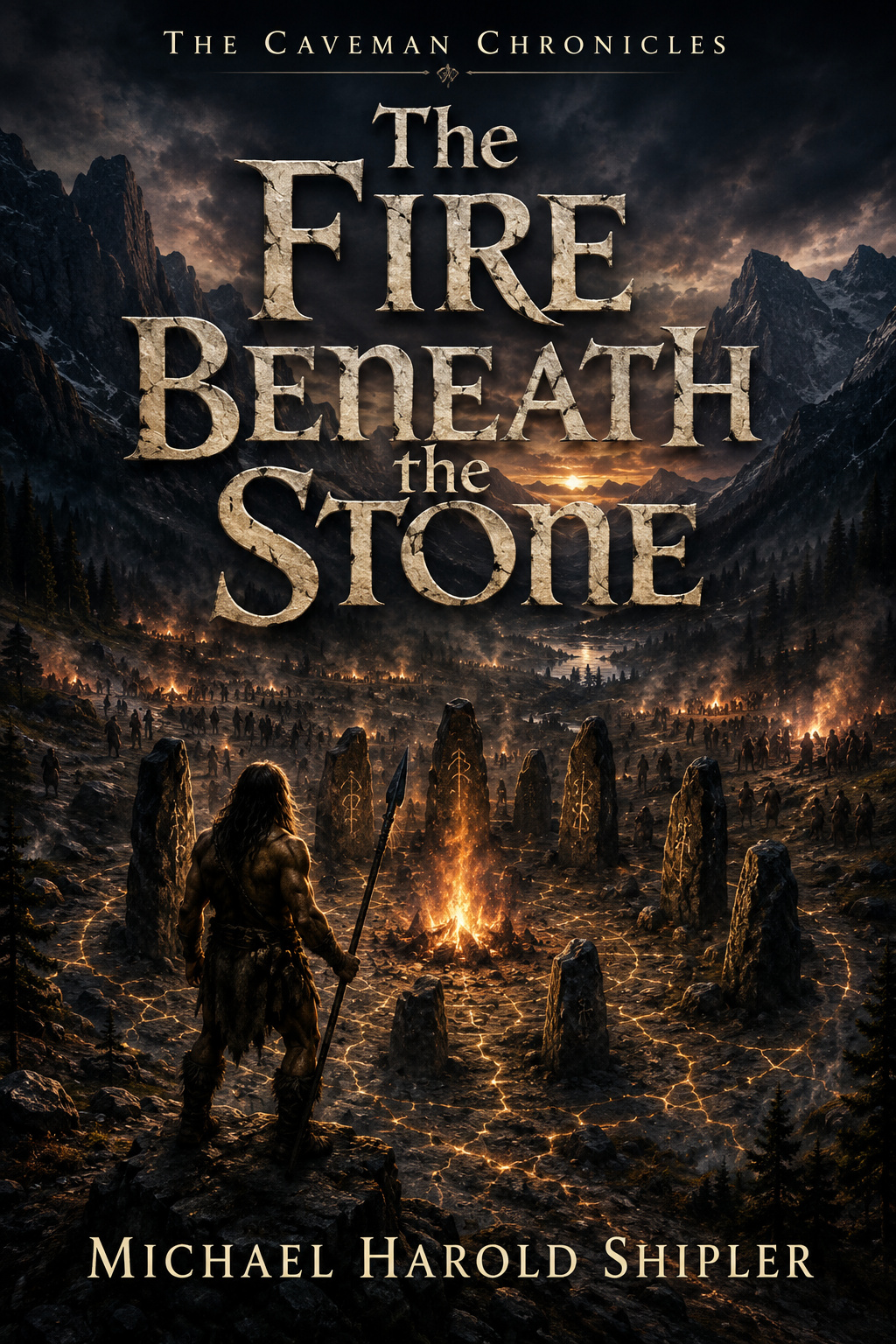
The Caveman Chronicles
This online reader is the current selected-reader edition for feedback.
Reader note: This page is for test reading only. Use the feedback form for pacing, clarity, character, typo, formatting, and ending notes. Current edition: v0.9 Test Reader / Candidate Production Draft. Game tie-in: play Caveman Chronicles Online.
The Caveman Chronicles
Book One: The Fire Beneath the Stone
Author: Michael Harold Shipler Edition: v0.9 Test Reader / Candidate Production Draft Date: 2026-07-15
Half Title
The Caveman Chronicles
Title Page
The Caveman Chronicles Book One The Fire Beneath the Stone Michael Harold Shipler
Copyright
Copyright © 2026 Michael Harold Shipler. All rights reserved.
This is a work of fiction. Names, characters, places, events, cultures, and incidents are products of the author's imagination or are used fictionally. Any resemblance to actual persons, living or dead, events, or places is coincidental.
This novel is a fictional prehistoric fantasy work inspired by global myth patterns, ancient-catastrophe speculation, and original worldbuilding. It is not intended as a historical or scientific claim.
First edition.
Test Reader Edition Notice
Edition: v0.9 Test Reader / Candidate Production Draft Date: 2026-07-15
This copy is for test reading and feedback only. Please do not distribute, repost, quote publicly, or treat formatting as final. The author is seeking feedback on clarity, pacing, character behavior, emotional impact, world rules, and ending satisfaction.
Dedication
For my son.
Table of Contents
Part One: The Fire and the Signs
Chapter One: The Quiet Valley
Chapter Two: The Fire Moves
Chapter Three: The Sea That Remembers
Chapter Four: Red Dust Under the Dead Star
Chapter Five: Where the Ground Has Teeth
Chapter Six: The Forest That Was Built
Chapter Seven: Ash on the Tongue
Chapter Eight: Smoke Through Pines
Chapter Nine: The Drowned Stair
Chapter Ten: The Word from Red Stone
Chapter Eleven: The People Below
Chapter Twelve: The Road Under Leaves
Part Two: The World Beneath Wakes
Chapter Thirteen: The Chant at the Old Camp
Chapter Fourteen: Salt in the Bones
Chapter Fifteen: The Scar Where Fire Fell
Chapter Sixteen: The Mushroom Sun
Chapter Seventeen: City Beneath Green
Chapter Eighteen: Teeth of the Sleeping Door
Chapter Nineteen: The Fire-Horn
Chapter Twenty: The Last Island Song
Chapter Twenty-One: The Word That Opens
Chapter Twenty-Two: Lower Than Roots
Chapter Twenty-Three: The Tree That Held a Star
Chapter Twenty-Four: Blood at the Seam
Part Three: The Gathering of Smoke
Chapter Twenty-Five: When All Fires Leaned
Chapter Twenty-Six: The Last to Look Back
Chapter Twenty-Seven: Boats Over Broken Water
Chapter Twenty-Eight: The Exiles of the Red Star
Chapter Twenty-Nine: The Warning from Below
Chapter Thirty: The Green Road Opens
Chapter Thirty-One: The Ash Priest
Chapter Thirty-Two: The Basin of Old Smoke
Chapter Thirty-Three: Many Fires, No Shared Tongue
Chapter Thirty-Four: The Stone Heart Beneath the Basin
Chapter Thirty-Five: The Wrong Opening
Chapter Thirty-Six: The Fire Beneath the Stone
Part One
The Fire and the Signs
Chapter One
The Quiet Valley
The valley slept beneath the old sky.
Mist lay low over the river, pale and thin, moving slowly through the reeds as if the water breathed in dreams. Beyond it, the grasslands rolled northward in silver-green waves, heavy with frost where the morning sun had not yet reached. Farther still, the white mountains stood with their teeth in the clouds, watching everything below with the silence of things too old to care who lived and who died beneath them.
The valley had always looked peaceful from above.
That was one of its lies.
In the high grass, small hunters moved under the stems. In the river, dark fish held themselves against the current and waited for weaker things to pass. Beneath the pines, cats with snow-colored bellies walked without sound. The caves in the cliffs held bats, bears, old bones, and deeper darks where no child of Ember-Ridge was allowed to wander.
And on the north face of the valley, above the largest cave and below a broken shelf of black stone, there was a place the old ones did not name.
The cliff there was wrong.
Most stone had shape from weather, root, rain, ice, and time. It cracked in crooked lines. It leaned where earth sagged. It wore moss where water found it. But this part of the cliff stood smooth and flat, its face too straight, its corners too sharp beneath the skin of lichen. A square shadow lived in it even when the sun changed. Dark rain-lines ran down from its upper edge like old tears.
Marks lay beneath the moss.
No hunter mark. No child scratch. No claw. No tally of kills.
God-marks, the elders called them, when children asked too loudly and there was no way to pretend they had not seen.
Then the elders would spit into the fire and tell the children to sleep facing away from the north cliff.
Three days before the chase, Ena vanished near the lower berry line.
She was twelve winters old, thin as a willow switch, with quick hands and a habit of humming through her teeth while she worked. She had carried water to Kael's mother during the coughing sickness, when many had stayed away from the sick hides and pretended not to hear the breath rattling inside. Ena had not stayed away. She had brought water every morning, spilling half of it because the skin bag was too large for her, and had said nothing when Kael's mother cursed her for waking the pain.
After Ena vanished, they found her basket overturned in the mud.
Berries crushed under strange feet.
No blood.
No body.
No sign of cat, bear, wolf, or river-drag.
Only pale clay smeared on a stone near the warning trees.
The elders said not to follow beyond that place.
Kael followed anyway.
Not because he was brave.
Brave was a word old men used after danger had already passed and could no longer argue. Kael followed because Ena had helped his mother when help had been costly. Because Ara had looked at the empty child-sleeping hide and said nothing. Because no one wanted to say aloud that maybe the painted men had taken her. Because someone had to know whether Ena was dead, taken, or worse.
And because Kael had believed he could see without being seen.
That had been his mistake.
Now he ran.
His name was Kael.
He was of the Ember-Ridge people, though in that moment even that meant little. He was not hunter, brother, son, or man. He was breath, blood, and legs. He was meat that had not yet stopped moving.
And he knew with the cold certainty of the hunted that if he slowed, he would die.
Behind him, men came through the trees.
Three at first.
Then five.
Then more sounds in the brush that might have been men or might have been fear making extra feet.
Their bodies were painted with pale clay and ash. White streaks crossed their faces. Bone charms clicked at their throats. Their hair was tied back with strips of hide darkened by old grease and smoke. One carried a spear with a black stone point. Another carried a club set with teeth from a beast large enough that Kael did not want to imagine its mouth. The tallest moved with a long, loping stride that wasted no strength.
They did not shout often.
That was worse.
Men who shouted wanted fear to do half their hunting.
These men saved breath.
A spear passed Kael's left side close enough for the air to slap his ribs.
He threw himself downhill through young pines. Branches tore his cheek. Frozen needles broke under his feet. His wounded arm struck a trunk and flashed white pain through his shoulder. He kept running.
The valley opened below him.
River.
Mist.
Grass.
Camp somewhere beyond the lower pines.
Too far.
The nearest painted man came hard through the brush behind him. Kael heard the wet pull of the man's breath, the slap of hide boots, the small grunt as he raised his arm.
Kael dropped.
The spear flew over him and struck a tree with a sound like bone splitting. Kael rolled, came up with mud in his mouth, and drove his shoulder into the man's knees.
They went down together.
The painted man was heavier. Older. Stronger. He smelled of ash, old blood, and sour hunger. His hand closed around Kael's throat. Kael stabbed upward with the flint knife he had almost dropped twice already. The blade struck ribs, scraped, slid, then found softness. The man made a surprised sound, as if death had been rude.
Kael tore the knife free and ran before the body finished falling.
The river waited below.
Cold water, fast from snowmelt, cutting through stone and reed. His father had taught him to cross it in spring when Kael was still small enough to be angry at instruction. Do not fight water like a fool, his father had said. Water does not care what you shout. Step where it lets you. Lean where it pushes. Give it nothing it can take.
His father had died two winters later under a cave-in while digging frozen roots from the upper bank.
Water had not cared then either.
Kael plunged into the river.
Cold seized his legs.
For one breath, his body forgot it belonged to him. The current struck his thighs and tried to fold him. He found the first stone with his left foot, slipped, slammed his shin, found it again. An arrow hissed into the water beside him. Men shouted now from the bank.
He crossed halfway.
The current took him.
Kael went under.
The world became white noise, cold, and bubbles. His shoulder struck rock. His knife vanished. He clawed upward and found air with a gasp that tore his throat raw. The river spun him, shoved him toward a fallen log, and tried to pin him beneath it.
He remembered his father's hand on the back of his neck.
Do not fight where it is strongest.
Kael let himself sink, pushed sideways with both feet, and came up beyond the log in shallower water. He crawled onto the far bank on hands and knees, coughing river from his chest.
A painted man entered the river behind him.
Then another.
Kael forced himself up.
The world tilted.
He ran anyway.
The lower woods were darker. Ferns grew thick between black roots. Deadfall lay under moss. The ground sucked at his feet. He heard splashing behind him, then a cry as one pursuer lost footing in the current. Good. Not enough.
He broke through a stand of thin trees and stopped so suddenly his heels skidded in mud.
An earth-bull stood ahead.
It was feeding among the ferns, tearing mouthfuls of green with a heavy side-to-side motion of its head. Its back rose higher than Kael's shoulder. Its hide was dark and pebbled. Two blunt horns jutted from its skull above small angry eyes. A ridge of stiff bristles ran along its spine. Steam puffed from its nostrils.
Kael did not breathe.
The earth-bull lifted its head.
Behind him, brush snapped.
The nearest painted man burst through the trees and saw Kael.
He smiled.
Then he saw the earth-bull.
The beast charged the louder thing.
Kael threw himself behind a rotting log as the earth-bull thundered past. The painted man tried to turn. Too late. Horn and skull struck him in the chest. His body lifted, folded, and hit a tree with a sound Kael felt in his teeth.
The earth-bull shook its head, confused by the breaking thing, then lowered its horns again.
Kael crawled.
Slow.
Slow.
When the beast turned toward the remaining noise in the woods, Kael slipped away through fern and mud, leaving the painted man's screaming behind him until it stopped.
The north cliff appeared through the trees.
Kael had not meant to come this close to it.
The square shadow sat above the cave mouth, dark against the morning stone. The god-marks beneath the moss seemed wet, though no rain had fallen. A hum moved in the air, low enough that it might have been inside his skull.
He felt the thing hidden in his hand.
The black shard.
He had taken it from the moss hollow before the painted men saw him. It was small enough to close his fist around and cold enough that he felt it through blood, sweat, and mud. Pale lines ran inside it like frozen lightning.
It had been near the place Ena's tracks ended.
He did not know why he took it.
That was another mistake.
Or the same mistake wearing a different skin.
A spear struck the tree beside his head.
Kael ran along the ridge path below the cliff.
The tallest painted man came after him now. The others had fallen behind or circled lower. This one moved steadily, not rushing, not tiring. His face was painted white from brow to chin except where sweat cut dark lines through the clay.
"Run," the man called.
His voice was low.
Almost amused.
Kael did.
The ridge narrowed.
Stone to one side. Drop to the other. Below, the valley opened again, and beyond the far trees, hidden by distance and smoke, lay the Ember-Ridge camp. Home. Fire. Ara. Sena. Brann. Thorn line. Dogs. Children.
If he reached them, he lived.
If he reached them, he brought death behind him.
The thought nearly broke his stride.
The tall man lunged.
Kael twisted. The spear point cut across his ribs. Fire opened in his side. He stumbled, caught himself on the cliff wall, and felt the god-marks under his palm.
The hum sharpened.
The black shard pulsed in his fist.
For one impossible breath, the square shadow seemed deeper than shadow. A line appeared in it, thin and black, like the start of an opening eye.
The tall man saw it too.
His face changed.
Not fear exactly.
Recognition.
Kael kicked loose gravel into his legs and threw himself down the ridge.
The path split near a fallen slab. One way curved down toward the river plain. The other cut through a narrow crack between rocks before dropping hard into brush. Kael chose the crack because no sane man would.
The crack swallowed him.
Stone tore his back. His shoulder struck both sides at once. His feet slid out from under him. He fell, rolled, struck earth, and kept rolling until a bush stopped him with thorns.
For a while, he did not move.
The world rang.
Then the dog barked.
Ember-Ridge dog.
Kael forced his eyes open.
The thorn line stood ahead.
Not far.
Too far.
A child gathering sticks saw him first. The boy stared, mouth open, bundle falling from his arms. Then he screamed.
The camp woke.
People came from shelters with spears, baskets, hides, half-cut meat, sleeping children. Dogs rushed the thorn gate and barked toward the trees behind Kael. Tor's voice cut through the noise, ordering the outer line. Brann appeared near the central fire, cave lion hide over one shoulder, black stone ring at his throat. Sena came slower, bent and small, but everyone made room for her.
Ara reached Kael before anyone else.
She dropped to her knees beside him and grabbed his face in both hands.
"Kael."
He tried to speak.
Blood came first.
Her eyes went wide, but she did not cry. Ara had their mother's eyes, dark and hard when fear wanted them soft.
"You stupid animal," she whispered.
He wanted to laugh.
It hurt too much.
Sena pushed Ara aside with surprising strength and cut Kael's torn wrap open. Her hands smelled of smoke, bitter herbs, and old bone. She pressed moss into the wound at his side and muttered to herself.
Brann stood over him.
"What followed?"
Kael swallowed.
"Painted men."
"How many?"
"Enough."
Tor cursed.
Brann's eyes narrowed. "Why?"
Kael's fingers were still closed.
He had forgotten the shard.
No.
He had not forgotten.
He had been pretending it might disappear if he did not open his hand.
Brann saw.
His voice lowered.
"What did you carry?"
That question cut deeper than the spear.
Not what chased you.
Not where is Ena.
Not how badly are you wounded.
What did you carry?
Kael knew before he opened his hand that Brann had already judged him.
Not wrongly.
His fingers uncurled.
The black shard lay in his bloody palm.
Small.
Cold.
Pale lines trapped inside it.
The camp seemed to lean away.
Sena stopped pressing the wound.
For the first time since Kael had known her, the old woman looked afraid before she chose not to.
"Not for all eyes," she said.
A dog at the thorn line growled toward the trees.
Far off, below the north cliff, a horn sounded.
Kael closed his hand around the shard again and understood that the chase had not ended.
It had only reached the fire.
Chapter Two
The Fire Moves
The fire did not know fear.
It burned in the center of the Ember-Ridge camp the same as it had burned the night before, and the night before that, and through winters older than the memories of children. It ate dry stick and split branch. It breathed when fed and sulked when smothered. It warmed the old, cooked meat for the hungry, hardened spear points, smoked hides, scared wolves, gathered stories, received the dead, and watched children become hunters one coal-lit face at a time.
The fire did not know painted men were coming.
The people did.
Fear moved through the camp faster than any scout.
It did not move as screaming. Not at first. Ember-Ridge had survived too long to waste itself in noise. Fear moved in hands. Women pulled children inward. Boys dragged thorn bundles toward the weak side of the fence. Old men who could no longer run picked up stones and sat where they could throw them. Hunters checked spear hafts. Dogs were tied back, then untied, then tied again by people who could not agree whether teeth were better held or released.
Above the camp, the morning sky was clear.
That made it worse.
Storm would have given them something to blame.
Kael lay near the central fire while Sena worked on him.
She had cut away the torn hide from his ribs and packed the spear wound with moss, ash, and a paste that burned worse than the cut. Every time he moved, she struck his thigh with two fingers, which hurt less than the wound but insulted him more.
"Still," she said.
"They are coming."
"Then bleed quiet."
Ara knelt beside him with a water skin. Her hands were steady, but her mouth had gone thin. That was how she carried fear. Not in tears. In the hard line of lips, in the way she looked toward the thorn gate every few breaths, in the way she kept one hand free for a knife.
Kael tried to sit.
Sena pushed him back with one palm.
He was not sure whether age had made her stronger or simply less interested in his opinion.
Brann stood across the fire with the black shard wrapped in a strip of hide at his feet. He had not touched it. No one had touched it after Sena covered it. The hide around it had darkened with Kael's blood.
Tor came from the outer line.
"Tracks on the lower slope," he said. "Five certain. More hidden. They crossed river upstream."
"Testing?" Brann asked.
Tor nodded. "Not rushing."
Brann looked toward the north trees.
He was not a young chief. His beard held gray. His left knee had never healed right after the winter fall four seasons back. But he had the stillness of a stone that had decided where the river must split around it.
"They want what he carried," he said.
Kael stared at the hide bundle.
"I found it near the cliff."
No one spoke.
Even the fire seemed to lower itself.
Brann's eyes returned to him. "Which cliff?"
Kael did not answer fast enough.
Ara did.
"The north one."
Sena closed her eyes.
Tor swore softly.
Brann's face did not change, which meant the change had gone deeper than face.
"You crossed the warning trees?" he asked.
Kael swallowed. "Ena's basket was there."
Ara looked at him sharply.
"You did not say."
"I saw pale clay. Tracks. I thought--"
"You thought alone," Brann said.
Kael had no defense against that.
Sena reached for the hide bundle.
Brann's hand snapped out and caught her wrist before she touched it. He was fast when he chose to be.
She looked at his hand.
He released her.
"Old woman," he said, "if that thing kills us because you wished to smell it, I will be angry in the spirit place."
"If you reach spirit place," Sena said, "I will tell them you talked too much."
She unwrapped the shard.
The black piece lay dull in the daylight. It did not look powerful. It did not look hungry. It looked like a broken bit of stone except for the pale lines inside it, lines that seemed too straight, too clean, too trapped.
Sena did not touch it with bare skin. She used a bone tool to turn it.
"Trouble," she said.
Tor snorted. "We knew that."
Sena looked up. "The kind that remembers."
A bird call came from the eastern watch rock.
Short.
High.
Twice.
Tor turned. "Vek sees them."
The camp tightened.
Brann began giving orders.
Not many. Good orders were few and sharp.
Children to the inner pit. Old ones behind the hide wall. Sling stones by the west gap. Spears to the north thorn. No full fire smoke. Dogs held until men broke through. Water skins away from the outer edge. No one chases into trees.
"No one," Brann repeated, looking at Kael.
Kael looked away.
Ara saw and almost smiled despite everything.
The first attack came without a shout.
A spear flew from the brush and struck the thorn wall. Then another. A third passed through a gap and hit old Merek in the shoulder. He sat down hard, surprised, then began cursing in a way that reassured everyone he would live.
Vek answered from the watch rock.
His arrow vanished into brush.
A painted man screamed.
Then the White Ash came low through the trees.
They were not many, but they moved like men who had hunted together in hunger. Pale clay streaked their faces and arms. Some wore bone charms. Some had black marks cut or painted across their chests: three lines near a circle, crude and ugly. Their weapons were good. Too good for starving raiders.
Tor met them at the north thorn.
The first painted man tried to force through a low gap and took a spear in the throat. The second threw himself over the thorn and landed inside the camp with both arms bleeding. A woman named Lera split his skull with a digging stone before he found his feet.
The third did not come through.
He looked.
Measured.
Then vanished back.
Brann saw it.
"They learn," he said.
Kael hated being on the ground.
He could hear fighting but not see enough. He could smell blood and smoke. He could hear children breathing too loudly behind the hide wall. He could hear Ara shift beside him every time someone shouted near the west side.
Then the west side smoked.
Not normal smoke.
Rot-smoke.
Gray-green, oily, crawling low under the drying racks. Someone had thrown a bundle of wet fungus, foul moss, and bitter root near the weak thorn gap. Dogs began coughing. Children cried. The smoke slid toward the inner camp where the old ones sat.
Ara moved before anyone ordered her.
She snatched a hide, wrapped it over her mouth, and ran toward the smoke.
Kael tried to rise.
Sena hit him.
He rose anyway.
Pain tore open his side with such force that black spots filled his sight. He stumbled, caught himself on a spear rack, and took one short spear because a longer one would have pulled him down.
Ara kicked dirt over the smoking bundle.
A painted man broke through the west gap behind her.
Kael shouted.
She turned too late.
The man grabbed her by the hair.
Kael crossed the space between them in three ugly steps and hit the man with his whole wounded body. It was not graceful. It was not skilled. It was meat colliding with meat. They went down together. The painted man struck Kael's wound, and the world went white.
Ara drove her knife into the man's neck.
Blood sprayed her hands.
The man jerked once and sagged.
Ara stared at him.
Then at Kael.
"You fool."
"You are welcome," he managed.
She laughed once, sharp and nearly broken.
Then Tor was there, dragging them both back as Vek and Lera closed the west gap.
The attack ended as suddenly as it began.
The White Ash pulled away into the trees, leaving three dead inside the thorn line and taking at least two more with them. They did not howl in defeat. They did not rage. They withdrew like hunters who had learned the shape of a trap and meant to return with a better way through it.
That was worse than victory.
Tor rolled one dead attacker onto his back.
The camp gathered.
On the man's chest, beneath drying blood and pale clay, someone had cut three lines into the skin. The cuts were old enough to scab, new enough to shine. They matched the pale lines inside the shard badly, like a child copying bird tracks from memory.
Sena crouched beside him.
"They wear what they do not know."
Brann looked toward the north cliff beyond the trees.
The ground rumbled.
Not hard.
Not enough to knock anyone down.
Enough.
Enough to silence dogs. Enough to shake ash from the central fire. Enough to make every person in the camp turn toward the mountains.
The fire bent.
Every flame in the central pit leaned north.
No wind touched them.
Children began to cry.
The black shard, wrapped again beside Sena, clicked against the bone tool.
Brann watched the bent flame for a long breath.
Then he said the words no one wanted and everyone already knew.
"We leave."
The camp did not argue.
Argument belonged to choices.
This was not one.
They moved quickly because survival allowed no proper goodbye. Hides came down. Tools were bundled. Dried meat was divided. Water skins filled. The wounded were wrapped. The dead White Ash were dragged outside the thorn line because no one wanted their blood near the fire. Ember-Ridge dead would have to be mourned later, if later still existed.
Sena went to the central fire with a hollowed horn lined in clay and old ash.
Ara followed her.
So did Kael, though he leaned on a spear and hated every step.
Sena knelt and chose from the heart of the fire.
Not the largest coal.
The oldest.
A deep red coal buried under gray ash, kept from night to night, camp to camp, season to season. She lifted it with bone tongs and placed it inside the horn. Then she packed warm ash around it, not enough to kill it, enough to cradle it. She sealed the horn with a pierced bone cap and wrapped it in moss and hide.
Then she held it out to Ara.
Ara did not take it.
Not at first.
Her face had gone still.
"Why me?"
Sena's eyes were black and sharp beneath white hair.
"Because your hands did not shake when blood came."
"They shake now."
"Good. Means you know what you hold."
Ara looked at Brann.
The chief nodded once.
She took the horn.
The camp changed around that small act.
Kael felt it.
The coal glowed inside the horn, small enough to hide in one hand and heavy enough to bend every heart in the camp toward it. Their shelters could be left. Their racks could be broken. Their spring could be stolen. Their dead could be mourned on another night if the night allowed it.
The fire would live, but not here.
Sena wrapped the black shard in ash-cloth, sealed it in a bone tube, and hung it around her own neck.
Brann saw.
"Old woman."
"Yes."
"If it eats you?"
"Then I bite back."
He almost smiled.
Almost.
The tribe left by the rear slope as the sun dropped behind the western ridge. No songs. No drums. No farewell cries to the spring. Children were carried when their legs failed. Dogs whined and looked back. Smoke from the dying camp fire rose behind them, thin and wrong.
Kael was placed on a litter despite his cursing.
Ara walked near the front with the fire-horn against her chest.
At the first rise, Kael lifted his head.
Below lay Ember-Ridge.
The thorn line. The shelters. The spring. The place where his mother had died. The place where Ena had laughed with berries on her fingers. The place where Ara had learned to set snares. The place where he had brought the shard.
Beyond it, the north cliff stood with its square shadow.
Birds circled above it.
From far below the stone, or from inside Kael's own blood, came a sound like something drawing breath for the first time after a long sleep.
They carried the fire into the trees.
Chapter Three
The Sea That Remembers
The sea had teeth, but Mara had learned where it hid them.
She moved barefoot across the black rocks while the morning tide pulled itself back into the western gray, leaving behind pools full of small life and quiet hunger. The stones were slick with weed and salt. Their edges cut like broken shells where the water had chewed them thin. A careless foot could split open. A careless hand could vanish beneath the rim of a pool and come back bleeding, if it came back at all.
Mara was not careless.
She crouched beside a hollow where the tide had left limp brown weed, purple shell, and a crab no wider than her thumb. She reached with two fingers, quick as a bird's beak, and caught the crab behind its claws before it could bury itself. It clicked and fought. She dropped it into the woven pouch at her hip.
Behind her, her younger brother Kesh made a soft disgusted sound.
"You always take the small ones."
"The small ones do not take fingers," Mara said.
Kesh held up both hands, displaying all ten fingers as if they were a great achievement. "I have all mine."
"Because I tell you where not to put them."
He grinned, then reached toward a narrow green pool under the rock shelf.
Mara struck his wrist.
He yelped. "What?"
She pointed.
At first he saw only water. Then the water moved wrong. A pale shape unfolded beneath the weed, all softness and waiting arms. One arm curled where his fingers had almost gone.
Kesh stepped back.
Mara leaned close to his ear. "The sea likes boys who think they have all their fingers forever."
Kesh swallowed and said nothing.
That was rare enough to please her.
Above them, the island cliffs rose dark and wet. Wind pushed mist across their faces. Farther up, the settlement clung to the slope in low huts of driftwood, hide, rib bone, and woven reed. Smoke came from shell-ringed fire pits where women dried fish over slow coals. Nets hung from poles. Children carried baskets. Old men patched boats with pitch and gut cord, their hands moving even while their eyes watched the horizon.
The people of the western rocks lived by the sea and mistrusted it like a generous enemy.
It fed them. It carried them. It took the weak, the foolish, the drunk, the unlucky, the beloved, and the brave. It gave shell, fish, weed, seal, driftwood, salt, and sometimes strange things from places no canoe could reach. It gave bones too large for whales. It gave stone worn smooth into shapes no hand had made. It gave black fragments that would not chip under hammer and would not warm in fire.
And always, always, it took back more than it gave.
Mara's mother had gone to the sea in a winter storm and had not returned. Not even her hair. Not even a tooth. The sea had swallowed her so cleanly that Kesh, still small then, asked whether their mother had ever been real.
Mara had hated him for asking.
Then she had held him while he cried.
That was the way of the sea people. The water took, and the living tied the remaining knots tighter.
"Mara."
The voice came from above the rocks.
Old Ila stood near the tide line with her sealskin cloak snapping behind her. Her hair was white, braided with shell, and her eyes were the pale gray of winter water. She was not chief. The western people had no one chief when the sea ruled all decisions. But when Ila sang, people listened.
Mara rose. "What?"
Old Ila did not answer.
She looked past Mara, toward the reef beyond the safe pools.
Mara followed her gaze.
The tide was still pulling back.
Too far.
It had already passed the black tooth rock where tide usually turned. It had passed the long kelp beds. It had exposed the lower reef, where barnacles crusted stone like old disease. Still the water withdrew, hissing and dragging weed behind it.
Kesh whispered, "It is hungry."
"No," Mara said.
But the word had no strength.
The sea floor emerged under gray light where no living memory had seen it bare. First came ridges of stone. Then old pools. Then shapes covered in weed and shell, shapes too straight to belong to reef.
Men and women stopped working.
Children were called back from the lower rocks.
Even the gulls seemed confused. They circled and cried, then landed on wet stone that no living bird had stood upon in Mara's memory.
Mara stepped down from one rock to the next.
"Mara," Ila warned.
"I am looking."
"Look from here."
But looking from there was not enough.
Out beyond the normal tide line, black steps descended into the sea.
They were broad. Smooth. Too even. Weed clung to their edges. Shells grew thick in their cracks. The lower steps vanished into dark water still pulling away from them. They did not lead from the island down to the sea. They seemed to lead from the sea up toward something that was no longer there.
Kesh crept beside her.
"Who made those?"
Mara did not answer.
No one answered.
Because no one living had made them.
The elders came down from the settlement one by one. Old men with net needles still tucked behind their ears. Old women with fish blood on their hands. Ila came last, though she had been first to see. She stood above the exposed steps and began making the warding sign with two fingers against her chest.
"No one goes down," she said.
A younger man laughed nervously. "They are stones."
Ila turned to him.
The laugh died.
"They are old-mouth stones," she said. "The sea covers what should be covered."
Mara stared at the steps.
At the side of the highest one, where weed had torn loose, markings showed beneath shell crust. Lines. Circles. Small star shapes. Not picture marks like a child might carve on bone. Not fish tallies. Not clan scratches. These were too fine, too ordered, set in rows along the stone as if the stone itself had once spoken and forgotten how.
Mara felt the hairs rise along her arms.
Kesh crouched.
Before she could stop him, he reached under a strand of kelp and pulled something free.
It was no larger than the end of Mara's thumb, black and smooth, rounded by wave and sand. It should have been stone. But when Kesh dropped it into her hand, it was colder than the water and heavier than it looked.
Old Ila saw it.
Her face changed.
Only a little.
That frightened Mara more than shouting would have.
"Give it," Ila said.
Kesh stepped behind Mara.
Mara held the fragment tighter. "What is it?"
"Give it."
"What is it?"
Ila came closer. Her shell braids clicked in the wind. "A thing from before drowning."
The words moved through the gathered people like cold foam.
Before drowning.
The old phrase belonged to songs. To winter stories. To the chants Ila sang only when storms took bodies and no bones came back. Mara had heard it since childhood, but always as rhythm, not history.
Before drowning, the people walked where fish now sleep.
Before drowning, the Last Island burned without wood.
Before drowning, the sea had not yet learned its full name.
Kesh whispered, "The Last Island?"
Ila closed her eyes.
That was answer enough.
Then the sea made a sound.
Not a wave sound. Not water breaking on rock. It was deeper. A slow breath drawn through a throat beneath the exposed steps.
The gulls lifted all at once.
Kesh's hand found Mara's wrist.
The water beyond the steps sank lower still, and something opened in the seabed.
A round black hole appeared between ribs of stone, rimmed with weed, breathing mist.
Men shouted now. Mothers grabbed children. Nets were abandoned. Someone called for ropes.
Kesh pulled away from Mara.
"Kesh!"
He did not hear. Or he heard and did not obey, which was worse. He had seen a stranded fish near the opening, silver and large, flopping weakly on exposed mud. Hunger and pride pulled him forward faster than fear.
The hole breathed again.
The mud around Kesh's feet trembled.
Mara ran.
Her bare feet slapped wet stone. She crossed the upper steps, slipped, caught herself, and kept going. Kesh bent for the fish.
The mud broke beneath him.
He vanished to the waist with a cry.
Mara threw herself flat and grabbed his arm.
The hole exhaled cold mist, then inhaled.
The pull was sudden and terrible.
Kesh screamed.
Mara dug one elbow into a crack in the stone and wrapped both hands around his wrist. His skin was slick. His eyes were huge and white.
"Do not kick!" she shouted.
"I am sinking!"
"Do not kick!"
He kicked.
The mud took him deeper.
Behind her, men were running with rope, but the exposed seabed stretched long between them. Too long. The hole inhaled again. Mara felt it pull through her own bones, felt the sea beneath the sea wanting what belonged above.
She dropped the black fragment.
No.
She had meant to free her hand, but her fingers would not open.
The fragment pressed into her palm.
For one heartbeat, the cold inside it sharpened.
The hole stopped breathing.
Only for one heartbeat.
But that heartbeat was enough.
Mara wrenched backward with all her strength. Kesh came free in a spray of mud and weed. He crashed into her, and they rolled across the slick step together. The hole exhaled again, angry now, and water began rushing back across the lower reef.
"Up!" Mara shouted.
They scrambled.
The sea returned not as tide returned, but as something released. Water poured around the lower steps, foaming white, climbing fast. Mara dragged Kesh by the back of his wrap. He coughed and sobbed and tried to say he had dropped the fish. She nearly struck him.
They reached the upper rocks as the lowest steps vanished.
Then the middle.
Then the marks.
Then the breathing hole.
Last of all, the highest black step disappeared beneath gray water, and the sea smoothed itself over the old thing as if nothing had happened.
The people stood silent on the shore.
Kesh shook beside Mara, covered in mud from chest to foot.
Old Ila came down the rocks and knelt before him. She touched his forehead, his throat, his chest, checking that he still belonged to the living.
Then she turned to Mara.
"Your hand."
Mara looked down.
She was still holding the black fragment.
Three pale lines, hidden until now by water and weed, glimmered inside it.
Not on it.
Inside.
The sea wind went cold.
From somewhere beneath the drowned stairs, a sound rose through the water.
It was not a voice.
Mara told herself it was not a voice.
But Old Ila began to sing.
Softly at first.
A song of the Last Island.
And far below, under stone and black water, something answered.
Chapter Four
Red Dust Under the Dead Star
The red ground remembered heat.
It held it through the day until the air shimmered and the lizards hid beneath stone. It released it at night when the cold came down from the empty sky and men huddled around small fires, ashamed of needing warmth from a world that had already burned them once.
Tovan walked behind the others with red dust on his feet and anger in his mouth.
His people moved in a thin line across the highland flats, carrying everything they owned on their backs and in hide slings. Children carried water gourds. Women carried seed bags and bone tools. Men carried spears, though in that country spears often found more stone than meat. The old carried memory, which weighed more than water and helped less with hunger.
At least, that was what Tovan thought when he was tired.
He was tired often.
The others called themselves the People of the Red Star when they spoke among themselves. Other tribes had less kind names. Ash-eyes. Sky-cursed. Star-burned. No-home people. Bad-omen walkers.
Tovan hated all of them.
He hated the red lines painted beneath his eyes each dusk. He hated the way his grandmother made him sit still while she mixed dust with fat and drew the marks down his cheeks with two fingers. He hated the songs that named a place none of them had seen. He hated looking up at the red star and pretending to mourn it like kin.
He especially hated that when he did look up, something inside him answered.
"Walk with your head down too long," his grandmother said behind him, "and you will think the ground is all there is."
Tovan did not turn. "The ground feeds us more than stars."
"The ground buries us too."
"So do old songs."
She laughed softly, which annoyed him because it meant she was not insulted.
Her name was Sava. Her hair had gone silver-white, but her back was still straight. The skin around her eyes was creased from years of watching sky. She walked with a staff made from dark wood no one knew the origin of, carved with small marks that were not clan marks, not kill marks, not moon counts.
Tovan had asked once what they meant.
She had said, "They are sounds too old for your tongue."
He had stopped asking.
Ahead, the band slowed near a field of black glass.
No trees grew there. No grass. No thorn. The glass lay in sheets and broken plates across the red earth, some pieces green-black, some dark as night. In places it had bubbled and frozen like water caught in pain.
Children were told not to walk barefoot there.
Men were told not to sleep there.
Elders were told not to die there, if they could help it, because bodies buried near the glass did not always stay quiet in dreams.
A boy named Rek bent and picked up a shard.
His mother slapped it from his hand.
Tovan smiled despite himself.
At sunset, they made camp beyond the glass field. Low fires were built in stone cups. Meat was scarce, so they ate bitter root and strips of dried lizard. The sky deepened from copper to purple. One by one, the stars came through.
Then came the red one.
Tovan tried not to look.
Sava sat beside him and held out the paint bowl.
"No."
"Yes."
"I am not a child."
"You speak like one."
He glared at her.
She dipped two fingers in the red paste.
The others were already marking themselves. Even the little ones sat solemnly while their mothers drew the lines down from their eyes. To outsiders, it looked like blood tears. To the Red-Star people, it was memory.
Tovan leaned forward with bad grace.
Sava touched his face.
"The red home lost its breath," she said.
He closed his eyes. "The red home lost its breath."
"The sky opened its teeth."
"The sky opened its teeth."
"The people crossed the black cold."
"The people crossed the black cold."
"The earth took them in."
He hesitated.
Sava's fingers stopped on his cheek.
"The earth took them in," he said.
Around them, the band spoke the old response together. Their voices were low, almost embarrassed before the night.
Rek, the boy who had touched the glass, whispered too loudly, "If the red home died, why do we keep looking at it?"
A few people smiled.
Sava did not.
"Because dead things can still call," she said.
The smiles faded.
Tovan opened his eyes and looked up.
The red star burned low on the horizon, steady and watchful. Nearer the west, the bright white star blazed too hard, a thorn of light in the evening. The elders watched both.
Tovan watched the elders.
Fear moved among them, subtle but real.
Then the sky flashed.
No thunder followed.
A green-white arc leapt from horizon to horizon, silent as a thought, wide enough to split the dark. For one breath the entire highland glowed. Stones cast shadows in two directions. The glass field answered with a pale shimmer.
Children cried out.
Dogs flattened themselves against the earth.
Tovan stood.
"What was that?"
No one answered.
The elders stared upward with faces emptied of everything but memory.
Sava whispered a word Tovan had never heard.
The next morning they found the dead animal.
It had been a horned desert grazer, lean and tough, the kind that could smell men before men saw it. It lay on its side beyond the glass field, legs stiff, one eye open. There was no blood. No bite. No spear wound.
One side of its body was burned black.
Not charred by fire. There was no ash beneath it, no scorched grass, no smell of smoke. The hide had split in thin lines like dry mud. Its horn had cracked open lengthwise.
Rek vomited.
Tovan crouched beside the carcass. The air around it tasted sharp, like stone after lightning.
"This is not from sky," he said, though no one had said it was.
Sava stood behind him. "No?"
He looked at her.
She pointed to the glass field.
There, half-buried where the green-white arc had shimmered strongest, something curved protruded from the red dust.
Tovan walked toward it before anyone could stop him.
It was not large. Perhaps the length of his forearm. Curved like a rib, but too smooth for bone. Dark beneath dust, with faint lines along its surface. When he brushed dirt away, the object seemed to drink light rather than reflect it.
"Do not touch," Sava said.
He touched it.
The world vanished.
He stood beneath a red sky that was not the sky above him.
The air was thin and bitter. Towers rose in the distance, not like trees, not like cliffs, but like spears made by minds too patient to be human. The ground shook. Across the heavens, fire moved in ropes and curtains. A white star burned huge and terrible where no star should be. The red earth cracked open. Wind screamed, but the wind was leaving, pouring upward into darkness.
He saw people running.
Not spirits. People.
Their faces were painted red beneath the eyes.
No.
Not painted.
Bleeding.
He saw lights lift from the dying red ground. Saw them cross blackness. Saw a blue-white world ahead, wounded but breathing.
Then something turned in the dark between worlds.
Something vast.
Something with no body he could understand.
A voice, or memory of voice, struck through him.
Not in words.
In command.
In grief.
In warning.
Tovan fell back into his own body with his mouth full of dust.
People shouted around him.
Sava knelt over him, holding his face in both hands.
"Tovan."
He tried to answer.
His tongue shaped a sound he did not know.
"Va-or."
Sava went still.
The others around them drew back.
Tovan coughed and blinked tears from his eyes. "What did I say?"
His grandmother looked toward the red star, pale now in morning light.
"A word," she said.
"I know that."
"No." Her voice was thin. "A word from before the falling."
The curved object lay in the dust beside him.
Its lines had begun to glow.
Chapter Five
Where the Ground Has Teeth
Nahu's grandfather had told him the earth had two mouths.
One mouth gave.
One mouth took.
The giving mouth opened in springs, roots, clay, salt, and caves where cool air saved hunters from the killing sun. The taking mouth opened in sinkholes, bad cracks, old tunnels, and places where the ground breathed when no wind moved.
"Never trust a breathing hole," his grandfather had said. "A thing that breathes is alive. A thing alive can hunger."
Nahu remembered this while kneeling beside a crack in the canyon floor that exhaled warm air against his face.
The hunting party had stopped above the dry wash, where rabbit tracks crossed between thorn and stone. Morning light fell red along the canyon walls. Lizards sunned themselves on flat rocks. Far above, vultures circled in patient spirals.
The boy Tiku stood too close to the crack.
Nahu clicked his tongue. "Back."
Tiku looked at him with the wounded pride of nine winters. "I am not little."
"Then be not little farther away."
The older hunters laughed. Tiku scowled and stepped back one pace, which was not enough but better than none.
Nahu was not old enough to command men, but he was old enough to know what fear smelled like in stone. The crack had not been there the last time they crossed this shelf. Or if it had, it had been narrow enough for dust to hide. Now it split the ground like a dark lip. Warm air came from it in slow breaths.
One of the hunters spat into it.
The spit vanished without sound.
"Deep," he said.
"Everything bad is deep," another muttered.
They moved on.
By midday, the ground trembled.
It began as a shiver underfoot. Pebbles clicked down the canyon wall. A bird lifted screaming from a thorn tree. Then the tremor rolled harder, passing through the stone shelf in a wave that made men bend their knees and grip spears.
Tiku shouted.
Nahu turned.
The crack had opened.
The boy stood at its edge, arms windmilling, dust sliding beneath his heels. For a heartbeat he hung there, balanced between light and dark.
Then the earth took him.
His cry dropped away fast, swallowed by depth.
The hunters froze.
Nahu ran.
"Nahu!" someone shouted.
He threw himself flat at the edge and looked down. Dust filled the crack. He could hear Tiku crying, far below but alive.
Alive changed everything.
A dead child belonged to mourning.
A living child belonged to action.
Nahu looped a hide rope around his waist and shoved the other end at the hunters. "Hold."
"No," said old Mak, the hunt leader. "We go back. Get elders. Get more rope."
"He will be dead."
"He may already be dead."
"He cries."
Mak's face hardened. "Below is not ours."
Nahu looked into the crack.
Warm air touched his face.
From below came Tiku's thin voice. "Nahu?"
That decided it.
Nahu slid into the dark.
The crack scraped his shoulders. Stone tore skin from his elbow. Dust filled his nose. The rope burned across his waist as the hunters lowered him by jerks and curses. Light narrowed above. The air grew warm and wet.
Then the crack opened into a chamber.
Nahu dropped the last body-length and landed on soft earth.
He lifted his torch.
The chamber walls were not like canyon stone. They were smooth in places, shaped from packed earth and hardened mud. Curving passages led away in several directions. Roots hung from the ceiling, but not randomly. They seemed braided into the walls. Along one passage, marks had been scratched deep: not human handprints, not claw marks from bear or cat. Something with long hard fingers had shaped them.
"Tiku."
A sob answered.
Nahu found the boy near a wall of pale fungus. His leg was twisted under him, but not broken through. His face was white with dust and tears.
"I told you to stand back," Nahu said.
Tiku began crying harder.
Nahu sighed and crouched. "That was not useful. I say different. You are alive. Good."
A sound came from the nearest tunnel.
Click.
Click-click.
Tiku stopped crying.
Nahu raised the torch.
The darkness moved.
At first he thought the wall had peeled away. Then he saw limbs. Thin, pale, jointed strangely but not insect legs. Arms. Hands with long dark nails. A narrow face. Eyes black and wet, reflecting firelight. The being crouched low, head tilted. Behind it, more shapes gathered.
Nahu's mouth went dry.
Stories rose in him. Under-people. Root-eaters. The hollow ones who listened beneath sleeping mats. Ant People who carried children below during the black winter and returned them speaking wrong.
He had never believed those stories fully.
Belief was easy above ground.
Below, belief had teeth.
Tiku whimpered.
The first being clicked softly.
Nahu lifted one hand, palm out.
The being copied him.
Its hand had too many long fingers.
Nahu did not move.
The being stepped closer. Its skin was pale gray-brown, soft-looking but ridged in places like bark. Its eyes were set wide. Its mouth was small. When it breathed, flaps along its neck trembled.
It reached toward Tiku.
Nahu raised his spear.
Every figure in the tunnel went still.
The first being looked at the spear, then at Nahu. Slowly, it lowered its hand. Then it touched its own chest.
Click. Click-click.
It touched the ground.
Click.
It touched the wall.
Click-click-click.
Nahu understood none of it.
Then the being reached toward him.
He should have struck it.
Instead, because the world is often changed by the small foolishness between fear and choice, Nahu let the fingers touch his forehead.
Darkness opened behind his eyes.
He saw the sky burning.
He saw ash falling so thick that day became night. He saw humans, thin and terrified, crawling into holes while above them forests burned and beasts screamed. He saw pale hands guiding children through tunnels. He saw seeds stored in clay chambers. He saw fires hidden below ground. He saw the surface freeze under a wounded sun.
Then he saw something deeper.
Straight black walls beneath the root tunnels.
Marks that were not Ant People marks.
Doors sealed with lines of pale light.
The vision broke.
Nahu fell backward, gasping.
The being withdrew its hand.
Tiku whispered, "What are they?"
Nahu looked at the pale figures filling the tunnel.
He thought of his grandfather's warning.
The earth has two mouths.
One gives.
One takes.
He lifted Tiku into his arms.
"I do not know," Nahu said.
The first being stepped aside, opening a path toward a sloping tunnel where daylight glimmered faintly above.
A gift.
Or permission.
Nahu carried the boy upward.
At the cave mouth, when they reached the surface and men dragged them into sunlight, Nahu looked back.
The pale being stood in the dark below.
With one long finger, it drew a spiral in the wet clay.
Then the clay hardened black around the mark.
Chapter Six
The Forest That Was Built
Ishka knew the forest did not speak.
Not as people spoke.
It did not make words with tongue and teeth. It did not sit beside fire and explain itself like an elder who thought wisdom grew longer with every breath. It did not answer questions because questions were a human weakness.
The forest spoke by changing.
Ishka had learned that from Nami before she learned to carry water without spilling. Her mother could read a pot by smell, a fever by skin, and a lie by the way a child looked at the floor. But Nami listened to people. Ishka listened past them.
That had made her useful and lonely.
When other children chased bright frogs, Ishka watched which frogs vanished before rain. When boys threw sticks at monkeys, she watched which branch the monkeys would not touch. When elders argued about where to plant, she dug her fingers into black soil and knew which mound still held old heat.
The forest did not reward loud people. It rewarded those who noticed the small warnings before they became teeth.
A bird calling at the wrong hour. Ants climbing before rain. A flower closing though the sun still stood high. Monkeys falling silent in one tree while insects screamed in another. A root cracking a stone where no root should grow. Fruit coming early. Fruit not coming at all.
Ishka listened to these things.
That was why she stopped when the others did not.
The hunters moved ahead through ankle-deep water, pushing aside broad leaves and hanging vines. The flooded forest smelled of mud, green rot, flowers, and hidden life. Mosquitoes whined around their ears. Somewhere nearby, a frog called with the voice of a broken bone flute.
"Ishka," her cousin Ren called. "We lose light."
She did not answer.
Her foot rested on a ridge beneath the water.
At first it seemed natural. A raised strip of earth, hard under mud, running through the swamp. Such ridges existed where old roots died and silt gathered. But this one did not curve. It ran straight between trees, vanishing under vines in one direction and flooded leaves in the other.
Too straight.
The forest disliked straight things unless men had once made them.
Ishka crouched and pushed her fingers into the water. Beneath mud she felt stone.
Flat stone.
Set beside another.
And another.
Ren came back, annoyed. "What now?"
She took his wrist and pressed his hand down.
His expression changed.
They called the others.
Rain came before the elder could finish complaining.
It fell hard, sudden, warm, hammering leaves and turning the world silver. Water rushed along the ridge. Mud peeled away in sheets. Black earth appeared beneath it, darker than normal soil, rich and soft and full of broken fragments: pottery, shell, charcoal, bone, bits of red stone not from this part of the forest.
Old Tima, who knew planting places, knelt despite the rain.
"This earth is fed," she said.
"All earth is fed," Ren said.
Tima picked up a handful and smelled it. "Not like this."
Lightning flashed.
In the white light, Ishka saw the moss-covered shape ahead.
A platform.
Low, broad, almost swallowed by roots. A jaguar stood upon it.
The hunters froze.
The jaguar was large, gold and shadow-spotted, its head low, tail moving slowly. It had come silently, as jaguars do, and now watched them with yellow eyes.
Ren lifted his spear.
"Do not," Ishka whispered.
The jaguar did not charge.
It stepped to the platform's edge and stopped, as if some boundary held it there. Rain streamed down its whiskers. Its ears twitched. It looked past the humans, deeper into the forest.
Then it turned and vanished.
No one moved until the leaves stopped trembling where it had passed.
Tima made a sign against her chest. "Old hands hold this place."
Ishka climbed onto the platform.
Roots covered most of it. She pulled at them with both hands. Mud broke under her nails. A vine tore free, then another. Beneath them was a carved face.
Not a human face exactly.
The eyes were closed. The mouth was wide but calm. Lines ran down from the brow in patterns too deliberate to be cracks. Moss filled the grooves like green memory.
Ren backed away. "We should go."
Ishka touched the closed eye.
The stone was warm.
That night, the useful trees around the village dropped fruit out of season.
Not one tree.
All of them.
The people woke to the sound of falling.
Thuds in the dark. Soft impacts on leaves. Children cried out as fruit rolled against sleeping mats. Women lit torches. Men grabbed spears. The village floor was covered in yellow, red, and green offerings from branches that should have been empty for another moon.
Some laughed.
Some prayed.
Some began gathering before the forest changed its mind.
Ishka did not gather.
She stood at the edge of the village and looked toward the hidden ridge.
The forest did not give without reason.
That night she dreamed.
She stood above the trees, though no hill rose there. Beneath the canopy, fires burned in straight lines. Not wildfires. Not village fires. Ordered fires. Roads of flame beneath green leaves. Water shone in channels too straight to be rivers. Mounds rose like sleeping backs. Stone faces watched from under roots.
At the center was a dark basin filled with stars, though the sky above was hidden by leaves.
A voice without words entered her dream.
Not human.
Not forest.
Older than both.
When Ishka woke, dawn had not yet come.
She walked alone to the ridge.
The storm had stripped away leaves and mud.
A road of stone waited beneath them, straight as a spear cast by a god.
It led into green darkness.
Chapter Seven
Ash on the Tongue
Varr washed blood from his hands in a pool that had once belonged to another people.
The pool lay at the edge of the captured camp, beneath a low shelf of stone where cold water gathered from the spring. Ember-Ridge had lined it with smooth rocks and set willow baskets nearby for fish. Their children had probably played there. Their women had probably washed hides there. Their old had probably sat with feet in the shallows and complained of bones.
Now the water clouded red from Varr's knuckles.
He scrubbed until skin split.
Still he smelled smoke. Mud. Blood. The bitter rot-smoke that had failed to blind the thorn camp long enough. He smelled the river on the boy they had chased. He smelled the earth-bull's musk where Ruk had been broken against a tree. He smelled fear.
Not his own.
He told himself not his own.
Behind him, the White Ash moved through the abandoned camp like wolves uncertain whether the den they had stolen might bite. Children picked at spilled grain and root bundles. Women tore usable hide from broken frames. Warriors dragged bodies away from the thorn line. The dead Ember-Ridge had taken none of their own, because they had left too quickly to bury enemies.
That angered some.
It relieved Varr.
Dead men with covered faces accused less.
Uln stood near the central fire pit.
He had not washed.
Ash paint covered him from brow to chest, but sweat had cut paths through it. Beneath the white clay, his skin was dark and corded, his ribs sharp from hunger. Around his neck hung finger bones, bird skulls, and three black stones that were not black stones at all. Varr had seen him strike one with a hammer. It had not chipped.
The priest-warrior lifted both hands over the smoking pit.
"This fire was weak," Uln said.
No one answered.
"It ran."
A woman with two hungry children glared at him but lowered her eyes when he turned.
Varr dried his hands on his thigh and walked toward the cliff path.
He did not want to look at the girl.
So he looked.
She sat bound near a pine, watched by one old woman and two boys with spears too large for them. Ena. That was the name she had cried when first taken. Or perhaps the name someone else cried for her. She was thin, mud-streaked, with one cheek swollen where she had been struck for biting.
She stared at Varr with hatred too large for her face.
Good, he thought.
Hatred kept children alive longer than pleading.
Uln came behind him.
"She saw inside."
Varr did not turn. "She is a child."
"She is small enough."
"The crack cut her arms."
"Stone takes blood before it gives mouth."
Varr faced him then. "You said the black tooth would open it."
"The runner took it."
"The runner nearly died with it. We lost five men for a finger-size thing."
Uln smiled.
Varr hated that smile. It held no hunger, no doubt, no memory of the dead. Only certainty.
"Then the thing is worth more than five men."
One of Varr's hands closed.
Uln saw. Of course he saw.
"You doubt because your belly speaks louder than your bones," the priest said. "You think of meat. Of hides. Of warm sleeping places. I think of what waits behind the old skin."
"What waits may kill us."
"What waits may feed us forever."
Varr looked toward the northern cliff.
Even from the camp, its square shadow could be seen above the slope, dark against gray stone. Too straight. Too still. The first time they found it, three moons past, Uln had fallen to his knees and wept. Varr had thought him mad then.
Now he was less sure.
That uncertainty was its own sickness.
The White Ash had not always been White Ash.
Once they had been three starving bands driven from lower hunting grounds by flood, sickness, and beasts moving out of season. They had fought one another until there were not enough left to fight. Uln had brought them together with stories of old stone and sleeping mouths. He had shown them caves that breathed warm air in winter. He had found black fragments in roots and claimed they were teeth shed by gods under mountain.
People who are starving will follow a man who says the world has hidden meat.
People whose children cry at night will wear ash if ash promises morning.
Varr had followed because the others followed, and because alone he would have died.
That did not mean he believed.
From the cliff came a low hum.
The camp quieted.
Even the children stopped chewing.
Uln closed his eyes, smiling again.
"The door tasted blood," he whispered.
Varr's throat tightened.
At the base of the forbidden cliff, they had scraped moss from the square shadow. They had cut away roots. They had broken stone that was not stone. Ena had crawled into a narrow crack no grown man could enter and come out screaming about black teeth in the wall.
Then Kael had appeared from the trees.
Too quiet.
Too fast.
A watching runner. A thief.
He had taken the black tooth from the moss hollow and run.
That was why they had chased him.
That was why men were dead.
Uln walked to Ena and crouched before her.
The girl spat at him.
He wiped it away with one thumb and laughed softly.
"You have fire in you. Good. The dark likes fire."
Varr stepped forward. "Leave her."
Uln did not look back. "She goes in again."
"No."
Now Uln stood.
The two boys watching Ena shifted away from them.
Around the camp, White Ash warriors pretended not to listen.
Uln came close to Varr, so close that Varr smelled old blood in his ash paint.
"You think because you are tall, the sky made you chief?"
"I think because I count dead men."
"Count living children with empty bellies."
Varr said nothing.
Uln lifted his voice.
"The Ember-Ridge carry the tooth. They carry the weak fire. They carry fear. We will take all three."
The White Ash began to murmur.
Uln turned toward the cliff and raised both hands.
"The sleeping door has tasted blood. It will not sleep again."
At the edge of the camp, Ena began to cry without sound.
Varr looked at the stolen spring, the abandoned thorn, the smoke rising from another people's fire pit.
For the first time, he wondered if they had taken a camp or been invited into a trap by something beneath the mountain.
Chapter Eight
Smoke Through Pines
The tribe moved like a wounded animal that refused to lie down.
Ember-Ridge climbed through the pines in a long broken line, leaving the valley below to smoke, ash, and enemies. The strongest carried the heaviest bundles. The old carried what pride allowed. Children carried what adults placed in their arms, then dropped it, cried, picked it up again, and learned the first lesson of leaving: if it cannot walk, someone must carry it, and someone is always tired.
Kael lay on a litter made of spear shafts and hide, hating every step taken for him.
The two men carrying his front end breathed hard. A woman named Lera carried the rear with Tor, her bandaged brow still dark with blood from the stone that had struck her. Kael told them twice that he could walk.
No one answered either time.
That was worse than being told no.
Ara walked ahead with the fire-horn against her chest.
Children stayed near her without being told. Their eyes followed the horn as if they could see the coal inside through clay, moss, bone, hide, and prayer. Perhaps they could. Children knew things adults buried under usefulness.
Sena walked behind Ara.
The black shard was hidden beneath the old woman's cloak in a bone tube marked with soot and red ochre. Kael could not see it, but he knew where it was. His body knew. His fist still remembered its cold edges.
Brann limped near the middle of the line. He had wrapped his knee tight with hide and said nothing of pain. Chiefs did not spend pain aloud unless it bought something.
Behind them, the old camp smoke rose through the valley.
Not their smoke now.
White Ash smoke.
Kael lifted his head from the litter and saw it between tree trunks, thin and gray against the cliff.
Ara looked back at him.
"You will tear your side."
"Then stop carrying me like old meat."
"You smell like old meat."
He almost smiled.
Pain stopped it halfway.
She slowed until she walked beside him. The fire-horn rested in the crook of her arm. Her fingers were wrapped around it so tightly that her knuckles had gone pale beneath dirt.
"Does it burn?" he asked.
"No."
"Is it heavy?"
"Yes."
He looked at the horn.
It held one coal. One ember hidden in ash. One piece of the life they had carried from camp to camp, winter to thaw, death to birth.
It should not have looked heavy.
It looked heavier than stone.
"They should have given it to someone else," Ara said.
"No."
"You do not know."
"I know."
She frowned at him.
"You carry better than me," he said.
"That is because you are on a litter."
This time he did smile, and pain punished him for it.
They halted before noon in a hollow where boulders blocked the wind. The tribe drank little. Water had to be saved until the next melt stream. Food was not opened except for children, the wounded, and elders whose bodies had begun eating themselves. Men checked weapons. Women adjusted loads. Dogs lay with tongues out, watching the back trail.
Kael pushed himself upright.
Sena appeared without sound.
"No."
"I did not say anything."
"Your bones did."
"I need to piss."
"Then piss close."
He glared.
She glared better.
Ara turned her face away, pretending not to laugh.
Brann called a small council at the edge of the hollow. Tor came. Sena came. Lera came with her bandaged brow, and two elder women settled on stones near the back. Kael came because he had seen the White Ash near the cliff. Ara came because Sena said the fire went where she went, and no one argued with that kind of old-woman nonsense when it might be true.
Kael told them what he had not fully said at the camp.
He told them of Ena's basket. The crushed berries. The pale clay on stone. The tracks going toward the warning trees. The smoke where no camp should be. The White Ash digging near the square shadow.
Ara's face tightened when he said Ena's name.
Brann listened without moving.
When Kael finished, Tor said, "You should have told me before going."
"I know."
"You should have taken two men."
"I know."
"You should have listened to the elders."
Kael looked at him. "I know."
Tor stopped.
There was little pleasure in striking a man who had already opened his own skin.
Ara said, "She may still be alive."
The hollow quieted.
Brann's eyes went to Kael.
Kael nodded once. "I heard a cry before they saw me. Small. From near the cliff."
"You did not say this," Ara said.
"I did not know."
"You did not say."
"I was bleeding."
"She may be alive."
"That is why I say it now."
Ara stood. "Then we go back."
"No," Brann said.
The word did not rise. It fell.
Ara turned on him. "She is a child."
"So are those." Brann pointed to the inner hollow, where three small children slept under one hide, mouths open, faces gray with exhaustion.
Ara's mouth closed.
Brann looked at Kael. "You brought danger because you went alone for one child. I do not throw all children after her because guilt bites."
Kael flinched.
Brann had meant him to.
Sena spoke then. "The painted ones chant at old camp."
All eyes shifted to her.
She had been staring down the slope through the trees.
Kael followed her gaze.
Far below, around the stolen spring, the White Ash moved in a ring.
Their voices rose faintly through the pines.
Not loud. Not clear.
But rhythmic.
Slow.
Three beats. Pause. Three beats. Pause.
Sena's face went still.
Tor said, "You know it?"
"No."
"You said--"
"I know it is not theirs."
The chant drifted upward.
The shard beneath Sena's cloak clicked once against the bone tube.
Kael heard it.
So did Ara.
Sena put one hand over her chest.
From far below, the stolen camp answered with smoke.
Chapter Nine
The Drowned Stair
Mara went back when the moon was thin enough to deny being witness.
She waited until the settlement slept in pieces. Sea people never slept all at once. Someone always watched tide. Someone always fed coals. Someone always listened for storm change, crying child, boat rope, dog growl, or the sound of water where water should not be. But watching is not seeing everything, and Mara knew the blind places between duties.
Her friend Senn came because he was foolish, loyal, and in love with danger when danger had not yet cut him deeply enough.
"This is stupid," he whispered while following her down the black rocks.
"Go back."
"I did not say I would not come."
"You said stupid."
"It is."
"Then be quiet stupid."
He grinned in the dark, teeth pale under moonlight.
The tide was wrong again.
Not as wrong as before. It had not exposed the full lower reef. But the highest drowned steps showed beneath the water, black backs glistening between waves. The sea moved around them uneasily, as if uncertain whether to hide or reveal.
Mara carried the wave-worn fragment in a pouch tied beneath her wrap.
She had not given it to Ila.
She did not know why.
That was a lie.
She knew. The fragment had stopped the breathing hole for one heartbeat. Maybe. Or she had imagined it because fear makes patterns from anything. But Kesh was alive, and the cold stone had pulsed in her hand when the hole inhaled.
A thing like that did not belong only to elders.
It belonged to the person it had chosen to frighten.
They reached the tide cave as water sighed around their ankles. Senn lit the fat-wick lamp cupped in a shell. Its flame was small and greasy, barely enough to push back the dark.
The cave mouth opened behind the exposed step, hidden unless tide dropped low. Mara slipped inside first.
The air changed.
Outside was salt, wind, bird, kelp, open water.
Inside was old wet stone.
The passage sloped down, then bent sharply. Waves muttered behind them. The walls were black and slick. Shells grew in seams near the floor, but higher up the stone was smooth. Too smooth.
Senn touched it. "This is bad."
"You are just now knowing?"
"No. I knew above. Now I know more."
The passage widened.
Their lamp revealed carvings.
Mara stopped.
Figures covered the wall in long bands. Not scratched by idle hands. Cut with care. Human shapes, or close to human, moved in rows across the stone. Some carried bundles. Some carried children. Some carried bowls with flames rising from them. Behind them stood a tall island made of rings: water ring, land ring, water ring, land ring, and at the center something like a tower or mountain with lines rising into the sky.
Above the island, stars fell.
No.
Not stars.
Fire.
Senn whispered, "The Last Island."
Mara had heard the song all her life.
She had never seen it before.
On another wall, people climbed into boats while waves rose behind them. Some boats reached other lands. Some were overturned. Some figures sank beneath lines of water, arms raised. At the bottom, below waves, black shapes waited.
Mara touched the carved island.
The fragment in her pouch went cold.
A sound came from deeper in the cave.
Senn backed away. "We saw. Good. We go."
Mara did not move.
"Mara."
The sound came again.
Not breathing this time.
Singing.
Very faint.
Senn cursed and ran for the passage, panic carrying him faster than loyalty could catch.
His footsteps slapped wet stone, then vanished around the bend.
Mara should have followed.
Instead, she walked deeper.
The tunnel ended in a chamber half-filled with dark water. In the center rose a black stone table, its surface carved with lines, rings, and dots. A map, perhaps, though not of any coast Mara knew. At one edge was the ringed island. From it, lines stretched outward like cracks in ice or paths across sea.
She set her hand on the island.
The chamber filled with light.
She stood on a high place above a city of stone and water.
Canals shone in rings below. Boats moved through them. Towers caught sunlight. People walked bridges. Gardens hung from walls. At the center rose a dark stone, not a tower, not a mountain, but something between, shaped with impossible straightness. Its sides held pale lines like trapped lightning.
Then the sky tore.
The sea rose.
The island shook.
People screamed.
The central stone burned without flame.
Mara saw children loaded into boats. Black tablets wrapped in cloth. Seeds. Fire bowls. Bodies crushed under falling stone. A woman singing while water climbed her legs.
Then the vision broke.
Water slapped her knees.
Real water.
The tide had returned.
Too early.
It poured into the chamber from the passage mouth, fast and cold. Mara grabbed the lamp, but the flame died. Darkness swallowed everything.
She plunged toward where she thought the passage was.
Her shoulder struck stone.
She went under.
Salt filled her mouth. The pouch at her waist pulled tight against her skin. The fragment inside burned cold.
No.
Not burned.
Called.
Mara kicked upward and found air against the ceiling. A hand's width. Less. She sucked breath and felt along the wall.
There.
A ridge.
A crack above the water line.
Not natural. Cut.
She pulled herself into it as water filled the chamber below. The crack scraped her hips, her ribs, her arms. She crawled upward through blackness, following air.
Behind her, the drowned map disappeared.
Ahead, through stone, she heard the old song again.
This time it sounded like warning.
Chapter Ten
The Word from Red Stone
Tovan woke with men standing around him as if he were either sick or dangerous.
He preferred sick.
Dangerous meant decisions.
Since the glass field, people had looked at Tovan in pieces. They looked at his mouth first, as if the word might crawl out without warning. Then his hands, as if his fingers had burned the dead animal. Then his eyes, where the red paint marked him as something he had not chosen.
No one said he should be tied while he slept.
No one said it loudly.
That was the shape of the camp now: unsaid things lying between sleeping hides like snakes.
The curved object lay wrapped in hide at the center of the elder circle. No one touched it. No one had touched it since Tovan fell speaking the word that turned Sava's face old in a way age had not managed.
Va-or.
He had tried not to think it.
Thinking it made his teeth ache.
Sava sat across from him, staff laid over her knees.
"What does it mean?" he asked.
The elders looked at one another.
That was when he knew they knew something.
Sava said, "It is from before exile."
"I know that. You said that."
"Knowing twice is good for boys who do not listen once."
"I am not a boy."
"You touched what I told you not to touch."
Tovan's jaw tightened.
One elder, thin and scarred, leaned forward. "The word is not for camp talk."
"Then why do I know it?"
No one answered.
A child cried somewhere behind the hides. A goat bleated weakly. Wind scraped dust against stone.
Sava looked at the wrapped object. "Some words sleep inside bone. Some inside blood. Some inside things that remember the hand."
"That is smoke talk."
"All true things are smoke before they become stone."
He hated when elders said things that sounded wise because no one could argue with them without sounding stupid.
The band moved on before midday, leaving the glass field behind. But Tovan felt it behind them like an eye.
By afternoon, they reached the shared water place.
It was not a spring, only a seep under a stone overhang where water gathered drop by drop into shallow basins. Three bands used it when paths crossed and no one was hungry enough to kill over it. Today another tribe was already there.
Ground people.
Broad-faced, dark-haired, wearing hides painted with yellow handprints. Their leader stood when he saw the red lines beneath Tovan's eyes.
"Bad sky walkers," the man said.
The dialect was rough but understandable.
Sava raised both hands. "Water for mouths. No blood."
The ground leader pointed toward the sky. "Your star cut night. Our dogs cried. One woman lost child before dawn."
"We did not cut sky," Tovan said.
The man spat. "You watch it. You call it."
Tovan stepped forward. "We are thirsty. That is all."
Sava's staff struck the ground once.
He stopped.
The ground leader smiled. He had wanted Tovan to move first.
They took water in silence and left with hatred following them.
That night, the wrapped object began to hum.
Tovan heard it before anyone else. Or perhaps he only admitted hearing it first because others feared what it meant. It lay beneath Sava's sleeping hide, wrapped in three layers, hidden from stars.
Still it hummed.
Tovan crept toward it.
Sava's eyes opened.
Sava had placed herself between Tovan and the rest of the camp since morning. She did it without announcing protection, which made it harder for men to challenge. She sat where his shadow fell over hers. She handed him water before anyone else could decide whether he deserved it. When an elder muttered that old words sometimes needed old stones to hold them down, Sava looked at him until the man found business with his own fire.
Tovan wanted to thank her. Pride would not let him. Shame would not either.
"No."
He froze.
"I only hear it."
"That is how touching begins."
He sat back.
The hum deepened.
Outside, the red star had risen. The white star burned hard. Its light and the red star's light fell through the smoke hole above Sava's shelter and touched the wrapped hide.
The object moved.
Every watcher leaned away from it. Even the fire seemed to lower itself in the pit.
Not far.
Only a finger's width.
But it moved toward the light.
Tovan's skin tightened.
Then a child screamed.
They rushed outside.
Little Rek sat near the fire with both hands over his nose. Blood ran through his fingers, down his chin, onto his chest. His mother wailed. Other children began crying. The dogs snapped at empty air.
Above, another green-white arc crawled across the sky.
Slow this time.
Silent.
The curved object hummed louder from inside Sava's shelter.
Tovan pressed his hands over his ears.
It did not help.
The sound was inside his bones.
Va-or.
No.
He bit his tongue until he tasted blood.
Va-or.
Sava grabbed his shoulders. "Do not speak."
"I am not."
"Do not."
The sky arc faded.
Rek's bleeding slowed.
The camp remained awake until morning.
At dawn, Sava ordered the band to pack.
"Where?" Tovan asked.
She looked east, toward red hills and the scarred lands beyond.
"To the place where fire fell."
The wrapped object lay across her back now, tied in hide and bone.
Tovan could still hear it.
Chapter Eleven
The People Below
The child Tiku did not sleep after coming back from the ground.
For two nights he sat by the fire with knees pulled to his chest, eyes fixed on the cave mouth. When he blinked, he did it slowly, as if darkness might enter through the small opening of his lids.
His mother tried songs.
His father tried anger.
Old Mak tried telling him boys who cried too long became food for owls.
Nothing worked.
On the third evening, Tiku spoke.
"They touched without hurting," he said.
The camp went quiet.
Nahu sat across from him, sharpening a stone point he did not need sharpened. He stopped.
Tiku's mother reached for the boy, but he leaned away, still watching the cave.
"Soft hands," Tiku whispered. "Hard fingers."
Someone spat into the fire.
An elder woman made the sign for underworld.
Mak stood. "We seal the hole."
"No," Nahu said.
All eyes turned to him.
He had known the word would come from someone. He had hoped it would not have to come from him.
Mak's one good eyebrow rose. "No?"
"They helped."
"They kept him until you came."
"They let us leave."
"Because you carried him away before they changed wanting."
Nahu stood too. He was younger than Mak, not as broad, not as scarred. But he had gone below and returned, and that gave weight even older men disliked.
"They showed me the old dark," Nahu said.
Mak snorted. "Dreams from bad air."
"I saw sky fire. People hiding below. Pale hands feeding children."
Murmurs moved around the fire.
Old grandmother Yara, who had not spoken all day, lifted her head.
"My grandmother told that," she said.
Mak looked annoyed. "Old women tell many things."
Yara bared her remaining teeth. "Because old women remember what proud men forget."
That earned some laughter, but thin laughter.
Night deepened.
No one sealed the hole.
The bundle from below lay unopened until sunrise because no one wanted to be first to admit need. Hunger solved that. Hunger had no pride.
Grandmother Yara was the one who finally cut the underground leaf wrapping. She did it with an old shell blade and the face of a woman daring every man to call her afraid. Inside, the pale mushrooms smelled clean, not rotten, and the dark seeds shone with a skin like wet clay. Tiku's mother took one root, crushed it with water, and rubbed it on the boy's swollen ankle. By midday, the heat in the swelling had lessened.
That did not make the Ant People safe.
It made them harder to hate simply.
No one slept near it either.
Nahu watched from behind a stone, spear across his knees. The air cooled. Stars sharpened above the canyon rim. Coyotes sang far away.
Then the cave breathed.
Warm mist drifted from the dark mouth.
The dogs whined and backed toward the fires.
Nahu stood.
A shape appeared at the edge of firelight.
The same pale being.
Or one like it.
It crouched low, long fingers touching earth. Its black eyes reflected flame. Around its shoulders hung a woven thing made of root fibers and pale fungus strips. It did not cross the line of light fully.
Men grabbed spears.
Nahu raised one hand.
"Wait."
The being placed something on the ground.
A bundle.
Then it clicked three times, touched its chest, touched the earth, touched the bundle, and withdrew a step.
Nahu walked forward slowly.
"Nahu," Mak warned.
He ignored him.
The bundle was wrapped in broad underground leaves, white and thick as skin. Inside were dried mushrooms, small dark seeds, and a root twisted naturally into a spiral.
Food.
Or medicine.
Or both.
Nahu looked at the being.
It touched its forehead with two fingers.
An image struck him, weaker than before.
Cold.
Dark.
People coughing.
Children eating pale fungus.
Then another image: a lower black door cracking open.
The being shuddered.
Nahu said softly, "You fear something."
The being clicked once.
Behind Nahu, Mak lifted his spear.
The pale being's head snapped toward him.
"Do not," Nahu said.
Mak's arm tensed.
Grandmother Yara spoke from the fire. "Mak. If you throw, throw at me first. I am old. Easier target."
The camp held its breath.
Mak lowered the spear.
The pale being backed into darkness and vanished.
Nahu sat awake until dawn with the bundle between his knees and the black spiral memory burning behind his eyes. Every time he closed them, he saw pale hands carrying children through ash. Every time he opened them, he saw his own people sleeping with their backs turned toward the cave.
That was the worst part.
Danger below did not look like danger above. There was no smoke column, no raider shout, no lion cough in the dark grass. There was only a breathing hole and a gift of food, and both asked the same question: what kind of mouth had opened beneath them?
At dawn, after touching Tiku's forehead and finding the fever lower, Nahu entered the cave again.
He found the wall where the crack had widened.
Behind it was not mud tunnel.
It was black stone.
Smooth.
Straight.
Cold.
Marks ran along it in lines no Ant Person claw had made.
From somewhere beyond, air breathed outward.
Not warm like the upper tunnels.
Cold.
The taking mouth had opened deeper.
And now Nahu had seen enough to know it would not stay below.
Chapter Twelve
The Road Under Leaves
The road did not want to end.
Ishka followed it for three days.
At first the others walked with excitement, laughing too loudly and pointing at every stone edge, every mossy block, every straight place where roots had lifted and failed to break the buried path. By the second day, laughter thinned. By the third, no one spoke unless needed.
The forest changed around the road.
Useful trees grew along it in patterns too even for chance: fruit, nut, medicine bark, straight cane, bitter leaf that kept insects away. Water gathered in shallow channels beside the stone and moved with slow purpose, though no river fed it. Mounds rose under trees. Some were small as huts. Others were large enough to hold whole villages beneath their green backs.
Old Tima walked with one hand on Ishka's shoulder.
Not for support.
To keep her from going too fast.
"You see too much," Tima said.
"I only look."
"That is how seeing begins."
On the third afternoon, the road opened into a place the forest had tried to bury and failed.
Raised earthworks curved around a central platform. Stone basins held rainwater clear as morning. Canals crossed beneath mats of floating leaves. Black soil lay exposed where pigs or root animals had torn at the ground. Broken pottery littered the mud. In one basin, small fish swam though no stream entered.
Ren knelt beside the water. "Good place."
Tima nodded slowly. "Too good."
They should have turned back then.
Instead, a rival river band arrived.
They came from the east with painted faces and reed spears, drawn by the same fruit fall, the same exposed road, or hunger sharp enough to smell opportunity through trees. There were twelve of them. Ishka's group had seven, and two were old.
Ren lifted his spear.
The rival leader pointed at the basins, then at the fruit trees, then slapped his own chest.
Mine.
Ren laughed once and slapped his chest harder.
Ours.
Ishka stepped between them.
Both men glared at her, which meant at least neither had thrown yet.
She looked down.
The old canal beside the platform was blocked with leaves, mud, and fallen branches. But beneath the blockage, water pressed softly, waiting. She had noticed it when they arrived. Water always told the truth if people stopped shouting long enough to hear it.
The rival leader shoved her aside.
That was a mistake.
Ishka fell, rolled, and came up beside the blockage. She drove both hands into the mud and pulled away a branch. Water pushed through. She pulled another.
Tima understood first.
"Back!" the old woman shouted.
Ren did not understand, but he trusted her enough to move.
The canal opened.
Water rushed through the old channel with sudden force, not a flood from rain but stored water released from somewhere higher, guided by a path made long before any of them were born. It swept across the low ground between the two groups, turning leaves, mud, and loose stones into a churning barrier.
The rival band stumbled back.
One man fell and lost his spear. Another grabbed a tree root and cursed.
Ren stared at Ishka.
She shrugged as if she had meant all of it.
The rival leader shouted across the new stream, furious but unwilling to cross.
For now, blood waited.
That was enough.
When the rival band withdrew, Ishka found the mark.
It had been hidden under mud at the edge of the central platform. Three straight lines crossing a circle of dots. Not the same as the carved face. Not the same as hunter marks. The lines were too clean.
She touched them.
The stone beneath her fingers pulsed.
A thousand birds lifted from the canopy.
Not nearby.
Everywhere.
They rose in waves of wings, screaming, beating westward above the trees. Parrots, blackbirds, small brown birds, white water birds from distant marsh. All flying the same direction.
The forest went suddenly empty of song.
Even Ren looked afraid now.
Tima whispered, "The green world is leaving."
Ishka looked down the road.
It continued beyond the platform, deeper into shadow, straight beneath roots and fallen leaves.
They searched the platform before dark and found more signs that the place had once fed many mouths. A stone trough held dark earth softer than river mud. A buried jar still smelled faintly of dried seed when Tima broke its clay lip. Near one basin, small channels spread like fingers into planting beds hidden beneath weeds.
Ren touched one of the channels with his spear tip. "People worked hard here."
Tima nodded. "Or people were made to."
That thought stayed with them after sunset, sitting beside each small fire like another hungry guest. Old places did not tell whether they had been built by love, hunger, fear, or command. They only remained.
That night, no one slept well.
In her dream, Ishka saw fires again.
Not only under trees.
One fire in snow.
One fire beside black water.
One fire beneath red stars.
One fire below ground where pale hands moved.
And one fire not yet lit, waiting in a basin of old smoke.
When she woke, the stone road was wet.
The canals had filled in the night without rain.
The road was no longer only a road.
It was a path for water.
And the water was moving west.
Part Two
The World Beneath Wakes
Chapter Thirteen
The Chant at the Old Camp
Kael learned that pain had many voices.
There was the sharp voice, which spoke when a wound first opened and the body still believed it could argue with damage. There was the hot voice, which came later, when blood dried and skin pulled tight and every movement reminded flesh that it had been divided. There was the deep voice, the one beneath ribs and bone, the one that waited until night and then began its slow chewing.
Then there was the quiet voice.
That was the worst.
The quiet voice did not scream. It did not burn. It did not throb.
It asked questions.
Why did you go alone?
Why did you bring them home?
Why did you live when Ena did not come back with you?
Why does your sister carry the fire because your hands brought trouble?
Kael walked behind Tor through the pines with that voice inside him.
He should not have been walking at all. Sena had said so. Ara had said so. Brann had said nothing, which was worse because silence from Brann often meant he was letting the world punish a man instead of wasting words on it.
But Kael had risen before dawn, tied his side with fresh hide, taken a short spear from the bundle, and stood until the dizziness passed.
Mostly passed.
Enough.
The small scout party moved along the ridge above the old camp. Tor went first. Vek followed with his bow. Kael came after him, moving carefully around the wound in his side. Ara came because she had refused to stay, and because Sena had said the fire must learn what danger smells like.
That made no sense, but it got Ara onto the path, so Kael had not argued against it.
Sena came last.
No one had invited her.
No one had asked her to leave.
The morning was cold enough to make breath show. Frost clung to dead needles beneath the trees. Below them, the valley lay half-hidden under mist. The river shone in silver cuts. The camp they had abandoned sat near the spring like an animal carcass already found by scavengers.
White Ash moved through it.
Kael stopped when he first saw them.
Tor looked back and made a fist.
Still.
Kael lowered into a crouch.
The old thorn line had been torn open in three places. Their drying racks stood crooked. One shelter had collapsed. Another had been repaired badly with hides White Ash had stolen from them. Smoke rose from the central fire pit, but it was not the Ember-Ridge fire. That coal had left with Ara. This smoke was different: thicker, darker, mixed with herbs or rot or bone.
The White Ash had painted the camp.
Not with beauty. Not with clan sign.
With ash.
White hand marks on shelter hides. Pale lines across stones. Three dark cuts drawn in soot near the fire pit. Around the path to the northern cliff, they had hung bone bundles from branches so that the wind made them clack softly together.
Ara's jaw tightened beside him.
"They made it ugly," she whispered.
Kael looked at what had been home.
"They made it theirs."
"No." Her voice sharpened. "They dirtied it. That is different."
Below, a child cried.
Kael's whole body went cold.
The cry came from near the cliff path, beyond the spring, where the land began to rise toward the square shadow. It was faint. Short. Quickly silenced.
Ara heard it too.
"Ena," she breathed.
Kael started forward.
Tor caught his shoulder and drove him down hard enough to tear a gasp from his ribs.
"Look first," Tor whispered.
"I heard her."
"So did they."
Kael followed his gaze.
Three White Ash warriors stood hidden near the lower path, not working, not eating, not watching the camp. Watching the slopes.
Bait.
Kael swallowed rage like a stone.
The chant began as the sun touched the upper cliff.
At first it was only a murmur. White Ash gathered near the base of the northern path, faces painted pale, hands blackened with soot. Uln stood before them, bare-chested in the cold. His ash paint had been renewed. Three black fragments hung around his neck, and beneath them his skin showed old scars cut in straight lines.
Ena knelt beside him.
Her hands were tied.
She was alive.
Small.
Filthy.
Alive.
Kael felt Ara's hand close around his wrist. Her nails dug into him. He was glad. The pain kept him from moving.
Brann had not come, but his command had: See. Return. Do not spend lives for anger.
Kael hated him for being right.
Uln lifted a stone knife.
The chant deepened.
Three beats.
Pause.
Three beats.
Pause.
It was not a song. It had no warmth in it. It was a tool made of throats. The sound struck the cliff and came back flatter, deeper, as if something inside the stone completed the missing part.
Sena crouched near Kael.
Her eyes were fixed on Uln.
"You know it," Kael whispered.
"No."
"You said before--"
"I know its bones. Not its meat."
That was no answer, but it was the kind Sena gave when truth had teeth.
Uln dragged Ena to her feet.
The girl stumbled. One White Ash woman reached as if to steady her, then pulled back when Uln looked at her.
Kael saw that.
Not all of them wanted this.
Varr stood behind Uln, tall and still. His face was painted, but not fully. Sweat had cut one line clean down his cheek. He watched Ena, then the cliff, then the trees above. For one breath, Kael thought Varr's eyes found him through the branches.
The shard beneath Sena's cloak clicked softly against its bone tube.
Uln stopped.
Every White Ash face lifted toward the sound.
Sena's hand closed over the tube.
Kael did not breathe.
Uln smiled.
He could not have heard it. Not from below. Not through wind, chant, and distance.
But he smiled.
He cut his own palm.
Blood welled black-red in morning light. He pressed the bleeding hand against the square shadow in the cliff.
The stone drank it.
That was the only word Kael's mind could make.
The blood did not run down. It thinned and spread into the straight marks, filling grooves that had been dry for longer than any tribe remembered. The chant faltered as White Ash saw it. Uln shouted, and they began again louder.
The cliff hummed.
Birds burst from trees below.
Mist curled away from the stone.
A seam appeared.
It was thin at first, no wider than a blade edge, running vertical through the square shadow. Blackness lived behind it. Not shadow. Something deeper than shadow. A cold smell rolled out: wet stone, old air, lightning after rain, and a bitterness Kael had no name for.
Ena began to scream.
Uln grabbed her hair and forced her toward the seam.
Kael moved.
This time Tor did not stop him.
Ara did.
Her hand caught his wrist with all the strength of the fire-bearer she had become.
"If you go now," she whispered, "you die before touching her."
"She is there."
"I see."
"They will put her in."
"I see."
Her eyes were wet, but her grip did not shake.
That stopped him more than Tor's strength would have.
Below, Uln held Ena close to the seam. He did not push her through. Not yet. He spoke into the opening in words Kael did not understand. Or perhaps he spoke nonsense and the stone listened anyway because blood had made it foolish.
The seam widened by a finger.
Then another.
Something knocked from inside.
Once.
The sound passed through the cliff, the trees, the frozen ground, and Kael's teeth.
Not loud.
Heavy.
Like a fist from the other side of the world.
The chant died.
No one moved.
Even Uln stepped back.
Ena collapsed to her knees.
The seam closed.
Not fully.
A black line remained where none had been before.
Sena exhaled through her teeth.
"Old skin is torn."
Tor's face had gone gray beneath his beard. "We go."
Kael stared down at Ena.
Alive.
Still there.
Brann's command had been see and return.
Kael had seen.
Now returning would be the harder wound.
Chapter Fourteen
Salt in the Bones
The cave did not let Mara out where it had taken her in.
She crawled upward through the narrow cut in the stone while seawater thundered below and behind her, filling the chamber of the drowned map. The passage scraped skin from her shoulders. Her knees struck hard ridges. More than once she wedged so tightly that panic climbed into her throat and beat there like a trapped gull.
She did not scream.
Screaming used breath.
The fragment in her pouch remained cold against her belly.
At first she cursed it. Then she followed it.
Whenever the passage forked, the cold sharpened toward one side. Mara had no reason to trust it except that every other reason had drowned beneath her. So she crawled toward cold.
The tunnel rose, flattened, then opened suddenly into a pocket of air.
Mara spilled out onto stone and lay there gasping.
Darkness pressed against her eyes. The shell lamp was gone. Senn was gone. The tide cave was below. She had no flame, no rope, no sense of where above might be.
Then the wall began to glow.
Not bright. Not like fire. Faint lines appeared in the stone where none had been, pale green-blue, thin as fish bones. They ran along the chamber in curves and straight cuts, meeting in marks and shapes that made Mara's eyes hurt if she stared too long.
The lines were not on the wall.
They were inside it.
Like the lines in the fragment.
Mara sat up slowly.
The chamber was small, dry compared to the lower cave, and carved with more figures. These were older than the ones below or simply stranger. Tall people stood beside a ringed island. Others knelt before a black central stone. Above them, the sky was crowded with shapes: circles, tails, branching lights, falling spears of fire.
On one wall was a wave taller than mountains.
Beneath it, people entered caves.
Some carried bowls of flame.
Some carried black tablets.
Some carried children.
Some carried seeds.
Mara touched the carved seeds.
For reasons she did not understand, that was the image that hurt.
Not drowning towers. Not falling sky. Not bodies beneath waves.
Seeds.
Whoever had carved this wanted something to live after everything else went under.
A voice came from the dark passage beyond.
"Mara?"
Senn.
She almost laughed from relief.
Instead she shouted, "Here!"
His answering sob echoed through stone.
It took him a long time to reach her. He had fled upward through another crack when the tide came and had found a passage sloping toward the same chamber. His face was cut. His eyes were wild. When he saw the glowing wall lines, he made a small broken sound.
"We do not tell," he said.
Mara stared at him.
He shook his head hard. "We do not tell. We saw nothing. We go back. We say tide took us and spit us out."
"The tide did not carve this."
"The elders will say curse."
"They already say curse."
"Then they will say you brought it."
That was probably true.
They found the upper opening near dawn. It emerged halfway up the sea cliff behind a screen of thorn and salt grass. From there, they could see the settlement below.
People were gathered near the main fire.
Waiting.
Senn went down first. Cowardice or mercy; Mara could not tell.
By the time she reached the lower path, he had told enough.
Her father did not strike her. That was how she knew he was truly afraid.
He stood beside the elder circle, hands at his sides, eyes hollow from a night without sleep. Kesh sat behind him wrapped in sealskin, still mud-stained, alive and miserable. Old Ila watched Mara with the same expression she wore when reading storm cloud.
"You went below," Ila said.
Mara nodded.
Senn looked at the ground.
"You touched old stone."
"Yes."
"You saw?"
Mara could have lied.
She thought of seeds beneath the carved wave.
"Yes."
The elders murmured.
A woman whose son had drowned the previous spring pointed at Mara. "Her mother went to sea and now she brings sea ghosts back."
Mara's father turned on her so quickly the woman stepped away.
"My wife's name stays out of your fear."
The village quieted.
Old Ila lifted one hand.
"What did you see?" she asked.
"The Last Island."
No one moved.
Kesh stared at her.
Mara continued before courage failed. "It was not only song. It was stone. The island with rings. Fire from sky. Water over towers. People leaving with seeds and children."
"Enough," one elder man snapped.
"No," Mara said.
Her own voice surprised her.
She had never spoken over an elder in council.
Now she did, and the world did not split.
"No. Not enough. The tide is wrong. The steps showed. The freshwater pool tasted of salt yesterday. Fish came onto shore. The breathing hole almost took Kesh. The songs are warnings."
Old Ila closed her eyes.
Mara saw then that the old woman already knew.
Not everything.
Enough.
The first storm wind hit before midday.
It came from the wrong direction.
The sky lowered. Clouds rolled in from the west, dark-bellied and fast. Men ran to pull boats higher. Women tied down drying racks. Children gathered loose nets. Thunder sounded far away, though no lightning showed.
Then someone screamed from the freshwater pool.
Mara ran with the others.
The pool sat in a hollow of stone above the tide line, fed by a spring from within the island. It had never failed in living memory. The people drank from it, cooked with it, washed wounds in it. It was the island's heart.
Old Berru knelt beside it, water dripping from his beard.
He looked at Ila.
"Salt."
People shoved forward to taste, then recoiled.
Salt.
Not strong like sea, but there. Enough.
The island's heart had begun to turn.
That night, the storm struck.
It tore two boats from their lines and smashed one against the lower rocks. It ripped smoke holes open. It drove sea spray up to the sleeping huts. Near moonrise, a piece of the western cliff cracked away with a sound like a giant bone breaking.
At dawn, when rain thinned, the people saw what the collapse had exposed.
A black chamber in the cliff face.
Square.
Smooth.
Impossible.
On the back wall, visible even from below, were three pale lines.
Mara stood beside Old Ila in the storm wreckage.
The old woman's voice was hoarse.
"The songs were not to remember."
Mara looked at the broken boats, the salted pool, the exposed chamber, the frightened faces of her people.
"No," she said. "They were to leave."
Chapter Fifteen
The Scar Where Fire Fell
Nothing grew in the scar.
Not thorn. Not grass. Not bitter root. Not the pale lichen that clung to stone where even goats found nothing. The land around it was red and dry and cruel, but still land. The scar was different. It was a circle of fused black glass and baked earth wide enough to hold ten camps, smooth in places, jagged in others, and empty in a way that made even wind seem reluctant.
Tovan's people stopped at its edge.
No one stepped in.
No child had to be told. No hunter had to be warned. Even the dogs, thirsty and thin from the long march, flattened their ears and lowered themselves to their bellies when the band reached the black ring.
The scar had no smell at first.
That was wrong.
Everything in the red land had smell. Dust smelled of old heat. Thorn smelled bitter when broken. Dry bones smelled of sun. Water, even bad water, could be found by nose before eye if a person had learned thirst deeply enough. But the scar gave nothing. It lay beneath the sky like a place the world had forgotten to finish.
Sava stood beside Tovan.
The wrapped curved object hung across her back in hide and bone. Since they had left the last water place, it had hummed at dusk, murmured at night, and fallen silent under the high sun, as if it too feared being seen too clearly.
Now it made no sound.
That was worse.
Tovan looked at his grandmother. "This is where fire fell?"
"Yes."
"From sky?"
"From above sky."
He hated answers that gave him more height to fall from.
A child behind them began to cry. His mother covered his mouth gently, not to silence him from shame, but because sound carried strangely across the black glass. A cough seemed to cross the scar and come back thinner. A whispered word returned without warmth.
Sava stepped forward.
The glass clicked beneath her foot.
Tovan caught her arm. "No."
She looked at his hand.
He let go.
She walked into the scar.
Her staff struck glass with small sharp sounds. Step. Click. Step. Click. Her shadow stretched behind her in the low sun. She seemed smaller out there, a bent old thing crossing the place where sky had once struck earth hard enough to make stone melt.
Tovan followed because he refused to let his grandmother walk alone into something that frightened grown hunters.
Also because the object called him.
Not as a voice. Not yet. But as pressure behind the breastbone. A pull in the teeth. A memory he had no right to own.
The band remained outside the circle, murmuring. Children were held back. Dogs whined and would not cross.
At the center, the glass formed a shallow bowl. It was darker there, almost blue-black, with a burned mark shaped like a foot too large for any beast. Sava knelt slowly. Her bones made the quiet sounds old bodies made when the world asked too much and they answered anyway.
"Help," she said.
Tovan knelt beside her.
Together they unwrapped the curved object.
The hide fell away.
The object lay between them, dark as wet night, curved like a rib from something that had never had flesh. Fine lines covered its surface. Not carved. Not painted. They were under the darkness, pale and red at once, like embers buried inside bone.
The glass beneath them answered.
Light moved outward in thin red lines, following cracks through the fused ground. Around the scar, people cried out and stepped back. Tovan almost pulled away, but Sava's hand clamped over his.
"Stay."
The red lines brightened.
Night seemed to fall though the sun had not set.
Tovan stood beneath another sky.
The red world again.
This time he did not only see fire.
He saw before fire.
He saw dry cities under a thin rose sky. Not villages. Not camps. Not stone circles such as earth people built. These were low and domed, shaped into red cliffs and beneath clear arches that held air like bowls over flame. Paths shone between them. Dust moved in careful streams. People walked wrapped against cold and light, their bodies lean, their eyes dark, their faces marked with red lines not as paint but as lineage, memory, office.
He saw things his mind had no names for.
So his mind made names badly.
Stone organs.
Light cages.
Singing ribs.
Sky shells.
Beasts without legs that moved without feet.
He saw the sky change.
A white fire wandered where no white fire should wander. The red world shook. Air screamed upward. Water boiled from shallow basins. Clear domes cracked. People ran to underground mouths and sky-shells. Some prayed. Some worked. Some fought one another at the doors.
Then he saw the blue-white world.
He had no word for it.
A breathing world. A wet world. A world of cloud, sea, green, ice, and storm. But wounded already. Its skies were torn with branching fire. Its waters were rising. Its old stone hearts glowed from beneath mountains, islands, forests, deserts, and caves. The before-people of that world looked upward and saw the red refugees falling like gods.
Some opened gates.
Some raised weapons.
Some knelt.
Some burned.
The vision shifted.
Tovan saw red hands and earth hands working near the same black heart. He saw sky-fire bent into stone. He saw water forced along channels beneath mountains. He saw roots grown into walls. He saw voices shaped into marks and marks shaped into commands. He saw pride wearing many faces.
Then he saw a warning cut into light by minds fleeing one world and fearing another.
Do not wake the stone hearts.
The vision broke.
He collapsed to his knees on the glass scar.
Sava remained upright, though tears ran down her face.
"You saw," she said.
Tovan nodded because speech had left him somewhere under the red sky.
"What are stone hearts?" he asked when breath returned.
Sava wrapped the curved object again with slow, shaking hands.
"The things the before-people made when they believed the world would always answer them."
"What do they do?"
"What hearts do."
He hated that answer because he understood it before he wanted to.
"They live?"
"They move life. Fire. Water. Sky. Stone. Maybe more. The old words are broken."
Tovan looked around the scar.
The band watched him as though he had become less human while standing there.
"Why did our people come here?" he asked.
Sava looked up. The red star had risen faintly in the bruised evening.
"Because our world lost breath."
"Did we break it?"
She did not answer quickly enough.
That was answer enough.
At the edge of the scar, the glass lines glowed again.
This time they did not spread in a circle.
They formed a path.
A faint red thread of light leading out of the scar, over the dead ground, toward far mountains barely visible through dust.
The curved object hummed once.
Tovan closed his eyes.
He wanted to be only a thirsty man in a hard land.
He wanted to hate the old songs again.
Instead, he heard the warning in his bones.
Do not wake the stone hearts.
And far away, something answered as if the warning had come too late.
Chapter Sixteen
The Mushroom Sun
Nahu descended with no rope.
That was how the Ant People wanted it.
He stood at the cave mouth while his tribe watched from behind him, their faces tight in morning shadow. Mak held his spear across both hands, still angry that Nahu had not allowed him to seal the hole. Grandmother Yara sat on a flat stone with her blanket around her shoulders and her old eyes bright as coals.
Tiku stood beside his mother.
The boy had not slept properly since coming back from below. His leg was bound. His eyes were too large. He watched the cave not with childish fear now, but with recognition. That troubled Nahu more. Fear could fade. Recognition remained.
"If they eat you," Mak said, "I will say I told him."
"If they eat me," Nahu said, "I will not hear."
"Good. Then I will say it loudly."
Yara cackled.
The laugh helped.
A pale figure waited just inside the cave, crouched where sun became darkness. It clicked twice, then turned and moved downward. Nahu followed.
The upper tunnel smelled of wet earth and fungus. The lower passages twisted through packed mud walls veined with roots. Sometimes the Ant guide moved on two legs. Sometimes it lowered and used its long hands against the walls, flowing through the tunnel with unsettling ease.
Nahu tried to remember the turns.
He passed workers who were not warriors at all. One scraped fungus from a wall with a curved bone and placed each piece carefully into a clay bowl. Another rubbed pale paste over a cracked root bridge. Two carried a blind infant between them, clicking softly until it stopped trembling.
Nahu felt shame then, sudden and uncomfortable. Above ground, his people had made monsters from stories because monsters were easier than neighbors. Below, the Ant People worried over food, children, broken paths, and the next place to sleep. Their bodies were strange. Their fears were not.
Left at root knot. Down at warm crack. Right where wall sweats. Under the hanging stone shaped like a jaw.
Soon memory failed.
The underworld did not want to be mapped by surface minds.
They passed chambers where pale fungi grew in shelves. Chambers where water dripped into clay basins. Chambers where small blind things scattered from their footsteps. Once they crossed a bridge made not of wood or stone, but of hardened root and mud woven together over a black drop.
Then the tunnel opened.
Nahu stopped.
A sun grew underground.
Not the sun above. Not fire. A great dome of glowing fungus filled the chamber ceiling, casting soft yellow-white light over everything below. Towers of packed earth rose from the floor. Root bridges connected them. Pale figures moved along walls and tunnels, carrying bundles, touching antenna-like fingers, clicking in layered rhythms that sounded like rain on dry leaves.
Children of the Ant People clustered behind an elder shape, smaller but no less strange. They watched Nahu with huge dark eyes.
He had expected caves.
He had not expected a people.
The Ant elder approached.
Nahu knew it was elder without knowing how. Its body was thicker, slower. Pale scars crossed its chest. Around its neck hung polished stones, bits of bone, and a small black spiral like the hardened mark at the cave mouth.
It touched its chest.
Click-click.
Then touched Nahu's chest.
"Nahu," he said.
The elder tried the sound.
"Naa-huu."
The chamber went silent.
Nahu smiled despite fear.
The elder placed one long hand against his forehead.
This time the memory did not strike like a thrown stone.
It opened slowly.
He saw people from the surface crawling below while ash fell thick enough to bury day. He saw Ant People carrying babies too weak to cry. He saw chambers filled with seeds, fungus, roots, dried meat. He saw fires burning in pits beneath stone vents. He saw surface people painting hands on cave walls before going deeper. He saw years pass in darkness.
Then he saw the Ant People alone again after the surface warmed.
Some humans left.
Some stayed too long and changed in spirit if not body.
Some forgot who had fed them.
The memory shifted.
Below the Ant chambers lay another place.
Black.
Straight.
Cold.
The Ant People had not made it. They had found it already sealed. Their elders had marked its doors with warning spirals and taught young never to go where walls did not curve.
Recently, the lower door had cracked.
Warmth from above, cold from below.
Things moved in the spaces behind it.
Hungry things.
Old things.
Not gods.
Not spirits.
Survivors.
The elder pulled away.
Nahu staggered but remained standing.
A sound rolled up from beneath the chamber.
Every Ant Person dropped flat.
Not crouched.
Not bowed in respect.
Flattened in terror.
The mushroom sun flickered.
Nahu looked toward the far side of the chamber. There, beyond root towers and pale bodies, a tunnel descended behind hanging curtains of fungus. Cold air drifted from it, visible as a low mist.
The Ant elder touched Nahu's arm, then pointed up.
Surface.
Then pointed to the cold tunnel.
Below.
Then spread both hands outward in a motion Nahu understood without language.
Coming.
Nahu swallowed.
"You want us to leave."
The elder clicked urgently.
"No," Nahu corrected himself, watching its fear.
Not want.
Warn.
The chamber shook.
From the cold tunnel came a cry unlike anything Nahu had heard: too deep for bird, too wet for cat, too hungry for man.
The Ant elder pressed a black spiral stone into Nahu's palm.
Then it pointed to him.
To the surface.
To the distance.
Above must move.
Below cannot hold.
Chapter Seventeen
City Beneath Green
On the fourth day beyond the road under leaves, the forest opened its hidden mouth.
Ishka's group stood at the edge of a city that should not have existed.
Not a village. Not old platforms scattered under roots. Not mounds that might be explained away by earth, flood, or patient trees.
A city.
Terraces rose in long green steps up the slope ahead, each one covered in vines but too even to be natural. Stone-lined canals cut through the lower ground, carrying clear water beneath mats of floating flowers. Mounds ringed a broad open place where enormous trees grew in deliberate positions, their roots wrapping stone blocks without breaking them. Broken walls disappeared into trunks. Carved faces looked from beneath moss. Birds nested in old windows.
The jungle had not destroyed the city.
It had swallowed it and kept it breathing.
Ren whispered a curse.
Old Tima sat down in the mud.
No one laughed at her.
Ishka walked first.
They found grinding stones half-buried near one terrace, still smooth where hands had worked them through generations. They found a child's bead made from green shell, though no sea lay anywhere near that forest. They found a broken bowl with blackened grain stuck to its inside, hardened into a little crescent of old hunger.
Those things frightened Ishka more than the tall terraces. Great stones could belong to gods in frightened stories. A child's bead belonged to someone who had once cried when it was lost. The city became harder to dismiss when it stopped being wonder and became home.
Not because she was leader. She was not. Not yet. But no one else moved, and the road had led her here with the stubbornness of a river.
The air inside the city felt different.
Still wet. Still hot. Still thick with leaf rot and flower breath. But underneath that was a colder smell, stone after long rain, water in deep places, the inside of a seed before it split.
At the center of the open place stood a stone basin filled with black water.
Leaves floated on its surface. No insects touched it. No frog eggs clung to its rim. The water was still enough to seem solid.
Ishka leaned over it.
She saw stars.
It was midday.
Above her, the canopy was thick and green, broken only by thin shafts of sun. No stars could show there. Yet the basin held a night sky, clear and deep, full of unfamiliar constellations.
Ren grabbed her shoulder. "Do not."
She brushed him away.
The water smelled of rain on stone.
She touched it.
The stars moved.
Fire crossed between them.
Lines of burning light fell toward a world she did not know she stood upon. Great waters rose. Forests burned. Mountains cracked. People ran beneath a sky filled with spears of white flame. Then green rain fell, hot and shining, and where it touched the ground, plants grew too fast, twisting around stone, covering bodies, covering roads, covering memory.
Ishka pulled her hand back.
The water stilled.
Her fingertip was black to the first knuckle.
Not burned.
Stained.
Tima crawled to the basin and took Ishka's hand. The old woman rubbed the stain with spit. It did not come off.
"What did it show?" Ren asked.
Ishka looked at the terraces, the canals, the trees placed like watchers.
"A city dying," she said. "And the forest keeping it."
Before anyone could answer, the undergrowth shook.
Spears rose.
A beast stepped into the open place.
It was taller than a tapir, longer than a canoe, with heavy hind legs, small forelimbs, and a crested head bright with blue and red skin beneath damp leaves. Its eyes were gold. It moved slowly, not because it was weak, but because nothing in that place had yet told it to hurry.
Ren lifted his spear again.
Ishka seized it. "No."
The beast looked at them.
Chewed.
A branch hung from its mouth.
Then it walked along one of the stone paths, careful as an old priest, never stepping on the basin stones, never disturbing the canals. It passed within three spear lengths of Ishka and continued into the trees.
The city knew the beast.
Or the beast knew the city.
Both thoughts were bad.
They made camp on a raised terrace because night in unknown jungle kills the proud first. No one wanted to stay near the basin, but no one wanted to leave it unguarded either. They lit small fires. Smoke curled around old stones.
Near moonrise, Ishka saw the tree.
It grew at the edge of the central place, larger than any tree around it, its trunk twisted around a broken black pillar. Roots had swallowed most of the stone. But one root curved outward in a loop, and inside that loop something dark showed.
A shard.
Black.
Smooth.
Caught in living wood as if the tree had grown to hold it.
Ishka did not touch it with her hand.
She touched the root around it.
The tree shivered.
Clear sap welled from the bark.
It glowed faintly beneath the moon.
All around the central grove, flowers opened though night flowers had already opened hours before. Fruit swelled on branches. Vines shifted with soft dry whispers.
Ren whispered behind her, "What is it?"
Ishka watched the glowing sap slide down bark like a tear.
"A star the tree would not let go."
In the basin, the false night sky rippled.
For one breath, Ishka saw other fires.
A fire in snow.
A fire beside black water.
A fire beneath red stars.
A fire under earth.
Then the basin went dark.
Chapter Eighteen
Teeth of the Sleeping Door
Varr dreamed of meat.
Not cooked meat. Not shared meat. Not festival meat with fat dripping into fire while children laughed and old men pretended not to take the softest pieces.
Raw meat.
Red. Warm. Held in both hands.
He woke with his mouth wet and shame in his belly.
Hunger had made animals of better men than him.
Outside his hide shelter, the White Ash camp was already moving. Uln had ordered no hunting parties that morning. No fishing at the spring. No gathering in the lower woods. All hands to the cliff, he had said. All breath to the door.
A starving people cannot eat a door.
Varr stepped into cold light.
The square-shadow cliff loomed above them, stripped now of moss across much of its surface. White Ash workers had cut away roots and scrubbed stone with sand until the smooth black-gray plane showed through. The vertical seam remained visible, thin and dark where Uln's blood had opened it. Around it, pale lines had begun to appear beneath the stone, faint as veins under skin.
Uln stood before the seam with three captives kneeling nearby.
Not Ember-Ridge.
White Ash.
Dissenters.
Varr knew all three. One was old Jek, who had said children needed food more than stone. One was Nara-of-Ash, named long before ash became curse, who had hidden dried roots for her daughter instead of giving them to Uln's ritual store. The last was a young man whose only crime was saying the old camp should be defended, not the cliff.
Varr walked faster.
"What is this?"
Uln turned. His eyes seemed brighter than before.
"Opening."
"These are ours."
"All blood under the door is door blood."
Varr grabbed his arm.
The camp froze.
Uln looked down at the hand on him, then up at Varr.
For a moment, Varr remembered when Uln had first found them starving in the lower ravine, before ash, before bone necklaces, before his voice learned to make hunger sound holy. Back then he had carried a child on his own back for two days.
Maybe that man had died.
Maybe hunger had eaten him from inside and left this.
"Do not," Varr said.
Uln smiled. "You still think the door asks permission."
He moved faster than Varr expected.
The stone knife flashed across old Jek's throat.
The old man fell forward without a cry.
Blood struck the base of the seam.
The cliff drank.
The pale lines brightened.
People gasped. Some wept. Some knelt.
Varr released Uln as if burned.
Not because he accepted it.
Because the seam widened.
Cold air rolled out, thick with smells that belonged nowhere under the morning sun: cold storm-stone, old lightning, sealed rot, stone dust untouched by wind.
The opening became wide enough for a child.
Then a man turned sideways.
Beyond it lay blackness crossed by thin pale lines.
Ena was dragged forward.
She had not cried today.
That made Varr feel worse.
Uln crouched before her. "You saw teeth."
She stared at him.
"Tell them."
No answer.
He lifted the knife.
Varr stepped in front of her.
Uln's followers tensed.
Varr did not look at them.
"She is no use dead," he said.
Uln studied him.
Then laughed.
"Good. You learn."
He gestured, and Ena was pulled back.
Uln turned to the opening and raised both arms.
"The old ones open."
No, Varr thought.
Something opens.
That was not the same.
Uln entered first.
Of course he did. Cowards sent others into dark. Uln was many things, but not coward. That was part of his danger.
Varr followed because someone had to see what killed them.
Inside, the air swallowed sound.
Torches burned low and blue. The walls were smooth and black, curving slightly but meeting at angles too clean for caves. Pale lines ran inside them, branching and joining. Some pulsed as Uln passed.
The floor was covered in dust so fine it held footprints perfectly.
Human footprints.
Small ones.
Ena's from before.
Also others.
Older?
Varr could not tell.
The corridor widened into a chamber lined with vertical ribs.
Black teeth.
That was what Ena had called them.
She had not been wrong.
They rose from floor to ceiling, each one smooth and dark, with pale lines between. Some were broken. Some leaned outward. One had cracked open, exposing inner fibers like bone, root, and glass together.
Uln touched it reverently.
"It is alive."
Varr said nothing.
He did not think it was alive.
He thought it was not dead enough.
A follower behind them coughed.
Then another.
The torch flames bent toward a side passage.
A young man stepped that way.
The floor opened beneath him.
No warning. No growl. No spirit hand. One moment he stood. The next he dropped into blackness and screamed until the scream ended hard.
The followers cried out.
Uln lifted a hand. "Test."
Varr stared at him.
The priest's face shone with joy.
"Test?" Varr said.
"The old ones ask price."
"The floor broke."
"Because he was not worthy."
A second follower, trying to back away, struck a wall panel. Pale light flashed. He convulsed and fell smoking, eyes open, mouth shaped around a word he never spoke.
Uln did not even look at the body long.
Varr understood then.
Uln would explain every death as proof.
There was no number of bodies that would prove him wrong.
They reached another chamber after a downward passage. At its center stood a stone shape waist-high, round and black, with lines moving inside it like pale worms. It was not large, but the whole place seemed arranged around it.
Uln approached with trembling hands.
Varr wanted to stop him.
He did not.
That failure would live inside him.
Uln cut his palm again and pressed blood to the stone heart.
The chamber woke.
Light ran up the walls. The air struck Varr's chest. Every pale line brightened. The stone heart pulsed once, and Uln arched backward with a sound between scream and laughter.
Pale lines appeared beneath the skin of his forearm.
Then his chest.
Then his throat.
They moved under him like trapped lightning.
The followers fell to their knees.
Varr did not.
He saw Uln's eyes.
For the first time since the ash, the priest was afraid.
Then the fear vanished behind ecstasy.
Uln turned, smiling with blood on his teeth.
"The old ones have entered me."
Varr backed away.
No.
Not entered.
Infected.
The stone heart pulsed again.
Far away, beyond the chamber, beyond cliff and camp and valley, something answered.
Chapter Nineteen
The Fire-Horn
Ara had thought carrying fire would feel like honor.
It felt like being hunted by cold.
The horn rested against her body during every step, every climb, every stumble over stone and root. She could not set it down without thinking someone might kick it, crush it, steal it, forget it, breathe wrong near it, smother it, expose it, ruin it. She slept curled around it. She woke when it shifted. She dreamed of opening it and finding only ash.
Children followed her now.
They did not mean to. That made it worse. Wherever Ara sat, they drifted near. When she drank, their eyes moved to the horn. When she warmed her hands, they warmed theirs beside her even if no flame showed. One little boy, Berr, had begun sleeping with one hand on the edge of her hide as though the coal inside the horn might leave if he did not help hold it in the world.
Ara had not asked for this.
Sena said no one ever asked for the things that made them.
They had made a small halt in a fold of stone above the old valley. Snow lay in shaded cracks though the lower trees dripped thaw. The tribe had not lit a full fire. Smoke would betray them. Instead, they used shielded coals in shallow pits, enough to warm broth, not enough to comfort fear.
Ara sat with the fire-horn between her knees while Sena showed her how to listen.
"Not with ears," the old woman said.
"I know."
"No. You think you know. Thinking knowing is young sickness."
Ara pressed her lips together.
Sena lifted the bone cap from the horn. A faint red glow lived beneath ash inside. It was small. So small. The whole tribe's fire, the birth fire, death fire, story fire, winter fire, all reduced to a coal no larger than a thumb joint.
Ara's chest hurt looking at it.
"Coal breathes slow," Sena said. "Too much air, it eats fast and dies. Too little, it sleeps too deep and dies. Wet kills. Wind kills. Pride kills."
"Pride?"
"People open to look when no need."
Ara looked away from the coal.
Sena smiled with one side of her mouth. "Good. You learn one thing."
Kael sat nearby, wrapped in hides, pretending not to need them. His face had gone pale under dirt. Ena slept near him, guarded by two women. Since being rescued from the White Ash edge, she had spoken only in scraps: black teeth, cold light, stone breathing, Uln's hands. She woke crying without sound.
Kael watched her the way a man watches a wound he cannot close.
Ara hated that too.
She hated many things now.
She hated the White Ash. She hated Uln though she had seen him only at distance. She hated Kael for going alone. She hated Brann for being right. She hated Sena for giving her the fire-horn. She hated herself for being proud that Sena had given it.
Mostly, she hated that saving Ena had not saved them.
Kael turned to her. "We should have killed more of them."
Ara looked at him. "You could barely stand."
"I stood."
"Then fell."
"After."
"Very brave. Fall after standing. Songs will be made."
His mouth twitched.
Then the humor left him. "They will follow."
"Yes."
"Because of that." He nodded toward Sena's chest, where the shard bone tube hung beneath her cloak.
Sena opened one eye. "This hears rude boys."
Kael ignored her. "We should throw it into a deep place."
"Deep places like old things," Sena said.
"Burn it."
"Fire may like it less."
Ara glanced at the horn.
Sena saw.
The old woman's expression changed.
"Bring coal closer," Sena said.
Ara stiffened. "You said not to open without need."
"This is need."
"That is what pride says."
Sena barked a laugh. "Good. Now bring."
Ara did, reluctantly.
Sena drew the bone tube from beneath her cloak and laid it on the stone between them. Kael leaned forward. Ena whimpered in sleep. The nearby dogs lifted their heads.
Sena unwrapped the tube.
Inside lay the black shard.
It looked smaller than the trouble it had caused.
Sena motioned to Ara.
Ara brought the open fire-horn close.
The coal brightened.
Not red.
Blue.
Only for one heartbeat.
A tiny blue flame licked upward from the coal and bent toward the shard.
Every person near them went still.
The shard's pale internal lines glimmered in answer.
Then the blue vanished.
The coal returned to red.
Ara realized she had stopped breathing.
Kael whispered, "What does that mean?"
Sena rewrapped the shard quickly.
"It means do not bring them together unless wanting answer."
"What answer?"
Sena looked toward the mountains ahead, then back toward the valley behind.
"The old kind."
Ara replaced the cap on the horn with shaking hands.
For the first time, the fire felt not only fragile.
It felt watched.
Later, when most of the camp tried to sleep, Ara practiced waking the coal without exposing it too much. Cap loosened. Breath shielded. Moss shifted. Ash lifted with a sliver of bone. Cap returned. Again. Again. Each movement small enough to seem foolish until she imagined doing it in rain, in flight, with shaking hands and children watching.
Her fingers learned before her fear did.
That night, Ara slept badly.
She dreamed the coal inside the horn was an eye.
When she woke, before dawn, Ena was sitting upright, staring at the covered fire-horn.
The girl's lips moved.
Ara leaned close.
"What?"
Ena whispered, "It sees the way."
Chapter Twenty
The Last Island Song
The chamber in the broken sea cliff had waited behind stone while generations were born, fished, sang, loved, drowned, and became names spoken less often until even grief lost their shape.
Now it stood open to storm light.
Mara entered with Old Ila while the rest of the village watched from below.
No one tried to stop them.
The salted pool had done what Mara's words could not. The smashed boats had done more. The exposed chamber, square and black in the cliff face, had done the rest. Fear had become too large for denial, and when fear grows that large, people look for someone willing to step toward it.
Mara wished that person were someone else.
The climb was wet and dangerous. Twice she nearly slipped. Ila climbed slower but with less wasted motion. Her shell braids clicked in the wind. In one hand she carried a lamp. In the other, a small bundle wrapped in seal gut.
"What is that?" Mara asked.
"Song bones."
Mara did not ask more.
Inside, the chamber walls drank the lamp flame.
It was not large, but it felt deep. The walls were smooth black stone, marked with pale lines and carvings. Unlike the lower tidal cave, this chamber was dry except for a stone bowl at its center filled with seawater.
No stream fed it.
No crack dripped into it.
Yet small ripples moved across its surface.
Mara walked along the wall.
The carvings showed the ringed island again, but clearer here. Circles of water and land. Tall structures. Boats in canals. Gardens. A central black stone rising from the middle like a dark tooth. Around the island were smaller lands, then open sea, then lines leading outward in many directions.
On the next wall, the sky burned.
Not like sunset.
Like war.
Two great lights faced one another above the world. One trailed fire. One bled red. Between them twisted ropes of brightness, branching and striking downward. Beneath them, the island shook. Waves rose. People fled.
Ila stood before the central stone image and opened her bundle.
Inside were small carved pieces of bone, each marked with tiny cuts.
"Song bones?" Mara asked.
"When words break, bones remember rhythm."
Ila arranged them on the floor one by one.
Mara watched.
"You knew this place was real."
Ila did not look up. "I knew the song was old."
"That is not answer."
"No. It is what I had."
"Why did you not tell us?"
Ila's hand paused over a bone.
"Because people who live by sea must believe shore will hold. If every child knows the water once climbed over the world, how does she sleep?"
Mara thought of Kesh. "With truth."
Ila smiled sadly. "You are young enough to say that."
She placed the last bone.
The pattern made rings.
Ila began to sing.
The first notes were familiar. Mara had heard them at funerals, storm vigils, and winter nights when old people forgot children were listening. But Ila did not stop where she usually stopped.
She continued.
The melody lowered, then turned. The words changed from known speech to something older, harder, full of sounds like wave over stone. Mara did not understand them, but the chamber did.
The pale lines in the walls brightened.
The bowl at the center filled higher.
Mara stepped back.
Images moved in the water.
The Last Island lived.
People ran along canals carrying bundles wrapped in black cloth. Children were loaded into boats. Seeds poured into clay jars. Fires were lifted from one altar to many smaller bowls. A man stood atop the central black stone and cut his hand, not in madness, but in farewell or command. Lines of light ran across the island and out beneath the sea.
Then the water rose.
Not slowly.
All at once the sea became a wall.
The island broke.
Boats scattered.
Some reached dawn.
Some vanished.
Some carried songs.
Some carried black fragments.
Some carried nothing but grief.
Ila's voice cracked.
She sang the final verse anyway.
Mara felt the words entering her, not through ears but through bone. She knew she would remember them even if she tried not to. Especially if she tried not to.
The bowl overflowed.
Seawater spilled across the floor, running into grooves Mara had not noticed. It formed lines around their feet, then rings.
Ila swayed.
Mara caught her.
The old woman's body felt suddenly light.
"Listen," Ila whispered.
"I am."
"No. To me."
Mara bent close.
"The Last Island was not first. It was last. Remember that."
Ila's eyes turned toward the carved central stone.
"They ran there when the rest fell. They thought sea would guard memory. Sea guards nothing forever."
Her fingers closed around Mara's wrist with surprising strength.
"Leave before sunset."
"We cannot. Boats are broken."
"Then mend grief into oars."
Ila smiled once.
Then died.
For a moment, the chamber made no sound but water.
Mara held the old singer while the lamp flame trembled.
Outside, the wind struck the cliff.
Below, her people waited.
Mara lowered Ila gently to the floor beside the song bones. She did not know the proper rite for someone who had died inside a song. Perhaps no one did anymore.
She took one song bone.
Only one.
The smallest.
When she stepped from the chamber, the village looked up at her.
Her father stood below with Kesh beside him.
Mara raised her voice against the wind.
"We leave."
No one argued.
Not then.
Not while the chamber behind her glowed with pale lines.
Not while seawater ran from a bowl that should not fill.
Not while Old Ila's final song still moved inside Mara's throat.
Far inland, beyond mountains, plains, jungle, red dust, caves, and stone, other black fragments answered the verse.
Mara did not hear them.
But she felt the world listen.
Chapter Twenty-One
The Word That Opens
Tovan began speaking in his sleep.
At first, the others pretended not to hear.
That was the way of frightened people when fear had no body to strike. They stepped around it. They spoke over it. They blamed wind, bad food, restless spirits, old dust in the lungs. But each night, when the fires burned low and the red star lifted above the horizon, Tovan's mouth shaped sounds no living tongue around him had taught.
Sava heard.
Of course she heard.
Grandmothers heard lies through walls, hunger through sleeping hides, and grief before tears. A dead language moving through her grandson's teeth could not hide from her.
On the third night, she struck him awake with her staff.
Tovan came up choking, one hand reaching for a knife that was not there.
Sava stood over him.
"Enough."
He stared at her, breathing hard. Around them, the camp had gone silent. Faces watched from beneath hides. Children peered from behind mothers. Men pretended to check weapons they had already checked. The wrapped curved object lay beside Sava's sleeping place, bound in hide and bone, but the bindings trembled.
"What did I say?" Tovan asked.
Sava's mouth tightened.
"What did I say?"
She sat down slowly beside him. Her bones made small sounds as she folded herself to the ground. For the first time in Tovan's life, she looked not old, but tired of being old.
"You said a door word."
He almost laughed.
Almost.
"That is not a thing."
"No?"
"No."
Sava nodded toward the wrapped object.
It hummed.
The sound was low, steady, patient. Not loud enough to wake anyone who did not already fear it. Loud enough that no one slept.
Tovan swallowed.
"What door?"
"The word is older than our exile. Older than the red lines. Older than the first children born under this sky." Sava touched the painted mark beneath her own eye. "It does not mean one thing. Old words were heavy. They carried many stones."
"Tell me."
"It means listen. It means wake. It means open. It means answer."
"That is four things."
"That is because your tongue is small."
A few elders made warding signs.
Tovan looked toward them and felt anger rise because anger was easier than fear. "Then why teach it to me?"
"We did not."
"You must have. I cannot know what no one taught."
Sava's eyes softened.
That was worse.
"Blood remembers what mouth forgets."
Tovan stood too quickly. The world tilted. He caught himself on a tent pole and waited for the dark at the edge of his sight to retreat.
"I am tired of blood remembering," he said.
"No one asked if you were tired."
"I do not want it."
"No one asked that either."
The wrapped object pulsed once.
Every dog in camp growled.
By morning, the others had begun avoiding Tovan more openly. No one asked him to carry water. No one sat close while eating. A mother moved her child away when he passed. Rek, whose nose had bled during the sky arc, watched him with accusation too old for a boy's face.
Only Sava stayed near him.
That made him angrier than abandonment would have.
The attack came at dawn two days later, when the camp had stopped near a shallow basin of thorn and dry grass.
The earth tribe from the water place had followed them.
Not many. Twelve, perhaps fifteen. Enough to frighten, not enough to be certain of victory. Hunger and blame had pushed them farther than caution. Their yellow handprints flashed on painted hides as they came over the ridge with spears raised.
"Sky-cursed!" their leader shouted.
The Red-Star people scattered into practiced defense. They were wanderers. Wanderers learned quickly where to stand when death came running.
Tovan grabbed a spear.
Sava grabbed his wrist.
"No word."
"I know."
"No."
"I know."
The first spear struck one of their goats. The animal screamed and collapsed, kicking dust. A child cried out. Red-Star hunters loosed stones from slings. One earth attacker dropped. Another ducked behind thorn.
The fight was ugly and close.
No battle song. No clean charge. Just bodies in dust, spears thrust from behind packs, women dragging children away, dogs snapping, men grunting as they tried to kill before being killed.
Tovan saw Rek fall.
Not dead.
A yellow-hand warrior had seized him by the hair and was dragging him toward the ridge. The boy kicked and clawed. His mother screamed.
Tovan ran.
He struck the warrior with his shoulder, and all three of them went down. The man rolled fast, stronger than he looked, and drove a knee into Tovan's ribs. Air left him. The man's stone knife rose.
Tovan caught the wrist.
The warrior's face was close. He smelled of sweat, fear, and old smoke.
"Bad star," the man snarled.
Tovan tried to push him away.
Could not.
The knife lowered.
Behind the man, Rek crawled backward, blood running from his nose again.
The wrapped object began to hum from Sava's shelter.
Tovan heard it through the fight, through blood pounding in his ears, through the weight of the man above him.
The word rose in his throat.
No.
The knife touched his skin.
No.
The word came anyway.
"Va-or!"
The world struck back.
Sound without sound burst from the ground beneath them. Dust lifted in a ring. The glass shards scattered around the basin flashed red-white though no fire touched them. The yellow-hand warrior arched backward, mouth open, eyes wide. For one heartbeat, pale lines appeared beneath his skin.
Then he was thrown aside.
He landed smoking.
Not burning.
Smoking.
The smell was terrible.
The fight stopped.
Even those too far to know what had happened felt the air change. The earth tribe backed away. One dropped his spear. Another began making frantic signs against evil. The leader stared at Tovan, then at the smoking man, then fled.
The others followed.
No one chased them.
Tovan lay in the dust, blood on his throat, the old word still echoing in his teeth.
Rek crawled to his mother and hid his face against her.
No one thanked Tovan.
No one touched him.
He sat up slowly.
The smoking man on the ground was not dead yet. His eyes moved. His mouth opened and closed, but no words came. Red lines glowed faintly in the dust beneath him, spreading outward like roots of light before fading.
Tovan's stomach turned.
"I did not mean--"
No one answered.
Sava came toward him with the wrapped object in her arms. She looked at the dying attacker, then at the ground, then at Tovan.
Her face held grief.
Not surprise.
That hurt more than fear.
"You knew this could happen," he said.
"I feared."
"That is not answer."
"It is the only honest one."
The attacker died before noon.
They burned him because no one wanted to bury what the word had touched.
The Red-Star people moved again before sunset. They left the burned place behind, but silence followed with them. Tovan walked alone at the rear. Sava walked near him but not beside him.
When night came, the curved object no longer hummed randomly.
It projected light.
A faint path appeared above the ground, visible only when the red star and the white star both stood in the sky. It bent away from the dry basin, away from old trails, toward far mountains hidden in evening haze.
Tovan stared at it.
Sava said, "It has heard something."
"What?"
She looked toward the path.
"Another piece."
Tovan thought of the man smoking in the dust. He thought of Rek's bleeding nose. He thought of the word that had burst from his own mouth like an animal escaping a trap.
"I cannot carry this."
Sava began walking.
"You already do."
Chapter Twenty-Two
Lower Than Roots
The Ant People would not cross the line.
Nahu saw fear in them before he saw the mark.
They had led him down through the mushroom chamber, past the root bridges and pale fungus towers. They passed clay rooms where blind children watched him from behind elder legs. They passed storage hollows filled with seeds, mushrooms, dried roots, and things wrapped in leaves that moved slightly though no wind touched them.
Down and down.
The air changed with each turn.
At first it was warm and wet, thick with the smell of earth-life. Then cooler. Then cold enough that his breath began to show. The walls changed too. The Ant tunnels curved. They bent around roots and stones. They widened where bodies gathered and narrowed where only one could pass. They felt grown and shaped at once.
The lower passage did not.
It began where the mud wall ended.
A black surface lay beneath it, exposed by the recent cracking of earth. Smooth. Straight. Cold. The edges met too cleanly. Pale marks ran across it in lines that made Nahu's eyes slide away if he stared too long.
Before that surface, the Ant People had drawn spirals in clay.
Many spirals.
Old ones. New ones. Some hardened black. Some still wet.
The Ant elder stopped there.
Its fingers clicked softly, fast with warning.
Nahu stood beside it, torch trembling in his hand.
"You do not go."
The elder touched its own chest, then the clay before the line, then shook all through its body.
No.
Not go.
Nahu looked beyond the line.
The black passage descended at an angle into darkness. No fungus grew there. No roots crossed it. No insects moved across its floor. Even dust seemed afraid to settle.
"You want me to go."
The elder touched Nahu's chest.
Then pointed down.
Then up.
Then outward.
The meaning came not as words but as weight.
See.
Return.
Warn.
Nahu thought of Mak and his spear. Of Grandmother Yara watching the cave mouth. Of Tiku sitting sleepless by fire. Of his people arguing above while the earth opened below them.
He stepped over the spiral line.
The Ant People flattened themselves to the ground.
Nahu almost stepped back.
Pride pushed him forward.
No.
Not pride.
Fear of returning without enough truth.
The black passage swallowed torchlight badly. It did not reflect like wet stone. It drank the flame and gave back only thin glimmers from pale lines within the walls. Nahu moved slowly, one hand brushing the surface. It was cold enough to hurt.
Images appeared along the wall.
At first he thought them carvings, but they were too fine. Too shallow. Some were cut. Some seemed grown inside the stone. He saw human shapes. Ant People shapes. Larger beasts. Tall figures with long heads. Smaller figures carrying bowls of flame. Lines descending from a sky filled with branching fire.
A refuge.
That was the feeling.
Not a tomb. Not a cave. A place built to hold life when the surface died.
He saw people entering below while the world above burned.
He saw Ant People guiding them.
He saw other doors closing.
Then the images changed.
Lower things.
Beasts with blind faces. Huge shapes curled in chambers. Eggs? Stones? Bodies? He could not tell. The old marks became warning marks. Not the Ant spirals. Straighter. Harsher.
Nahu reached a door.
It had once been sealed.
Now it had cracked open.
The opening was not wide. Only enough for cold air to pour out in a slow breath. The smell beyond was old meat, wet stone, and sleep disturbed.
Something scraped inside.
Nahu lifted his torch.
An eye opened in the crack.
White.
Blind.
Too large.
The door burst outward.
Nahu fell back as pale jaws snapped where his head had been. A body forced itself through the crack: long, low, slick-skinned, with limbs bent wrong from squeezing through too small a place. Its head was wedge-shaped, its mouth wide, its eyes filmed and useless. It smelled him and screamed.
The sound tore down the passage.
Behind him, Ant People answered in terror.
Nahu ran.
The beast came after him, claws shrieking on black floor. It struck the wall once and kept coming. Blind, but fast. Too fast.
Nahu threw the torch behind him.
The beast snapped at flame, recoiled, then charged again.
He reached the spiral line with the thing close enough that its breath struck his back. The Ant People surged forward despite fear. Not past the line, but to it. They hurled hardened clay pots at the ceiling above the black passage.
Nahu understood half a breath before it happened.
He dove.
The ceiling came down.
Mud, root, stone, and black fragments collapsed between him and the beast. The thing screamed from the other side, a wet fury muffled by falling earth. One pale claw thrust through a gap, scraping, reaching.
The Ant elder drove a black spiral stone into the gap.
The claw withdrew.
Silence came slowly.
Nahu lay on his back, shaking. The Ant elder crouched over him, touching his chest, his face, his arms, checking that he remained whole.
He laughed once.
It came out broken.
The elder did not understand laughter. Or perhaps it did and found none of this funny.
When they returned to the mushroom chamber, the Ant People were already moving.
Bundles came down from walls. Children were gathered. Food stores were sealed. Tunnels were marked. The living colony shifted around Nahu with urgent rhythm.
The elder brought him to an upper passage and placed a black spiral stone in his hand.
Then it pointed upward.
Surface.
Pointed outward, toward lands beyond Nahu's canyon.
Move.
Then downward, toward the collapsed passage.
Cannot hold.
Nahu closed his fingers around the stone.
"What comes?"
The elder touched his forehead.
For one breath, Nahu saw many doors opening beneath many lands.
Cold air rising.
Old beasts waking.
Black marks glowing.
Surface fires moving like insects fleeing flood.
The vision ended.
Nahu staggered.
The elder watched him with black eyes.
"Above must move," Nahu whispered.
The elder clicked once.
Behind them, from somewhere lower than roots, something struck the collapsed passage.
Once.
Then again.
Chapter Twenty-Three
The Tree That Held a Star
The fruit grew overnight.
Not slowly, not with the patient swelling of green life under sun and rain, but in one dark turning of the world. When Ishka slept, the branches above the old city grove held small hard knots. When she woke, they bent under heavy fruit the size of fists, yellow-skinned, red-veined, smelling of honey and storm water.
Ren laughed when he saw them.
He stopped when Old Tima slapped his hand away.
"Do not eat what hurries," she said.
The warning came too late for one of the younger hunters.
His name was Oru, and hunger had always been faster in him than thought. He bit into the fruit before anyone could stop him. Juice ran down his chin, clear at first, then faintly luminous in the shade.
He smiled.
Then his eyes rolled back.
He dropped to his knees.
The grove erupted in shouting. Ren grabbed him under the arms. Ishka forced his mouth open, sweeping fruit pulp from his tongue. Oru did not see her. He stared through her, past the trees, past the green day.
"Rain burns," he whispered.
Old Tima knelt beside him, pressing fingers to his throat. "Hold his hands."
Oru began to shake.
"City burns under green rain," he said. "People running. Trees growing through them. Roots drinking light. Do not open the root. Do not--"
His body arched.
Then he vomited.
The vomit steamed where it struck stone.
No one ate the fruit after that.
Ishka looked toward the great tree that held the black shard in its root. Clear glowing sap still wept from the bark. Around it, vines had grown thicker during the night, weaving themselves around old stones, forming patterns too close to the carvings on the basin wall to be chance.
The forest was not only remembering.
It was changing.
By midday, the rival river band returned.
More of them this time.
They had seen the fruit. Seen the glowing sap. Smelled power, food, medicine, or whatever hunger tells men when it wants permission to become violence.
Their leader came painted black across the eyes, carrying a spear tipped with fishbone.
"We take tree," he said.
The words were not Ishka's exact tongue but near enough.
Ren lifted his spear. "You take nothing."
The rival leader pointed at Oru, still weak and shaking beneath a shelter of leaves. "Your man ate. Did not die. Strong fruit."
"Bad fruit," Ishka said.
"Then you do not need."
Behind the rival band, two men moved toward the glowing tree with bark knives.
Ishka felt anger rise hot in her chest.
Not because the tree belonged to her.
Because none of them understood what they were touching.
She ran to the old canal gate.
It was half-hidden under roots at the edge of the central grove. She had found it earlier, a stone slot packed with mud and leaves. The old canal behind it held water under pressure. She did not know how she knew. The ground told her. The roots told her. The faint trembling beneath the stone told her.
Ren shouted her name.
She dug both hands into the mud and pulled.
The first root snapped.
Then the second.
Water hissed.
The rival men reached the tree.
One raised his knife.
Ishka kicked the stone wedge loose.
The canal opened.
Water burst through the grove, not wild, but directed. It rushed down carved channels hidden beneath leaves, struck a curved stone lip, and split around the tree in a ring. The rival men stumbled back as water surged to their knees. One slipped and nearly struck his head on stone. The leader shouted.
Ren and the others raised spears but did not throw.
Ishka stood in the canal water, breathing hard.
"No blood here," she shouted.
The rival leader glared across the water.
"You command old place?"
"No."
That answer seemed to unsettle him more than yes.
Ishka looked at the glowing tree. "It commands itself."
The rival band withdrew at dusk, not defeated, not friendly, only delayed.
Delay was sometimes the shape mercy wore before war returned.
That night, Ishka went alone to the black-water basin.
The water no longer reflected false stars.
It reflected fires.
One burned in a cold place among stone and snow. Around it stood people wrapped in hides, faces drawn by hunger and loss.
One burned near black water under storm clouds while sea people pushed broken boats into surf.
One burned under a red sky where a young man stared at his own hands as if they belonged to a stranger.
One burned below ground among pale figures and mushroom light.
And one fire had not yet been lit.
It waited in a basin ringed by mountains and old stones.
Ishka watched until tears ran down her face, though she did not know why.
Behind her, Old Tima spoke softly.
"You see far."
Ishka did not turn. "I see people."
"Where?"
"I do not know."
The basin water rippled.
For one breath, all the fires leaned in the same direction.
Then the old city's canals began to move.
Not the small channels she had opened. All of them. Water whispered under roots, along roads, through stone throats clogged for lifetimes. The city woke with the sound of hidden rivers remembering their paths.
Old Tima made a low frightened sound.
Ishka looked toward the straight road beyond the grove.
It had flooded in the night.
Not drowned.
Filled.
A road for water.
A road for canoes.
A road leaving the city.
The tree behind her released one drop of glowing sap.
It struck the root below.
The black shard within the root pulsed like a captured star.
Ishka understood then with the certainty of animals before storm.
The forest was not showing her wonders.
It was opening a way out.
Chapter Twenty-Four
Blood at the Seam
Brann listened to everyone and obeyed none of them.
That was why he was chief.
Kael argued first because guilt had made him sharp and stupid.
"We know where Ena is. We know where they hold her. If we wait, Uln puts her inside."
Tor argued second because experience had made him hard and correct.
"If we go, we risk hunters we cannot replace."
Ara argued third because fire had changed the weight of her voice.
"If we do nothing, we carry coal and leave a child to the dark. Then what does the fire mean?"
That silenced the hollow.
The tribe had made temporary camp beneath a stone overhang two ridges from the old valley. Snowmelt ran nearby. The children slept in a tight cluster. The old warmed hands over a shielded coal pit. No full fire burned. Smoke was still danger.
Brann sat on a flat stone with the cave lion hide around his shoulders and his bad knee stretched before him. He looked older than he had two days before. Not weaker. Older, as if each decision placed another winter into his bones.
Sena said nothing.
That was unusual enough that Brann finally looked at her.
"You have no words?"
"Many."
"Spend one."
Sena pointed toward the covered bone tube at her chest. "They will follow this until they take it or die."
"Then we should leave faster," Tor said.
"They follow faster. And the child has seen inside. Uln will use her eyes if he cannot use the shard."
Kael leaned forward. Pain pulled across his ribs, but he ignored it. "So we go."
Sena's black eyes moved to him. "You go because guilt bites. That is bad reason."
"I go because Ena is alive."
"Better."
Ara looked at Brann. "I go."
"No," Kael and Brann said together.
She turned on Kael first. "You do not tell me."
"You carry fire."
"Yes."
"That is why--"
"That is why I know what leaving someone means."
Kael had no answer.
Brann did.
"You go," he said.
Kael stared at him.
Ara did too.
Brann lifted a hand before either could speak. "Not because you demand. Because if they break us while you are gone, the fire must know the path back. Because Sena says fire and shard speak. Because the child trusts you more than men with spears. And because I am tired of saying no to people who go anyway."
Ara's mouth opened, then closed.
Tor muttered something unkind.
Brann pointed at him. "You go too."
"I assumed."
"Assuming is for dead scouts. Listen."
The rescue party would be small: Tor, Kael, Ara, Vek with bow, Lera with spear and bandaged brow, and Sena because no one could stop Sena when she had already decided where her feet belonged.
Brann would remain with the tribe.
Kael did not like that.
"Chief should be there."
"Chief is here," Brann said.
"You know what I mean."
"I know what you want. Not same."
Brann leaned closer.
"Bring child if you can. Do not chase vengeance. Do not enter old dark unless no sky remains behind you. Do not spend all lives for one. Do not spend one for nothing."
Kael nodded.
Sena came to him before they left. She pressed a smear of ash to his brow.
"Do not speak into dark if dark speaks first."
Kael looked at her. "Why would I speak?"
"You are young."
That was apparently explanation enough.
They moved before moonrise.
The path to the old camp had changed in two days. Or perhaps Kael had changed enough to see it differently. The trees seemed bent toward the cliff. The birds were gone. No insects sang. Even the river below sounded muted, as if the valley held its breath around the square shadow.
They crawled the last distance on bellies through wet pine needles.
White Ash fires burned below.
Not many. They had learned smoke could betray them too. Most of the cult had gathered near the cliff base, where the seam now stood open wide enough for a man to enter sideways. Pale light came from within, faint and sickly.
Ena knelt before the opening.
Uln stood behind her.
He had changed.
Kael saw it even at distance. The priest-warrior's skin seemed marked from within now, thin pale lines visible along his arms and throat whenever he moved near the seam light. The White Ash watched him with terror and worship braided together.
Varr stood apart from the others.
Tall. Still. A spear in hand. His face was painted, but the ash did not hide the tension in his jaw.
Tor touched Kael's shoulder and pointed.
Two guards near Ena. One near the lower path. Three by the fire. Others chanting.
Vek slid left into brush with his bow.
Lera moved right.
Ara stayed beside Kael, the fire-horn wrapped tight against her chest.
Sena crouched behind them, muttering to herself or to things no one else wanted to hear.
The chant began.
Uln lifted both arms.
"The tooth returns tonight," he said.
His voice carried strangely. Not loud, but every word seemed to arrive whole.
Kael's hand tightened on his spear.
Sena touched the bone tube at her chest.
The shard clicked once.
Uln turned.
His eyes searched the dark.
Varr's did too.
Kael waited for alarm.
None came.
Instead, Uln smiled toward the trees.
"He comes."
Kael's blood went cold.
Tor whispered, "Now."
Vek's first arrow struck the guard nearest Ena in the throat.
The second guard turned, and Lera hit him from the side like a thrown stone. Chaos broke open. White Ash shouted. Dogs barked. Someone kicked a fire, scattering sparks. Tor surged from the brush and drove his spear into the lower path guard before the man could cry warning.
Kael ran for Ena.
Pain tore at his side, but he ran.
Ena saw him.
For one heartbeat she did not understand.
Then her face broke.
"Kael!"
Uln seized her hair.
Ara screamed and threw her short spear.
It struck Uln's shoulder.
He staggered but did not release Ena.
Kael crashed into him.
The two of them hit the ground at the edge of the seam.
Uln was stronger than he looked, hot with fever or old light. His fingers dug into Kael's wound. Kael's vision flashed white. Uln's face came close, eyes bright, pale lines crawling under his skin.
"You carry the tooth," Uln hissed.
Kael slammed his forehead into Uln's nose.
It worked on madmen as well as hunters.
Uln reeled.
Ara dragged Ena back, cutting her bindings with a flint blade. The girl clung to her so hard Ara nearly fell.
The seam pulsed.
Kael turned.
Inside the cliff was a corridor.
Not cave.
Corridor.
The walls were black and ribbed, lined with pale marks like trapped stars. Structures rose along the sides, curved and toothed. Ena's words came back to him.
Black teeth.
The air smelled of cold stone and old storms.
Something far within moved.
Not close.
Far.
But large enough that distance did not comfort him.
A voice entered his head.
Not words.
Invitation.
Hunger.
Memory.
Kael opened his mouth.
Sena struck him from behind with her staff so hard he bit his tongue.
"Do not answer!"
White Ash rushed from the camp.
Varr reached Kael first.
The tall man had a spear.
Kael had lost his.
For one breath they faced each other beside the open old dark. Kael knew this man. The ledge. The cruel word. Run. The chase. The spear. The river.
Varr could have killed him.
He did not.
Instead, he looked at Ena clinging to Ara.
Then at Uln, rising behind Kael with blood streaming from his broken nose and pale lines burning brighter beneath his skin.
"Go," Varr said.
Kael stared.
Varr shoved him hard enough to send him stumbling toward Ara.
"Go!"
Tor appeared, dragging Kael the rest of the way. Vek loosed another arrow. Lera cut across the retreat path, buying three breaths with a spear and fury.
Uln screamed.
Not in pain.
In triumph.
He stood before the seam, blood dripping from his nose and shoulder onto the stone threshold.
"The door knows us!"
He turned to his followers.
Some hesitated.
Some wept.
Some followed him.
Uln stepped inside.
The seam widened.
The cliff answered.
The ground lurched beneath everyone.
Kael fell to one knee. Ara held Ena with one arm and the fire-horn with the other. Sena clutched the bone tube at her chest, teeth bared. Tor shouted for retreat, but his voice bent strangely in the air.
From inside the corridor, pale lines flared.
The pulse came next.
It moved through stone first.
Then roots.
Then water.
Then bone.
Kael felt it pass through his wounded side, his teeth, his blood, and the ground under his hands. The world seemed to inhale.
Far away, though he could not know it, a sea bowl overflowed, a glass scar lit, an underworld tunnel cracked, and a jungle basin filled with stars.
At the cliff, Uln and his followers vanished into pale darkness.
The seam did not close.
Varr remained outside, face emptied of faith.
He looked at Kael one last time across smoke, blood, and old light.
Then the rescue party fled into the trees with Ena alive, the shard hidden, and the door behind them awake.
The valley was no longer quiet.
It was listening.
Part Three
The Gathering of Smoke
Chapter Twenty-Five
When All Fires Leaned
The pulse did not belong to sound.
Sound traveled through air. It struck ears. It startled birds, woke children, sent dogs barking, made men turn their heads toward the thing that threatened them.
This was deeper.
It moved through places sound could not reach.
Through stone.
Through root.
Through water.
Through old black walls sealed from daylight.
Through the marrow of people who did not yet know they were part of the same fear.
In the high cold forest above the valley that had once been quiet, Ara felt it first through the fire-horn.
She was running with Ena stumbling beside her and Kael crashing through brush behind them when the horn kicked against her chest.
Not moved.
Kicked.
Ara nearly dropped it.
She stopped so suddenly Ena struck her back. Kael grabbed both of them and shoved them behind a pine as White Ash shouts rose below.
"What?" he gasped.
Ara could not answer.
The horn was warm.
Too warm.
The coal inside, sealed beneath ash, hide, clay, and bone, had awakened like an animal hearing its name.
Sena came through the trees behind them, breath harsh, bone tube clutched in one hand. The old woman's eyes went to the fire-horn.
"Open," she said.
"We are running."
"Open."
Ara obeyed because Sena's voice held no room for fear, only command.
She pulled the bone cap loose.
A blue flame rose from the coal.
It did not flicker upward.
It bent north.
Toward the cliff.
Toward the open seam.
Toward whatever Uln had entered.
There was no wind.
All around them, the forest went still.
Then the flame bent farther, almost flat, pointing through trees like a living finger.
Ena began to sob.
Kael stared at the blue flame.
"What did he do?"
Sena looked toward the unseen cliff. For once, the old woman seemed her age.
"He made old stone call."
The flame snapped back upright and turned red again.
But Ara had felt its pull in her hands.
The world wanted the fire to look.
Far west, beneath storm cloud and broken cliff, seawater overflowed a bowl that sat higher than the tide.
Mara stood inside the black chamber where Old Ila had died and watched water rise from nowhere.
It spilled over the bowl's rim in a clear sheet, ran into grooves around the floor, and filled the carved rings at her feet. Her father waited outside the chamber with three others, tying rope around bundles of tools and song bones. Below, the village worked in frantic silence to mend boats that should have been mended days before. No one argued about leaving now. The island's freshwater heart had turned to salt. The sea had entered from below. Argument had drowned before they did.
Mara had returned to the chamber for Ila's body.
That was what she told herself.
But when the bowl began filling, she knew the chamber had called her.
The black fragment in her pouch went cold enough to burn.
Water filled the first carved ring.
Then the second.
Then the third.
The chamber lines glowed pale blue-green.
Mara heard a sound like a deep horn underwater.
In the bowl, the water showed not her face, but fire.
A small red coal in darkness.
A blue flame bending sideways.
A girl's hands around a horn.
Mara did not know Ara. She did not know the cold forest, the fleeing tribe, the cliff that had opened beneath the mountain.
But she saw the fire lean.
Then the water shook.
The image broke.
Her father called from the entrance. "Mara!"
She covered the bowl with Ila's old sealskin cloak.
The water soaked through at once.
From deep below the island, something answered the horn-sound with a slow vibration that traveled up the cliff and into Mara's bones.
The sea was listening too.
In the red highlands, Tovan woke with blood in his mouth.
He had bitten his tongue again.
Not to stop a word this time.
The word had not risen.
The curved object had.
It hung in the air above Sava's sleeping hide, turning slowly, still wrapped in three layers of hide that no longer touched it. Pale red light seeped through the wrappings. Around the camp, every face stared.
No one moved.
Even Sava.
That frightened Tovan more than the floating object.
Then the red star brightened.
The red star, low and steady moments before, flared with a dull inner pulse. The white star burned across from it. Between them, faint as a scar seen beneath skin, a line of light appeared.
Not lightning.
Not cloud.
A thread drawn across sky.
The wrapped object hummed the same note Tovan had heard inside the glass scar. The old word stirred behind his teeth, but did not escape.
Sava whispered, "It hears a heart."
"What heart?"
"Not one."
The object turned until one end pointed toward the mountains.
Tovan stepped closer.
A vision flashed through him, weaker than before but sharp: a fire in a horn; water spilling from a stone bowl; a black tunnel cracking beneath pale hands; a tree root holding a star.
He stumbled.
Sava caught him.
He had never felt her hands shake before.
"There are others," he said.
She closed her eyes. "There were always others. We forgot how to find them."
The object settled back onto the hide.
The sky thread faded.
But the red star remained too bright until dawn.
Below the canyonlands, the Ant People began sealing chambers.
Nahu stood beside the mushroom sun while pale figures moved around him in urgency. They carried young into upper tunnels. Packed fungus into woven root bags. Pressed seeds into clay pods. Marked walls with fresh spirals. Their clicking speech filled the chamber like rain before flood.
The pulse came from below.
Not from the collapsed passage where the blind beast had struck.
Lower.
Older.
The mushroom sun dimmed.
Every Ant Person froze.
Then the chamber exhaled ash.
It poured from cracks in the floor in thin gray streams, warm and bitter, coating roots and pale hands. Ant children clicked in panic. The elder struck the ground with all four long fingers and the colony moved again.
Nahu coughed and covered his mouth.
Above must move.
Below cannot hold.
The elder came to him carrying a clay tablet hardened black. On it, lines crossed and branched. Nahu did not understand it fully, but he knew a map when he saw one. Spirals marked cave mouths. Straight lines marked old black passages. Dots marked places where fires once gathered.
The elder pointed to one dot inside a ring of marks.
A basin.
Then it pointed toward Nahu.
"Go there?"
The elder clicked.
"Why?"
The elder touched Nahu's forehead.
A vision opened: fires bending, water rising, red star light, green roads, mountains.
Then another image: many surface peoples gathered around one fire while darkness moved below them.
The vision snapped shut.
The elder pressed the black tablet into Nahu's hands.
The pulse came again.
This time, something below answered with a strike that cracked one of the chamber walls.
The Ant People screamed in clicks.
Nahu ran upward with the map against his chest.
In the jungle city, Ishka watched the black-water basin fill with stars at noon.
The canals had begun moving before dawn, carrying leaves, flowers, and small fish along stone channels that had slept beneath roots for lifetimes. Her people had split at last. Some stayed in the village with her mother. Some followed Ishka to the old city and now stood among terraces, afraid to touch fruit, afraid not to.
The basin changed first.
Its surface turned blacker than shadow.
Then fires appeared.
Five of them.
One in snow.
One at sea.
One beneath red stars.
One underground.
One in the jungle beside her own feet.
Ishka crouched at the rim and saw each fire lean toward a place beyond the basin's edge. Not a direction she could name. Not north, south, east, or west. A pull older than paths.
The shard held in the great tree root pulsed.
The tree shuddered. Clear glowing sap ran down its bark in many lines now. Where sap struck the ground, small white flowers opened instantly, lived one breath, and died.
Old Tima made a sign with both hands.
"What does it show?" Ren asked.
"People leaving," Ishka said.
"From what?"
She looked into the basin.
For a heartbeat, the reflection changed.
She saw a door inside a mountain.
Open.
A man painted white walking into it with pale lines beneath his skin.
Behind that door, deeper in the black, something vast shifted.
Ishka stood.
"From what wakes."
Above the jungle, birds rose again.
This time they did not scatter.
They flew in one direction.
The canals below began to carry water the same way.
The road had opened.
The forest was leaving.
Or leading.
Perhaps that was the same thing.
Across the world, animals moved before people understood why.
Horses fled low valleys.
Old beasts came down from hidden slopes.
Fish ran against tide.
Birds abandoned nests with eggs still warm.
Wolves crossed into rival hunting grounds without stopping to fight.
Snakes poured from cracks in canyon stone.
In caves, handprints made by dead generations darkened as moisture gathered around them.
In ruins beneath sea, pale lines woke and vanished.
In red deserts, glass sang softly under stars.
In jungles, straight roads drank water and became rivers.
And in the square-shadow cliff, where Uln had entered with blood and hunger and the wrong kind of faith, the seam remained open.
The world had heard.
Now the world began to answer.
Chapter Twenty-Six
The Last to Look Back
Brann had always believed a chief should be the last to look back.
Not because chiefs were braver.
Bravery had little to do with it. The young could be brave because they still believed death was impressed by courage. The old knew better. Death took the brave and the cowardly with the same patient hand.
A chief looked back last because someone had to count what was being lost.
The Ember-Ridge people climbed the hard pass in a line of bent backs and stumbling feet. Behind them lay the valley, the spring, the thorn line, the camp, the girl they had rescued, the door they had not closed, and the dead they had no time to mourn properly. Ahead lay cold rock, thinning trees, uncertain game, and the chance that every step was carrying them toward worse danger.
Brann walked near the rear.
His knee had swollen under the binding. Every step sent pain up his thigh and into his hip. He did not limp when anyone looked. When no one looked, he allowed the limp to exist.
Sena saw anyway.
Old women and death noticed everything.
"You walk bad," she said.
"I walk."
"For now."
"For now is all walking ever is."
She snorted. "You become wise when leg hurts."
"Then I am nearly a spirit."
The pass narrowed above them. Snow clung to cracks in the stone. Wind scraped over the ridge and carried the smell of ice. Below, the forest had already begun to disappear behind mist.
Kael walked now, though he should not. He leaned on a spear shaft, jaw locked, side bound tight. Guilt made a stronger crutch than wood. Ara walked ahead with the fire-horn. Ena stayed near her, one hand always gripping Ara's hide wrap. The girl had not let go since the rescue.
Brann watched them.
The tribe had begun to orbit Ara differently. Not fully. Not knowingly. But in small ways. Children slept near her. Women asked if the coal needed moss. Men checked wind before building even shielded pits. Fire had always mattered. But now the fire had bent blue, and everyone had seen what fire could answer.
That would change a people.
Whether for good or ill, Brann did not know.
They reached a shelf below the highest ridge near midday and stopped to breathe.
From there, the world opened.
Valleys folded below them. Pines darkened slopes. Rivers shone like scars. Far to the west, the sky blurred into haze. Far to the east, the land broke into lower hills. Smoke rose in columns from more than one place.
Not camp smoke.
Moving smoke.
Small. Scattered. Many.
Tor came beside Brann and saw them too.
"Other tribes."
"Yes."
"Moving."
"Yes."
Tor's face tightened. "Because of us?"
Brann looked toward the hidden valley behind them. "I am old. But not old enough to carry all blame."
Tor accepted that with a grunt.
A cry came from the middle of the line.
Not alarm.
Fear from inside a child.
Brann turned.
Ena had collapsed near a boulder, hands over her ears, rocking. Ara knelt beside her, speaking softly. Kael stood helplessly nearby. Sena approached slower, watching the girl the way hunters watched thin ice.
Brann went to them.
Ena was whispering.
"Teeth. Teeth in wall. Black teeth. Lights like stars. Not sky stars. Trapped stars. He made me crawl. He said little bones go where big bones break. He said the dark likes fire."
Kael closed his eyes.
Ara's face hardened.
Brann crouched despite what it cost his knee.
"Ena," he said.
She did not look at him.
"Ena."
Her eyes found his.
Brann had seen that look in wounded animals. In men after battle. In mothers holding children who had stopped breathing. Some part of her had stayed in the crack near the cliff.
"You came out," Brann said.
She shook her head.
"Yes. You came out. That is the first true thing. Hold it."
Her breathing hitched.
"The wall had teeth."
"I believe you."
That seemed to frighten her more than doubt.
"There was a light far inside," she whispered. "It moved when Uln sang. It looked at me."
Sena's fingers tightened around her staff.
Brann did not look away from Ena.
"What else?"
Ena swallowed. "There was a sound. Like stone heart."
No one spoke.
The phrase had no place in their tongue. Not as Ena said it. Not unless she had heard it elsewhere.
Sena knelt suddenly.
"Who gave you those words?"
Ena began to cry again. "I do not know."
A shadow moved above them.
Then a scream.
The snowcat came from the ledge without warning.
It had been hidden among white stone and old snow, ribs showing beneath pale fur, eyes yellow with hunger. It struck one of the rear carriers and bore him down before the man could lift his spear. The tribe erupted. Children scattered. Dogs lunged. Spears swung toward danger and nearly struck one another.
Brann moved before thought.
His bad knee vanished under old memory.
He took three steps and drove his spear into the cat's side as it turned. The beast screamed and twisted, claws raking his thigh. Pain opened white in his head. He held the spear with both hands and drove harder.
The cat struck him.
He hit stone on his back, air gone, cave lion hide twisting under him. The snowcat came over him with blood on its mouth.
Brann drew the stone knife from his belt and shoved his left arm into the beast's throat.
Its jaws closed.
Pain.
He drove the knife up under its jaw.
Once.
Twice.
The third time, the blade found the soft path into the skull.
The cat collapsed across him.
Men dragged it off.
For a moment Brann saw only sky.
Pale blue.
Empty.
Then Kael's face appeared above him.
"Brann."
"Did it get the children?"
"No."
"The man?"
Kael looked away.
That was answer.
Brann tried to sit. Failed. Tried again. This time Tor helped and pretended not to.
The bite on Brann's arm was deep. His thigh bled freely. His bad knee had swollen worse from the fall. Sena pushed through and began cursing in a language older than patience.
Brann looked at Kael, who stood with his wounded side and haunted eyes.
"Guilt," Brann said.
Kael blinked. "What?"
"Guilt is a stone. Useless if held. Useful if carried to build wall."
Kael stared at him.
Brann gripped his wrist with the hand that still worked.
"Carry."
Then he let go.
They did not stop long.
They wrapped the dead man. They cut meat from the snowcat because waste was insult to hunger. Brann allowed his wounds to be bound and then stood before anyone could suggest a litter.
Sena glared. "You fall, I leave you."
"You would not."
"I would complain while others carry."
He smiled despite pain.
The tribe moved again.
At the top of the pass, Brann looked back last.
Below, the valley was hidden in mist.
But from where the square-shadow cliff stood, faint pale light pulsed once.
Then disappeared.
Ahead, beyond the pass, smoke columns marked other peoples leaving their own quiet valleys.
Brann turned from the old home and followed the fire.
Chapter Twenty-Seven
Boats Over Broken Water
The boats went into the sea wounded.
So did the people.
Mara stood knee-deep in surf while waves struck her thighs and tried to steal the boat from her hands. Around her, men and women shoved patched hulls over slick stones. Children clutched bundles wrapped in seal gut. Old people were lifted like cargo and hated it loudly enough to prove they still belonged to the living.
The island broke behind them.
Not all at once. That would have been cleaner. It broke in groans, cracks, falling stones, salted wells, and the slow betrayal of places that had always seemed permanent. The western cliff had split again before dawn. A shelter near the lower path had slid twenty body-lengths into the sea. The freshwater pool was undrinkable. Fish lay dead in it now, pale bellies up.
The sea had entered from below and laughed at height.
Mara's father tied the last bundle to the second boat: tools, nets, shell hooks, dried fish, Ila's song bones, and the small black fragment wrapped in Mara's own sleeping hide. Kesh sat near the bow with a paddle across his knees and fear trying to pretend it was importance.
Old Ila's body remained in the chamber.
That had been her place at the end.
Mara had taken one song bone.
She could feel it tied against her chest beside the fragment pouch.
Her father came to her.
"The third boat leaks."
"They all leak."
"This one faster."
"Put the old in the first two. Strong swimmers in the third."
He looked at her with an expression she did not understand at first.
Then she did.
He was not hearing a daughter speak.
He was hearing someone people might follow.
That frightened her.
A wave broke hard against them. The boat lurched. Kesh yelped and nearly dropped the paddle.
Mara shoved the bow straight. "When the wave pulls, do not fight. Push when it lifts."
"I know," Kesh said.
"You do not."
"I know some."
"You know almost dying in mud."
His mouth tightened.
She regretted it at once.
Before she could speak, he said, "Then teach me fast."
So she did.
They launched under a sky bruised green-gray by storm.
The first boat made it through the breakers with six rowers and three children bailing. The second nearly turned sideways, but Mara's father shouted them through. The third, leaking boat, took on water immediately and had to be dragged back, emptied, patched with a hide strip and prayer, then launched again into worse surf.
Mara went in the second boat.
Not because she wanted to.
Because her father put her there before she could argue.
"If first turns, you sing," he said.
"I do not know the whole song."
"You know more than we do."
"I am not Ila."
"No." He pushed the boat into the next wave. "You are what is left."
That was unfair.
It was also true.
The sea beyond the breakers was worse than it looked from shore. Swells lifted them high enough to see the island shrinking behind, then dropped them into gray troughs where only water walls existed. Wind tore spray from wave tops. The patched hull flexed under every strike.
They rowed.
Hands blistered.
Children vomited.
An old woman began laughing and could not stop until someone slapped her.
By midday, the storm found them fully.
Rain came sideways. Lightning flashed behind clouds but made no thunder. The waves grew confused, striking from two directions at once. The boats spread apart. Mara could see the first only when lifted high. The third vanished often.
Then the forbidden song rose in her throat.
She did not choose it.
Maybe fear chose for her.
Maybe Ila did.
Maybe the sea had placed the song inside human bones long ago so it could hear itself remembered.
Mara sang.
At first no one heard.
Then Kesh picked up the rhythm with his paddle.
Strike.
Pull.
Strike.
Pull.
A rower joined. Then another. The song did not calm the storm. It did not part water or command waves like a tale told by liars.
But it gave the rowers one rhythm.
That mattered.
The boat stopped fighting itself.
When a wave lifted, they pulled together. When it dropped, they held. The first boat heard and answered with a rougher version of the same rhythm. For a time, the two boats moved as if connected by sound.
Then the third boat broke.
Mara saw it from the crest of a wave: the leaking hull turning sideways, a man standing foolishly, a child thrown into white water, the boat's spine cracking.
The sea took them into rain.
The song faltered.
Mara's father's voice struck from the first boat.
"Sing!"
She sang.
With grief now.
With anger.
With the knowledge that stopping would not bring the lost back and might feed the sea more.
Under the waves, something glowed.
At first Mara thought lightning had entered water. But the light came from below: pale lines stretching along the sea floor, far beneath them, running in straight paths no reef would make. For a breath she saw drowned walls. A broken arch. Steps. A black shape like the central stone of the Last Island, fallen and half-buried in sand.
Then the swell passed.
The light vanished.
By dusk, they reached a foreign coast.
Not a safe coast. No coast was safe. But it held a beach of dark sand and cliffs low enough to climb. The survivors dragged the boats beyond reach of the tide and collapsed among driftwood.
They counted the living.
They counted the lost.
The numbers did not balance in any heart, but they were spoken anyway.
Kesh slept with his head in Mara's lap, one hand still wrapped around his paddle.
Mara walked the beach alone before full dark.
That was when she found the footprints.
Not theirs.
Older by perhaps half a day, pressed into wet sand above the tide line. A group had passed there, moving inland. Not sea people. Their feet were wrapped differently. Some had dragged poles. One had used a staff.
Beside the tracks, on a flat stone, someone had marked three lines in red dust.
Mara crouched.
Red dust on a black coast.
She looked inland.
A narrow ravine led away from the sea, toward hills and, beyond them, mountains hidden by evening mist.
The Last Island song bone clicked softly against the black fragment at her chest.
Mara knew then that leaving the island had not been escape.
It had been joining the road.
Chapter Twenty-Eight
The Exiles of the Red Star
The path of light could be seen only at certain hours.
At dawn it vanished. At noon it was a memory Tovan doubted. At dusk, when the red star bled through the darkening sky and the white star burned too bright to ignore, the curved object woke and cast a faint red-white thread along the ground.
The Red-Star people followed it because every other direction had become argument.
Behind them lay the water place where earth tribes hated them. Behind them lay the glass scar where memory had opened. Behind them lay the man Tovan had burned without flame. Ahead lay mountains, cold, hunger, and whatever the object heard calling.
At least ahead had not yet accused them.
At night, when the others slept, Tovan sometimes scraped the red paint from beneath one eye and watched the mark smear across his fingertip. It looked like ordinary dust and fat then. Not memory. Not exile. Not the blood of a dead sky. Just color that could be wiped away.
By morning Sava always painted him again.
She never scolded him for scraping it off. That made the ritual heavier. She knew refusal was part of carrying. She simply put the red back where the old story said it belonged.
They moved through dry highland breaks where the soil turned from red to brown, then back to red in streaks like old wounds. Thorn gave way to low grass. Lizards became fewer. Birds more common. Streams appeared and vanished under stone. The people walked with eyes up more often now, watching for sky arcs.
Tovan walked near Sava.
No one else wanted him near.
That hurt less each day.
Or he was growing hide over the hurt.
"What did our people do?" he asked her on the fifth evening.
Sava did not pretend not to understand. "Many things."
"That is an old-person answer."
"It is a true answer. Truth is often old and annoying."
He kicked a stone from the path. "Did we break the red home?"
Sava walked a long time before speaking.
"No one hand breaks a world."
"That is not no."
"No."
The word struck harder than he expected.
She continued. "The red home was already wounded. Sky changed. Water left. Air thinned. Some tried to heal. Some tried to flee. Some tried to take power from the wound. Some believed they could command what should only be listened to."
"Stone hearts?"
"Not ours. Not first. The before-people of this world had their own hearts. Deep ones. Strong ones. Our people knew sky-fire, shells that crossed the black cold, and words of light. Their people knew stone, root, water, beast, weather, and earth-breath. Some among both peoples thought together they could hold back what came."
"And?"
Sava looked toward the white star. "They were wrong."
Tovan imagined two drowning people clinging to each other and sinking faster.
The next day they found the traders.
Not traders like later ages would know. No markets. No counted coins. Just a small moving band carrying things from one people to another because they had learned that shells from the west could buy meat inland, red ochre could buy hides near cold rivers, and stories could buy shelter if told well.
They were camped beside a shallow stream, nervous but not hostile. Their leader was a woman with one clouded eye and a necklace of teeth from animals found in many lands.
She saw the red marks beneath Sava's eyes and touched her own charm.
"Sky walkers," she said.
Sava raised empty hands. "Road walkers."
The woman considered this. "All roads bad now."
"Then we share bad road."
They traded dried root for two strips of smoked meat and a packet of bitter leaf that kept insects from bedding. Tovan stayed back, but the curved object would not stay quiet.
It hummed beneath its wrappings.
The trader woman's head snapped toward it.
Sava went still.
The woman reached into her pack and drew out a small black piece wrapped in rabbit skin. It was not like Tovan's curved object. It was flatter, broken, with two pale lines visible inside.
"Found near dead river," she said. "Bad luck. Good trade maybe."
The curved object pulsed.
The trader woman almost dropped the shard.
Tovan stepped forward before fear could stop him.
"Where did it come from?"
She pointed north and west. "Many fires moving. Cold people. Sea people. Spiral people. Bad signs. I go away from them."
Sava looked at Tovan.
The path of light brightened at his feet.
"Not away," he said.
He hated that his voice sounded certain.
They did not take the trader's shard. Sava warned against gathering every tooth of a sleeping mouth. But the curved object had heard it. That was enough.
That night, the white star flared so brightly shadows appeared on the ground.
Children woke crying.
The path of light bent.
No longer toward vague mountains.
Toward a specific gap between two distant ridges.
Tovan stood beneath the sky, feeling the old word behind his teeth and the dead red world above his head.
He thought of what Sava had said.
Some tried to heal.
Some tried to flee.
Some tried to take power from the wound.
"What do we try?" he asked.
Sava came to stand beside him.
She leaned on her staff.
"We try not to repeat them."
Chapter Twenty-Nine
The Warning from Below
Nahu returned to his people carrying a black map no one wanted.
He came out of the cave at dawn, coated in gray ash, eyes red from smoke and underworld air. Behind him, pale insects poured from cracks in the stone and rose in a trembling cloud. They did not scatter randomly. They flew above the canyon rim and turned toward distant highlands as if following a scent too old for wind.
Mak saw them and swore.
Grandmother Yara saw the map in Nahu's hands and did not.
That was why Nahu went to her first.
The black clay tablet was hard, light, and marked with lines that seemed simple until one looked too long. Spirals for cave mouths. Dots for gathering fires. Straight marks for deep wrong places. A ringed basin at the crossing of many routes.
Yara touched it with two fingers.
Her face folded inward.
"My grandmother sang of this," she said.
Mak barked a humorless laugh. "Your grandmother sang of everything. That is what grandmothers do when teeth leave."
Yara ignored him.
Nahu stood before the gathered tribe and told them what the Ant elder had shown: lower doors opening, blind beasts moving, underground chambers failing, many fires gathering in a basin ringed by old stones.
He used the words he had.
They were not enough.
How does a man explain a thing beneath the world to people who need to know whether there will be meat tonight?
How does he say old refuge when his tongue knows only cave, shelter, under-mouth, and place that should stay shut?
How does he tell them that the Ant People are afraid?
Mak listened with growing anger.
"So pale hole-crawlers give you a rock and now we leave canyon?"
"Yes."
"My father is buried here."
"So is mine."
"Our water is here."
"For now."
"Our traps. Our storage pits. Our paths."
Nahu looked at the cave. Warm ash still drifted from it.
"Below is not holding."
Mak spat. "Below can keep its trouble."
That night, trouble came up.
It did not come from the main cave. Perhaps the Ant People still held that way. Perhaps the lower thing found another crack. Perhaps the canyon had more mouths than anyone knew.
The beast entered through a dry wash under moonlight.
The dogs died first.
That was what woke the camp.
Not barking.
The sudden end of barking.
Nahu came out of sleep with spear in hand. Around him people shouted. Fires flared. A child screamed. Something pale and low moved between shelters with terrible speed.
Blind.
Long.
Wet-skinned.
Its head split open around teeth built for things that did not see sunlight.
Mak struck it with a spear. The point slid along slick hide. The beast turned toward vibration and snapped the shaft in half. Mak fell backward. Nahu reached him, grabbed his shoulder, and dragged him away as jaws closed where his leg had been.
"Still think below keeps its trouble?" Nahu shouted.
Mak, to his credit, did not answer stupidly.
The beast lunged toward the children's shelter.
Yara stood before it.
Old, bent, blanket around her shoulders, holding a burning branch in one hand.
"Hey," she croaked.
The beast turned.
Nahu threw his spear into its open mouth.
The point lodged deep. The beast thrashed, screaming wetly, and slammed into the shelter frame. Men and women attacked then, not bravely but together. Stones, spears, burning branches, axes. The beast bled pale fluid that smoked in the dirt.
It died slowly.
When it was still, no one cheered.
Three dogs were dead.
One hunter's hand was gone.
A child had been bitten and might not see sunrise.
Mak sat in the dirt, staring at the broken spear shaft in his hands.
Before dawn, he came to Nahu.
"We leave when sun clears wall," he said.
Nahu nodded.
Mak looked toward the cave. "Do your pale friends know a path?"
As if summoned by insult, the Ant Person appeared at the cave mouth.
Not the elder. A smaller one, with a bundle across its back. It clicked once and gestured toward a narrow crack hidden behind thorn.
The underpass.
The tribe packed with the ugly speed of people who have finally believed too late.
The canyon people did not pack as travelers. They packed as people insulting the future by refusing to believe they would be gone long. Too many took grinding stones too heavy for a hard march. Too few took extra sinew. One man tried to carry a cracked sleeping frame until Mak struck it with his broken spear shaft and told him if he loved it so much he could die beside it.
Fear makes some people quick. It makes others foolish with memory.
Nahu moved between them with the black map tucked under one arm, hating how little time truth had given him.
They carried water skins, seed bundles, spear points, sleeping hides, children, old bones, and the injured. Yara insisted on walking until she fell, then allowed herself to be carried while complaining that everyone did it wrong.
The Ant People guided them beneath a ridge through a tunnel no surface person had known. Its walls held old marks and maps, not all made by Ant hands. In one chamber, Nahu saw carvings of many peoples walking toward the same ringed basin.
Some wore shells.
Some carried fire.
Some had red marks beneath their eyes.
Some came through trees.
Some came from caves.
Nahu touched the carving.
The black map in his hand pulsed.
When they emerged from the underpass, it was night on the other side of the canyon range.
The sky glowed faintly in the distance.
Not dawn.
Not fire.
Something beyond the hills was calling.
Nahu looked back once.
At the cave mouth, half-hidden in shadow, the Ant guide watched.
Then it drew a spiral in the dirt and sealed the tunnel behind them.
Chapter Thirty
The Green Road Opens
Ishka left her mother beneath the breadfruit tree.
That was the hardest thing.
Not the old city. Not the glowing sap. Not the rival band. Not the visions in black water. Not the fruit that made Oru speak of green rain and burning people. Those things frightened her, but fear could be walked with if one kept moving.
Leaving her mother required standing still.
The village had split before sunrise.
Those who stayed gathered near the old sleeping huts with baskets, tools, and stubborn eyes. Those who left stood by the flooded road-canal with bundles tied high and children already sitting in hollowed logs. No one called the stayers cowards. No one called the leavers fools. The words were present anyway, floating unspoken between them like insects over stagnant water.
Ishka's mother, Nami, stood with the stayers.
Her hair was threaded with gray. Her hands were scarred from years of cutting root, weaving fiber, scraping bark, birthing children, burying two, and keeping the rest alive. She had not forbidden Ishka to go.
That almost made it worse.
"You saw the basin," Ishka said.
"I saw water."
"You saw the fires."
"I saw reflection."
"You know it was more."
Nami adjusted the strap on Ishka's shoulder bundle. Tightened it. Retied it. A mother's hands will find work when words are dangerous.
"My life is here," Nami said.
"The forest is opening the road."
"Then let the young road walk."
"If the danger comes here--"
"Danger is already here. Fever. Snake. Bad water. Men with spears. Trees that fall when wind is sleeping. You think leaving finds a place where death forgets your name?"
Ishka had no answer.
Nami touched her black-stained fingertip, the one the basin water had marked.
"You were always listening past me," she said.
"That is not true."
"It is. It hurt. It also made me proud."
Ishka's throat tightened.
Nami pulled her close, held her hard once, then pushed her away before grief softened either of them too much.
"Go before I remember more reasons to keep you."
So Ishka went.
The old canal carried them.
At first they moved awkwardly. The water road was narrow, half-covered in places by floating leaves and fallen vines. Canoes bumped stone edges. Children complained. Ren cursed every time a hidden root caught his pole. Old Tima sat in the center canoe with the black-root shard wrapped in bark and tied before her like an unwelcome baby.
The canal did not wander like a river.
It cut through the jungle with frightening purpose.
Straight for long stretches, then turning sharply around mounds, platforms, and old tree clusters. Sometimes it passed beneath root arches grown so perfectly over the water that Ishka wondered whether the trees had shaped themselves or been asked long ago. Useful plants grew along the banks: fruit, medicine leaf, cane, oil nut, insect bark. The old world had not only built with stone.
It had built with hunger in mind.
By midday they reached a wall of carvings.
The canal passed beside it. Ishka ordered the canoes slowed.
Figures covered the stone: people with shell necklaces, people with red lines beneath their eyes, people with spirals, people carrying horn-shaped fire carriers, people standing beneath tall trees. Not her people exactly. Not strangers exactly.
Many peoples.
One road.
Ren stared. "This place knew them?"
Old Tima said, "Or wished for them."
A deep splash answered from ahead.
The river beast rose where the canal widened.
It was huge, armored in dark plates, with a mouth broad enough to take a child and a neck thick as a tree trunk. It struck the first canoe from below. The canoe flipped. People screamed. Water boiled with arms, paddles, baskets.
Ishka moved before fear named the beast.
"Left bank!" she shouted. "Not trees! Stone lip!"
Ren dove in after a child. The beast turned toward thrashing. Ishka grabbed a pole and struck the water hard on the opposite side, once, twice, again, making louder prey. The beast swung toward the sound.
"Now!"
The overturned swimmers reached the stone lip where the canal shelf rose just beneath the water. Ishka had seen the flow change there. Old construction. A maintenance edge. A safe line if one knew to look.
The beast lunged at her pole.
She let go.
Its jaws crushed the wood.
Ren hauled the last child onto the shelf.
Old Tima, from the second canoe, threw a basket of bitter fruit into the water. The fruit broke around the beast's head, releasing sharp yellow pulp. The beast recoiled, shaking itself, then sank with a wave that lifted all canoes.
No one spoke for a long moment.
Then the rescued child began to wail.
Life returning.
They lost one canoe, three baskets of food, and a bundle of sleeping hides.
They did not lose a child.
That was enough to keep moving.
Toward evening, the canal entered a dry place.
It should not have.
One moment, jungle crowded both sides. The next, trees thinned, air cooled, and the canal passed between stone banks into a basin of cracked earth and low grass. Behind them, green closed like a curtain. Ahead, hills rose blue in the distance.
Ren turned in the canoe and stared back. "Where is this?"
Ishka did not know.
The water road had carried them somewhere no normal river could.
Old Tima unwrapped the black-root shard.
It pulsed once, faintly.
The canal water flowed onward through the dry basin, silver under the setting sun, toward lands where the forest should not reach.
Ishka touched the stained finger to the water.
In its surface she saw the fire again.
Not the jungle fire.
The waiting fire.
The one in the mountain-ringed basin.
Then she saw other travelers moving toward it, each from their own broken home.
She thought of her mother beneath the breadfruit tree.
She thought of the forest opening a way out.
She thought of death knowing every name, as Nami had said.
"Then we make it learn many names at once," Ishka whispered.
The canoes followed the impossible water west.
Chapter Thirty-One
The Ash Priest
Inside the mountain, Uln learned that gods did not need air.
Men did.
That was the first thing the old dark taught him.
The corridor beyond the square-shadow cliff swallowed breath slowly. Not all at once. Not with the kindness of a hand over the mouth or water in the lungs. It took breath in pieces. A man walked ten paces and felt strong. Twenty and felt light. Thirty and began to hear his heart. Forty and wondered why the torch flame burned low and blue.
One of the younger White Ash warriors began coughing before they reached the first chamber.
Uln did not stop.
Varr followed behind him with six others, though every part of him wanted to turn back toward the open seam, toward trees, toward wind, toward any place where stone had not been made too straight by hands no living man could name.
The walls were black and smooth, but not dead. Pale lines moved beneath them, faint and branching. Sometimes they followed the group like eyes under skin. Sometimes they brightened near Uln's bleeding shoulder and palm. Sometimes they went dark as he passed, as if refusing him.
Uln saw blessing in all of it.
Varr saw warning.
The first man died in a room of ribs.
Black vertical shapes rose from floor to ceiling, curved inward like the inside of a huge beast's mouth. Ena had called them teeth. She had been a child, afraid and bleeding, and still she had named them better than any priest.
One White Ash follower reached out and touched a rib.
The rib opened.
Not like a door.
Like a wound.
A pale thread snapped out, struck his wrist, and pulled.
The man screamed once before the wall took his arm to the elbow. Varr and another grabbed him by the waist and dragged backward. Skin tore. Bone cracked. The man fell free, but the arm stayed inside the rib wall, vanishing into blackness as if swallowed.
Blood sprayed across the floor.
The pale lines brightened.
Uln fell to his knees in joy.
"The old ones take offering."
Varr clamped both hands over the wounded man's stump. "Tie it!"
The others stared at Uln.
"Tie it!" Varr roared.
A woman named Sesh moved first, wrapping hide around the stump, hands shaking. The wounded man gasped and thrashed. Uln watched him with shining eyes.
"He is chosen."
"He is dying," Varr said.
"All chosen die from the old life before entering the new."
Varr looked at him then, really looked.
Uln's skin had changed more since the seam. The pale lines beneath his throat no longer faded between pulses. They remained there, dim but present, branching under the skin like roots of light. His eyes were fever-bright. His broken nose had swollen, but he seemed not to feel it. His shoulder wound still bled, yet the blood ran slower than it should.
Something was keeping him standing.
Something that did not love him.
They carried the one-armed man no farther. He died before the next passage and was left beneath the black ribs because no one had strength or courage to carry dead weight deeper.
The second death came at a floor that looked solid.
Uln stepped across first.
Nothing happened.
Two others followed.
Nothing.
The fourth man crossed with a torch held high. Halfway through, the floor vanished under him. No crack, no warning, no breaking sound. One breath he walked. The next he fell into darkness so deep his scream seemed to drop for a long time before ending suddenly.
The hole closed.
A smooth black floor remained.
The followers stared at it.
Uln smiled. "The path chooses feet."
Varr stepped close to him. "The path killed him."
"Because he was afraid."
"He was carrying fire for you."
"Then fire chose poorly."
Varr's hand moved toward his knife.
Sesh saw and shook her head once.
Not here.
Not yet.
They reached the stone heart after losing two more. One died in a pocket of air that turned foul and dropped him quietly as sleep. Another stepped into a flash of pale light that cooked the eyes in his skull and left the rest of him standing for three breaths before he fell.
By then the followers no longer sang.
They whispered.
They wept.
They stayed because going back alone through those halls seemed worse than following madness forward.
The stone heart chamber opened beneath a low arch.
It was round. The ceiling disappeared into darkness. At the center rose a black structure waist-high, shaped not by chisel but by a will too exact for stone. Pale lines moved inside it, circling, branching, gathering beneath its surface like trapped rivers of moonlight.
Uln approached with arms out.
Varr grabbed him.
"No."
Uln turned slowly.
For one heartbeat, Varr saw the man from before: hollow-cheeked, desperate, hungry, human.
Then the pale lines in Uln's throat brightened.
His voice came out layered.
One voice was his.
The other was not a voice at all, but the idea of sound moving through a dead chamber.
"You fear the mouth because you are meat."
Varr released him.
Not from obedience.
From horror.
Uln placed both bloody hands on the stone heart.
The chamber woke.
Light ran through the walls, up the ceiling, under the floor. The surviving White Ash fell to their knees screaming. Varr staggered backward as images tore across the black surfaces: sky fire, water walls, red dust, roots covering towers, pale under-people sealing doors, islands sinking, stars moving like beasts, and beneath all of it a shape too large to be seen whole.
Uln laughed.
The stone heart pulsed.
His skin split along one pale line.
No blood came out.
Light did.
Varr saw then that Uln had not become chosen.
He had become opened.
The priest turned toward them, and the lines beneath his skin shifted like worms.
"The old world lives," Uln whispered. "It hungers."
Sesh began backing away.
Uln lifted one hand.
The chamber door sealed behind her.
Varr's knife was in his hand before thought caught up.
Uln looked at it and smiled.
"You still think sharp stone matters."
"Against men," Varr said. "Yes."
"You are in the house of gods."
"No." Varr stepped closer. "I am in a hole that eats fools."
He struck.
Uln moved badly, not like a warrior now but like a puppet pulled by delayed strings. The knife cut his side. Light spilled from the wound. Uln hissed, more surprised than hurt, and slammed his palm against Varr's chest.
The chamber flashed.
Varr flew backward and hit the wall.
For a moment he could not breathe.
When sight returned, Uln was gone.
A passage had opened behind the stone heart, narrow and descending. The priest's bloody footprints glowed faintly on the floor, leading into it.
The sealed door behind the remaining followers opened again.
Not because Uln allowed it.
Because the chamber had finished with them.
Varr pushed himself upright.
Sesh crawled to him, eyes wide.
"What do we do?"
From the passage below came Uln's voice, singing now in no human rhythm.
Varr looked toward the way out.
Then toward the deeper passage.
He thought of Ena.
Of the runner Kael.
Of the stolen camp.
Of starving children who had followed ash because ash promised food.
"We leave," he said.
"And Uln?"
Varr gripped his knife.
"If he comes out, we kill him."
Sesh stared toward the lower dark.
A pulse moved through the floor, stronger than before, traveling outward through the mountain.
Varr knew then Uln was no longer trying to open a door.
He was trying to become one.
Chapter Thirty-Two
The Basin of Old Smoke
By the time Ember-Ridge reached the basin, the world had become crowded with signs.
They found shell beads in a place no sea could be smelled.
They found red dust smeared on a standing stone though the ground around it was brown and cold.
They found a spiral pressed into clay at the mouth of a cave, hardened black at its edges.
They found a feather bright green and blue, unlike any bird that lived among the pines.
Tor found all these things and disliked each one more than the last.
"People," he said.
Kael leaned on his spear and looked across the basin.
"Yes."
"Many."
"Yes."
"Hungry?"
Kael glanced at him.
Tor shrugged. "All people are hungry. Question is how much."
The basin lay between mountains like an old bowl held in two hands. Pines ringed the upper slopes. Below them, grasslands opened around a wide central flat where stones stood in broken circles. Some stones were tall as men. Some had fallen. Some were half-buried. Marks covered them, but not all the same kind. Spirals. Wave lines. Straight cuts. Dots arranged like stars. Handprints so old they had become part of the stone skin.
Ena saw the stones before the others named them danger.
She had been walking beside Ara, one hand tangled in the fire-bearer's hide wrap, when the first standing stone came into view. It leaned from the grass like an old tooth, gray and moss-skinned, marked with lines nearly hidden beneath weather and time.
Ena stopped.
Ara felt the pull and turned. "What?"
The girl did not answer at first. Her eyes had gone far away, back into a crack beneath the square-shadow cliff, back to black ribs and pale light and Uln's hand in her hair.
"It has teeth too," Ena whispered.
Ara looked toward the stone.
It was only a standing rock.
Until the fire-horn warmed against her chest.
Smoke rose from distant points around the basin.
Small fires.
Many.
Ember-Ridge was not first.
That unsettled them more than being alone would have.
The tribe descended cautiously. Brann walked with a spear despite Sena's threats. His arm was bound from the snowcat bite, and his leg dragged when he thought no one watched. Everyone watched. No one mentioned it.
Ara carried the fire-horn at the center of the group. Ena stayed near her, silent except in sleep. The rescued child had become a shadow with eyes.
Sena walked beside Kael.
The bone tube containing the shard rested beneath her cloak.
It had been clicking softly since they entered the basin.
"Bad?" Kael asked.
"Yes."
"How bad?"
Sena looked at the standing stones. "Old bad."
That was not helpful.
They made camp beneath a line of rocks that gave some shelter from wind and left sightlines open. Brann ordered no full fire until dark. Ara opened the horn under Sena's guidance and fed the coal carefully with dry grass and shaved bark. When flame took, children exhaled as one.
The fire lived.
That still mattered, no matter what else woke.
Near sunset, Kael went with Tor to scout the western edge.
They moved low through grass.
Halfway to a broken stone arch, Kael stopped.
A person stood ahead.
Not Ember-Ridge.
Not White Ash.
A young man with skin weathered dark by sun and wind, hair tied with shell, holding a spear tipped with bone. Around his neck hung something white and curved: a shell charm. His eyes widened when he saw Kael and Tor.
Tor lifted his spear.
The stranger lifted his.
For one breath they were only two frightened animals with sharpened sticks.
Kael slowly lowered his spear point.
Tor hissed, "Do not be stupid."
"Quiet."
Kael touched his own chest. "Kael."
The stranger stared.
Kael repeated, slower. "Kael."
The young man touched his chest. "Ruan."
The word meant nothing.
The gesture did.
Tor did not lower his spear.
Ruan looked past them toward Ember-Ridge smoke. Then he pointed to himself, toward the west side of the basin, and made a gesture like waves with his hand.
Sea people.
Kael did not know the thought in those words, but he understood not from here.
He pointed toward the mountains behind him.
Ruan nodded as if this were obvious.
Then a horn sounded from the far side of the basin.
Not a horn like Ember-Ridge used. This one was deeper, made from shell or beast bone, long and wavering.
Ruan flinched.
Tor turned toward the sound.
Another answered from the north.
Then a drum from somewhere low and hidden.
Across the basin, fires appeared one by one as dusk thickened.
Too many.
Kael and Tor returned to camp with Ruan following at a distance, though not close enough to be called guest.
Brann listened.
"So," the chief said, "the world spits all its frightened people into one bowl."
Sena looked toward the central stones.
"Not spits."
"What then?"
"Calls."
The shard clicked beneath her cloak.
Ara's fire burned low and red.
At full dark, Kael climbed a small rise above camp.
He could see them now: fires on ridges, fires near the western ravine, fires near the cave mouths, fires by a dry channel where reeds should not grow. Different peoples. Different smoke. Different lives.
All gathered under the same sky.
The stars above the basin seemed too sharp.
Near the center, the old stones stood black against firelight.
For one heartbeat, Kael thought he saw pale lines move beneath them.
Then the earth gave a small answering hum.
The fires around the basin leaned inward.
Every one.
Then stood upright again.
No one slept easily after that.
Chapter Thirty-Three
Many Fires, No Shared Tongue
The first fight almost began over fish.
Not land.
Not god-stone.
Not insult.
Fish.
A sea woman had laid three silver bodies on a flat rock near the western camp to dry. A hungry child from a cold-land tribe took one because hunger understands ownership poorly. The sea woman shouted. The child ran. A man from Ember-Ridge grabbed the child, thinking to return him. The sea woman thought he was helping theft. Her brother raised a bone spear. Tor raised a stone one. Three others stepped forward with knives.
And so the first gathering of many peoples around the old basin nearly became blood because a child's belly spoke before his manners.
Mara arrived in time to strike her brother Kesh across the back of the head.
Kesh yelped. "What?"
"You raise spear over fish?"
"He stole--"
"He is small."
"He has hands."
Mara took the fish from the child, who began crying because he thought death had become more likely than breakfast. She gave it back to the sea woman, then took a dried strip from her own pouch and shoved it at the boy.
The Ember-Ridge man blinked.
Tor lowered his spear slowly.
Kael watched from a few paces away, impressed despite himself.
He did not understand Mara's words. She did not understand his. But anger, food, children, and shame needed little translation.
Mara looked at Kael.
He touched his chest. "Kael."
She studied him, then touched hers. "Mara."
The names sat between them like two stones placed on a path.
Not a bridge.
A beginning.
By midday, more peoples had come into the basin.
The Red-Star band arrived from a dry ridge under a sky that seemed to burn too bright above them. They wore red lines beneath their eyes. Their elders watched the sky more than the ground, which made Tor mutter that they would step in holes and blame stars. A young man among them carried a wrapped object that made Sena's bone tube click hard against her chest.
His name was Tovan.
No one knew that at first.
He stood apart while others stared at his people's face marks. Some children hid. Some pointed. One old Ember-Ridge woman spat to ward off sky sickness.
Tovan saw.
His face became stone.
Then the caves on the north side opened and Nahu's people emerged.
They came dusty and hollow-eyed, carrying wounded, children, and a black tablet wrapped in hide. Their clothing was canyon-worn. Their speech came in hard dry sounds. At the mouth of the cave behind them, for one breath only, pale figures watched from shadow.
Sena saw them.
So did Kael.
The figures vanished.
"Under-people," Sena whispered.
Kael decided not to ask if that was good.
By evening, water came where no water should.
A narrow channel filled from the south, silver and slow, cutting through dry grass. Canoes followed it.
Jungle people stepped from them with bright feathers, woven packs, and skin smelling of green rain though no rain had fallen. At their center walked Ishka, carrying one hand wrapped in leaf and black stain. Old Tima came behind her with a bark-wrapped bundle that made flowers open briefly where drops of water fell from it.
The basin did not become peaceful.
It became crowded.
Crowded with suspicion. With smells. With strange weapons. With children from different worlds staring at one another. With elders making signs against everyone else's spirits. With dogs growling at people who smelled of sea, cave, jungle, and red dust.
No shared tongue held them.
Only repeated gestures, traded objects, careful distance, and the one truth every people understood: children should not be the first to bleed.
At sunset, the fragments began to answer one another.
It started with Ara's fire.
She had opened the horn to feed the coal into the central Ember-Ridge flame. The coal caught, red and steady. Then blue appeared at its base.
Sena stiffened.
Across the basin, Mara's black fragment went cold against her chest. She pulled it from its wrapping. Pale lines glimmered inside.
Tovan's curved object hummed loud enough for those near him to step away.
Nahu's black tablet warmed in his hands.
Ishka's bark-wrapped root-shard bled clear sap through its bindings.
The old stones at the basin center lit one by one.
Not bright.
Not fully.
But enough.
Pale lines appeared beneath weathered surfaces, forming patterns that had slept under moss, dust, and centuries of hands that did not know what they touched.
Every group backed away.
Except the ones carrying pieces.
Ara stood frozen with the fire-horn.
Mara looked at the glowing stones and began to whisper a line of the Last Island song.
Tovan clamped his mouth shut so tightly blood appeared at his lip.
Nahu held the black map before him, watching one dot glow.
Ishka touched the water channel with her stained finger and saw the stones reflected as stars.
Ena crouched near Ara's side. Her eyes were fixed on the standing stones, wide and shining in firelight.
"They know me," she whispered.
Ara pulled her closer.
"No," Ara said, though she did not know if that was true. "They know the dark you saw."
The ground hummed.
All arguments stopped.
Even hunger waited.
From the north ridge came a shout.
Not from any gathered camp.
A warning.
White Ash scouts had been seen.
The basin full of strangers turned toward one shared danger.
No one trusted anyone.
But everyone understood painted men with weapons.
For that moment, it was enough.
Chapter Thirty-Four
The Stone Heart Beneath the Basin
The passage opened when fire touched smoke.
No one planned it.
That was important later, when each people argued over who had caused it and whose sign mattered most.
Ara stood near the central stones with the fire-horn open in both hands. The coal glowed red-blue. Sena stood beside her holding Kael's black shard wrapped in ash-cloth. Mara held her wave-worn fragment and sang under her breath because not singing felt worse. Tovan held the curved object and did not speak. Nahu held the black map. Ishka stood with water dripping from her stained finger onto the old stone.
Smoke from the small central fire curled around them.
Ara lifted the horn away from it.
The smoke followed.
It wrapped around the old stones in thin gray ropes. As it passed over the weathered marks, hidden lines appeared in pale light: wave, spiral, star, root, flame, straight cut. The different marks did not erase one another. They joined.
The ground beneath the stones sank.
Not collapsed.
Lowered.
A circular opening appeared where grass and dirt had been, revealing steps descending into blackness.
No one moved.
Then every group began speaking at once.
Arguments erupted in languages that did not meet. Elders shouted. Warriors pulled children back. Sea people made warding signs. Red-Star elders watched Tovan as if he had betrayed them by standing near the opening. Nahu's people backed toward the cave mouths. Ishka's group stared at the steps with the wary awe of forest people seeing a hollow tree large enough to swallow thunder.
Tor said the clearest thing in any language.
"No."
Kael looked at him.
Tor pointed at the stairs. "No."
From the north ridge, Vek's warning cry came again.
White Ash.
Closer.
Ena did not go below.
No one asked her to. No one with sense would have asked. But when the passage opened beneath the basin stones, she began to shake so hard Ara heard her teeth strike together.
"Same dark?" Ara asked.
Ena shook her head, then nodded, then shook her head again.
"Not same," she whispered. "Older."
That frightened Ara more than if the child had screamed.
Brann limped into the circle before anyone could stop him. His bandages were dark. His face had gone gray beneath weathered skin.
He looked at the opening.
Then at the scattered peoples.
Then at the ridges where enemy scouts moved unseen.
"If this place called us," he said, knowing most could not understand him, "then it calls them too."
Sena nodded once.
Mara seemed to understand tone if not words. She pointed toward the north, then down into the passage, then made a cutting motion with her hand.
Tovan spoke a word in his own tongue.
Sava struck his arm before the old word came with it.
Nahu unwrapped the black tablet and showed the glowing dot to those nearest. Ishka crouched and placed her stained finger against the first step. Water gathered there though the stone had been dry.
The passage breathed upward.
Not cold like the cliff.
Not warm like Ant tunnels.
Old.
That was the only word Kael had.
A small group went down because sending many would be foolish and sending none impossible.
Kael went because the shard had begun with him.
Ara went because the fire had opened the way.
Mara went because the song had not stopped in her throat.
Tovan went because the curved object pulled him so hard his hands shook.
Nahu went because the Ant map marked this place.
Ishka went because the water moved down the steps before any foot did.
Sena went because old women went where secrets tried to hide.
Tor went because someone sane had to.
Brann tried.
His leg failed on the second step.
Kael caught him.
For one moment they faced each other close, chief and guilt-bearer, old wound and new.
Brann gripped Kael's shoulder.
"Carry," he said.
Then he let him go.
They descended.
The passage beneath the basin was unlike the cliff corridor.
That place had felt sealed, hostile, wounded open by blood. This place felt waiting. Not safe. Never safe. But built for approach. The walls were black stone veined with pale lines, but roots passed through them in deliberate channels. Water ran beside the steps in a narrow groove, disappearing and reappearing. Small vents carried air. The smoke from Ara's fire-horn drifted ahead instead of upward.
The first barrier was a wall of pale light.
It stretched across the passage, thin as skin, shimmering.
Tor threw a pebble.
The pebble vanished.
No sound.
No bounce.
Gone.
Tor looked at Kael. "No."
Tovan stepped forward.
Sava had not come. No one was there to strike him.
His face tightened with fear.
He spoke softly.
"Va-or."
The barrier rippled.
It did not vanish.
Mara's song rose beside him, low and uncertain.
The light changed.
Nahu touched the Ant spiral stone to the floor. Ishka placed her stained finger in the water groove. Ara opened the fire-horn.
Smoke crossed the barrier.
This time, it opened.
Tor stared. "I hate all of this."
They passed through.
The chambers beyond tested them in ways no one understood fully.
A flooded passage rose suddenly, black water filling the corridor. Mara sang the Last Island rhythm, and the water stilled long enough for them to cross along submerged stones.
A root-filled chamber tightened around their legs until Ishka touched the living root that held her shard and whispered to it like a child calming an animal. The roots withdrew.
A dark crossing bore warning marks Nahu recognized from below. He stopped them before they stepped onto a floor that would have opened like the cliff corridor.
A wall showed marks invisible until Ara held smoke before it. In the smoke, lines appeared: human hands, Ant spirals, wave rings, red star, tree roots, and beneath them all a single shape like a heart inside stone.
Then something moved in the side passage.
Kael heard claws before he saw the beast.
It came low and fast, pale-skinned, half-blind, starved from long confinement. Not the same as Nahu's underworld predator, but kin to it. It struck Tor first. Tor fell with it, knife in hand, cursing. Kael drove his spear into its flank. The beast screamed. Mara stabbed with a bone blade. Nahu struck its head with the black tablet so hard the edge cracked. Ishka threw bitter sap into its eyes. Tovan shouted--not the old word, only fear--and Ara thrust the open fire-horn toward its face.
The blue flame leapt.
The beast recoiled.
Kael killed it with a thrust under the jaw.
They stood panting in pale light, strangers no longer untouched by one another's survival.
At last they reached the chamber.
The stone heart beneath the basin was larger than the one Varr had seen, though none there knew that. It rose from the center of a round room where water, roots, air vents, smoke channels, and pale wall lines all met. It was not only stone. It was not only altar. It was not only one more old thing waiting in the dark for blood and foolish hands.
It was a place where the old world had asked the living world to answer.
When they approached, it woke.
The chamber vanished.
They stood in vision beneath a sky that held two burning worlds.
One red and losing breath.
One blue and breaking under fire.
Between them moved sky-shells, white scars, storms of fire, and powers no living tongue in the chamber could hold. They saw the Nameless Before in many lands: sea rings, mountain doors, jungle canals, underworld refuges, sky scars, stone hearts. They saw Sky People arrive as refugees and as warnings. They saw some welcomed, some worshiped, some feared, some killed. They saw old knowledge joined and misused. They saw hearts built to steady a wounded world.
Then they saw doors sealed.
Not to keep people out.
To keep something in.
The vision ended with a sound from below the chamber.
A vast shifting.
A slow hunger turning in sleep.
Kael fell to his knees.
Around him the others gasped, wept, prayed, or stared.
From above came the echo of shouting.
White Ash had reached the basin.
Chapter Thirty-Five
The Wrong Opening
Uln came into the basin wearing light under his skin.
Varr had meant to kill him when he came out of the mountain. He had told Sesh so with blood in his mouth and a knife in his hand. But Uln did not come out as a tired man from a dark hole. He came out at dawn while the cliff seam burned pale behind him, and the hungry White Ash fell to their knees before Varr could cross the space between them. Children reached toward him. Old women wept. Warriors who had lost brothers in the black corridor lowered their spears and called his survival proof.
Varr saw then that killing Uln would not only mean killing a man. It would mean cutting through the last hope of a starving people who had already mistaken sickness for blessing.
So he followed.
Not beside him.
Behind him.
Knife hidden. Eyes open.
The White Ash followed Uln in a broken mass: warriors, hungry families, ash-painted fanatics, terrified survivors from the cliff corridor, and those who had no faith left but nowhere else to go. They came over the north ridge as dusk bled across the basin, carrying spears, torches, bone charms, and the stink of the opened mountain.
At their head, Uln walked barefoot over stone and thorn.
Pale lines glowed along his arms, throat, and chest. His wounds shone. His eyes were too bright. When he spoke, some heard words, some heard thunder, some heard their dead mothers, and some heard nothing but the fear inside their own skulls.
The gathered peoples around the basin scattered into defense. No one had one leader. No one had one tongue. That nearly killed them before White Ash raised a spear.
Ember-Ridge warriors formed near their fire. Sea people dragged children behind overturned boats. Red-Star hunters pulled their elders back toward rocks. Canyon people guarded cave mouths. Jungle people moved toward the water channel. Everyone defended themselves first.
Uln saw this and laughed.
"Many meats," he said.
Only the White Ash understood the words.
Everyone understood the hunger.
He raised both hands.
"I opened the sleeping door. I walked the black throat. I carry the old ones in blood. Give me the teeth. Give me fire. Give me song. Give me the red word. Give me root and spiral. Give me the heart below."
He should not have known.
But the pale lines under his skin pulsed with each named thing.
Sena stood at the passage mouth with her staff in both hands.
"No," she said.
Uln turned toward her.
For a heartbeat, the basin went silent.
Then White Ash charged.
The fight broke across the basin in fragments.
Tor met the first wave with Ember-Ridge hunters, stone spear against black flint. Mara's brother Kesh stabbed a White Ash man in the thigh and then looked surprised that stabbing worked. Red-Star slingers brought down two attackers before they reached the central stones. Nahu's people pulled enemies toward cave mouths where footing broke badly. Ishka opened a side channel of water that turned dry grass to mud beneath charging feet.
Old Tima stood behind her with a child tucked under each arm, shrieking orders at men twice her size. Mak, who had once argued against leaving the canyon, braced himself near Nahu with a spear in his good hand and the expression of a man furious to discover he had been wrong about almost everything.
Still, the White Ash came.
Not because they were stronger.
Because they had already lost too much to turn back.
Kael and the others burst from the underground passage into chaos.
He saw Ara first near the central fire, holding the fire-horn in one hand and a bloody knife in the other. He saw Brann standing where he should not be standing, bad leg braced, cave lion hide over one shoulder, spear raised before children and elders. He saw Uln moving toward him with light under his skin.
The stone heart below pulsed.
The ground shook.
Every old object answered.
Mara's fragment flashed.
Tovan's curved object rose from its wrappings.
Nahu's cracked tablet heated.
Ishka's root-shard bled glowing sap.
Sena's bone tube split open, dropping Kael's black shard into her palm.
Uln saw it.
His face became joy.
"The tooth."
Kael moved to block him.
Uln struck him aside with one hand.
Not strength. Not human strength. A pulse passed through Kael's body, and he hit the ground unable to breathe.
Ara screamed his name.
Uln walked toward Sena.
Varr moved then.
He had been waiting for a clear path or courage. Perhaps both arrived together. He came from Uln's blind side and drove his knife into the priest's back.
The knife sank deep.
Light burst around it.
Uln arched, more enraged than wounded.
Varr held on.
"You are not chosen," Varr snarled into his ear. "You are sick."
Uln turned and struck him across the face.
Varr fell, jaw broken or near enough. Uln reached for Sena again.
Ena appeared between them.
Small.
Shaking.
Holding a stone in both hands.
"No," she whispered.
Uln paused.
Maybe some human piece of him remembered using her. Maybe the old thing inside him recognized the eyes that had first seen the black teeth. Maybe madness likes witnesses.
It was enough.
Mara's fragment jerked in her palm.
Not toward the crack.
Toward Ara's fire-horn.
Mara did not understand the pull. She only knew better than to argue with a thing that had once held back the sea for a heartbeat.
She threw the fragment to Ara.
Ara caught it against the fire-horn. Blue flame burst upward.
Tovan shouted, "Do not say it!"
Whether he shouted to Uln or himself, none could tell.
Uln said the old word.
Wrong.
Not Va-or as Tovan had spoken it, heavy with fear and inheritance.
Uln spoke it with blood in his mouth and hunger in his heart. He bent it. Twisted it. Joined it to sounds from the cliff chamber that no human throat should carry.
The basin opened beneath them.
Not the passage.
The deeper place.
A crack split the central stone circle. Pale light burst upward. Wind howled down into the earth instead of out. The stone heart below answered violently. The standing stones lit white. Roots writhed from the ground. Water surged from channels. Fires bent flat. The sky above the basin flickered with branching light between the white star and the red star.
Below, something moved.
Large.
Old.
Not fully awake.
But no longer asleep.
The peoples stopped fighting because the world had become the enemy.
Brann understood first.
Or perhaps old chiefs only recognize when death has changed shape.
"Together!" he roared.
Most did not understand the word.
They understood the gesture.
He drove his spear into a White Ash attacker, then pointed toward the widening crack, toward children, toward falling stones, toward the need to hold the passage long enough for the underground group to act.
Kael crawled to his feet.
Sena threw him the black shard.
It struck his chest and he caught it.
Ara held the fire-horn and Mara's fragment. Tovan stood beside her, face white, the curved object trembling before him. Nahu set the cracked tablet on the ground at the edge of the opening. Ishka poured glowing sap from the root-shard into the water channel feeding the central stones.
None of them knew what they were doing.
But the old heart did.
It had been built for many pieces.
Many peoples.
Many forms of memory.
Tovan spoke the word again.
Correctly this time.
"Va-or."
Mara sang beneath it.
Ara opened the fire-horn.
Nahu pressed the spiral stone into the crack.
Ishka touched the water with her black-stained finger.
Kael placed the shard into the blue flame.
The flame became white.
For one heartbeat, the basin stood inside the old world.
Every mark on every stone lit.
Every root, every water channel, every smoke line, every star alignment, every fragment answered.
The crack stopped widening.
Uln screamed.
He threw himself toward the opening, trying to force it wider with his own blood. Pale lines tore across his skin. His body was breaking into light.
Varr, half-conscious, grabbed his ankle.
Uln kicked him away and lunged.
Brann intercepted him.
The old chief drove his spear through Uln's chest.
Uln did not fall.
He looked down at the spear, then at Brann, and smiled with a mouth full of light.
"You are meat."
Brann stepped closer, forcing the spear deeper.
"Yes," he said. "And still here."
The ground collapsed beneath them.
Brann had time to look once toward Ara.
Not Kael.
Ara.
The fire-bearer.
Then he shoved Uln backward into the breaking edge.
Both vanished into white-dark.
Kael shouted and ran, but Tor caught him around the waist. The crack snapped inward. The stone circle slammed shut with a sound that knocked every person in the basin to the ground.
Silence followed.
Then a final pulse passed outward.
Not opening.
Closing.
Below, the vast thing shifted once, angered but denied.
The fires stood upright.
The sky darkened to normal night.
White Ash survivors dropped weapons or fled.
The gathered peoples remained where they had fallen, panting, bleeding, alive.
At the center of the stone circle, Brann's spear lay broken.
The cave lion hide was gone.
Ara knelt with the fire-horn clutched against her chest.
The coal inside still lived.
Chapter Thirty-Six
The Fire Beneath the Stone
Morning came as if nothing beneath the world had tried to wake.
That was cruelest.
The sun rose over the eastern ridge in pale gold. Mist lifted from the grass. Birds called from pines as though nests had not been abandoned, as though blood had not soaked the basin stones, as though chiefs and fools and hungry men had not vanished into light under the earth.
The living counted themselves.
Then they counted the dead.
Counting took a long time.
No single people owned the mourning. Ember-Ridge had lost Brann and two hunters. The sea people had lost three, one of them Kesh's friend who had survived the broken boats only to die under a White Ash spear. Tovan's Red-Star band lost an elder who had stepped between a child and a blade. Nahu's canyon people had lost two hunters to the first rush of White Ash spears, and Mak sat among the wounded with one arm bound, saying nothing because belief had finally cost him words. Ishka's people had lost a young poleman from the canal road, and Old Tima sat beside his body with bitter leaves in her hand, too tired to sing over him yet.
White Ash dead lay among them too.
For a while no one wanted to touch those bodies.
Then Varr, jaw swollen and face dark with bruises, rose from where he had been left under guard and began dragging his people's dead into a line.
No one stopped him.
One by one, a few White Ash survivors helped.
Then a sea man.
Then one of Nahu's hunters.
Then Tor, cursing the whole time.
Blood dried the same color on every skin.
The dead were dead.
That made them everyone's burden.
Brann's body was not found.
Only the broken spear.
And a scrap of cave lion hide caught between two stones at the sealed crack.
Kael knelt there until his knees went numb.
He had thought grief would come as a roar.
It came as absence.
No Brann standing by the fire. No Brann refusing foolishness. No Brann telling him guilt was a stone and ordering him to carry it. No Brann looking back last.
Ara came beside him.
She did not speak.
For a while, neither did he.
Finally Kael said, "He looked at you."
Ara closed her eyes.
"I know."
"He chose you."
"No."
Kael turned.
She held the fire-horn in her lap. The coal inside had been used to rebuild the central fire, but the horn still seemed warm.
"He chose the fire," she said.
Kael looked toward the basin center.
The gathered peoples had built one fire there because too many smaller fires had become dangerous and because no one wanted to sleep alone after the night before. Ara had started it from the Ember-Ridge coal. Mara had placed a shell beside it. Tovan's grandmother had sprinkled red dust. Nahu set a black spiral stone near the edge. Ishka planted a seed in the dark earth where glowing sap had fallen.
No one had planned the rite.
It happened because hands needed something to do with memory.
Around the fire, mourning took many shapes.
The sea people sang low over their dead, rocking as if waves moved through them. Mara led because Ila was gone and because no one else knew the full verse now. Her voice cracked once, then steadied.
The Red-Star people painted red lines beneath the eyes of the dead and turned their faces toward the red star before covering them. Tovan did this with hands that shook but did not stop.
Nahu's people placed stones over the mouths of the dead, not to silence them, but so their spirits would have weight and not be carried below by hungry air. At the edge of the cave mouth, pale Ant People watched in shadow. Nahu saw them and bowed his head. One clicked softly and vanished.
Ishka's people buried the young poleman with seeds, bitter leaf, and a piece of black soil from the jungle city. Ishka pressed her stained finger into the dirt above him and left a mark that looked like no tribe sign and every root at once.
Ember-Ridge burned Brann's spear shaft, what remained of it.
Not the stone point.
Ara kept that.
Tor objected. Then stopped objecting when Ara looked at him.
By midday, the White Ash survivors had gathered apart. Some had stripped off their ash paint. Others clung to it as if bare skin would make them vanish. Varr stood among them, not leader, not prisoner exactly, not free.
Kael approached him.
Tor followed because trust was not a thing built in one morning.
Varr watched them come.
His jaw had swollen badly. Speaking hurt him. Good, Kael thought, then was ashamed that he thought it.
"Uln?" Kael asked.
Varr understood the name.
He looked toward the sealed crack.
"Gone."
"Dead?"
Varr's eyes darkened.
He touched his own chest, then made a motion of opening, light spilling, falling below.
Not answer.
Or not answer enough.
Kael looked at the White Ash survivors: thin children, frightened women, wounded men, old people who had followed hunger into madness and come out with less than they carried in.
"They cannot stay near us," Tor said.
Varr understood tone and smiled painfully.
Kael looked at him.
Varr had spared him at the cliff.
Varr had turned on Uln.
Varr had also chased him like prey and brought death to their thorn line.
Both things were true.
That was inconvenient.
Kael pointed to the north ridge, then made a walking gesture away from the central fire.
Varr nodded.
Then he pointed to the basin, to the old stones, to the ground below, and made the sign for danger as best he knew.
Kael nodded.
Yes.
Danger stayed.
The White Ash survivors left before sunset, heading east along a lower ravine. Varr went with them. At the ridge, he looked back once.
Kael lifted one hand.
Not farewell.
Not forgiveness.
Acknowledgment.
Varr returned the gesture and disappeared.
That evening, the gathered peoples sat around one fire.
They did not become one tribe.
That would have been too easy and too false.
They still mistrusted. Still watched one another's hands. Still argued over food, space, water, dead rites, children, and who had the right to sleep nearest the fire. They still lacked shared speech. They still carried old fears.
But they sat.
That mattered.
Sena stood when the fire had settled into deep red.
She was smaller than most present. Bent, smoke-dark, old as a root and twice as stubborn. Many did not understand her words. It did not matter. Her voice carried the shape of meaning.
"The world remembered us," she said.
Kael listened.
Ara listened.
The others listened without knowing why.
Sena pointed to the ground.
"Old stone below. Old fire above. We walked apart. We bled apart. We came here apart."
She touched her chest.
"Now stone knows our feet."
She pointed to the sky, where the white star and the red star were visible in the deepening dusk.
"Sky not done."
She pointed toward the sealed crack.
"Below not done."
Then she pointed to the fire.
"This lives."
Ara rose.
She carried the old coal-horn, now empty of its first burden but not empty of meaning. She knelt beside the central fire and placed Brann's stone spear point near its edge.
Mara stepped forward and laid Ila's smallest song bone beside it.
Tovan placed a red glass shard from the scar.
Nahu placed the black spiral stone.
Ishka placed a seed.
Ena sat close to Ara that night, but not behind her.
That was new.
Since the rescue, the girl had hidden behind bodies, hides, stones, smoke, anything that stood between her and open dark. But now she sat where firelight touched her face. Her eyes still moved too often toward the sealed crack, and her hands still trembled when the ground made any small sound.
But when Ara fed the central flame, Ena reached forward with one thin stick and pushed it gently into the coals.
The fire accepted it.
The girl did not smile.
But she did not pull away.
Kael hesitated.
In his hand lay the black shard that had begun all this for him.
He had taken it from a forbidden place.
He had carried it through blood, river, camp, migration, rescue, and the opening under the basin. It had brought death. It had helped close death. He did not know whether it was curse, tool, tooth, key, memory, or all of those at once.
He placed it near the fire.
Not in it.
Near.
It was still a stone.
But now he knew stones could build as well as break.
The pale lines inside it glimmered, then dimmed.
The fire warmed his face.
For the first time since the quiet valley, Kael allowed himself to breathe without running.
Above them, the sky deepened.
Around them, many peoples watched one flame.
Beneath them, far below the sealed stone, something old moved in its sleep and turned away.
For now.
Far below, where no fire reached and no living mouth could draw clean breath, a pale line moved once through darkness.
Then went still.
Across the world, other places answered.
Under black water, a drowned chamber filled with pale light.
Beneath red dust, glass scars began to sing.
Below roots, a tree tightened around the star it held.
In canyon dark, Ant People sealed doors that would not stay sealed.
Inside a dead mountain, a line of light moved beneath stone like an opening eye.
The gathered peoples did not see these things.
They saw only the fire.
The fire lived.
But now the stone did too.