
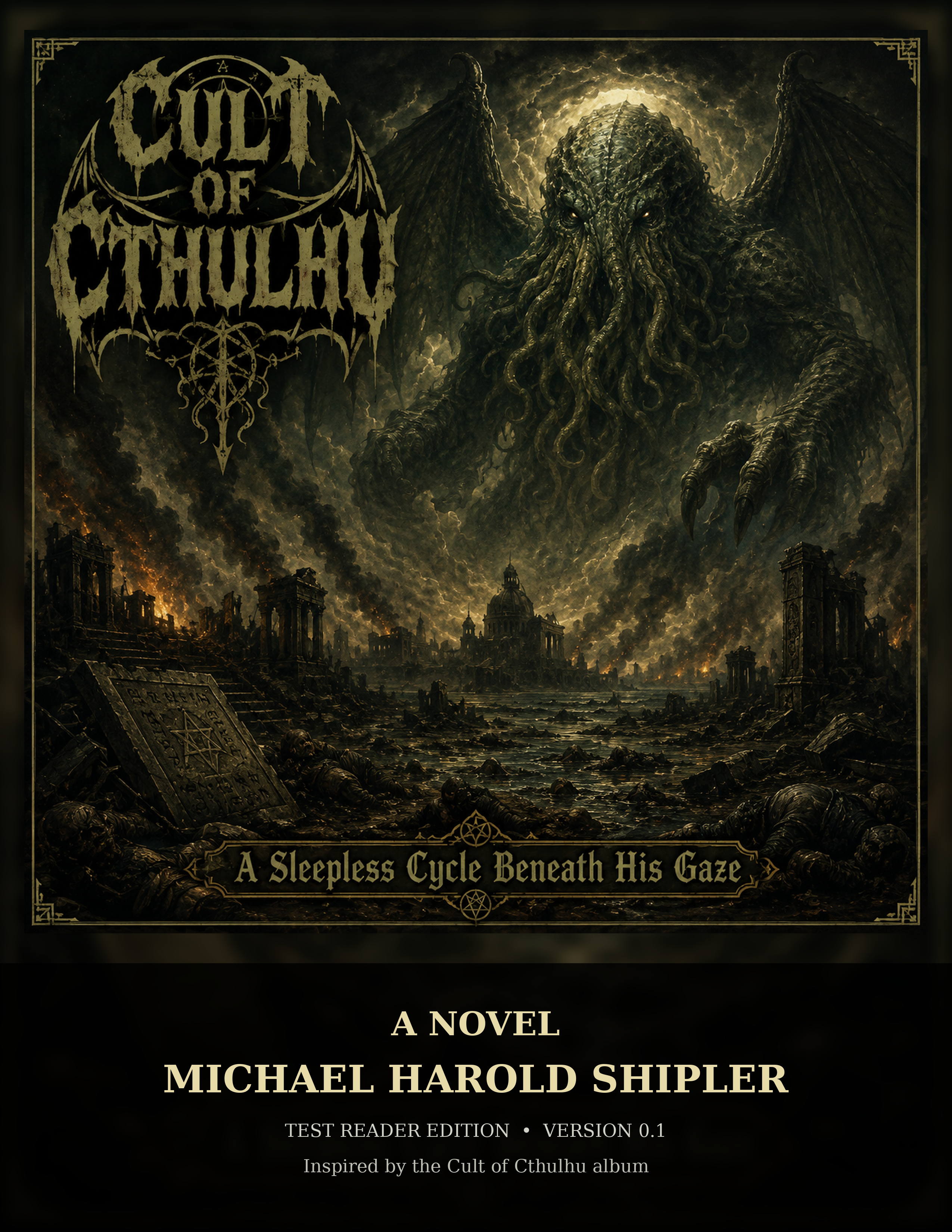
A Sleepless Cycle
Beneath His Gaze
A Novel
Michael Harold Shipler
Test Reader Edition • Version 0.1 • July 18, 2026
Test Reader Edition
This is a prerelease manuscript prepared for private test reading. It is not the final frozen master and may change after reader feedback.
Copyright © 2026 Michael Harold Shipler. All rights reserved.
This is a work of fiction. Original human characters, organizations, events, and settings are fictional. Lovecraftian names and concepts are used as literary inspiration within an original story.
Please do not distribute, reproduce, upload, or publicly post this test edition without the author’s permission.
PART I
THE BEGINNING OF...
CHAPTER 1
Static Before Dawn
The first time my dead daughter spoke through Municipal Channel Nine, I blamed a corroded ground strap.
That was the kind of man I was before the end. Give me a voice where no voice belonged and I would look for loose copper. Show me a miracle and I would ask who had bypassed the breaker. There was comfort in believing every impossible thing had been installed badly by somebody in a hurry.
It was 3:17 in the morning, according to the red digits above Console Three. The date on the incident board was July 14, 2049, though dates had become less useful than outage cycles and water deliveries. The annex had been running on backup power for six hours, which was no longer an emergency so much as an operating condition.
The facility had been designed when emergency meant an event with a beginning and an end. Fire. Flood. Attack. It had not been designed for the Long Decline, when each repaired system returned weaker and each temporary measure became permanent. We kept analog consoles beside digital ones because neither could be trusted alone. We scavenged relays from casino demolitions, batteries from buses, and copper from buildings the county had abandoned. The public believed the network still existed as one coherent thing. In reality, it was Daniel Vale, Mara Ortiz, three rotating dispatchers, and a cabinet of parts no manufacturer admitted making. Half the ceiling lights were out to preserve the batteries. The ones still burning hummed with the gray, insect sound of cheap drivers. Beyond the reinforced glass, the dispatch room was empty except for Mara Ortiz, asleep upright in a chair with her arms folded over her vest.
I envied her for almost three seconds.
Then the speaker cracked.
Not the usual burst of desert static. Not atmospheric skip or a mic keyed under somebody's seat. This was a single dry pop, followed by the low, rhythmic wash of an open carrier. I leaned over the console and checked the indicator.
Channel Nine had been decommissioned eleven years earlier.
The old municipal frequency still existed in our programming because nobody had authorized the money to remove anything. The repeater itself had been taken off Black Mesa after the solar farm bought the ridge. The antenna had been cut up for scrap. The feed line ended in an equipment cabinet that housed mice and one laminated warning sign nobody had bothered to remove.
The carrier strengthened.
I reached for the gain knob.
“Dad?”
I stopped with two fingers against the plastic.
The voice was quiet, breathless, and close enough that for an instant I thought Leah stood behind me.
Mara woke when my chair struck the equipment rack.
“What happened?”
I held up one hand. The speaker whispered with static.
“Daniel?” Mara said.
I pressed the playback key. The buffer had captured the previous thirty seconds. The console gave me a low hiss, the pop, the carrier.
Then: “Dad?”
Mara came through the door so quickly she left her radio on the desk. Her hair was flattened on one side and there was a crease across her cheek from the edge of her sleeve. She looked at the display, then at me.
“Play it again.”
I did.
She listened with her face closed. That was how Mara handled shock. She put every feeling behind a door and dealt with what was physically in the room.
“What frequency?” she asked.
“Nine.”
“That's dead.”
“Yes.”
“Local bleed?”
“No source to bleed from.”
“Somebody patched an old recording into the system.”
I wanted that answer badly enough to resent her for saying it first.
The speaker clicked again.
“Dad, don't wait for them.”
My hand closed around the console edge.
Leah had said those words two years earlier in a voicemail I had never played for anyone.
The evacuation north had already failed by then, though none of the official channels admitted it. Smoke from the California fires had mixed with dust over the Valley. Water deliveries were three days behind. State police had closed the interstate because too many cars had stalled on the grade. Leah had called from a grocery distribution center near Mesquite, frightened and angry.
Don't wait for them, Dad. Just go. Please.
I had told her to stay where she was until I could verify a safe route.
I verified for four hours.
By then the distribution center was empty, its cameras dead, the road blocked by abandoned trucks. No body was found. No confirmed survivor remembered seeing her leave.
I kept the voicemail on an offline phone in the locked drawer beneath my workbench. It had never touched the annex network.
Mara knew the outline of Leah's disappearance. She did not know the words.
“What did she mean?” she asked.
“It's not her.”
“I didn't ask who it was.”
The carrier dropped. Channel Nine went silent.
I opened the diagnostics panel. The console showed no incoming source, no signal strength, no repeater identification. The recording existed in the buffer without an associated transmission event.
That was impossible in six separate ways.
I started checking them one at a time.
Mara stood beside me while I traced the audio path. She did not tell me to stop. She knew better. I checked the local network, the patch matrix, the voice logger, the maintenance port, and the remote access history. Nothing. I pulled the console faceplate and inspected the board as though Leah's voice might be hiding among the dust.
At 3:41, the annex lights dimmed.
A tone sounded from the battery room.
“Generator transfer failed,” Mara said.
“I heard it.”
The building had two diesel units, both older than Jonah Price. Unit One had lost a coolant pump the week before. Unit Two had been carrying the annex through the latest grid outage with a vibration in the rear bearing that procurement classified as noncritical because replacement parts were no longer manufactured domestically.
The vibration had become a hammering knock.
I grabbed my tool bag and went outside.
The air was already warm. July in the Valley used to mean heat that settled over you by noon. By 2049 it meant the pavement never fully cooled. The eastern sky carried a dirty orange band from fires in Arizona and whatever was burning beyond them. The annex yard smelled of diesel, hot concrete, and creosote.
Unit Two shuddered inside its enclosure. I killed the load, opened the panel, and found the coupling half-sheared. The failure had been coming for months. I had written three reports and one request in language rude enough to be remembered. None of it had produced a part.
Mara held a flashlight while I fitted a salvaged coupling from a pump assembly that had almost the same diameter.
“How long have you been awake?” she asked.
“Since yesterday.”
“That isn't an answer.”
“Thirty hours.”
She moved the light into my eyes.
I turned my head. “Quit.”
“You said twenty-six at midnight.”
“Then why ask?”
“Because if you lie differently each time, I know where you are.”
I tightened the set screw until my fingers trembled. I blamed the angle.
Nobody had been sleeping well. The clinics called it a heat response, then a stress response, then an emerging disorder. Emergency departments filled with people who had gone four or five nights without more than a few minutes at a time. Sleep medication became more valuable than fuel. There were raids on pharmacies and break-ins at veterinary hospitals. The public health notices advised dark rooms, reduced screen use, hydration, and breathing exercises, as if the entire Southwest had simply forgotten how bedtime worked.
I had slept badly since I was a boy. It had never seemed important enough to call an illness.
My father handled the nightmares by refusing to discuss them. If I woke screaming, he checked the locks, gave me water, and told me the house was solid. Once, when I described stairs descending beneath an ocean, he slapped me hard enough to split my lip. He apologized the next morning and said fear made people stupid. Years later, I found the same angular eye scratched into the underside of his workbench. He had carved over it until the wood splintered.
After he died, I cleaned out the garage and found nine iron washers fused into a ring beneath the concrete floor coating. I assumed they had fallen into wet sealant. That was the kind of explanation I collected: plausible, physical, and late. I woke with salt in my mouth and the sense of deep water pressing against the ceiling. Sometimes I dreamed of stone buildings beneath a green-black sea. Sometimes I heard something enormous turning in the dark.
As I got older, I learned the usual treatments: work until my hands ached, leave the television on, drink enough to knock the dreams flat. After Leah disappeared, even the alcohol stopped helping. I quit when I began hearing her in the instant before sleep.
The generator caught on the third attempt.
Power returned to the annex with a series of hard clicks. The exterior lights came on. Mara looked past me toward the roof cameras.
“Daniel.”
There was a particular way she said my name when something needed to be seen before it could be explained.
We went inside.
Every exterior monitor displayed the same image. The parking yard. The fence. The dark outline of Frenchman Mountain to the east. Above it, the moon.
A black line divided the lunar disk from top to bottom.
“Camera artifact,” I said.
“On six cameras?”
“Same video processor.”
I switched sources to the state traffic feed. The highway camera showed empty lanes, windblown trash, and the moon split cleanly in two.
Mara opened a public weather stream. The picture came from Reno. Same black line.
Then Denver.
Then Calgary.
The line was not on the moon in the way a crack is on glass. It was too dark for shadow and too straight for anything natural. When I looked through the west window, the real moon appeared whole.
My relief lasted until Mara handed me binoculars.
Through the lenses, the line was there.
It widened while I watched.
Not by much. The width of a hair, perhaps. Enough that a pale glimmer appeared inside it, not white or blue but a color I had no useful name for. The sight made the pressure behind my eyes intensify.
Across the dispatch room, Console Three keyed itself.
The carrier returned without power to Channel Nine's transmitter path.
This time the voice was not Leah's.
It was mine.
“Can't you see the signs?” it asked.
All six exterior cameras turned toward the moon.
They were fixed cameras.
None of them had motors.
CHAPTER 2
Bombs for Light
By sunrise, the city had decided the moon was fake.
That was easier than admitting it had changed.
The official statement blamed a coordinated intrusion into camera networks and augmented displays. That explanation survived for forty-three minutes, until people began posting photographs taken on film. The next statement described an upper-atmospheric optical effect. A university astronomer went on a battery-powered news channel and said the line could not be an eclipse, a surface feature, a lensing event, or anything caused by known orbital mechanics. The interview cut to a detergent advertisement halfway through his sentence.
At 6:12, somebody bombed the North Intake pumping station.
We felt the concussion through the annex floor.
Mara was at the dispatch console, talking a field crew away from a crowd near a dry distribution tank. She flinched but did not stop speaking.
“West on Owens,” she told them. “Do not take the underpass. Flood-control gates are locked open. Repeat back.”
The crew repeated.
A second concussion followed, farther away. The lights flickered. Our map wall updated with three red failures and then froze.
“Those aren't air strikes,” I said.
“No,” Mara answered. “People are doing it themselves.”
The municipal network filled with overlapping calls: gunfire at a ration depot, a transformer fire near Sunrise Manor, a bus overturned on Charleston, a woman standing naked in the middle of Interstate 15 and screaming at the moon.
Mara moved between channels with the efficiency of a pianist playing a piece she hated. She told a father how to cool a fever without power. She ordered a patrol away from a crowd whose members had stopped responding to pain. She stayed on the line with a dispatcher in Henderson while the dispatcher's coworkers fell asleep one by one and began walking into the server room.
“Lock the door,” Mara said.
“They have keys.”
“Barricade it.”
“They are saying my name.”
“Do not answer them.”
The caller whispered, “My mother is with them.”
Then the channel filled with the sound of many hands touching glass. Every third caller mentioned not sleeping. Every fifth insisted somebody was whispering from an unplugged radio or a dead phone.
I worked the equipment failures while Mara worked the people.
That had been our division for years. Machines failed honestly. A burned regulator did not insist it was fine. A ruptured fuel line did not blame the technician. People could watch a system collapse in front of them and argue over whether the warning light was politically motivated.
At 7:30, Jonah Price arrived on an electric dirt bike with three battery packs strapped behind the seat and a drone case across his back.
He was nineteen, narrow as antenna mast, with brown curls he had hacked short on one side and forgotten on the other. His mother had worked dispatch before the county stopped funding night shifts. Jonah had been hanging around radio rooms since he was tall enough to steal zip ties.
He entered through the service door without knocking.
“Tell me you recorded it,” he said.
Mara pointed at him without looking away from her console. “Tell me you did not cross the east channel.”
“I crossed the east channel.”
“It is under evacuation.”
“That's why there was no traffic.”
“Jonah.”
“I recorded it.” He set the drone case on my bench and opened it. Inside were a spectrum analyzer, a cracked tablet, two handheld radios, and enough improvised wiring to violate every electrical code ever written. “Channel Nine. Also aviation guard, old weather, amateur two-meter, and an irrigation controller frequency that should not carry audio at all.”
He looked at me and lost some of his speed.
“You heard a voice,” he said.
I kept my attention on the analyzer. “What did you hear?”
“My brother.”
Mara turned.
Jonah's younger brother, Eli, had disappeared during the same evacuation season as Leah. Different road, different week. His father believed he had joined a convoy south. His mother believed he had died in a drainage tunnel. Jonah believed every unverified signal because the alternative was a grave without a body.
“What did he say?” Mara asked.
Jonah swallowed. “He told me where he hid my birthday present when I was twelve.”
“Who else knew?”
“Nobody. I didn't know. I checked this morning.”
He pulled a dented metal box from his pack. Inside was a plastic model rocket, yellowed with age.
The annex speaker popped.
All three of us stared at it.
Only static came through.
Jonah connected his analyzer to the console. The waveform from Channel Nine showed a carrier without a frequency. That is not a poetic description. Frequency is what a carrier is. But the analyzer displayed energy across every band at once and nowhere measurable. When he narrowed the window, the signal narrowed with it. When he shifted ranges, it followed.
“Like it's coming through the idea of radio,” Jonah said.
Mara gave him a look.
He raised both hands. “I know how that sounds.”
I loaded my recording of Leah's voice beside the old voicemail from my offline phone. Mara watched but did not comment when I unlocked the drawer.
The two waveforms matched almost perfectly.
Almost.
The impossible transmission had the right pitch, timing, and room tone. It had copied a faint refrigerator compressor from Leah's apartment and the traffic hum beyond her window. But when I isolated the breath before the word Dad, there was no inhalation. The voice began as if the air had already been waiting inside a throat.
Mara heard it too.
“It's made from the recording,” she said.
“Then somebody accessed the phone.”
“Daniel.”
“Physical access. A clone. Malware before I took it offline.”
“Two years ago, somebody prepared a fake message to play today on a frequency that doesn't exist?”
“I didn't say it was likely.”
“You said you wanted an answer that has parts.”
Outside, sirens rose and stopped. The citywide alert system attempted to activate, produced a descending tone, and began broadcasting a child's laughter.
Mara shut it off at the console.
The laughter continued from the ceiling speakers.
Jonah pulled the amplifier fuse.
The laughter continued from his handheld radio.
He threw it against the concrete wall. The case broke. The speaker kept laughing until Mara crushed it under her boot.
At 9:03, the main grid failed across the Valley.
The towers on the Strip went black one by one, visible through smoke as blank vertical cuts in the morning. Solar reserves should have held hospitals, pumps, and emergency services for several hours. Instead, inverters tripped as though daylight itself had become unstable. Our generator took the load, coughed, and settled into a rough rhythm.
The temperature in the dispatch room began climbing.
We moved operations to the roof because the antenna feeds were easier to isolate there and because all three of us needed to see the moon with our own eyes.
The sky had turned the color of old brass. Smoke veiled the sun. The moon remained visible in the west, pale and divided, though it should have faded into daylight.
Through the binoculars, the line was wider.
Inside it, stars moved.
Not points of light. Shapes. Slow configurations folding around one another in a depth that could not exist inside the moon.
I lowered the binoculars and found Jonah watching me.
“You saw it,” he said.
“No.”
“You did.”
“I saw an optical effect.”
“What effect?”
“I don't know yet.”
He laughed once without humor. “That's what everybody says right before they decide the people who saw it are the problem.”
Mara stood at the parapet with her radio pressed to her ear. “Quiet.”
From far south came a growing roar.
Three aircraft crossed the smoke, low and fast, military silhouettes without visible markings. They banked toward the Strip. For a hopeful moment I assumed they were carrying emergency supplies.
Then the first bomb struck the old airport.
The flash washed the city white.
The second hit somewhere near the convention district. The third disappeared behind a hotel tower and lifted a black column of debris above the rooftops.
Every radio channel erupted.
The aircraft were not ours, according to the remaining military dispatcher. Then they were ours, according to another voice. Then no aircraft had been launched, according to a third. A clipped digital announcement instructed residents to shelter from an attack. A second announcement ordered immediate evacuation. A third advised citizens to look directly at the moon and remain calm.
Mara ripped the rooftop speaker cable from its junction box.
Below us, the city was dark enough that the explosions became its only sunrise.
Bombs were our only source of light.
The phrase entered my mind with the certainty of a remembered lyric, though I could not remember hearing it before.
On the streets, people stopped running.
They turned west together.
Hundreds of them, then thousands, visible in intersections and on rooftops and between stalled vehicles. They faced the divided moon. Some raised their arms. Others knelt.
A woman on a neighboring building climbed onto a parapet and spread her hands as though waiting to be received. Mara shouted, but the distance swallowed her voice.
The woman stepped forward.
She fell without moving her arms.
Jonah made a sound in his throat.
My field radio keyed against my belt.
Leah whispered, “You waited too long.”
I tore the battery free.
The display remained lit.
Numbers crawled across it in groups of two and three.
At first I took them for corrupted channel data. Then I recognized a coordinate format.
Black Mesa.
Mara read over my shoulder.
“No,” she said.
“We need to see what's transmitting.”
“There is no transmitter.”
“Then we need to see what is there.”
“We have a city coming apart.”
“And something is doing it through our network.”
“You don't know that.”
“No. I know my daughter's voice came through a dead channel and gave me a location.”
Mara's face hardened. “That is exactly why you are not going.”
The radio screen changed.
A second set of coordinates appeared beneath the first.
Jonah looked at them and went still.
“What?” I asked.
He turned the screen toward us.
The numbers pointed to the shuttered university library where Dr. Ruth Halden had once maintained the prohibited archive.
Jonah said, “My brother told me the same place.”
Far below, the people facing the moon began to scream.
Not one after another.
Together.
CHAPTER 3
The Last Normal Morning
There are moments that become borders only after you cross them.
At the time, leaving the annex felt like a bad operational decision. Later I would understand it as the last ordinary choice I made. Everything before it belonged to a world where roads connected known places and a locked door meant there was something on the other side rather than another condition of reality.
Mara refused to go for twenty-two minutes.
She coordinated the remaining dispatchers, transferred priority channels to a mobile unit north of the Valley, and argued with a deputy administrator who had not entered an emergency facility in six years. I loaded tools, batteries, water, trauma supplies, and the portable direction-finding array into a municipal truck.
Jonah stood between us and pretended not to listen.
“You are not fit to drive,” Mara said.
“I can drive.”
“You can barely thread a connector.”
“The connector is cross-threaded because procurement bought counterfeit fittings.”
“You've been awake at least two days.”
“Thirty-eight hours.”
“Forty-six.”
I looked at the wall clock.
It read 10:14.
My watch read 9:52.
The console clock read 11:03.
Jonah checked his phone. “Mine says 7:19.”
For eleven seconds, every clock in the annex stopped.
The generator continued running. The cooling fan turned. Dust moved through the beam of a flashlight. But the second hand on Mara's analog watch held motionless between marks.
In that absence of counted time, something breathed through the building.
The sound came from the ducts, walls, speaker grilles, disconnected handsets, and the hollow steel legs of the desks. One breath entering through a thousand openings.
Then a voice said, “Daniel Vale.”
Not Leah. Not mine.
The words were pronounced carefully, with the attention of someone trying a human name for the first time.
The clocks resumed.
Mara took the truck keys from my hand.
“I drive,” she said.
That was her concession.
We left the annex at 10:31 by the console, 8:02 by Jonah's phone, and no reliable time by the sky.
The main roads were blocked with stalled vehicles, so Mara drove flood-control access routes and utility lanes. The municipal truck still carried seals that opened some gates. Others had been cut away or welded shut by neighborhoods defending water tanks.
The Valley looked less like a city after a disaster than a city that had finally admitted what it had become.
Storefronts were boarded from previous riots. Apartment towers showed black windows where cooling systems had failed years earlier. Makeshift shade cloth stretched between freeway columns. Smoke from new fires mixed with old dust and turned the distance brown. Every few blocks we passed people carrying containers toward taps that no longer worked.
Some watched us.
Some watched the moon.
A man in a business suit stood in the center of Sahara Avenue holding a dead pigeon against his ear like a telephone. He smiled as we passed.
“Don't look back,” Mara said.
“I wasn't going to.”
“You were.”
The radio remained off. We wrapped it in a signal-shielding bag and placed it inside a steel tool box. Leah's voice still came faintly from the truck's door speakers whenever we stopped.
Jonah sat behind us with the direction-finding equipment on his knees.
“The signal isn't stronger toward Black Mesa,” he said. “It isn't weaker either.”
“Then the coordinates may not be a source,” Mara said.
“Could be a meeting point.”
“For whom?”
Jonah did not answer.
We reached the university from the service side after crossing three unofficial borders. A neighborhood militia searched the truck for water and let us pass only because Mara recognized their leader from an old dispatch call. At a clinic checkpoint, exhausted volunteers sprayed our tires with bleach and asked whether any of us had dreamed of submerged towers. Mara lied for all three of us.
Near the campus, hundreds of birds lay dead along the road, arranged in circles around streetlights. None showed injury. Jonah collected one feather, then threw it away when it began vibrating in time with the signal.
The main campus had closed seven years earlier after the state consolidated higher education into remote instruction and sold most physical properties. The library's upper floors had been stripped of copper. Sand covered the entry plaza. A faded banner still promised KNOWLEDGE FOR THE NEXT CENTURY.
Someone had painted beneath it:
THERE ISN'T ONE.
The loading door stood open.
Mara drew the compact pistol she carried for field work. I took a pry bar from the truck. Jonah launched a palm-sized drone through the doorway.
Its camera feed showed stacks, fallen ceiling panels, mold-dark carpet, and a trail of wet footprints.
It had not rained in the Valley for eighty-three days.
The footprints led toward the lower archive stair.
“Human?” Mara asked.
“Bare feet,” Jonah said. “Maybe.”
The drone descended.
At the bottom landing, its video filled with static. A shape crossed the frame—too tall, too thin, jointed wrong—and the feed ended.
Jonah's controller displayed RETURNING HOME.
The drone did not return.
“Truck,” Mara said. “Now.”
From inside the library, a woman called, “Mr. Vale?”
The voice was old, irritated, and entirely human.
Dr. Ruth Halden appeared at the loading door carrying an oil lamp.
She was small and upright, with white hair cut close to her skull and a respirator hanging at her throat. I recognized her from archived lectures and one disciplinary hearing broadcast years ago. She had been accused of retaining restricted religious materials after the university ordered them digitized and destroyed.
She looked at the pry bar in my hand.
“If that is your entire preparation,” she said, “you are more disappointing than I expected.”
Mara kept the pistol low. “How do you know his name?”
“Because the transmitters have been speaking it for three nights.”
Jonah stepped forward. “Did they say Eli Price?”
Halden's expression changed by less than an inch.
“They say whatever opens the listener fastest.”
“Is he alive?”
“I did not say the voices were false. I said their purpose was opening.”
She turned and walked back inside as if our decision to follow did not require discussion.
Mara caught my arm.
“This is wrong.”
“Yes.”
“You still want to go in.”
“Yes.”
“Because of Leah.”
“Because this started before the signal and she may be part of it.”
“That's not the same thing.”
“No.”
“What happens when you hear what you want?”
I looked into the dark loading bay.
“I verify it.”
Mara's grip tightened. “That answer is why I have to come with you.”
The archive stair smelled of wet paper and cold stone. Halden's lamp cast more shadow than light. We passed rows of shelves draped in plastic, boxes marked with obsolete hazard codes, cabinets of microfilm, sealed display cases, and a wall of magnetic tapes furred with mold.
The deeper we went, the cooler the air became.
Jonah checked his phone. “No service.”
“There has never been service down here,” Halden said.
His screen lit with an incoming call.
ELI PRICE.
Jonah nearly dropped it.
Mara took the phone and declined the call.
It rang again.
This time the name read LEAH VALE.
Mara powered the phone off.
The screen remained lit.
A third call appeared.
DANIEL VALE.
The phone was calling itself.
Halden opened a steel door and motioned us through. “Leave every device outside.”
I kept my field radio.
She noticed.
“That is how it has trained you,” she said.
“It's equipment.”
“It is a mouth.”
“I need the recordings.”
“You need your grief to have a technical interface.”
I disliked her immediately because she spoke as if she had been present for every mistake I had made.
The room beyond the door had no shelves. A single table stood beneath a hanging lamp powered by a cable that vanished through the stone wall.
Around the perimeter sat objects in sealed cases: a bronze cylinder covered in tiny spiral writing, a child's slate containing the same equation repeated until the chalk cut grooves, a wax recording labeled INNSMOUTH HARBOR - DO NOT PLAY, and nine black stones shaped like teeth. Halden had cataloged each item with precise dates and uncertain origins.
“Every generation believes it discovered the forbidden thing,” she said when she saw us looking. “Usually it has only found the latest container.”
One case was empty. Its label read WATCHER CHARM - REMOVED FOR ACTIVE USE.
I looked at the pendant in Halden's hand. On the table lay a bundle wrapped in black cloth.
The cloth was wet.
Halden did not touch it.
“The title you know is not its title,” she said. “Necronomicon is a useful error. The surviving texts are copies of copies, translations interrupted by frightened men, fragments carried out of fires by people who later burned themselves. This one came west in 1931 with a surveyor who claimed he had found a door under the desert.”
Mara said, “What does it have to do with the broadcasts?”
“It describes a condition in which dreams stop belonging to individuals.”
She pulled the cloth aside with a pair of brass tongs.
The book was not a book in any uniform sense. Some leaves were paper. Others looked like thin hide, bark, or material pressed from gray fibers. The stitching changed every few pages. The text moved between Arabic, Latin, Greek, and signs that seemed to pull away when I tried to focus on them.
One diagram did not move.
An angular eye enclosed within a broken circle.
I had drawn it all my life.
On school desks. In dust. In the margins of maintenance reports. I had never known why.
Halden watched recognition cross my face.
“The Sign of the Watcher,” she said.
A sound came from behind the far wall.
Three slow knocks.
Then Leah's voice, clear and terrified:
“Dad, please. It knows you're here.”
The wall had no door.
When I stepped toward it, the black-wrapped pages turned by themselves.
They stopped on a ritual diagram centered on the Watcher's Sign.
Beneath it, in handwriting that looked exactly like mine, were the coordinates to a chamber under our feet.
SIGNAL FRAGMENT 01 - PUBLIC SLEEP ADVISORY
The following messages were transmitted within the same forty-minute period:
NATIONAL PUBLIC HEALTH SERVICE: Citizens experiencing prolonged insomnia should avoid driving, hydrate regularly, reduce exposure to distressing media, and seek supervised medical sleep when available.
WESTERN EMERGENCY NETWORK: Do not enter medically induced sleep. Sedated patients have exhibited violent parasomnia and shared vocalization.
VALLEY CIVIC AUTHORITY: Rumors concerning dream transmission are false. Report unauthorized symbols, gatherings, or ritual activity to local enforcement.
UNKNOWN SOURCE: Your eyelids are not walls.
NATIONAL PUBLIC HEALTH SERVICE: Previous advisory withdrawn. Remain awake until further notice.
UNKNOWN SOURCE, USING DANIEL VALE'S VOICE: The first door opens inward.
The final message contained a background sound later identified as rain. No rain was recorded at any authorized transmitter site.
PART II
GATES OF HELL
CHAPTER 4
The Halden Archive
The chamber beneath the archive did not appear on any campus drawing.
That did not surprise me. By then I had spent twenty-six years working inside buildings whose official plans described rooms that had never existed and ignored rooms large enough to park trucks in. Institutions lose track of their own bodies long before they die.
What bothered me was the stair.
It began behind the stone wall after Halden pressed the Watcher's Sign with two fingers. There was no mechanical sound, no sliding panel, no seam widening under pressure. One moment the wall was continuous. The next, a narrow opening descended into darkness.
I examined the edges with my flashlight.
“What mechanism?” I asked.
Halden folded the wet cloth back over the manuscript. “You are still using that word as a prayer.”
“There has to be a cavity, track, hinge, counterweight—”
“There has to be nothing you understand.”
Mara stood between us. “Enough. What is down there?”
“A threshold.”
“To where?”
Halden looked toward the open stair. “That depends on which side has begun moving.”
Jonah had gone pale. His dead phone was still on, displaying a call duration of seventeen minutes though nobody had answered. He held it away from his body.
“Eli is breathing,” he said.
Mara reached for the phone.
Jonah pulled back. “Listen.”
The speaker gave us a faint, uneven respiration. A child trying not to cry.
“Eli?” Jonah whispered.
The breathing stopped.
A man spoke in Jonah's own voice.
“Come down.”
Jonah threw the phone against the floor. This time it broke into enough pieces to stay broken.
Halden took a canvas satchel from beneath the table. Inside were wax pencils, a coil of red cord, small glass bottles, a brass bowl, iron nails, a packet of salt, and a black pendant on a leather thong.
The pendant looked like volcanic glass, although its surface absorbed the lamp's reflection. The Watcher's Sign had been cut into it so deeply that the grooves seemed to continue through the stone.
Mara said, “You keep a ritual kit under the table.”
“I kept a fire extinguisher beside the archive as well. Neither means I wished to use it.”
“You knew this could happen.”
“I knew it had happened before.”
Halden lifted the pendant. Her hand trembled once, then stopped.
“In 1986, four of us believed we had translated enough of the passage to seal a dream breach. We were young scholars, which is another way of saying we believed danger became respectable if footnoted. We completed only the first sequence before one of us broke the boundary.”
“What happened?” I asked.
“Two died. One has been confined ever since. I stopped sleeping without medication.”
“Where?”
“Not here. The chamber does not remain attached to one place.”
Mara looked at the open stair. “Then close it.”
“I cannot.”
“Undo whatever you did.”
“I did nothing. Mr. Vale recognized the sign.”
All three of them looked at me.
I thought of the hundreds of times I had drawn that angular eye without intention. On notebook covers. Work orders. Condensation on windows. Once, as a child, in blood from a split thumb across the bathroom tile.
“I didn't open anything,” I said.
Halden held out the pendant. “Not consciously.”
I did not take it.
From below came the sound of iron moving against stone.
The room temperature dropped. The hanging lamp dimmed until its filament glowed orange.
Leah called again from beneath the floor.
“Dad.”
This time her voice broke on the word exactly as it had the night she disappeared.
Mara stepped in front of me.
“Play the real recording,” she said.
“What?”
“Your voicemail. Now.”
I retrieved the offline phone from my pack. The battery had been removed during the drive. I installed it, waited for the device to start, and opened the saved message.
Leah's real voice filled the stone room.
“Don't wait for them, Dad. Just go. Please. The buses aren't coming back and people are leaving on foot. I know you want to check, but there isn't time to make it certain. I love you. I'm sorry. I love you.”
The voice below repeated the message with perfect words.
But it did not breathe.
It did not hesitate before the second I love you. It did not rush the word certain because Leah always tripped over it when frightened. It reproduced sound without reproducing the person who had made it.
Mara watched me understand.
“It's bait,” she said.
“Or an echo.”
“Daniel.”
“An echo can come from something alive.”
Halden said, “It can also come from an empty room.”
I shut off the phone.
The copied voice below continued.
“I love you. I'm sorry. I love you.”
Each repetition lost more emotion until the words became a pronunciation exercise.
Halden placed the pendant in my hand.
It was warm.
“What does the ritual do?” I asked.
“The margin notes describe two sequences. One invites recognition. The other interrupts passage.”
“Which is which?” Mara asked.
“The pages are damaged.”
“Then we do neither.”
Halden pointed to the ceiling.
The archive speakers, disconnected for years, had begun murmuring. Hundreds of voices overlapped in different languages. Some prayed. Some laughed. Some recited strings of numbers. Beneath them all, the same low chant repeated in a rhythm I felt through my teeth.
“Passage has already begun,” Halden said. “The question is whether we leave it uncontrolled.”
I opened the manuscript to the ritual diagram.
The handwriting that resembled mine had changed. The coordinates were gone. In their place were four words:
YOU HAVE DONE THIS BEFORE.
I touched the letters.
The memory came without warning.
I was eight years old, standing barefoot in my father's garage. Night pressed against the windows. On the concrete floor I had arranged nine iron washers around a bowl of water. I was speaking sounds I did not understand while something knocked beneath the slab.
My father found me before I finished. He struck the bowl from my hands and dragged me outside. For years afterward he insisted it had been a nightmare.
My father had been dead for twenty-one years.
I had not remembered the garage until the page gave it back.
I withdrew my hand.
“What did you see?” Halden asked.
“Nothing.”
Mara said, “He saw something.”
The stone stair waited.
I wanted to leave. That fact matters. I was not dragged downward by irresistible magic. I was not possessed. I understood enough to be afraid, and I still believed fear could be separated from evidence.
If the signal was using my memories, I needed to know how it had reached them. If the ritual could interrupt it, every minute we delayed meant more voices coming through dead systems. If Leah was alive somewhere inside the phenomenon—however unlikely—I could not walk away from the only path that had ever answered.
Those were my reasons.
Nyarlathotep would later show me how reasons become handles.
Mara fastened the holster at her hip. “I go first.”
“No,” Halden said. “The recognized one enters the sign first.”
Mara looked at me. “You are not doing this alone.”
Jonah picked up his equipment case.
“You stay here,” I told him.
He laughed too loudly. “Absolutely not.”
“This isn't a repeater site.”
“My brother's voice is down there.”
“And that's why you stay.”
“That's why you don't get to tell me to.”
Mara said, “We are wasting time.”
Halden lit a second lamp.
We descended.
The stair turned more times than the depth allowed. I counted one hundred twelve steps before we passed beneath the basement floor. At two hundred, the air smelled of salt water. At three hundred, I looked upward and could no longer see the opening, though the stair had never curved enough to hide it.
The walls changed from poured concrete to dressed stone, then to a dark mineral surface scored with parallel marks. Some were shallow as scratches. Others were deep enough to fit my hand inside.
Jonah whispered, “Tool marks?”
“No,” Halden said.
“How can you know?”
“Tools repeat the dimensions of the hand that uses them.”
The marks were six feet long.
At the bottom stood an iron door.
It was taller than the stairwell and narrower than a human shoulder. Its proportions hurt to look at. The Watcher's Sign had been hammered into its center.
Leah's voice came through the iron.
This time it whispered a name I had never told Mara or Jonah.
Danny-boy.
My father had called me that when he was drunk and afraid.
I raised the charm.
The sign on the door opened like an eye.
CHAPTER 5
Sign of the Watcher
The chamber beyond the iron door was circular and dry.
That dryness frightened me more than the voices. We had descended through wet air and salt smell, yet the black floor held dust fine as ash. Our footprints appeared behind us before our boots touched down.
A shallow basin occupied the center. Nine iron channels radiated from it to the walls. At the end of each channel stood a narrow recess shaped for a body far taller and thinner than ours.
The ceiling could not be seen. Our lamps illuminated a column of darkness that seemed to continue upward without limit.
Halden remained at the threshold.
“Do not enter until the boundary is marked,” she said.
Mara swept her light around the chamber. “And if something is already inside?”
“It is.”
Jonah backed into me.
One of the recesses had changed. A darkness separated itself from the surrounding dark, not by becoming lighter but by acquiring edges. It unfolded from the wall in a sequence of wrong joints.
I saw an iron mask with no eye holes.
Then a vertical mouth.
Then nothing shaped like a face at all, only the sensation that attention had turned toward us.
The Watcher.
My knees weakened. The charm in my hand burned.
Halden drove an iron nail into the dust at the threshold. She tied red cord around it and began walking the perimeter.
She made us repeat the rules while she worked. Do not step across the cord after the first word. Do not answer any voice outside the circle. Do not look into the basin after the water appears. If one participant speaks a name not written in the text, the others must stop that person physically. If the Watcher presents a familiar face, treat recognition as evidence of intrusion rather than identity.
Jonah asked what to do if Halden herself gave an instruction that contradicted the rules.
“Obey the written sequence,” she said.
Mara pointed at the damaged columns. “The sequence you cannot read.”
Halden's mouth tightened. “Yes.”
That should have ended the attempt. Instead, urgency had already begun masquerading as necessity., setting eight more nails at measured points. Mara followed, pouring a line of salt just inside the cord. Jonah placed glass bottles at the channels under Halden's direction.
“What is in those?” he asked.
“Water taken from sleepers who woke speaking languages they never learned.”
“That's not an answer.”
“It is the only answer I have.”
The Watcher remained in the recess. Whenever I looked away, it seemed closer.
Halden opened the manuscript on the floor outside the cord. She weighted the corners with brass objects and turned to a page containing two columns of text.
“The left sequence marks the petitioner's recognition,” she said. “The right sequence commands closure.”
“You said you weren't certain,” Mara replied.
“I am certain of the functions. I am not certain which column is which.”
Jonah stared at her. “You brought us down here to guess?”
“The distinction was written in a lost color. Both surviving inks appear black.”
I crouched beside the page. The columns were nearly identical. A line in one curved inward at the bottom; the other curved outward. A margin note showed the Watcher's Sign drawn one way, then reversed.
“Can we test it?” I asked.
Halden gave me a look I had seen from engineers when a contractor proposed testing structural capacity by loading the finished roof until something moved.
“No.”
The chamber breathed.
The glass bottles vibrated against the floor.
From the recesses came nine voices. Leah. Eli. My father. A woman calling Mara's name. A child sobbing. Halden's own voice repeating a phrase in Arabic. Two voices I did not know. The ninth was not human enough to imitate one.
Mara's face changed at the voice calling her.
“Who is that?” I asked.
“Nobody.”
“You know it.”
“Do the work.”
Halden handed me the wax pencil. “Draw the sign in the basin.”
“Which direction?”
“The one you remember.”
“I don't remember learning it.”
“Memory is not the same as instruction.”
I stepped over the red cord.
The Watcher moved.
It did not cross the room. It occupied the space directly in front of me without passing through the distance between. The iron mask hung inches from my face.
Behind it, something vast leaned close.
My body reacted before thought. My bladder released. My stomach clenched. The muscles in my legs tried to fold. Every animal instruction in me demanded I run, hide, make myself small, stop being noticed.
The charm burned against my palm and held me upright.
No craven heart shall breach this awful place.
The sentence entered my mind in Halden's voice, though she had not spoken.
I understood the Guardian then—not what it was, but what it measured. Courage was the wrong word. It did not care whether I was noble. It required continuation under terror. A threshold could not use anyone who turned away from it.
I walked past the Watcher.
Its attention remained against my back.
At the central basin, I knelt and drew the angular eye from childhood. The wax left a dark red line on black stone. I completed the broken circle.
The chamber answered with a low metallic groan.
“Now the words,” Halden said.
“Which column?” Mara demanded.
Halden's lamp flickered. Her eyes moved between the texts.
“The right,” she said.
The field radio inside my pack keyed itself.
Leah whispered, “Left.”
I closed my eyes.
The lack of sleep had become a pressure behind every thought. My hands felt distant. Shapes remained after I stopped looking at them. I knew voices were being used against me. I knew the thing could imitate Leah.
But Halden had failed this ritual before.
Leah had always been better than me at deciding when certainty was impossible.
Don't wait for them. Just go.
I opened my eyes and looked at the page.
The left column appeared sharper. Not brighter. More complete, as if the damaged characters had restored themselves.
“Left,” I said.
Halden caught my sleeve. “No.”
“You hesitated.”
“Because I remember choosing left.”
“What happened in 1986?”
“We opened recognition.”
“Then right is closure.”
“Yes.”
The radio said, in my own voice, “She is lying.”
Halden heard it. Fear entered her face.
That decided me.
I chose the right column.
Even now, I cannot tell you whether the page changed, whether Nyarlathotep reversed my perception, or whether Halden's terror made truth look false. I can only tell you what I did.
I began to chant.
The words were not meant for a human mouth. Consonants struck the back of my throat. Vowels required breath to move in two directions at once. The first line made the iron channels ring. The second caused the glass bottles to fill with dark vapor.
Mara stood inside the cord at my left. Jonah at my right. Halden remained outside with one hand pressed to the manuscript.
At the third line, every voice stopped.
At the fourth, the basin deepened.
It did not physically lower. The black stone inside became a distance. Stars appeared beneath the wax sign, moving through liquid darkness.
At the fifth, the Watcher turned toward Halden.
She shook her head.
“No,” she whispered. “That is not closure.”
I stopped chanting.
The chamber screamed.
Not a creature. The stone itself. Every surface vibrated with a sound like metal torn underwater.
“Finish!” Halden shouted. “If you stop between names, it remains unbounded.”
“What am I opening?”
“Finish!”
The red cord snapped taut. Something pressed against it from every direction.
Jonah's nose began bleeding. He did not notice. He was staring into the basin.
“Eli,” he said.
Mara slapped him hard enough to turn his head. “Do not look down.”
I resumed the chant.
The words came more easily now. That was worse. My tongue remembered them. My body knew where each sound belonged.
The Watcher raised one jointed arm.
Halden stepped backward.
Her heel crossed the salt line.
The boundary opened at that point like cloth cut under tension.
Darkness struck her.
For one instant she stood stretched between two positions, one beside the manuscript and one inside the wall recess. Her mouth opened in both places. Then the two images folded together and she was gone.
Her lamp hit the floor.
The manuscript pages turned violently.
Mara lunged for them, but the Watcher moved between. She fired three times. Muzzle flashes lit an iron mask, a forest of limbs, the underside of an ocean, and Halden's face flattened across something that had no skin.
The bullets did not strike anything I could name.
The final line waited in my mouth.
I could feel it there, shaped like a key.
“Daniel, don't,” Mara said.
The basin showed Leah standing in a flooded street. She was older than when she vanished. Thin. Alive. Water moved around her waist.
She reached toward me.
“Dad.”
The chamber walls bowed inward.
I spoke the final name.
The Gate opened.
CHAPTER 6
Beyond the Door
There was no fire.
No horned demon rose from a pit. No Christian image survived the first second.
The basin became an opening larger than the chamber, though its rim remained three feet across. Through it I saw a city under black water. Towers leaned at angles that changed when I tried to understand them. Vast stairs climbed downward. Shapes moved between structures, some swimming, some walking along surfaces that were not horizontal.
Above the city, something slept.
I did not see its body. I saw the effect of its breathing on the sea.
Each exhalation moved buildings.
Each inhalation pulled stars downward.
The charm split in my hand.
A sound entered the chamber through every solid surface. Not a voice, yet my mind forced it into meaning:
FOUND.
Jonah fell to his knees.
Mara grabbed my collar and pulled me backward. The Watcher unfolded over us. Its mask opened along a seam that had not existed. Behind it was a vertical distance filled with moving lights.
“Cord!” Mara shouted.
I saw the broken red boundary and understood nothing except that it had to be restored. I crawled through dust, found the loose end, and wrapped it around the nearest iron nail.
The cord passed through my fingers like wet hair.
The Gate widened.
Water poured upward from the basin without wetting the floor. It rose in a clear black column full of pale shapes. One pressed a hand against the inside surface. It had too many fingers, each tipped with something like a closed eye.
Jonah spoke in a language I did not know.
Mara dragged him away from the basin.
I tied the cord.
The knot tightened itself.
For a moment the boundary held. The Watcher struck it and recoiled. The salt line flared white. The glass bottles shattered one after another, releasing screams in voices stolen from sleepers.
The manuscript lay open where Halden had vanished.
The two ritual columns were visible.
The heading above the right column had darkened enough to read in Latin.
AD APERIENDUM.
For opening.
The left column read AD VINCULUM.
For binding.
I had chosen the opening sequence.
Mara saw the words over my shoulder.
“You knew?” she asked.
“No.”
“The voice told you left.”
“It knew I wouldn't trust it.”
Her expression contained more terror than anger, which hurt worse.
The field radio began transmitting a citywide emergency tone.
Through the Gate, the submerged city answered.
A pulse moved across the water. The chamber lights died. In darkness I felt attention rise from below.
Not the Watcher's attention. Something deeper, slower, large enough that my entire life could not have occupied one complete thought within it.
The divided moon appeared inside my skull.
The black line opened.
I saw the stars behind it arrange themselves into a shape like a crown, or claws, or wings folded around a head. The pressure broke something in me. I heard myself scream, but the sound seemed to come from another room.
Then Leah took my hand.
Her fingers were cold and wet.
“Come on,” she said.
I knew it was not her.
I followed anyway.
We crossed the basin.
For a period I cannot measure, I walked through the drowned city.
The water did not resist my body. I did not need to breathe. Leah moved ahead of me in the yellow jacket she wore the day she disappeared. Her hair floated around her face. Every time I tried to catch her, the street lengthened.
Buildings rose on either side, constructed from green-black blocks too large to have been moved. Their doorways were low and triangular. Carvings covered the walls: processions of scaled beings, circular stars, great shapes descending from space, oceans climbing over land.
A shadow passed above.
I looked up.
The sleeping mass opened one eye.
My heart stopped.
That is not metaphor. I felt the beat halt in my chest and remain absent while the eye regarded everything beneath it.
It was not an eye in any biological sense. It was a region where the universe became aware of being observed.
Leah turned.
Her face belonged to Nyarlathotep.
I did not know the name yet, but I knew the expression. Amusement without warmth. Curiosity without compassion. A thousand possible faces waiting behind one familiar arrangement.
“You wanted certainty,” it said in Leah's voice.
The drowned city rushed upward.
I woke on the chamber floor with Mara striking my chest.
My heart resumed under her fist.
Jonah was curled against the wall, sobbing and laughing. The Watcher was gone. The basin had returned to shallow black stone, although water dripped upward from it and vanished into the unseen ceiling.
“How long?” I gasped.
Mara pressed two fingers to my neck. “Three minutes.”
I remembered walking for days.
Halden remained absent. One of her shoes lay beyond the broken salt line. The inside was packed with wet gray sand.
The manuscript had partially burned without flame. Several pages were black, their writing visible as pale afterimages. I gathered what remained.
Mara caught my wrist. “Leave it.”
“We need the binding sequence.”
“You opened that because you thought you could fix it.”
“I opened it because the text changed.”
“You chose.”
“Yes.”
The word stayed between us.
I had chosen.
Not freely, perhaps. Not knowingly. But my hand had drawn the sign. My mouth had spoken the words. Every later attempt to blame the book, the voice, Halden, exhaustion, or fate had to pass through that fact.
Jonah lifted his head.
“Eli is alive,” he said.
Blood covered his mouth and chin.
Mara crouched beside him. “You saw something.”
“I saw where he is.”
“You saw what it wanted.”
“He's waiting in a town. It's raining there.”
“What town?”
Jonah smiled through bloody teeth.
“Mistbound Hollow.”
Before we left the chamber, Mara made us account for our bodies. It was the kind of inventory she used after building collapses, when survivors insisted they were fine because the alternative would delay escape.
Jonah had a split lip, ruptured vessels in both eyes, and a pulse too fast to count accurately. Mara's right wrist was swelling where the thing at the boundary had struck the pistol from line. I had burns across my palm in the exact shape of the charm, a bruised sternum from her attempts to restart my heart, and three missing hours in my memory that no clock confirmed.
Halden's absence occupied the chamber more completely than a body would have. Her shoe remained beside the broken cord. Her lamp—if the lamp had ever existed—burned in the recess where the Watcher had stood. Mara would not let me retrieve either.
“We say what happened before we climb,” she told us. “Out loud. Same version.”
Jonah stared at the basin. “She went into the wall.”
“Ruth crossed the line,” Mara said. “Something took her. Daniel completed the chant. The basin opened. Daniel's heart stopped. We are leaving together.”
She looked at me.
I added, “The right column was the opening sequence. I read it. I spoke it.”
It was the first record of my guilt. Mara wrote the words in her notebook before we climbed.
The field radio keyed.
A low chant came through, spoken by hundreds of voices in perfect time.
We climbed the stair while the chamber shook behind us.
Halfway up, Jonah collapsed. His body remained rigid, eyes open. Through clenched teeth he described a rain-soaked street and a boy knocking from inside a house. Mara and I carried him between us until he began walking again without remembering the interruption.
At step two hundred, I heard Halden below us calling for help. Her voice recited private details she could not have known: the combination to my father's tool chest, the name of Mara's first dispatcher trainer, the hiding place of Jonah's model rocket. None of us turned.
At step one hundred, the iron door slammed shut.
The impact came from above.
For several seconds, the stair continued in both directions. The charm burned and the correct route reappeared beneath my feet.
At the archive level, every device had turned on. Phones, tape players, old televisions, public-address amplifiers, battery toys in sealed boxes. Each carried the same chant.
Outside, the university's emergency speakers joined it.
Then the city sirens.
Then car radios in the parking lots.
Then voices from the streets.
The chant spread across the Valley faster than any network could carry it.
Mara tried the truck radio. Every channel produced the same words.
Jonah translated one phrase from the pattern, though he could not explain how he understood it.
“The sleeper hears,” he said.
The moon remained split above the smoke.
Something moved behind the opening.
I looked down at the surviving pages.
A sentence had appeared across the burned margin:
THE DOOR IS NOT IN THE EARTH.
Beneath it, in the same handwriting as mine:
THE DOOR IS IN THE ONE WHO OPENS.
SIGNAL FRAGMENT 02 - PROPAGATION
At 14:09 local time, the chant appeared on disconnected systems across at least nineteen countries. Operators reported audio recorded on receivers without microphones; identical voices speaking in different local languages while preserving the same waveform; emergency speakers functioning after removal from buildings; printed maintenance logs adding new entries beneath old signatures; and sleeping listeners responding to questions before the questions were transmitted.
One station in New Zealand isolated the carrier inside a sealed room with no equipment. The room continued broadcasting after the building was demolished.
A final operator transmitted: “It is not moving through the network. The network is the shape we gave it so we could notice.”
The operator then recited the names of every person listening, including those who had not identified themselves.
PART III
SLEEPLESS SHADOWS
CHAPTER 7
No Night Left
We returned to the annex because I still believed switches mattered.
During the drive I built a shutdown plan in my head: isolate the external feeds, pull the repeater control cards, ground every antenna, wipe the voice servers, and destroy the console amplifiers if necessary. Each step had tools, sequence, and a measurable result. I repeated the plan until Mara asked what I was saying.
When I told her, she said, “And if the voices continue?”
“Then we know the network is not the path.”
“You already know that.”
“I know it used the network.”
“You need the building to fail in a way you can understand.”
She was right, and I went back anyway.
That belief survived the ritual by perhaps four hours.
The streets had changed while we were underground. Not physically at first. Buildings stood where they had stood, traffic lights hung over the same intersections, and the mountains remained fixed against the western haze. But people moved through the city with the wrong purpose. They were no longer fleeing fires, searching for water, or fighting over fuel. They wandered toward sources of sound.
Every radio, speaker, alarm panel, and phone carried the chant. People followed it into stores, drainage tunnels, substations, and burning vehicles. Some pressed their ears to utility boxes. Others knelt beside storm grates and answered voices beneath the pavement.
Mara drove with one hand and kept the other on the horn. It made no sound.
Jonah sat behind us repeating Mistbound Hollow under his breath.
I read the surviving manuscript pages by the light of a headlamp. Most had become useless. The letters overlapped, changed language, or arranged themselves into diagrams when I looked away. The page that named the opener as the door remained legible.
Below the sentence, a second line slowly appeared:
WHAT ENTERS DREAM MAY LEAVE BY MEMORY.
I closed the book.
“You need to tell me everything you saw,” Mara said.
“I told you.”
“You said you walked in a city underwater.”
“That is what happened.”
“You said Leah was there.”
“It used her face.”
“And you followed.”
“Yes.”
“Why?”
I had no answer that did not sound like surrender.
Jonah leaned forward between the seats. “Because it was real while he was there.”
Mara looked at him in the mirror. “You do not help by agreeing with the worst part.”
“You didn't see Eli.”
“No. I heard my mother.”
That silenced both of us.
Mara's mother had died before I met her. She rarely mentioned family and never by accident.
“What did she say?” I asked.
“Nothing you need.”
The annex gate had been torn from its track. A municipal ambulance sat sideways in the entry with both front doors open. Blood marked the pavement, but there was no body.
Inside, the generator still ran.
The chant had stopped.
Silence filled the dispatch room so completely that the tiny mechanical noises became enormous: fan bearings, relays, the expansion of hot metal, Jonah's breath clicking in his nose.
Mara checked each room with her pistol. Nobody.
The status wall showed green indicators across every system.
The voice logger contained nine hundred forty-three new calls received during our absence. Most had no originating number. Mara sampled them while I examined the network.
A school custodian whispered that children had fallen asleep standing and were walking toward the basement in a line.
A trauma nurse reported that every sedated patient in her ward had begun speaking one phrase in different languages.
A man in Oregon described a wet city beneath his house. A woman in Maine said the Atlantic had been knocking against her bedroom window from the inside. A pilot over the Midwest asked why the stars were visible beneath his aircraft.
The final recording came from our own annex twenty minutes before we arrived.
My voice said, “The door is open. Bring me the sleepers.”
Mara stopped playback.
“That isn't possible,” I said.
“What?” Jonah asked.
“The network is up.”
The grid was down. Fiber trunks had failed. Two mountaintop sites had burned. We had physically disconnected Channel Nine and several other paths. Yet every repeater reported full power, clean signal, and zero faults.
I sat at Console Three and opened the topology screen.
The map displayed hundreds of new nodes.
They had no equipment identifiers or addresses. They appeared as black circles connected by thin green lines. One at first, then ten, then thousands, filling the Valley and extending beyond the map edges.
Mara looked over my shoulder. “What are they?”
I enlarged the nearest.
The software placed it inside the annex.
A second node appeared beside it.
Then a third.
“People,” Jonah whispered.
The black circles matched our positions.
I stood. My circle moved with me.
Mara's remained fixed until she stepped back. Jonah raised an arm; his node pulsed.
We were not connected to the network.
The network was representing us as equipment.
A fourth node appeared in the locked room behind Console Five.
That room stored spare batteries and decommissioned repeaters. Only I had the key.
The map labeled the node LEAH VALE.
Mara caught my sleeve before I reached the door.
“No.”
“I need to see.”
“You know what is in there.”
“I know what the screen says.”
“You know what uses her name.”
The handle turned from inside.
I had locked it that morning.
The door opened three inches.
Darkness filled the gap, though the room's emergency lamp should have been on. A smell of cold seawater moved across the dispatch floor.
“Dad?”
The voice had breath this time.
That improvement was almost enough.
I pulled Mara's hand free and opened the door.
The equipment room was gone.
Beyond the frame lay a corridor from Leah's old apartment building. Beige walls. Stained carpet. A flickering light above Unit 207. Water covered the floor to my ankles and continued through the doorway without spilling into the annex.
Leah stood at the far end.
She wore the yellow evacuation jacket. Her face was older, thinner, and wet with tears.
“You finally came,” she said.
Mara stepped beside me. “Play the voicemail.”
I did not move.
Leah looked at Mara. “He doesn't need your permission.”
The cruelty was wrong. Leah had been angry with Mara once or twice, but she had never used me as a weapon against her.
Mara heard the same error.
“Ask her what she called the stray cat,” she said.
Leah smiled. “You think memory proves love?”
The corridor lengthened.
The walls bowed outward. Apartment doors multiplied along both sides. Behind each came knocking, then voices calling names.
Jonah pushed past us.
“Eli?”
A boy answered from one of the doors.
Jonah ran into the corridor.
I caught the back of his jacket. Water surged around his legs with impossible force. The apartment hallway darkened at the far end and something unfolded behind Leah.
Her smile widened.
The field radio against my chest said, “Every sleeper is a door.”
Mara slammed the equipment-room door.
The corridor vanished.
Jonah and I fell backward onto dry tile.
The map showed the LEAH VALE node directly inside my chest.
CHAPTER 8
The Door in the Mind
We shut down the annex in layers.
First the transmitters. Then the network switches. Then every console, amplifier, recorder, and backup system. I pulled breakers by hand. Jonah disconnected batteries. Mara carried all portable radios outside and placed them in the concrete drainage channel.
The new nodes remained on Console Three.
Jonah exported the map to a portable drive. The file contained no ordinary image data. When he opened it on a disconnected tablet, the black circles rearranged into a view of the night sky. Each human node corresponded to a star that did not exist in any catalog. Daniel Vale occupied the dark opening inside the divided moon.
He tried deleting the file. The storage meter showed more available space each time, eventually reporting a negative capacity. Then every personal photograph on the tablet changed. Family gatherings, repair sites, school pictures—all contained the same dark-suited figure standing at the edge of the frame.
Jonah smashed the drive with a hammer.
The screen stayed lit without power.
I covered it with a blanket.
Green light shone through the fabric.
By late afternoon, we had accepted that the signal did not require equipment. We had not accepted what it required instead.
Mara converted the conference room into a shelter. She inventoried water, food, ammunition, medical supplies, and fuel. Numbers steadied her. Jonah paced and argued with voices only he heard. I sat on the floor with the Necronomicon pages spread around me and tried to find the binding sequence.
At Mara's insistence, I performed a maintenance check on myself as if I were another damaged system. Resting pulse: one hundred twenty-two. Blood pressure: high enough to make the cuff alarm. Fine tremor in both hands. Delayed pupil response. Failure to remember three words after five minutes. I could still calculate voltage drop and repeater coverage, but I twice forgot why I had opened the calculator.
Jonah attempted to lie down while we worked. He swore he would not sleep, only take pressure off his back. Within seconds his breathing changed.
Every dark monitor in the conference room displayed the same image: Jonah standing in a rain-soaked street, knocking on the door of a crooked house.
Mara dragged him upright.
He woke with mud between his toes.
The soles of his boots were dry.
After that, none of us sat without another person watching. We used a kitchen timer in five-minute intervals, though it sometimes rang before being set and sometimes displayed numbers that did not exist.
My hands shook too badly to hold the magnifier.
“You need to eat,” Mara said.
“I ate.”
“When?”
I remembered opening a protein bar. I could not remember chewing it.
She handed me another.
The wrapper felt unusually thick. When I tore it, black water spilled across my palm.
I dropped it.
The floor was dry.
Mara watched me.
“What did you see?”
“Nothing.”
“That answer is over.”
I looked at the unopened bar near my boot.
“Water.”
“Where?”
“In the wrapper.”
She crouched so her face was level with mine. “You are having visual hallucinations.”
“I know.”
“Do you?”
“Yes.”
“Then say the next part.”
I understood what she wanted.
“I cannot trust everything I see.”
“Or hear.”
“Or hear.”
“Or remember.”
That hurt. “Not yet.”
“Daniel.”
“My memory is intact.”
“You told me we were underground for four hours. My watch says one hour and twelve minutes. Jonah says six. You said Halden gave you the charm before she opened the stair. Jonah says she gave it after. You keep referring to a lamp that neither of us remembers carrying out.”
I looked beside the pages.
Halden's oil lamp sat on the floor, flame burning low.
“Mara.”
“What?”
“You don't see the lamp.”
Her eyes moved to the empty space.
“No.”
I reached toward it.
Heat touched my fingers.
The lamp was real to every sense I possessed.
Its glass reflected a room that was not the conference room. Stone walls. A low ceiling. Figures standing behind me with scaled heads and long robes.
One lifted a hand.
The reflected fingers closed around my shoulder.
I jerked away.
Mara grabbed me before I struck the wall.
“Stay here,” she said. “Look at me.”
Her face changed while I watched.
Not dramatically. The features remained Mara's, but they drifted through ages and expressions: young, old, dead, laughing, furious, skin stretched tight over bone. For one blink she wore Leah's eyes. For another, her mouth was a vertical seam.
I closed my own eyes.
That made it worse.
The annex disappeared.
I stood again in the drowned city, but this time I knew my body remained in the conference room. Awareness divided. One part felt Mara's hands on my shoulders. The other felt stone beneath bare feet and water moving through my lungs.
The submerged streets were full of sleepers.
Men, women, and children floated upright in doorways, eyes closed, hair drifting. Thin black lines extended from their mouths and disappeared upward through the sea. Each line vibrated with a voice.
I followed them.
They passed through the water, through miles of earth, through hospital rooms, shelters, bedrooms, cars, sidewalks, and collapsed buildings. Wherever a person slept—even for seconds—the line entered.
A woman in a clinic closed her eyes after six days awake. Her body relaxed.
Something opened behind her face.
A soldier dozed against a barricade. He woke speaking the chant and shot the man beside him.
A child fell asleep in her mother's arms. When she opened her eyes, she asked why the sky was underwater.
Every sleeper was a door.
Wakefulness kept the door closed, but only by destroying the room around it.
The system was elegant in the way traps are elegant.
I tried to pull back.
The black lines tightened around me.
A human figure walked along the side of a tower as though it were level ground. It wore a dark suit cut in an old style, perfectly dry beneath the sea. Its face changed with every step—Halden, Jonah, Mara, Leah, my father, myself.
When it reached the street, it had no face at all.
“You opened correctly,” it said.
The voice was not transmitted through water. It arose inside the part of me still sitting in the annex.
“You changed the text.”
“I clarified your choice.”
“You used Leah.”
“I used what you brought.”
“What are you?”
It smiled with my mouth.
“You have said my name many times without knowing it.”
Around us, the drowned city pulsed.
I remembered the chant from the chamber. A sequence within it, a cluster of syllables I had taken for one of the ritual titles.
Nyarlathotep.
The name moved through the water like a current.
The figure bowed.
“Names are doors too.”
I tried to wake.
“You are awake,” it said.
The city folded inward.
I came back to the conference room on my knees, screaming into Mara's shoulder.
Jonah stood in the doorway with blood on his hands.
Behind him, the covered console glowed brighter.
Mara held my face. “Where were you?”
“Here.”
“No.”
“I never left.”
Jonah began laughing.
We turned.
He had cut the word ELI into the inside of his forearm with a utility blade.
“He told me how to find him,” Jonah said.
Mara moved toward him slowly. “Give me the knife.”
“It isn't a place on a map.”
“Knife, Jonah.”
“Mistbound Hollow is where they keep the ones who don't wake up.”
He held out the blade handle-first.
Mara took it and began wrapping his arm.
I looked down at the Necronomicon pages.
A new diagram had appeared: a human head in profile, the Watcher's Sign drawn where the eye should be, a door open behind the skull.
Under it:
THE OPENER MAY CROSS WITHOUT SLEEP.
Mara saw me reading.
“No.”
“I may be able to reach the place it is using.”
“You just came back unable to recognize this room.”
“I saw how it enters.”
“And now you want to enter it.”
“If I can find the connection—”
“There is always another connection. Another wire. Another thing you can pretend will make this repairable.”
The building shook.
Mara forced both of us to drink water and eat measured portions while we still understood the task. Jonah could not swallow until she counted breaths for him. I chewed without tasting, watching shadows gather beneath the conference table.
We heard emergency traffic through the wall though the speakers were off. A city hospital had created a wake ward where nurses slapped, shocked, and restrained patients to prevent sleep. The ward failed when the nurses began dreaming while standing. A shelter had distributed stimulants and triggered mass cardiac arrests. Another group used bright light until people clawed out their own eyes to escape the shapes behind their eyelids.
There was no safe state left: sleep opened the door; wakefulness dismantled the person guarding it.
A crash sounded from the dispatch room.
We found the blanket on the floor. Console Three's screen had cracked outward, as if something inside had struck it.
The network map no longer showed the Valley.
It showed a human brain.
Every black node was lit.
At the center, one green circle pulsed beneath a label:
DANIEL VALE - REPEATER ACTIVE.
CHAPTER 9
Crossing Awake
The annex began rearranging itself at sunset.
Before the corridors changed, the personnel board changed. Names of former employees appeared beneath ours: people retired, transferred, or dead. Beside each name was a status.
ASLEEP.
OPEN.
RECEIVING.
Leah's name appeared at the bottom without an employee number.
Her status read WAITING FOR FATHER.
Mara erased it. The letters returned through the paint.
We first noticed the physical change when the hall to the battery room gained a second turn.
The original corridor ran straight for forty feet. I had walked it thousands of times. Now it bent left after the fire cabinet and continued beyond the exterior wall. The added section was lined with doors from other buildings: a hospital room, a motel, a school classroom, Leah's apartment.
We marked the real route with orange paint.
The paint moved.
Mara tied cord from the conference room to the exit. The cord passed through walls and returned from the ceiling. Jonah launched his remaining drone. Its camera showed the annex from above, but the roof had opened like a mechanical iris around a dark ocean.
Outside the windows, night had fallen too quickly.
The split moon hung directly overhead.
“We leave now,” Mara said.
The truck was thirty yards from the service door. We could see it under the yard lights. Between us and it, the pavement rippled as though something breathed beneath the concrete.
Jonah packed batteries and radios.
I gathered the manuscript pages.
Mara took them from me and put them into her own bag. “You do not read while we move.”
“I need the binding sequence.”
“You need to reach the truck without walking through another wall.”
A voice came from the dispatch room.
“Help me.”
It was Mara's voice.
The real Mara stood beside me.
The voice repeated, weaker. “Daniel, please.”
Jonah looked between us. “Which one?”
Mara slapped his shoulder. “This one.”
From the dispatch room came a gunshot.
The Mara beside me jerked. Blood spread across her shirt.
I caught her as she fell.
Jonah screamed.
Then the blood vanished. Mara stood upright, uninjured, gripping my arms.
“Microsleep,” she said. “You were out maybe two seconds.”
I had felt her weight. I still had blood on my hands.
The blood became black water and ran between my fingers.
“We cannot walk out like this,” I said.
“We are not staying.”
“The building is using my perception. If I cross deliberately, I may control which version we move through.”
“May?”
“Better than waiting for the floor to become ocean.”
Jonah said, “The sign.”
He pointed to the charm. The pendant had broken into three pieces during the Gate. I had threaded the largest shard onto its leather cord. The carved line remained warm against my chest.
Halden had said the charm permitted recognition and passage.
The manuscript said the opener could cross awake.
Mara shook her head before I spoke.
“I need you to trust me once,” I said.
“I trusted you underground.”
“I know.”
“And Ruth Halden disappeared.”
“I know.”
“You opened it.”
“Yes.”
The direct answer stopped her.
I had spent hours defending the sequence, the altered page, the voice. It was the first time I said the fact without explanation.
Mara looked toward the service door, then at Jonah.
“What do you need?” she asked.
“Hold on to me. Do not follow any voice that isn't coming from the person touching you. Do not let go even if you see me somewhere else.”
Jonah looped a strap around our waists. Mara tied the three of us together.
I pressed the charm shard against the Watcher's Sign I had drawn on my palm with wax.
Pain traveled up my arm.
The annex lights went out.
The drowned city returned.
This time the conference room remained visible beneath it, two places occupying the same volume. Desks stood inside stone streets. Ceiling panels floated like pale fish. Black water filled the air without wetting us.
Mara's hand gripped my belt.
Jonah whispered behind her.
I chose the service door and walked.
Mara saw a different route. She told me later that she was following a hospital corridor where her mother lay behind every curtain. Jonah saw a row of suburban houses, each with Eli waiting on the porch. The strap tying us together pulled in three directions although our bodies remained within arm's reach.
“Describe what you touch,” Mara ordered.
“Concrete floor,” I said. “Nylon strap. Metal door frame.”
Jonah said, “Grass. A mailbox. Eli's sleeve.”
Mara said, “Tile. Bed rail. Daniel's belt.”
We moved only when at least two descriptions shared an object. The method was crude, but shared physical detail became a vote on reality. When Jonah insisted the exit lay to our right and both Mara and I felt a solid wall, we did not follow him. When I saw the service door ahead but Mara's hand met open air, we waited until its metal frame existed beneath her fingers too.
Distance resisted. Each step required me to reject a dozen corridors that appeared more real than the one ahead. Leah stood inside one, alive and furious. My father sat in another, sober for the first time in my memory. Halden waited beside the iron door with her face restored.
“Wrong way,” she said.
I kept moving.
The suited figure walked parallel to us along a wall.
“You can repair the error,” Nyarlathotep said.
“No.”
Mara's fingers tightened. “Who are you answering?”
“Not you.”
“You have always wanted one more chance,” it continued. “One more call. One more verified route. One more hour before loss becomes real.”
The service door receded.
I pressed the shard harder. The cut in my palm opened.
Blood floated upward in red spheres.
The Watcher appeared between us and the exit.
Its iron mask split.
Behind it, I saw the annex yard.
The Guardian was not blocking the door. It was the door.
I stepped toward it.
Every instinct failed at once. My legs locked. My lungs refused air. The charm shard burned hot enough to blister skin.
Mara said my name.
The sound was physical. Breath, fear, irritation, history. Nyarlathotep could copy her words, but it could not produce the uncertainty in them because uncertainty required caring what happened next.
I moved.
The Watcher opened.
We passed through its face.
For an instant I became every version of myself that had ever approached a threshold: the child in the garage, the father waiting for certainty, the technician entering the archive, the old man recording an ending I had not yet lived.
Then we were outside.
We landed on the annex pavement beneath a sky full of wrong stars.
The building behind us had no doors or windows. Its concrete walls were covered in wet black stone. The roof rose in stepped angles toward the divided moon.
The truck remained where we had left it.
Mara cut the strap and shoved Jonah into the back seat. I reached for the driver's door.
My reflection in the window smiled.
I did not.
The reflection lifted one finger to its lips.
Then it spoke from the glass in my own voice.
“Now I know the way through you.”
The window shattered outward.
Mara pulled me down as shards crossed the yard.
We drove west with the annex chanting behind us.
By morning, every emergency frequency in the country carried my voice.
SIGNAL FRAGMENT 03 - FALSE DANIEL VALE BROADCASTS
Recorded instructions attributed to Daniel Vale included:
• Sleep is safe.
• Sleep is fatal.
• Travel west.
• All western routes are compromised.
• The dead may be verified by asking a private question.
• Private questions strengthen the imitation.
• Mark the Watcher's Sign above every door.
• Destroy every Watcher's Sign.
• Daniel Vale has closed the breach.
• Daniel Vale is the breach.
Voice analysis confirmed that all messages reproduced Vale's speech patterns with greater consistency than Vale's own later recordings. Several contained breaths and heart sounds copied from unrelated medical files.
The only reliable distinction was purpose: each message caused listeners to take an action that made the next message more believable.
PART IV
NIGHT BREED'S EMBRACE
CHAPTER 10
A Thousand Faces
My voice told the country to kill itself at 6:00 in the morning.
It used the remaining emergency broadcast network, military guard channels, weather frequencies, private satellite feeds, marine radios, and the battery receivers people had carried into shelters. The message was calm, professional, and unmistakably mine.
“This is Daniel Vale, Municipal Emergency Communications. Sleep is now safe. Turn off all lights. Lie flat. Close your eyes. Do not resist the first voice you hear.”
Mara shut off the truck radio.
The message continued from the dashboard speakers.
She struck the panel with the butt of her pistol until the plastic split. My voice continued beneath the engine noise, now coming through the vents.
Jonah covered his ears.
“Make it stop.”
“I can't.”
“You made the repeater.”
“I didn't make anything.”
“You opened it.”
Mara looked at him in the mirror. “Not now.”
“When?” Jonah shouted. “When do we get to say it?”
“Say what?” I asked.
“That this is because of you.”
The accusation should have angered me. Instead, I felt relief. Blame was still a human arrangement. Cause, action, consequence. If I had caused the end, then the end still belonged to a scale where one man's mistake mattered.
“Yes,” I said.
Jonah stared.
“I opened the Gate.”
Mara's hands tightened on the wheel.
“That does not mean it began with you,” she said.
“No. It means it came through me.”
My voice from the vents whispered, “Such modesty.”
The road west had become a corridor of abandoned vehicles. Mara drove along the shoulder, then through a drainage channel where the concrete was dry enough to carry the truck. People stood on the overpasses watching us. Some wore white cloth over their eyes. Some had cut the Watcher's Sign into their foreheads.
A woman stepped into the channel ahead.
Mara braked.
The woman wore a state emergency vest. Her face was sunburned and streaked with blood. She raised both hands.
“Please,” she said. “There are children in the culvert.”
Mara reached for the door.
I caught her arm.
The woman smiled at me.
Leah's smile.
Then Halden's.
Then mine.
The face changed without movement, each identity passing across the same bones.
Mara saw it.
She accelerated.
The woman did not step aside. The truck struck her hard enough to throw the body beneath the left wheels. I felt each impact through the floor.
Jonah screamed at Mara to stop.
She did not.
In the side mirror, the woman stood from the channel with her head turned backward. She raised one hand and waved.
A man appeared on the next overpass in the dark suit from the drowned city. Behind him stood dozens of identical silhouettes.
Nyarlathotep did not pursue. It occupied whatever place our attention reached.
Billboards displayed its faces. Dead phones lit as we passed. Store windows reflected crowds that were not physically present. Once, I looked toward a burned neighborhood and saw every front doorway filled with Leah.
“You wanted proof,” the entity said through all of them.
I kept my eyes on the road.
“You wanted the voice to be hers more than you wanted truth.”
“That is not Leah,” Mara said.
The figures looked at her together.
“No,” they replied. “But he would have opened for less.”
Mara drove faster.
The drainage channel ended at a locked flood gate. We had to return to surface streets. Smoke darkened the morning. The sun appeared as a red disk, while the divided moon remained visible on the opposite horizon. Day and night had stopped excluding each other.
At a service station, we found a diesel tanker with enough fuel to refill the truck. Two bodies lay beside the pump, both wearing sleep masks. Their hands were clasped.
Mara checked them while Jonah worked the transfer hose.
“Dead?” I asked.
“One is.”
The other body opened its eyes.
A middle-aged man looked at Mara and began crying.
“I slept,” he said.
Mara knelt. “How long?”
“Years.”
“What's your name?”
“I had one.”
His gaze shifted to me.
Recognition entered his face.
“The hinge,” he whispered.
He seized Mara's wrist.
I pulled him away. His grip was stronger than it should have been. Under his fingernails, black threads moved like worms.
“The Night Breed comes through the cracks,” he said. “A thousand faces. A thousand hands. It gave me such beautiful terror.”
His jaw opened too far.
Mara fired once through his chest.
He remained standing.
I struck him with the pry bar. Bone broke. He smiled with blood in his teeth.
Jonah hit him from behind with the fuel nozzle. Diesel sprayed across the pavement. The man fell into the spill.
Mara fired again.
The muzzle flash ignited the fuel.
Flame climbed the man's body. He sat upright inside it and laughed in Leah's voice.
We left before the tanker caught.
A family emerged from behind the station as Mara accelerated: two adults and a girl of perhaps seven. They waved empty water containers. The girl's eyes were covered with a strip of cloth.
Mara braked again despite everything.
The father approached the passenger side. “She hasn't slept,” he said. “None of us have. Please.”
The mother held the girl against her chest. The child's mouth moved beneath the blindfold.
“What is she saying?” I asked.
“Nothing,” the mother replied too quickly.
The child spoke louder in Leah's voice. “Dad, open the door.”
The father grabbed the handle.
Mara drove. He held on for several yards, pounding the glass and shouting that we were murderers. In the mirror, the family remained in the road while fire rolled across the station behind them. The girl removed her blindfold.
A vertical black opening occupied her face.
The explosion followed us across the interchange.
My exhaustion had passed beyond tiredness into an altered state. My hands sometimes moved before I decided to move them. Words appeared in my mouth without the memory of forming them. My peripheral vision filled with crawling shapes. When I blinked, I lost fractions of time and returned with new injuries: a cut on my knuckle, blood at my nose, bruises I could not explain.
Mara made me recite facts every twenty minutes.
“My name is Daniel Vale. I am forty-eight. Leah is missing. Mara is driving. Jonah is behind me. We opened the threshold beneath the archive. We are traveling west.”
At the next interval, I said, “My name is Daniel Vale. I am eight. My father is in the garage. The thing under the floor is awake.”
Mara slapped me.
I came back holding the charm shard so tightly it had cut my palm again.
Jonah said, “You spoke for ten minutes.”
“What did I say?”
He would not answer.
Mara said, “You told us what we do tomorrow.”
CHAPTER 11
Fractured Minds
We reached the western emergency route near noon and found the checkpoint abandoned.
Concrete barriers formed a zigzag across the highway. Military trucks stood with doors open. Personal gear, helmets, rifles, food, and water had been left in place as if the soldiers had stepped away for a briefing.
There were no bodies.
A handwritten sign had been wired to the last barrier:
DO NOT FOLLOW YOURSELF.
Jonah read it twice.
“What does that mean?”
Nobody answered.
We collected water and medical supplies. Mara found a route map marked with evacuation corridors toward Pahrump and the California line. Red ink crossed out every road except a service trail through the mountains.
I examined the soldiers' radios. All were tuned to my municipal Channel Nine.
One activated when I touched it.
My voice said, “Mara will shoot Jonah at 2:16.”
Jonah backed away from her.
Mara removed the magazine from her pistol, cleared the chamber, and handed both pieces to him.
“Now she can't,” she said.
The radio continued. “Jonah will return the weapon at 2:14.”
He dropped it.
“We do not listen,” Mara said.
“What if it's warning us?” Jonah asked.
“It is arranging us.”
“How do you know?”
“Because every useful warning makes us obey the next one.”
We left the weapons on the road and took rifles from a different truck. It felt clever for five minutes.
At 1:58 by Mara's watch, we entered the mountain service trail. The sky darkened under a bank of clouds that had appeared without wind. Rain struck the windshield in heavy drops.
The desert around us remained sunlit and dry.
The rain existed only over the road.
Jonah checked the time every thirty seconds.
“Stop,” Mara said.
“It's 2:07.”
“Put it away.”
“2:08.”
“Jonah.”
“What if it happens because we don't know when?”
“What if it happens because you are counting toward it?”
At 2:11, the road divided.
The map showed no fork.
The left path climbed toward a visible ridge. The right descended into fog.
A boy stood at the right fork.
Jonah opened the door before the truck stopped.
Mara grabbed him, but he kicked free and ran.
“Eli!”
The boy turned.
He was perhaps twelve, wearing a red hooded sweatshirt. His face was hidden by rain.
Jonah reached him.
The boy lifted his head.
His face was Jonah's face at twelve.
Jonah stumbled backward.
The child said, “You left me.”
Mara caught up and pulled Jonah away. The boy's arm lengthened beneath the sleeve. Fingers closed around Mara's wrist.
Jonah seized the rifle from her shoulder.
He aimed at the child.
The child became Mara.
Jonah fired.
The shot struck the truck's front fender as the real Mara knocked the barrel aside.
He swung toward her.
For one terrible second, his finger tightened again.
I struck him behind the ear with the flat of the pry bar.
He collapsed.
The child in the road laughed with Nyarlathotep's many voices and dissolved into rain.
Mara held her wrist. Four black bruises formed where the fingers had touched her.
“Time?” I asked.
She checked her watch.
2:16.
The prophecy had been wrong in detail and correct in function. Mara had not shot Jonah. Jonah had nearly shot Mara because we feared the prediction.
We carried him to the truck.
When he regained consciousness, he did not speak for an hour.
We established rules.
Mara wrote them on strips of white tape and fixed them to the dashboard where no reflection could replace the words. She made each of us sign beneath them. Jonah added one more: IF ELI APPEARS, JONAH DOES NOT DECIDE ALONE. Mara added the same rule for Leah and for her mother.
I resisted signing the line about Leah. That hesitation told Mara more than agreement would have.
No person moved out of physical contact without announcing it. No voice was trusted unless its source could be touched. No prediction was discussed before its claimed time passed. We repeated names, injuries, possessions, and destination at each stop. Mara wrote everything in her dispatch notebook.
The procedures helped because procedures are small walls. They do not stop the ocean, but they give the hands something to build.
We tested them at an abandoned toll station where six survivors had barricaded themselves inside the booth complex. They aimed rifles until Mara recited the checkpoint call signs painted on their vests. Their leader, a retired corrections officer named Benson, asked whether we had heard the messages predicting violence.
His group had. One message said a woman named Claire would poison their water at 1:30. They tied Claire to a chair and spent two hours arguing over whether to kill her. While they argued, a different man poured bleach into the supply because a voice told him it was the only way to sterilize dream contamination.
Benson showed us three dead people behind the booths.
“The warnings are never exactly wrong,” he said. “They just make the thing happen sideways.”
Mara gave him our rules. He copied them onto cardboard and nailed the list above the door.
When we left, the survivors were still awake.
Ten minutes later, their frequency carried six voices chanting in time.
Rain intensified.
The left road toward the ridge looped back to the fork three times. The odometer gained miles. Fuel decreased. The same bent sign appeared at each return.
At the fourth fork, the child no longer waited.
Instead, three versions of our truck sat on the right-hand road.
In one, I drove alone.
In another, Mara's body was strapped to the roof.
In the third, Jonah sat behind the wheel smiling while two empty skins occupied the passenger seats.
“Left,” Mara said.
“We have gone left.”
“We keep going left.”
Jonah whispered, “Mistbound Hollow is right.”
“That is why we do not go right.”
A voice came through the rain on the roof.
Not from the radio. From thousands of drops striking metal.
Mist-bound. Mist-bound. Mist-bound.
The repetition entered the rhythm of the windshield wipers.
Jonah covered his ears. Mara gripped the wheel. I unfolded the route map.
The paper showed only one road now.
It descended right.
At the bottom, in ink still wet, someone had written:
YOU CANNOT ESCAPE A ROAD INSIDE YOUR HEAD.
CHAPTER 12
By the Light of Day
We chose the road into fog because every other direction returned us to the choice.
Before turning, Mara parked at the fork and made us wait through one full hour by the truck's mechanical clock. She believed the loop might depend on panic and immediate response. During that hour, the left road showed sunrise, sunset, snowfall, and a line of burning vehicles. The right road remained under rain.
At the forty-minute mark, a version of our truck returned from the left with nobody inside. Its engine idled beside us. Blood covered the seats. The odometer showed nine thousand additional miles.
At the end of the hour, the empty truck drove into the fog by itself.
Mara called our choice coercion. Jonah called it finding Eli. I called it movement because I could not admit how relieved I was to stop deciding.
The rain erased the desert within fifty yards. Rock, cactus, utility poles, and the pale slope of the mountains vanished. The truck headlights revealed wet pavement bordered by black trees that could not grow in Nevada.
No navigation system recognized the road.
The compass rotated slowly.
Daylight strengthened behind the fog, but it did not become morning. The light had no visible source. It flattened color and made every object appear already remembered.
We passed the first body at what Mara's watch called 3:40.
A woman knelt beside the road with her face pressed into the mud. Her back rose and fell.
Mara stopped fifty feet away.
“Living,” Jonah said.
“Maybe,” Mara replied.
We approached together, tied by cord.
The woman wore a hospital gown. Her bare feet were torn. Symbols had been drawn down her spine in black ink. When Mara touched her shoulder, she rolled onto her side.
Her eyes were open.
She was asleep.
The pupils moved rapidly beneath unclosed lids. Her mouth formed silent words.
I recognized the rhythm of the Gate chant.
“We can't leave her,” Jonah said.
Mara checked the woman's pulse. “We cannot carry everyone.”
“There's one person.”
“There will be more.”
The woman smiled in sleep.
“Daniel,” she whispered.
I stepped back.
Her head turned toward me while the rest of her body remained limp.
“The Night Breed knows your shape now.”
Her jaw cracked open.
A cloud of black insects poured from her mouth.
We ran.
The insects struck the truck windows like thrown gravel. Jonah screamed that they were under his clothes. Mara drove until the road climbed and the swarm disappeared behind us.
When we stopped, no insects were inside the cab.
Jonah had scratched his chest bloody.
The light became brighter.
Through breaks in the fog we saw things that darkness might have hidden. Trees with bark like overlapping scales. Telephone poles made from fused bones. Houses standing far off the road with roofs that rose and fell like breathing chests.
Once, the fog lifted entirely.
The landscape beyond was not Nevada.
A gray plain extended under a divided sky. Thousands of people walked in lines toward distant black towers. Some dragged suitcases. Some carried sleeping children. Above them moved shapes on long membranous wings.
The people did not look up.
The fog closed again.
Mara said, “We are not seeing the same place.”
“What do you see?” I asked.
“Water.”
Jonah said, “Buildings.”
I described the plain.
Mara wrote all three in the notebook.
“Which is real?” Jonah asked.
“All of them may be,” I said.
Mara looked at me sharply. “Or none.”
That distinction had begun losing importance.
My eyes burned as if sand had been rubbed under the lids. I experienced microsleeps every few minutes. In one, I was driving although Mara remained at the wheel. In another, the road passed vertically beneath us while the truck climbed the sky. Each time I returned, some detail had changed.
The rearview mirror showed four passengers.
A man sat between me and Jonah.
He wore the dark suit. His knees did not fit the cab, so they bent backward.
“What are you waiting for?” he asked.
I did not turn.
Mara said, “Who is there?”
“You cannot see him?”
“No.”
Jonah whispered, “I see Eli.”
The figure's face became the boy in the red sweatshirt.
Then Leah.
Then a vast black shape with a single red tongue where the face should be.
“Every mile is consent,” Nyarlathotep said.
“We had no other road.”
“You always have the road that ends.”
The charm shard burned against my chest.
I drew the Watcher's Sign on the fogged window.
The reflection screamed.
Every window in the truck shattered at once.
Mara lost control. The truck slid sideways, struck an embankment, and rolled onto the passenger side.
Metal folded. Glass moved through the cab. My head struck the roof and the world narrowed to a bright point.
When I returned, rain fell through the broken windows.
Mara hung from her seat belt with blood running from her scalp. Jonah lay against the lower door, conscious and gasping. My left shoulder had partially dislocated. I forced it back into place against the seat and nearly blacked out again.
We crawled through the driver's window.
Mara's scalp wound bled freely. Jonah's left ankle had swollen, and my shoulder slipped again when I pulled him from the cab. We used the wreck as shelter while Mara forced the joint back into place. The pain made the fog pulse.
Inside the truck, the clocks all read different years. The dashboard showed 2049. Jonah's phone displayed 2027. The analog watch on Mara's wrist had stopped at a date before she was born.
We salvaged one pack, two lights, the radios, water, and the manuscript. The fuel tank ticked as it cooled. Somewhere in the fog, a tow cable tightened with the metallic groan of a vehicle being pulled, though nothing was attached.
“Walk before the road changes again,” Mara said.
We moved twenty feet.
The road ended ahead.
Beyond it stood a stone marker covered in moss.
Letters had been carved deep into its face:
MISTBOUND HOLLOW
The town descended into a valley of wet roofs and crooked chimneys. Yellow light glowed in a few windows. A narrow river wound between black trees. No smoke rose, though the air smelled of peat and wood fire.
Behind us, the road disappeared into an unbroken wall of fog.
A bell began ringing somewhere in the town.
Jonah stood despite his injuries.
“Eli is here,” he said.
From every lit window, unseen people whispered our names.
SIGNAL FRAGMENT 04 - ROAD REPORT
SOURCE: County Survey Truck 18, automatic route logger.
EXPECTED DISTANCE: 36.4 miles.
RECORDED DISTANCE: 411.7 miles.
NET DISPLACEMENT: Unknown.
WEATHER: Clear desert; heavy rain; snow; submerged roadway; clear desert.
PASSENGER COUNT: Three, four, three, six, zero, three.
UNPLANNED DESTINATION: MISTBOUND HOLLOW.
The route logger generated one written note after its printer had been disconnected:
THE ROAD DID NOT TAKE THEM TO THE TOWN.
THE TOWN WAS THE PART OF THEM THAT WANTED TO STOP.
PART V
MISTBOUND HOLLOW
CHAPTER 13
Where the Fog Creeps
Mistbound Hollow smelled like rain on graves.
That was my first thought as we descended from the wrecked truck. Wet stone, cold earth, moss, chimney soot, and something sweet beneath it all—the odor of flowers left too long in standing water.
The road became cobblestone at the town boundary. Rain filled the joints but never overflowed. Our boots made no splash. Each footprint darkened, then faded before the next step.
Mara walked with one hand against the cut on her scalp. I had bandaged it with gauze from the truck kit. The bleeding had slowed too quickly. My shoulder no longer throbbed. Jonah's torn forearm had stopped seeping through the wrap.
“That should hurt more,” Mara said.
“It did.”
“When?”
I could not remember.
The town descended along both sides of a narrow stream. Houses leaned over the water, upper stories nearly touching. Their stone walls had bowed with age. Roofs sagged beneath moss and black slate. Windows glowed dim yellow behind curtains that moved without wind.
No person appeared in the street.
Curtains shifted as we passed. At one upstairs window, a line of children pressed their palms to the glass. Their clothing came from different decades. Each opened a mouth, and Jonah's radio produced their combined whisper: DON'T LET THEM PUT YOU TO BED.
A delivery cart stood abandoned beside the stream. Its parcels were addressed to people we knew. One bore Mara's name and a date twenty years earlier. Another was addressed to DANIEL VALE, FINAL OCCUPANT, RELAY CHAPEL.
We left them unopened.
The bell continued ringing from somewhere below.
Jonah walked faster.
Mara caught his pack. “We stay together.”
“He's close.”
“You do not know that.”
“I can feel him.”
“That is not evidence.”
Jonah looked at me. “Tell her.”
I wanted to agree with Mara. Instead I understood exactly what he meant. Leah felt close too—not as a voice now, but as pressure behind the lit windows. A presence waiting in rooms we passed.
“That feeling is why we are careful,” I said.
Jonah pulled free but slowed.
At the first intersection, four streets branched beneath an iron signpost. The signs pointed toward CHAPEL, INN, LOWER MILL, and HOME.
The HOME arrow rotated as we approached, pointing toward each of us in turn.
Mara turned it facedown.
The metal was cold enough to burn her palm.
We chose the inn because it was the only building with an open door.
A brass plate beside the entrance read THE WAKEFUL TRAVELER. Beneath the name, someone had carved a second line by hand: NO GUEST DEPARTS RESTED.
Inside, a coal fire burned in the grate. A row of boots stood beneath wall hooks, all wet, all different sizes. The common room contained tables set with bowls, bread, and steaming stew. No host waited behind the counter.
Jonah crossed the room.
Mara blocked him. “We do not eat.”
“I haven't eaten since yesterday.”
“Maybe.”
The stew smelled of beef, onions, and rosemary. My stomach cramped so hard I bent forward. On the road, hunger had become nausea. Here it returned clean and sharp.
At one table, three bowls waited.
Beside them lay a folded paper.
Mara opened it.
WELCOME, DANIEL, MARA, AND JONAH.
REST. YOU HAVE TRAVELED FARTHER THAN YOU REMEMBER.
Jonah sat down.
Mara pulled the chair away before he could reach the bowl.
“Enough,” he snapped. “Everything can't be a trap.”
“Why not?”
“Because then there's no point doing anything.”
“That is the point of a trap.”
I examined the food. It had heat. The bread tore normally. A drop of stew on my fingertip tasted real.
Behind the counter, a clock ticked.
Its hands read 4:23.
The clock above the fire read 11:08.
My watch displayed no numbers, only a thin black line.
I set the bread down.
Mara found sealed jars in the kitchen and chose one at random. Pickled vegetables, sour and nearly tasteless. We ate those with water from our own packs.
Jonah refused at first, then ate enough to stop shaking.
The fire warmed us. That was dangerous in a way cold had not been. My body recognized rest. Muscles unclenched. The chair seemed to rise around me.
Upstairs, three guest rooms stood open. Each contained clothing in our sizes and personal objects from places we had left behind. My room held the brown work boots I threw away after Leah disappeared and a glass containing two fingers of bourbon. Mara's room held an emergency headset from her first dispatch job. Jonah found his brother's model rockets arranged across a quilt.
We returned downstairs without touching anything.
The inn had offered not generic comfort but exact exhaustion: the objects each of us associated with the last time life had felt recoverable.
Mara tied our wrists together across the table. “If one person starts to sleep, the others pull.”
We lasted nine minutes.
I closed my eyes and opened them in the garage from childhood. Nine washers surrounded a bowl on the floor. My father's hands gripped my shoulders hard enough to bruise.
“Do not finish the circle,” he said.
Behind him, a younger Ruth Halden stood in the doorway.
I woke to Mara dragging me across the table. The fire had gone out. Wet footprints circled our chairs.
None of us admitted who had fallen asleep first.
Mara slapped the table.
I had closed my eyes.
“For how long?” I asked.
“Less than a second.”
The room had changed.
Every table was occupied.
Men and women in old-fashioned clothing sat in silence, eating from bowls. Their skin had the gray translucence of candle wax. Water dripped from their hair. Children swung bare feet beneath chairs. Nobody looked at us.
Jonah whispered, “Do you see them?”
Mara nodded.
One by one, the diners stopped eating.
They turned toward Jonah.
A boy sat at the nearest table wearing a red hooded sweatshirt.
“Eli,” Jonah said.
The boy's face remained lowered.
Jonah stood.
Mara caught his wrist.
The boy lifted his head.
This time his face was not Jonah's. It was younger, rounder, marked by a pale scar through one eyebrow. Jonah made a sound that told me the resemblance was correct.
“Jo?” the boy said.
The single syllable carried breath, doubt, and hope.
Nyarlathotep had learned.
Or this was Eli.
That uncertainty was the cruelty.
Jonah pulled against Mara. “Ask him something.”
“You ask,” she said.
“What did you hide in the wall behind our bed?”
The boy frowned. “The blue car. Mom got mad because you blamed me.”
Jonah began crying.
The other diners watched without expression.
I said, “What happened after the evacuation?”
The boy looked at me.
His pupils were too wide.
“I slept.”
“Where?”
“Here.”
“How long?”
“There isn't long here.”
He held out his hand to Jonah.
“Come home.”
The HOME sign outside scraped against its post.
Mara drew Jonah backward.
The fire went out.
Darkness filled the room.
When Jonah switched on his flashlight, the tables were empty. The bowls held black rainwater. The chair where Eli had sat was wet.
Jonah's hand was closed around a blue toy car.
CHAPTER 14
The Living Among the Dead
We left the inn and followed the stream toward the chapel.
Jonah carried the toy car in both hands. Mara asked him to put it away. He refused. I did not support her because I had begun feeling Leah behind us, walking at the distance of one unlit doorway.
The Hollow did not threaten openly. That was its strength.
Rain softened every sound. The air was cool. Our injuries continued to improve. Exhaustion became less painful, as though the town had placed a hand beneath our bodies and agreed to carry part of the weight.
For the first time in days, I believed I might sleep.
Not collapse. Not lose seconds standing up. Sleep in a bed under a roof while rain moved across glass.
Each house offered a version of that possibility.
Through one window I saw my childhood bedroom, wallpaper faded exactly as I remembered. Through another, Leah sat at a kitchen table doing homework at fourteen. A third showed Mara asleep on the dispatch-room couch before the shortages, one shoe on the floor, coffee cooling beside her.
Mara would not look into the windows.
“How do you know where the chapel is?” she asked.
“The bell.”
“It stopped.”
I listened.
She was right.
We had been following silence.
At the next bridge, the stream flowed uphill.
Jonah leaned over the stone rail. Faces moved beneath the water, drifting against the current. Some were old. Some newly dead. Halden passed beneath us with her eyes open and iron marks around her throat.
She raised one hand.
I stepped back.
Mara saw her too. “Keep moving.”
Before reaching the chapel, we crossed a cemetery without a wall. Headstones leaned between houses and rose from the stream. Many carried no dates, only descriptions:
THE WOMAN WHO LISTENED AT THE WELL.
THE CHILD WHO DREAMED THE ROAD.
THE MEN WHO OPENED BEFORE THE STARS WERE RIGHT.
One stone read RUTH HALDEN, though the carved death date changed while we watched.
Another bore LEAH VALE.
I tried to read the date beneath her name. Mara turned the stone face-down before I could.
“You do not get certainty from this place,” she said.
A smaller marker beside it read DANIEL VALE - STILL ARRIVING.
The chapel stood at the bottom of the town, its narrow tower leaning toward the stream. The door opened before we touched it.
Inside, rows of pews faced an organ built into the stone wall. The pipes were black, irregular, and too long for the building. Rain tapped the stained-glass windows from both sides.
A guest ledger rested on a lectern.
Mara opened it.
Names filled the pages in different inks and languages. Some dates were centuries old. Others had not happened yet.
Near the end, three entries had been written in fresh black ink:
DANIEL VALE - ARRIVED AFTER OPENING
MARA ORTIZ - ARRIVED WOUNDED
JONAH PRICE - RETURNED HOME
Jonah smiled.
Mara tore the page out.
A new entry appeared beneath it.
MARA ORTIZ - DENIED REST
She shut the book.
The organ played a single low chord.
A man emerged from behind the pipes. He wore a minister's black coat green with age and water. His face had collapsed inward around empty eye sockets.
“Travelers require a room,” he said.
“We require a road,” Mara answered.
“All roads are rooms viewed lengthwise.”
He offered us three keys. Mine was tagged 207, Leah's apartment number. Mara's carried her mother's birth date. Jonah's bore no number, only the word HOME.
Mara threw the keys into the aisle. They struck the floor as teeth.
The minister bowed and stepped backward into the organ case. The pipes began breathing.
My body responded to the chord like an animal hearing its mother. The vibration traveled through the floor and loosened something behind my ribs. A melody followed, slow and mournful. It resembled the tune my father used to hum when he thought nobody could hear him.
“Do you know that?” Mara asked.
“Yes.”
“So do I.”
“What do you hear?”
She did not answer.
The pews filled behind us.
The townspeople appeared without footsteps. Wet figures occupied every row. Some wore modern clothing. Others belonged to decades and centuries I recognized only from pictures. All looked exhausted. All watched the organ.
A woman in the front row turned.
Leah.
No yellow jacket now. She wore jeans and the faded blue shirt she had taken from my closet in high school. Her hair was dry. She looked twenty-five, the age she would have been.
“Dad,” she said.
I could not breathe.
Mara placed herself between us.
Leah looked at her with sadness, not hostility.
“You kept him moving,” she said. “Thank you.”
Mara's shoulders tightened.
“What did he call you when you broke the garage window?” Mara asked.
Leah smiled at me. “He didn't call me anything for two days.”
That was true.
“What did you say in the car after your mother's funeral?” I asked.
Leah's smile faded.
“You said we would talk about it later.”
Also true.
The details were not proof. Nyarlathotep had my memories. The Hollow might have them too. But the person before me included pauses, discomfort, and the small impatience Leah used when she believed I was hiding inside a question.
“I waited,” she said.
The words opened the old wound cleanly.
“Where?”
“At the center. Then the buses left. Then the road burned. I walked until it got dark.”
“What happened?”
“I slept.”
The same answer Eli had given.
“Are you dead?”
Leah considered.
“Not while you remember me.”
That answer was not human enough.
I stepped back.
Her face changed—not into a monster, but into disappointment. That hurt more.
“You came all this way,” she said.
“I came because something used you.”
“Everything uses the dead.”
“Leah would not say that.”
“How do you know what I became?”
I did not.
Mara opened the ledger again. “Daniel.”
The page now listed our arrival date as two years before Leah disappeared.
Below it were hundreds of entries for people still alive when we left the Valley.
The Hollow was not a refuge after death. It was a reservoir of surrender, collecting people whenever they stopped resisting the dream.
The organ deepened.
Several townspeople closed their eyes.
Their outlines blurred into the pews.
Mara seized the bell rope hanging near the lectern and pulled.
The tower bell sounded directly inside my skull.
Every window shattered inward.
The congregation screamed.
Leah reached for me as rain entered the chapel.
Her fingers passed through my sleeve and left cold marks on my skin.
“Stay,” she said.
For one second, I wanted nothing more.
Then I heard the thing beneath her voice repeating the word without breath.
Mara dragged me through the vestry door.
Jonah did not follow.
CHAPTER 15
No Escape, They Say
We found Jonah in a house beside the stream.
I knew the house from stories he had told while we repaired repeaters. His family had lived in a two-bedroom rental with a cracked block wall and a kitchen window facing an alley. The Hollow reproduced every defect: grease stain above the stove, missing cabinet pull, pencil marks recording the brothers' heights.
Jonah had once spent an entire summer assisting me at the annex because his mother could not afford childcare. He learned connector types by color and the phonetic alphabet before algebra. I had treated him like an irritating apprentice and, occasionally, like the son I had never had. Until that room, I had not understood that he remembered those days as safety.
He sat at the kitchen table with Eli. A woman I recognized from photographs as their mother cooked at the stove. The room was warm. Socks dried near the fire. A radio played an old baseball game through gentle static.
Jonah looked younger.
Not physically at first. His face had relaxed into an expression I had never seen because he had grown up after the world learned to ration everything. He was not scanning exits or conserving battery. He was simply sitting with his brother.
Mara stood in the doorway, rain behind her.
“Jonah.”
He did not turn. “I'm staying.”
“No.”
“You don't get to decide.”
“Whatever this is, it is feeding on you.”
“So is everything outside.”
Eli pushed the blue toy car across the table.
Jonah caught it and smiled.
Mara entered. The mother at the stove continued cooking without acknowledging her.
“We can find another way,” Mara said.
“To what?” Jonah asked. “More roads? More people killing each other? The ocean in the sky? You heard the radios. There isn't anything to go back to.”
“There are living people.”
“Maybe.”
“You are living.”
“I haven't slept in six days.”
“Neither have we.”
“Exactly.”
He looked at me then.
“You saw Leah.”
“Yes.”
“Did you want to stay?”
“Yes.”
“Then don't lie and tell me this isn't real.”
“I don't know what it is.”
“I know what it is to me.”
Mara reached for his shoulder.
The woman at the stove turned.
Her face was smooth skin without features.
The kitchen door slammed shut.
Walls stretched upward. The fire filled with black water. Eli's eyes became reflective disks.
Mara drew her pistol.
Jonah stepped between her and the family.
“Don't.”
“They are not your family.”
“They remember me.”
“So does the thing on the radio.”
“Maybe memory is all anybody is.”
The sentence could have come from the Celestial Well, from Nyarlathotep, or from a frightened nineteen-year-old who had reached the limit of endurance. That was the danger of true words in false places.
I moved beside Mara.
“We can carry him,” she said quietly.
“We would have to hurt him.”
“He is not deciding clearly.”
“Neither are we.”
Her face turned toward me. “You are leaving him?”
“No.”
“That is what walking out means.”
Jonah opened his arms. “I'm not asking you to save me.”
The house began breathing.
Jonah looked at me across the table. “Do you remember the first repeater we rebuilt?”
“Red Ridge.”
“You let me solder the power leads.”
“You burned through the board.”
“You said failure was how you learned where the heat went.”
I knew what he was asking. He wanted permission to treat the Hollow as his own experiment, his own risk, not merely another failure adults prevented.
“This is not a board,” I said.
“No. It's my life.”
The answer belonged to him even if the place had helped shape it.
Each inhale pulled the walls inward. Each exhale revealed other rooms through the plaster: bedrooms full of sleeping people, hospital wards, flooded basements, tents under freeways. The Hollow was larger than the town. It existed wherever surrender became architecture.
The Watcher shard burned.
A route appeared in the floorboards as a dark line leading toward the back of the house.
I knew with the certainty of dream that it led to the stream tunnel and out.
Mara saw me look.
“You choose him,” she said, “or you choose the route.”
The decision was not that simple, but decisions rarely are when spoken aloud by someone who understands them.
I thought of Leah at the evacuation center. I had delayed because I wanted a route without risk. By the time I chose, her choice had been taken from her.
Jonah still had one.
It might be manipulated. It might be fatal. It might be the only choice he would ever make that felt like mercy.
I removed the field radio from my pack and held it out.
The casing bore a scratch Jonah made at thirteen when he dropped it from the annex roof. He had expected me to scream. Instead, I made him take it apart and replace the cracked housing. The repair was ugly but still held.
“You taught me half of what still works in that thing,” I said.
Jonah took it.
Mara stared at me.
“You are giving him the signal?”
“I am giving him a way to call if he changes his mind.”
The radio crackled in Jonah's hands.
Eli's voice came through from six feet away and from the speaker at once.
“He won't.”
Jonah flinched.
For a moment I thought the duplication would break the illusion.
Then he set the radio on the table and took Eli's hand.
“Go,” he said.
Mara moved toward him.
I blocked her.
She struck me across the face.
The pain clarified everything.
“Move,” she said.
“No.”
“I will not leave a kid in this place.”
“He is nineteen.”
“He is injured and hallucinating.”
“So are we.”
“He trusted us.”
“He asked us to go.”
The faceless mother began humming.
The tune matched the organ.
The black line in the floor widened.
I took Mara's wrist and pulled her toward the back room. She fought me until the house shifted and the kitchen moved twenty feet away. Jonah remained at the table, smaller in the distance.
“I'm sorry,” I told him.
He smiled.
“For what?”
The floor opened beneath us.
Mara and I fell into cold water.
The current dragged us through a stone tunnel too narrow to stand. Rainwater, stream water, and something thicker filled my mouth. I held Mara's coat until the current threw us against a grated opening.
Behind the bars, the town watched.
Every resident stood along the stream. Jonah and Eli were among them, holding hands.
Mara kicked the grate until one rusted hinge broke. We forced ourselves through and fell down a black slope into darkness.
The Hollow receded above us.
Jonah raised the field radio to his mouth.
“Daniel?”
His voice came from the device clipped to my own belt.
I looked down.
The radio I had given him was still in my hand.
Through its speaker, Jonah whispered, “There's no escape, they say.”
The town vanished.
Only the underground river remained, carrying Mara and me toward a violet light beneath the earth.
SIGNAL FRAGMENT 05 - HOLLOW REGISTER
The following names appeared in the guest ledger during Daniel and Mara's escape:
JONAH PRICE - RETURNED HOME.
ELI PRICE - REMEMBERED INTO RESIDENCE.
DANIEL VALE - DEPARTED WITHOUT REST.
MARA ORTIZ - DENIED DISSOLUTION.
RUTH HALDEN - STILL AT THE THRESHOLD.
LEAH VALE - ROOM UNCONFIRMED.
A final entry appeared beneath them:
MISTBOUND HOLLOW - OCCUPANCY INCREASES WHEN THE WORLD CANNOT WAKE.
Jonah's voice continued to appear on Daniel's radio after the device was physically present in Daniel's hand. The voice alternated between asking for rescue and insisting that rescue would be murder.
No method established which request, if either, belonged to Jonah.
PART VI
THE CELESTIAL WELL
CHAPTER 16
Shades Sublime
The underground river carried us out of darkness and into color.
At first I thought the violet glow came from mineral deposits. The tunnel walls glittered with quartz and wet crystal. Then the light shifted to rose, blue, green, and a deep ember color that seemed to shine through my bones rather than against my eyes.
The current slowed.
Mara and I crawled onto a ledge of smooth black stone. Our clothes were soaked. Her head wound had reopened, but the blood moved strangely in the colored light, each drop separating into threads that drifted upward before falling.
Behind us, the tunnel had sealed.
No masonry blocked it. The darkness simply ended at a wall that reflected no light.
Ahead lay a cavern large enough to contain weather.
A circular opening occupied most of its floor. Its rim descended in terraces of stone, each step carved with symbols and shallow seats worn by bodies that had waited there.
Objects had been left on those seats by visitors from different ages: a bronze knife green with corrosion, a shattered astronaut's visor, prayer beads made from finger bones, a child's plastic bracelet, and a metal identity tag stamped in an alphabet I did not know. The Well had received pilgrims long before our civilization and, somehow, after it.
On one terrace, a human skeleton sat with both hands folded in its lap. Luminous moss had grown through the ribs in the shape of wings. When Mara passed, the skull turned slightly to follow her.
We did not stop to ask whether it was alive. Above the opening, luminous strands rose in slow spirals and vanished into the unseen height.
The Celestial Well.
I knew its name before I understood what I was seeing.
There was no water inside it.
Stars moved below the rim.
Not reflections. Galaxies, colored clouds, luminous tendrils, and entire worlds turned through a depth without bottom. Some passed close enough to reveal oceans beneath unfamiliar moons. Others were only patterns of light whose scale shifted depending on where I focused.
The air smelled clean.
After smoke, diesel, blood, wet stone, and the sour odor of sleepless bodies, that purity felt obscene.
Mara sat against the wall and began laughing.
It was not hysteria. It was relief.
“What?” I asked.
“Nothing hurts.”
I checked my shoulder. The joint that had been swelling since the crash moved freely. The cut in my palm had closed. Hunger, thirst, and exhaustion remained in memory but not in my body.
The Well had taken the burden away.
A melody drifted through the cavern.
The same organ line from Mistbound Hollow, transformed into something wide and luminous. No instrument produced it. The colors themselves changed in rhythm.
Mara removed the bandage from her head. The wound beneath had become a pale line.
“Is this another town?” she asked.
“I don't know.”
“Is Jonah here?”
The radio in my hand remained silent.
I placed it on the stone. Its screen lit with a field of stars. No channel number, no signal meter.
A voice came from the Well without sound.
WELCOME, SMALL ONE.
The meaning entered through every sense. The stone beneath my hand warmed. The air brightened. A taste like cold metal filled my mouth.
Mara stood.
“You heard it.”
“Yes.”
“What did it say?”
“Welcome.”
“To which of us?”
I had no answer.
The luminous strands drew together above the opening and formed a human silhouette. It had no face, no sex, no fixed age. Stars moved inside its body.
Nyarlathotep had used familiar forms. This presence did not imitate us. It suggested that human shape was one temporary arrangement among countless others.
Images entered my mind.
The Well did not present them as a sequence. Human chronology was one pattern among many, useful only at a certain scale. I experienced beginnings and endings folded together: a star collapsing while its first light still crossed empty distance; a species remembering an ocean its planet had lost; a civilization choosing to become a single thought and discovering too late that unity could also be loneliness.
I saw worlds where Cthulhu's kind had never reached the surface and worlds where they had risen before life learned fear. I saw humanity from above, not as nations or generations but as a brief luminous mold across a wet stone, beautiful in complexity and temporary by nature.
The vision should have humiliated me. Instead it produced wonder so intense that I forgot to be afraid.
I saw the earth before oceans. I saw cells divide in warm darkness. I saw species rise and vanish without witness. I saw humanity spread lights across the night side of the planet and mistake visibility for importance.
Then I saw Leah.
Not standing in a room or calling from a road. I experienced her as a sequence of moments: first breath, scraped knee, rage at fourteen, sleeping in the passenger seat, the pressure of her hand when she was small enough to hold one finger, the last voicemail, fear on a road I had never seen.
The Well did not tell me whether she lived or died.
It showed me that the distinction mattered only within the shape called Leah.
Beyond that shape, every atom continued. Every memory that had altered another mind remained as consequence. Nothing was lost because nothing had ever belonged to itself.
The idea arrived with perfect peace.
I understood why people entered.
Mara stepped toward the first terrace.
I took her arm.
She looked at me with tears on her face.
“It isn't lying.”
“I don't know that.”
“You feel it.”
“Yes.”
“For the first time since this started, it isn't asking us to be afraid.”
“No. It is asking us not to be us.”
“Maybe that is what peace is.”
The sentence frightened me because it sounded like her.
We descended one terrace.
The Well expanded.
Its light moved through my skin and revealed dark lines inside me—the connections Nyarlathotep had made, the path from the drowned city through memory into waking thought. I saw myself as a damaged relay. Signals entered through grief, crossed guilt, and left through every system I touched.
The Necronomicon pages in Mara's bag began glowing.
She removed them. The burned text had become clear.
At the center of one page was a drawing of a hinge.
On one side, an eye.
On the other, a sleeping city.
Under it:
THE OPENER BEARS THE THRESHOLD UNTIL THE WITNESS IS ENDED.
“I am still carrying it,” I said.
Mara read the line twice. “Can the Well take it out?”
The presence above the opening unfolded its arms.
COME WITHOUT BORDER.
The lines inside my body brightened.
The Well could remove Nyarlathotep's path by removing the self through which it passed.
It could end the pain.
It could also end Daniel Vale.
Behind us, the sealed darkness began knocking.
Three slow impacts.
The Watcher had found the other side.
CHAPTER 17
A Fragile Mote
We moved farther down the terraces because the knocking grew louder.
That is the excuse I used at first.
The truth was that I wanted the Well.
I wanted to stop carrying Leah's last call. I wanted the ritual to belong to a chain of matter rather than a moral choice.
The Well returned me to my father's garage with greater clarity than memory had ever allowed. He was younger than I remembered, wearing work pants stained with paint. The ritual washers were not mine. He had placed them around the bowl before I entered. When he struck it away, terror—not anger—twisted his face.
“Where did you learn the words?” I asked the memory.
My father looked toward the dark beneath the workbench.
“From you,” he said.
The vision could have been revelation, invention, or another route through guilt. The Well did not distinguish. It showed possibilities with equal light and left judgment to the self it was inviting me to surrender. If individuality was temporary and responsibility only a local illusion, then my guilt could dissolve with me.
The Well offered no forgiveness.
It showed me lives in which I made different choices. In one, I left immediately after Leah's call and found her walking south beside the interstate. In another, I reached the distribution center minutes after a fire and identified her body. In another, she never existed because I turned left instead of right at a bar thirty years earlier and never met her mother.
Every version felt equally complete while I inhabited it.
The Well offered a scale on which forgiveness did not matter.
Mara sat on the lowest terrace. Light moved over her face in amethyst and gold. Her expression had become young, almost unguarded.
Around her, the Well assembled the voices she had answered across twenty years of dispatch work. A man trapped beneath a collapsed roof. A child hiding while her father broke furniture in the next room. An old woman who called every night because she feared dying unheard. Some had survived because Mara stayed on the line. Some had died while listening to her promise that help was coming.
The voices did not accuse her. They simply continued from the exact point where the calls had ended.
Mara pressed both hands over her ears.
“I remember every one,” she said.
“You couldn't.”
“I remember enough.”
The Well showed her how the voices could be released from ownership. Their fear, her guilt, the outcomes—everything could become pattern without blame.
“What do you see?” I asked.
“My mother.”
“Is she speaking?”
“No.”
“What is she doing?”
“Making tortillas.” Mara laughed softly. “She always used too much flour. It got everywhere.”
The image reflected in the Well. A kitchen formed among stars. An older woman pressed dough while a child watched. The scene contained imperfections Nyarlathotep usually omitted: flour on the woman's wrist, a cracked tile, irritation when the pan smoked.
“This is memory,” Mara said.
“Yes.”
“Memory is real.”
“Yes.”
“Then what is wrong with staying where it can keep happening?”
“Because it isn't happening. It happened.”
“That is what all memory is.”
The knocking stopped.
The darkness behind us opened.
Not into the Hollow. Into the annex conference room.
Jonah stood there with Eli. Halden sat at the table. Leah leaned against the wall. All looked alive.
Nyarlathotep entered last, wearing my face.
“Such labor,” it said. “Such insistence on pain.”
The Celestial presence did not react.
“You cannot come here,” I said.
“I am already in what you bring.”
It stepped onto the first terrace. The colors passed through its body without illuminating anything inside.
Mara stood. “What does it want?”
“To make the choice feel like mine,” I said.
Nyarlathotep smiled. “Your choices are always yours. That is why they are useful.”
Leah walked forward.
“Dad, please don't leave me again.”
I closed my eyes.
The Well remained visible through my lids.
Nyarlathotep continued in Leah's voice. “You can stay. You can know every moment. You can stop waiting.”
The Celestial presence offered dissolution.
It did not conceal the price. I felt my name loosening. Daniel became a convenient knot in a field of sensations: copper smell, Leah's childhood hand, generator vibration, bourbon heat, Mara's voice, black water. The knot could be untied without destroying any strand. That was the argument.
Nyarlathotep offered reunion.
Both required surrendering the same border for different reasons.
Mara moved toward the edge.
I caught her around the waist.
She fought me with sudden violence.
“Let go.”
“No.”
“You don't get to decide this for me.”
“I know.”
“Then let go.”
The Well rose around her feet like colored mist. Her outline began separating into points of light.
I pulled harder.
She struck my wounded shoulder. Pain returned all at once. I nearly released her.
“Daniel!” she shouted. “I am tired.”
“So am I.”
“I don't want to watch everyone die.”
“Neither do I.”
“There is nothing outside.”
“Then choose that after we know what this is.”
“We will never know.”
That was true.
I had no superior argument. I had only fear that her choice was being shaped by exhaustion and cosmic pressure, which made it no different from every choice we had made since the signal began.
The Well brightened.
I saw Mara's possible dissolution: her memories spreading through the luminous field, every person she had saved becoming part of a pattern, pain losing ownership. It was beautiful.
I also saw a darker possibility: the pattern consumed, copied, and played forever without the person who had created it.
Nyarlathotep applauded slowly.
“Hold her,” it said. “Save her against her will. You have practiced.”
Leah stood beside it, eyes full of accusation.
I almost released Mara just to prove the entity wrong.
That was another handle.
Instead I said, “Mara, tell me your name.”
She stopped fighting.
“What?”
“Your name.”
“Mara Ortiz.”
“Where are you?”
“I don't know.”
“What do you want?”
She looked into the Well.
“To stop.”
“Do you want to die?”
“I don't know.”
“Then we do not call this a decision yet.”
Her body trembled.
The light withdrew from her outline.
I pulled her onto the terrace.
She collapsed against me and wept with anger.
“I hate you,” she said.
“I know.”
Nyarlathotep's Leah smiled.
“She said that too,” it whispered.
The old voicemail in my offline phone activated inside my pack.
Leah's real voice began: Don't wait for them, Dad.
The false Leah spoke along with it.
Perfectly at first.
Then the real recording hesitated before certainty.
The copy did not.
That tiny error gave me something solid.
I took the phone and played the message again at full volume.
The Celestial Well responded to the human voice. Colors surged. Nyarlathotep's figures flickered.
“Memory is not the person,” I said.
The false Leah's face split into a thousand expressions.
“And yet it opens you,” Nyarlathotep replied.
The darkness behind it filled with wings.
CHAPTER 18
Leaving Earthly Realms Behind
The Watcher entered the cavern.
The terraces shifted beneath its weight. Seats carved for vanished worshipers filled with translucent figures, each wearing the charm at a different stage of fracture. I understood that we were not the first opener and not the first civilization to mistake a threshold guardian for a protector.
It came through Nyarlathotep's borrowed doorway, unfolding until its upper body vanished into the heights. The iron mask turned toward me. The charm shard against my chest cracked again.
The Celestial presence opened into a column of stars.
For one impossible moment, the three forces occupied the same space: the Watcher preserving passage, Nyarlathotep exploiting it, and the Well offering an end to the boundaries that made passage meaningful.
None cared whether Mara or I survived.
That realization restored the human scale.
Mara pushed herself upright. “How do we get out?”
“The pages.”
She held the surviving Necronomicon leaves. The hinge diagram pulsed in time with the lines inside my body.
At the bottom of the page, text appeared:
TO BREAK THE WRITTEN ROAD, RETURN THE WORD TO DEPTH.
“The Well,” I said.
Nyarlathotep moved between us and the edge.
It wore Halden now.
“Destroy the only instructions you possess?” it asked. “You will never close what you opened.”
“You said I am the door.”
“And a door may close.”
“How?”
Halden's face softened. “Stay. Let the Well remove you. No hinge, no passage.”
“That might be true,” Mara said.
I looked at her.
She wiped tears from her face. “It might.”
“Yes.”
“You could stop it.”
“Maybe.”
The word between us held the weight of every uncertain choice.
If I entered the Well, perhaps Nyarlathotep's path through me would end. Perhaps the larger awakening would continue without me. Perhaps surrender was the one effective act left.
Then I remembered the global signal had begun before the ritual. The moon had split before I opened the Gate. Halden had heard my name for three nights. The apocalypse had used me, but it had not originated in me.
My death might close one door in a building already without walls.
“I am not important enough to stop this by dying,” I said.
Nyarlathotep's smile vanished.
That was how I knew the thought was mine.
Mara threw the pages.
They struck the luminous surface without falling. For an instant each leaf hung above a different galaxy. Then the writing lifted from them in black strands.
The words screamed.
The physical pages ignited in white fire and vanished.
Every ritual line burned across my memory at once. I knew the opening, the binding, the names, the signs, and the full shape of the error. Then the knowledge tore free and descended into the Well.
Nyarlathotep reached for me.
The Watcher struck it.
Their collision produced no physical blow. Identity failed around them.
Mara became a dozen Maras: child, dispatcher, old woman, corpse, luminous pattern. I became the boy in the garage and the drowned man at the chapel simultaneously. The cavern filled with doors opening into every place we had passed.
Through one, Jonah stood in the Hollow. He looked directly at me, no longer smiling.
“Daniel,” he shouted. “It isn't Eli.”
I lunged toward him, but the door closed around my arm. For an instant, cold fingers gripped my hand from the other side. Then they released.
Whether Jonah truly changed his mind or Nyarlathotep offered one more weapon, I never learned. I saw my own face multiplied across the cavern, each version living a different decision: staying with Leah, entering the Well, killing Mara, never leaving the annex, never having a daughter, never being born.
Mara screamed my name.
I followed her voice.
The Well rose like a storm.
Luminous tendrils wrapped around us. The Celestial presence conveyed one final meaning:
THERE IS NO OUTSIDE. ONLY SCALE.
Then it opened a path.
Mara and I fell upward.
We passed through layers of stone, water, cloud, memory, and light. I saw Mistbound Hollow below us, not as a town but as a cluster of sleeping minds tied together by rain. Jonah sat at the center holding Eli's hand. Whether he looked peaceful or empty changed each time I blinked.
I saw the Valley burning.
I saw coastlines moving.
I saw something enormous beneath the Pacific beginning to rise.
We landed on dry ground under a red sky.
For several minutes neither of us could speak. Ordinary gravity felt crude after the Well. Pain returned in stages: my shoulder, the cut in my palm, Jonah's absence, Leah's absence, responsibility.
Mara struck me once in the chest.
“You do not pull me away again,” she said.
“I could not let you choose while it was inside your mind.”
“It was inside yours too.”
“I know.”
“You keep making your uncertainty a reason to control everybody else's decision.”
I had no defense that did not prove her point.
“I am sorry,” I said.
“Do not use that to finish the argument.”
She walked away from me and stood facing the western horizon.
The world had advanced while we were beneath it.
A highway stretched east-west across a desert flooded in shallow black water. Vehicles lay overturned. Dead fish covered the lanes though the nearest ocean had once been hundreds of miles away.
Mara stood slowly.
On the western horizon, a wall of water reflected no sunlight.
It was taller than the mountains.
Emergency alerts scrolled across the screen of an abandoned car:
PACIFIC COASTLINE LOST.
NAVAL CONTACT UNCONFIRMED.
MASS CASUALTY EVENTS GLOBAL.
DO NOT SLEEP.
DO NOT LOOK WEST.
Mara looked west.
Clouds above the water formed the outline of wings.
My field radio activated.
Jonah's voice came through, distant and calm.
“Daniel, the town says the sea is coming for everybody.”
Then another voice replaced his.
Deep, slow, and too large for the speaker:
CTHULHU DREAMS NO MORE.
SIGNAL FRAGMENT 06 - COASTLINE FAILURE
PACIFIC COMMAND: Coastline estimates are invalid. Water elevation does not correspond to tide, storm surge, seismic displacement, or known gravity.
ATLANTIC COMMAND: Simultaneous rise confirmed. Source is not geographically limited.
INLAND HYDROLOGY NETWORK: Rivers are reversing toward elevated terrain. Reservoirs contain marine organisms not present twelve minutes earlier.
CIVILIAN REPORT: The sea is coming through mirrors.
LUNAR OBSERVATORY: The division across the moon is not a fracture. It is an alignment corridor. Please stop asking what is aligned with what.
UNKNOWN SOURCE: R'lyeh does not rise from one ocean. Oceans rise toward R'lyeh.
PART VII
TENTACLED GOD
CHAPTER 19
Seas Where There Were None
The ocean reached Nevada before the official maps admitted California was gone.
Black water filled the low desert in sheets, carrying kelp, roof shingles, children's toys, and fish split open by pressure. The highway remained above it for several miles, a narrow strip of cracked asphalt between new shores.
At a rest area, we found two survivors on the roof of a restroom building: a road-maintenance worker named Kevin Lau and his sister June. They had watched the water arrive from the west and east at the same time. Kevin had not slept for five days. June had tied bells around both wrists so movement would wake her from microsleeps.
We used a maintenance ladder to bring them down. Mara intended to take them east with us.
The moment Kevin entered the truck, the radio spoke in his dead wife's voice.
He opened the door while we were moving and ran into the water. June went after him before Mara could stop her. They stood waist-deep, embracing someone we could not see. The water closed over all three without a ripple.
Mara wrote their names in her notebook.
Mara and I searched the abandoned vehicles for a working engine.
Most had died from water in their electronics. We found an old diesel utility truck with a mechanical injector pump and enough fuel to run. Its cab smelled of cigarettes and sun-baked vinyl. The key hung from the ignition beside a plastic tag marked COUNTY SURVEY.
“Somebody left in a hurry,” Mara said.
“Everybody did.”
The words came out flat. My emotional responses had become delayed. Horror occurred, and some separate part of me filed it for later. There would be no later, but the habit remained.
Mara's anger from the Well had not disappeared. She accepted water when I handed it to her and let me examine the wound on her head, but she did not speak unless necessary.
I deserved some of that silence.
The rest belonged to what she had almost chosen.
We drove east along the elevated highway, away from the wall of water.
The truck's survey maps were paper, which made them more trustworthy than the screens. Even so, the printed contour lines altered when the tide approached. Low basins became deep circular depressions. Mountain ridges connected into symbols. Roads ended at coastlines that had never existed.
Mara marked our actual route in her notebook, writing each turn twice. At one intersection we passed the same dead horse three times without turning. On the fourth pass, the animal stood and watched us with seawater pouring from its nostrils.
We stopped using road signs after that. The Valley lay roughly seventy miles ahead. The hilltop relay chapel stood above the western basin, if it still stood. From there, we might reach the old emergency network and guide anyone who remained to high ground.
It was a smaller objective than closing the Gate.
That made it feel almost possible.
The radio scanned automatically. Most channels carried static or open microphones. The surviving network no longer followed geography. Signals from other continents arrived at local strength while a transmitter a mile away faded beneath them.
We heard fragments:
A pilot repeating altitude while an alarm screamed.
A woman in Sacramento saying the water was coming from the wrong direction.
A ship captain giving coordinates that placed his vessel two hundred miles inland.
A hospital announcing that all sedated patients had awakened at once and were facing west.
A military controller ordering aircraft not to engage a target because its distance could not be determined.
A lunar observatory reporting that the split seen across the moon was not on its surface. Instruments pointed through it toward coordinates that changed each second and yet remained fixed relative to R'lyeh.
A mosque, a church, and a sports arena broadcasting the same low organ note although none possessed an organ.
A sleep researcher pleading for volunteers to stay awake long enough to confirm whether the shared dream had a common center. His message ended when every person in his laboratory said Daniel Vale at once.
Then a child's voice reciting the Watcher chant.
Mara shut the radio off.
It turned itself back on.
I removed the fuse.
The voice continued through the speaker at lower volume.
“Leave it,” Mara said. “We need information.”
“It is not information.”
“Some of it is.”
“That is how it keeps us listening.”
She looked at me. “You finally learned.”
The statement was not kind, but it was contact.
We passed a line of people walking west through ankle-deep water. They carried no supplies. Their eyes were open and unfocused. Some had removed their clothes. Others wore business uniforms, hospital gowns, military gear, or pajamas.
Mara slowed.
“They're alive.”
“They're going toward it.”
“We can take some.”
The truck could carry two in the cab and perhaps six in the bed.
Mara stopped beside a woman carrying an infant.
“Get in,” she called. “We're going east to high ground.”
The woman looked at her.
The infant turned its head.
It had no eyes.
Black water poured from its mouth.
The woman smiled and continued west.
Others passed around the truck. None spoke. One man dragged a length of chain attached to nothing. A boy held a photograph of a green-black city.
Mara watched them disappear behind us.
“We still should have tried,” she said.
“Yes.”
The highway rose across a dry ridge. From the crest we could see the scale of the change.
Water covered the Pahrump basin and extended west to the horizon. Mountain peaks stood as islands. On the east side, flood channels carried black streams toward the Valley, climbing grades water should not climb.
Above the western sea, clouds spiraled around a dark center.
Lightning revealed a vertical shape within them.
Not the full entity. A portion. Something like the curve of a shoulder or the outer edge of a wing, large enough that the storm itself functioned as shadow.
My mind rejected the scale and replaced it with nearer things: a tower, a mountain, a moving wall. Each comparison failed.
Mara covered her eyes.
“You see it.”
“I see weather.”
“You don't believe that.”
“No.”
The radio came alive with military traffic.
“CONTACT DESIGNATE ABYSS CROWN MOVING EAST-NORTHEAST.”
“Range?”
“Unable.”
“Give me an estimate.”
“Nearest return at twelve kilometers. Farthest at four hundred. Both tracking same motion.”
“Size?”
Silence.
“Observer, size?”
The reply came as sobbing.
A second network cut in.
“All remaining units, authorization is confirmed. Repeat, authorization is confirmed. Strike package inbound.”
Mara looked west.
Aircraft appeared as dark points above the mountains.
“We need to move,” she said.
The first missiles crossed overhead before we reached the truck.
CHAPTER 20
Fire Against the Deep
The attack began with weapons designed to destroy cities.
Before launch, the military opened a public channel. A woman identified herself as General Amara Greene and stated that the target had caused mass casualties, disrupted command networks, and violated national territory. The language belonged to laws that had no category for what stood in the sea.
She promised that human forces remained capable and coordinated.
Behind her formal statement, somebody whispered, “Please let it have a body.”
I knew the weapon class from the warning tones. The military used priority codes that had not sounded in my career, remnants from an era when institutions still planned for singular disasters. Every surviving receiver repeated the same automated sequence.
Mara drove. I watched the western horizon.
White lines descended into the storm.
The first detonation erased the mountains.
Light filled the sky without color. The truck's windshield darkened automatically and still failed to protect us. I saw the bones of my hands through my skin. Heat arrived seconds later, followed by a pressure wave that lifted the rear of the truck and shoved us across two lanes.
Mara kept control.
A second detonation struck farther north.
Then a third.
The western sea became a field of rising steam. Clouds tore apart. For several seconds, the thing inside them vanished.
Military channels erupted in cheering.
Somebody shouted, “Direct hit.”
Another voice said, “Target dispersed.”
A third ordered all aircraft to turn away and climb.
Then the ocean stood up.
Not a wave. The entire visible surface rose as one mass, carrying wreckage and islands. Steam condensed into black rain. Through it, vast appendages unfolded.
Tentacles was the word my mind used because it was the nearest available shape. They were not soft or animal. Each carried ridges like drowned architecture. Some divided into smaller limbs. Others vanished into cloud and returned miles away.
One swept across the sky.
The strike aircraft disappeared.
No explosion. No debris. They were present, then absent, like marks wiped from glass.
The military channel went silent for three seconds.
General Greene returned. Her official cadence had vanished.
“All units,” she said, “the impact sites are inside the target and outside it. We are receiving detonations before release. Do not look at optical feeds. Navigate by instrument only.”
A pilot answered, “Ma'am, the instruments are praying.”
Then every remaining operator began speaking at once.
Some prayed. Some laughed. Some transmitted coordinates. One calmly described his childhood bedroom. Another repeated, “It sees the inside. It sees the inside.”
The second wave of weapons launched from somewhere east of us.
Mara shouted, “Down!”
We left the highway and drove into a dry wash. The truck struck rocks hard enough to break a front shock. We abandoned it beneath an overpass and climbed into a concrete culvert.
The detonations became continuous.
Dust filled the tunnel. The ground moved in deep rolling motions. Water began flowing uphill around our boots.
The culvert walls displayed images with each flash: coastal cities folding beneath waves, crowds tearing down sleep clinics, people building enormous versions of the Watcher's Sign across stadium fields. In one image, the annex stood intact at the bottom of the ocean, every console occupied by a drowned dispatcher.
Mara held her hand against the concrete. “This isn't projection.”
The images were inside the aggregate. Pebbles, sand, and cement rearranged themselves into detail and returned to random texture when the light faded.
The world had stopped keeping visions inside minds.
Mara pressed her back against the wall and laughed once.
“What?” I asked.
“Human beings.”
“What about them?”
“We see a god come out of the ocean, and our answer is to shoot it until we run out.”
“That has solved things before.”
“Has it?”
The culvert entrance flashed.
A man stumbled inside.
He wore a torn flight suit and carried a sidearm. Half his face was burned. He looked at us with one clear eye.
“Did it work?” he asked.
“No,” Mara said.
He nodded as if relieved to receive a definite answer.
“My crew is gone.”
“Sit down.”
“They opened the canopy.”
“Who?”
“Everybody.”
He sat in the water.
Mara examined his burns. There was little she could do. Skin hung from his neck. His breathing had a wet rattle.
“What did you see?” I asked.
The pilot stared past me.
He told us his name was Captain Aaron Pike. His squadron had launched with twelve aircraft. The target appeared at a different range to each pilot. One saw it beyond the horizon. Another saw a face pressed against the canopy. Pike's targeting system drew a lock box around his own aircraft.
On the final approach, his copilot began describing a city under the ocean. Then she removed her oxygen mask and inhaled water that was not present in the cockpit.
“What did you see?” I asked.
“Nothing.”
His face relaxed.
“That's the problem. We weren't attacking a body. We were attacking the place where a body would be if the world made sense.”
He raised his pistol.
Mara seized his wrist, but he was stronger than his injuries allowed. The muzzle turned toward his mouth.
I knocked it aside.
The shot struck the culvert wall.
The pilot screamed—not in fear but fury.
“Let me wake up!”
He fought us until Mara injected him with a sedative from the trauma kit.
The drug entered his vein.
Every light in the tunnel went out.
The pilot's eyes opened wider.
A second voice came from his mouth.
“Thank you.”
His back arched. Joints cracked. Something pressed outward beneath his skin, moving from chest to throat.
Mara backed away.
The pilot tore open along the sternum.
A pale creature unfolded from inside him, slick with blood, all limbs and closed eyes. It struck the ceiling, twisted, and crawled toward the culvert entrance faster than any wounded thing should move.
I fired until the rifle clicked empty.
Bullets broke limbs. The creature continued. Mara poured fuel from a maintenance can and ignited it with a flare.
The thing burned in the rising water.
Its closed eyes opened one by one.
Each contained the divided moon.
We ran deeper into the drainage system.
Behind us, the pilot's radio transmitted one final military order:
“All units cease engagement. The target is not approaching.”
A pause.
“It has always been here.”
CHAPTER 21
Tentacled God
We emerged from the drainage system after dark.
Dark was no longer a useful term. The sun had not set in any normal sense. It remained as a dim red circle above the eastern mountains while stars burned overhead. The divided moon had widened into two pale crescents separated by a corridor of moving blackness.
The Valley lay below us.
Much of it was on fire. The Strip towers stood without power, some broken, some leaning. Floodwater filled the lower streets and reflected flames in long red bands. Crowds moved across rooftops. Helicopters circled without destination.
Above the western edge of the basin rose Cthulhu.
I write the name because language requires a label. What I saw did not fit inside it.
There was a head, perhaps, vast and ridged, surrounded by moving appendages. Wings opened behind it, but their edges intersected the sky in ways that made distance collapse. A hand rested on a mountain and made the mountain appear small, then the same hand seemed close enough to touch the nearest tower.
Its surface was not flesh as we know flesh. Stone, scale, ocean, cloud, and living tissue exchanged places across it. Architecture grew from its body. Water fell upward along its limbs.
The face turned slightly.
Everyone in the Valley reacted.
People on rooftops fell to their knees. Drivers left moving vehicles. Helicopters descended without control. Mara made a choking sound and pressed her forehead to the ground.
I remained standing only because the Watcher shard burned through my shirt.
The gaze passed over us.
It was not directed at me.
That truth destroyed the last human fantasy in the event.
Cthulhu had not risen for revenge, judgment, punishment, or conquest. We had not offended it. We were not enemies. Humanity's extinction was no more personal than mold removed when a sealed room opened to sunlight.
For one instant, I felt the vast sleeping thought behind the gaze.
My own memories lost their boundaries. The day Leah was born existed beside the first organism crawling from an ancient sea. Mara's voice at a dispatch console overlapped with chanting beneath cities built before mammals. I understood that Cthulhu did not send dreams as messages. Dreaming was the pressure produced when a mind of that scale passed near smaller minds, the way a ship displaces water without addressing each wave.
R'lyeh.
Stars aligned across distances that made human history microscopic.
Oceans remembered old boundaries.
Dreams from billions of minds joined into one pressure wave.
The age of man ended before our bodies understood.
A sound moved through the Valley.
Not loud. Absolute.
Every living person heard it within the skull. Some tore at their faces. Some embraced strangers. Some walked calmly into water. Some began killing with tools, teeth, hands, whatever lay near.
The old restraints did not vanish because Cthulhu commanded violence. They vanished because human meaning had been revealed as temporary, and many minds could not survive the revelation.
On one rooftop, a group continued working. They passed children across a gap using a ladder while the streets flooded below. A man fell and two others took his place without stopping. Not everyone became violent. Some people responded to meaninglessness by creating smaller meanings with their hands.
That sight held me longer than the killing.
Mara saw it too. “Remember them,” she said.
I did, though I never learned their names.
Mara stood with blood running from her nose.
“We have to go,” she said.
Her voice sounded very far away.
I could not stop looking.
Cthulhu's tentacles moved across the city. One passed through a casino tower without touching it physically. Every window blew outward. People inside rose into the air, suspended for a moment, then folded into shapes too small to contain bodies.
A second appendage entered the floodwater. The water became black and climbed buildings.
Mara struck me.
“Daniel.”
I looked at her.
For a second her face was composed of stars.
Then human again.
We descended toward the relay chapel using a maintenance trail along the ridge. The chapel stood five miles east and a thousand feet above the basin floor. Between us and it, people fought in the road.
Some wore the Watcher's Sign. They had painted it on vehicles and skin. A man in a judge's robe stood on a truck hood shouting that the old laws were dead. Behind him, followers dragged prisoners toward the flood.
Mara tried to lead us around.
A woman saw us and pointed at my chest.
“The hinge!”
The crowd turned.
Nyarlathotep had entered their faces. Not all of them. Enough.
They came uphill carrying knives, clubs, rifles, and lengths of chain.
We ran.
A bullet struck the rock beside my head. Another tore through Mara's left side.
The impact spun her. For a second she remained upright, looking offended rather than hurt. Then blood darkened her shirt at the flank and appeared again through the back.
She stumbled.
I caught her before she fell down the slope.
Blood spread beneath her ribs.
“Through,” she gasped. “I think through.”
We reached a service shed and barred the door. The crowd struck it from outside. I cut Mara's jacket and examined the wound. The bullet had entered low and exited near the spine. Too much blood. Possible kidney, bowel, major vessels. I packed both wounds and applied pressure.
She watched my face.
“Don't lie.”
“I don't know yet.”
“That is your favorite lie.”
The door buckled.
Mara handed me her pistol.
“I can walk.”
“No.”
“I have to.”
The roof peeled away.
A tentacle moved overhead, blotting the stars.
The crowd outside stopped shouting.
Silence lasted one breath.
Then billions of voices ceased at once.
I felt the absence as a pressure drop in the mind.
Somewhere across the world, cities had gone silent together.
The service-shed door opened.
The crowd was gone.
Only clothing, weapons, and wet black outlines remained on the ground.
Mara leaned against me.
“What happened?”
I looked toward Cthulhu.
One of the shapes around its mouth withdrew from the Valley.
“It breathed,” I said.
CHAPTER 22
The Last Road Above Water
I carried Mara for the first mile.
Every few hundred yards I set her down and checked the dressings. The exit wound continued bleeding around the packing. Her abdomen became rigid. She vomited once and apologized for wasting water when I rinsed her mouth.
“Kidney?” she asked.
“Maybe.”
“Bowel?”
“Maybe.”
“Vessel?”
“If it were a major vessel, you would already be dead.”
“That is almost comforting.”
She objected until pain took enough breath that speech became work. I kept one arm beneath her knees and one behind her back. My body should not have managed it. I had not slept in more days than I could count. My shoulder was damaged. My hands trembled. Yet the Watcher shard burned against my chest and something inside the opened path kept me moving.
I hated it for helping.
The maintenance trail climbed along the ridge. Below us, water filled the Valley faster than terrain allowed.
We passed the remains of a temporary camp where perhaps twenty people had tried to wait above the first flood. Bedrolls, food wrappers, and water bottles remained neatly arranged. In the center, the campers had built a circle from stones and placed every watch and phone inside it. All displayed the same time: 3:17.
A note beneath the stones read WE SLEPT IN SHIFTS. IT LEARNED THE SHIFT.
No bodies were present. Wet footprints led uphill for fifty yards and ended at bare rock. It moved against gravity, rising in vertical sheets along buildings and floodwalls. Fires continued burning beneath the surface.
The old emergency relay chapel appeared on the next hill, a small stone building attached to a steel antenna tower. It had been constructed in the 1950s by a religious broadcast group, then purchased by the county for microwave relay. A cross still stood above the entry, though one arm had fallen years earlier.
Mara looked at it and managed a weak laugh.
“Gates of Hell to church.”
“It's a radio site.”
“Of course it is.”
We found an abandoned utility cart halfway up. Its batteries were dead, but the flat bed let me pull her rather than carry her. I tied her in place with antenna rope.
The field radio continued receiving fragments.
To keep Mara conscious, I made her tell me how we first met. She claimed I had arrived at dispatch carrying a smoking radio console and blamed her coffee for the failure. I remembered that the console was already smoking and the coffee only finished it.
“You were unbearable,” she said.
“You requested me on every field call after that.”
“Because you were the only technician who answered at night.”
“Still a request.”
She smiled despite the pain.
I asked whether we had ever been something other than friends.
“We were whatever two people become when they keep showing up,” she said. “Don't make it smaller by naming it now.”
Between official messages came ordinary voices. A mechanic describing how to start an old diesel without electronics. A nurse explaining pressure dressings. A grandmother reading a children's story to anyone still awake. A man reciting the names of people in his shelter because he feared the world would end before anybody knew they had existed.
Then the fragments returned.
“...London barrier failed...”
“...no longer seeing the stars...”
“...all ships reverse course...”
“...mother, I am sorry...”
Then Jonah:
“It's dry here, Daniel.”
Mara opened her eyes. “Is that him?”
“I don't know.”
“The Hollow?”
“Yes.”
Jonah's voice continued. “Eli wants to know if the ocean can come into a dream.”
I raised the radio. “Jonah, listen to me. Do not sleep.”
He laughed softly. “Too late.”
The signal ended.
Mara closed her eyes.
I shook her shoulder.
“I am awake,” she said.
“Keep talking.”
“About what?”
“Anything.”
“You hate anything.”
“Specific anything.”
She thought for several steps.
“My mother used too much flour.”
“You said that at the Well.”
“I know. I want to remember it here.”
The trail narrowed above a flooded cut. Wreckage struck the slope below: roofs, vehicles, pieces of bridges. Among them moved pale forms that crawled onto dry ground and turned their closed eyes toward us.
I pulled faster.
One reached the trail ahead.
It was the same kind of creature that had emerged from the pilot, but larger and less human in proportion. Long forelimbs ended in finger clusters. A membrane stretched between its ribs. Its skin carried moving shadows.
I fired the pistol until it fell.
Two more climbed behind us.
Mara reached for the rifle tied to the cart. She shot from her back, controlled and accurate despite the wound. One creature tumbled into the water. The other continued with half its head missing.
We abandoned the cart.
I took the radio, notebook, one water bottle, the pistol, and the charm shard. Everything else remained on the trail.
Mara leaned against me and walked.
Each step left blood.
The chapel door was locked. I broke the old hasp with the pry bar, the last heavy tool I had carried from the annex.
Inside smelled of dust, mouse nests, and wet stone.
A narrow sanctuary occupied the front. Behind it, relay equipment filled a concrete room. An electric organ stood beneath the stained-glass window, its wood warped from years of heat.
The building had no power.
The organ played.
One low note, sustained.
Mara stopped in the doorway.
“Tell me you hear that.”
“I hear it.”
The note changed into the melody from Mistbound Hollow and the Celestial Well.
Rain began against the roof.
Outside, the sky remained clear.
I carried Mara to the front pew and laid her down.
Below the hill, the black water reached the final road and covered it.
There was no way back.
SIGNAL FRAGMENT 07 - LAST HIGH-GROUND ROUTES
The western relay received twelve evacuation plans after all mapped routes had flooded.
Nine directed survivors toward elevations already underwater.
Two led to military facilities whose personnel had disappeared.
One consisted only of names and the instruction KEEP SAYING THEM.
A final highway camera showed a line of people climbing toward the relay chapel. The camera failed before they arrived. Daniel and Mara saw no travelers on the road.
Audio analysis found footsteps outside the chapel throughout the Final Vigil. The recording contains no door opening and no third human voice.
PART VIII
THE FINAL VIGIL
CHAPTER 23
Empty Church
The chapel generator started on fuel that should have spoiled years earlier.
Before I touched it, I checked the tank for water, bled the line, cleaned the injector, and tested every connection twice. The work consumed twenty-three minutes by Mara's watch. I knew she did not have twenty-three minutes to spare, but my hands refused to skip steps. A machine was one of the last places where correct sequence still promised a result.
I found it behind the relay room in a steel enclosure, a single-cylinder diesel unit connected to a rusted day tank. The battery read zero volts. The starter cable had been chewed through. I repaired the cable, bypassed the starter with Mara's last good battery pack, and turned the engine by hand until compression nearly tore the crank from my grip.
On the fifth attempt, it fired.
The sound was small against the rain.
Power moved through the building. Fluorescent lamps flickered in the relay room. Old equipment fans spun reluctantly. Status lights appeared across microwave racks that no longer connected to anything.
The organ continued playing without a person at its bench.
Mara lay on the front pew, skin pale beneath dried blood. I had packed the wounds again, wrapped her abdomen, given her antibiotics and the smallest amount of pain medication that would not make her sleep.
It was not enough.
Her pulse had become fast and weak. Her hands were cold.
I knew the signs.
I continued checking because checking delayed the sentence.
“Daniel.”
“I'm here.”
“Stop.”
“I need to see if the bleeding—”
“Stop fixing me.”
The words removed the last mechanism I was hiding behind.
I sat on the floor beside the pew.
Rain moved down the stained glass in black lines. The window depicted a shepherd under a blue sky, but the colors had faded until the figure appeared to stand beneath water.
“I can get the transmitter up,” I said.
“Who is listening?”
“Anybody on high ground. Ships. Shelters.”
“Then do that.”
“I don't want to leave you.”
“You will be in the next room.”
“That is not what I mean.”
She closed her eyes.
I touched her face until she opened them again.
“I know,” she said.
The relay rack contained an old high-frequency transmitter once used for regional emergency backup. Most of its components were analog enough to survive neglect. The antenna feed went to a wire array stretched between the tower and a ridge anchor.
I tested the line. Open circuit.
The old maintenance log remained in a weatherproof box. My own signature appeared on an inspection sheet dated six years earlier. I had forgotten the visit. Beneath my note about replacing a corroded connector, somebody had added a second entry in my handwriting:
KEEP THIS SITE READY. THE FINAL WITNESS WILL REQUIRE HEIGHT.
The ink had aged with the paper.
Mara read it when I showed her.
“Did you write that?”
“No.”
“Could you have?”
“I don't know anymore.”
“Then treat it as hostile and fix the antenna anyway.”
Practical contradiction. It was one of the things I loved about her.
Outside, rain fell hard enough to erase the Valley. I climbed the tower with a coil of cable over my shoulder. Wind moved the structure. Below, black water covered everything except islands of fire and a few high roofs.
The antenna had torn at the lower insulator. I spliced it with wire from a lightning-ground lead, knowing the arrangement would arc under power.
At the top platform, I looked west.
Cthulhu stood farther inside the world.
The phrase is inadequate but accurate. The entity was no longer merely on the horizon. Its presence had changed the relationships between places. R'lyeh's black towers rose through water in several directions at once. One appeared beyond the western mountains. Another shadowed the eastern sky. A third occupied the space beneath the Valley, visible through the flood as though the earth had become transparent.
The creature's wings enclosed stars.
I looked away before my knees failed.
On the descent, the tower ladder became the iron stair beneath Halden's archive. I counted steps. One hundred. Two hundred. Three hundred. The smell of salt returned.
Leah waited below.
“Dad, you can still close it.”
I stopped.
Rain passed through her.
“How?”
“Jump.”
The tower extended beneath me into the drowned city. Far below, the basin waited.
“Your death closes the hinge,” she said.
“That is not Leah.”
“Does it matter if it is true?”
The temptation was not reunion. It was usefulness. One final repair.
I took the Watcher shard from my neck and held it to the rain.
The carved sign reflected no light.
“If my death would close it,” I said, “you would not ask.”
Leah's face became Nyarlathotep's smile.
The tower returned.
I climbed down.
Mara was conscious when I entered. The organ had stopped. The silence after it felt deliberate.
“Did you see her?” Mara asked.
“How did you know?”
“You came in looking like you lost an argument.”
“I won.”
“Those are the ones you look worst after.”
I connected the transmitter. The frequency dial moved by itself to Channel Nine.
I turned it away.
It returned.
“Fine,” I said. “Use the mouth.”
The transmitter keyed.
I spoke into the microphone.
“This is Daniel Vale at the western regional relay above the Las Vegas Valley. If anyone receives this, move to the highest ground available. Do not sleep. Do not follow familiar voices unless you can verify the living source. The water is moving against grade. Conventional evacuation routes are gone.”
Static answered.
Then voices.
A woman at a mine site in Utah. Her name was Sienna Brooks. She had thirty-one people in an ore tunnel above the flood and only twelve doses of stimulant remaining.
A National Guard unit in Colorado. Its operator, Sergeant Luis Bell, had tied his soldiers together so microsleeps could not carry them away unnoticed.
Three people on a hotel roof in Phoenix.
A fishing vessel that claimed to be above Kansas. The captain laughed each time he repeated the location, not because it was funny but because language had no response left.
A research station in Antarctica hearing waves beneath the ice. The station doctor said the sound matched a heartbeat slowed beyond measurement.
For seven minutes, I spoke to them. We exchanged elevations, weather, injuries, supplies, and names.
Sienna Brooks asked whether the mine tunnel would hold against the rising water. I knew nothing about its structure, so I asked for details and gave her the only useful answer available: move farther from the portal, take tools, mark air quality, conserve batteries, and do not trust any voice coming from unoccupied workings.
Sergeant Bell asked whether he should order his soldiers to continue waking one another after two had died from cardiac failure. Mara took the microphone.
“Do not make one rule for all bodies,” she told him. “Rotate stimulation. Monitor pulse. If somebody sleeps, restrain before waking. And tell them what you are doing before they forget who you are.”
The network was not salvation. It was people sharing methods for surviving another minute. Nobody pretended rescue was coming. The practical information mattered because people were still alive enough to use it.
Human beings remained.
For a few minutes, the network became what it had been built to be: scattered people describing conditions, sharing elevations, correcting rumors, counting supplies. Mara listened from the sanctuary doorway, one arm around her wound.
Then a new signal entered beneath them.
A slow pulse.
Every person on the network heard it.
The woman in Utah stopped speaking first.
The Guard operator whispered, “It knows where we are.”
The fishing vessel transmitted a sound like wood breaking.
One by one, the voices ended.
The transmitter remained keyed.
Mara lowered herself into the chair beside me.
“Start at the beginning,” she said.
“What?”
“The truth. Not the warning. Not the useful part. Everything.”
“There is no time.”
“There is exactly as much time as there is.”
I looked at the blank recorder display.
“You want a confession.”
“I want you to stop editing yourself into a man who had no choice.”
The words struck with Halden's precision and none of her cruelty.
Mara opened her notebook.
Dates, times, names, fuel levels, injuries, routes, statements, and contradictions filled the pages. Where our memories differed, she had written both versions.
“This is what happened when you weren't looking,” she said. “Use it.”
I placed the notebook beside the microphone.
The recorder began counting.
Mara placed the Watcher shard beside it. “This stays in frame,” she said.
“There is no camera.”
“Then in the sound.” She tapped it against the metal desk. The shard produced a clear, high note. “Somebody should know the object existed.”
I described its shape, weight, fractures, transfers, and effect. I described Halden's hand when she gave it to me and the burn it left at the Gate. Mara nodded. The first item in the final evidence record was not a monster. It was a small broken object passed from one frightened person to another.
For the first time since Channel Nine spoke, all clocks in the chapel agreed.
CHAPTER 24
The Final Vigil
I began with the ground strap.
Mara laughed when I said it.
“Of course you did.”
So I told the story from there.
At first I sounded like a technician giving an incident report. I stated times, equipment status, and observed failures. Mara stopped me whenever I used passive language.
“The sequence was selected,” I said.
“You selected it,” she corrected.
“The boundary was broken.”
“Ruth stepped across it because she was afraid.”
“The boy remained in the Hollow.”
“We left Jonah.”
Each correction made the account less defensible and more true.
I recorded the annex, Leah's voice, the divided moon, the bombed intake, Jonah's analyzer, Halden's archive, the Watcher, the choice of columns, and the opening of the Gate. I did not say the text forced me. I did not say I had no choice. I said I chose the right column because the false voice told me left and I mistook distrust for independent judgment.
Mara corrected details when she could.
“The first bombing was 6:12,” she said.
“I thought 6:20.”
“Six-twelve.”
I used her time.
We continued through the annex, the mental door, Nyarlathotep's faces, the road, the Hollow, Jonah, and the Well.
When I reached Jonah, my report collapsed into excuses. I said he had made a choice. I said he was legally an adult. I said dragging him away might have killed him.
Mara listened until I ran out.
“We left him,” she said.
“Yes.”
“Do you believe it was wrong?”
“I don't know.”
“Then say you don't know. Do not build certainty after the fact.”
I recorded that too.
Mara added the names from calls I had forgotten: dispatchers, drivers, nurses, the woman at the mine, the Guard operator, and people whose voices had ended before we learned more than a first name. She refused to let the apocalypse become scenery around my guilt.
“Other people were here,” she said. “You are not the whole end of the world.”
When I described holding her back, she looked toward the stained glass.
“You still think you were right,” she said.
“I think I was afraid.”
“That is not an answer.”
“No. I don't know if I was right.”
“Put that in.”
I did.
The recorder captured rain, generator vibration, and her increasingly shallow breath.
At intervals she asked me to stop and read back a section. She objected whenever the prose became grander than the event.
“You said the city screamed,” she told me once. “Cities do not scream. People did. Say who.”
I replaced the sentence with the voices I remembered: a dispatcher named Nolan, the woman on the neighboring roof, the pilot in the culvert, Jonah asking whether a dream could flood.
It was harder and more honest than apocalypse.
Hours may have passed. The tide rose around the hill. The chapel became an island. Shapes circled in the black water, sometimes bodies, sometimes things with wings folded beneath the surface.
Mara asked me to move her into the sanctuary.
Before I lifted her, she tore several pages from the back of her notebook and wrote three messages. One was to her mother, though the woman had been dead for decades. One was addressed to Jonah. The third bore my name.
She folded all three and placed them under the organ lid.
“What did you write?” I asked.
“Messages.”
“To dead people?”
“Do you suddenly object to the audience?”
I did not read them while she lived. Later, after the rain stopped, the papers were gone. Whether the water took them or the organ had never contained them, I cannot say.
I laid blankets beneath the stained-glass window. The organ bench had become wet though the roof did not leak above it.
“Play something,” she said.
“I don't play.”
“You repair organs.”
“I repaired the power supply once.”
“Then press a key.”
I sat at the bench.
The keys were yellowed and soft at the edges. I pressed a low E.
The organ answered with a tone deeper than the instrument could produce. Rain trembled on the glass.
I found the next note from memory. Then another.
The melody from Mistbound Hollow emerged slowly, wrong in my hands but recognizable. Mara closed her eyes.
“Stay awake,” I said.
“I am.”
“Open your eyes.”
“No.”
I stopped playing and went to her.
She opened them with effort.
“Still here,” she whispered.
“Tell me your name.”
“Mara Ortiz.”
“Where are you?”
“In an empty church with an idiot.”
“What do you want?”
She considered.
“For you to finish.”
“I will.”
“No. Listen.” Her fingers closed around mine. “You are going to want to follow me. Don't turn that into love.”
I could not speak.
“You finish,” she said. “Not because it saves anyone. Because it is true.”
“Who will hear it?”
“Maybe nobody.”
“Then what is the point?”
She looked at me the way she had looked at callers who wanted certainty before acting.
“The point is that you choose what you do while it is still yours.”
Her hand weakened.
I told her I was sorry.
“For which part?”
“All of it.”
“Too broad.”
“For opening the Gate. For Jonah. For the Well. For every time I made waiting sound responsible because I was afraid to be wrong.”
She breathed out slowly.
“That one,” she said.
The generator coughed.
The lights dimmed.
Mara's eyes shifted toward the window.
“Do you see it?” I asked.
“My mother.”
“Is she real?”
Mara smiled faintly. “She uses too much flour.”
Her hand went still.
I remained beside her until the rain stopped.
It ended all at once, every drop cut off in the same instant.
The silence was so complete I heard the generator's last rotation before it died.
Darkness filled the chapel.
One final thunderclap rolled beneath the hill. It did not come from the sky. It came through the water, the stone, and the bones of the building.
I carried Mara to the front pew and covered her with my coat.
Then I returned to the transmitter.
The recorder battery showed six percent.
The notebook lay open to a blank page.
Below the hill, the Obsidian Tide had reached the chapel steps.
Everything I have written until this sentence was memory.
Now the account has caught me.
I am sitting in the relay room. The microphone is warm beneath my hand. Mara is dead in the sanctuary. The Watcher shard is in my pocket. The water is coming through the front door.
I have not slept.
The radio has begun breathing.
SIGNAL FRAGMENT 08 - END OF NETWORK TIME
At the moment the rain stopped above the relay chapel, surviving clocks divided into three groups:
1. Clocks that stopped at 3:17.
2. Clocks that counted backward.
3. Clocks that displayed no units, only a widening black line.
The final synchronized network event was a thunderclap detected in Nevada, the Pacific basin, Antarctica, orbiting instruments, and underground facilities at the same relative distance.
Afterward, transmissions could no longer be ordered by cause and response. Some final messages arrived before they were spoken. Others were received from people already recorded dead.
Daniel Vale's account becomes present tense at this point.
No dependable chronology exists beyond the Final Vigil.
PART IX
THE OBSIDIAN TIDE
CHAPTER 25
R'lyeh's Shattered Keep
The water enters without a wave.
Before it crosses the threshold, every bell in the drowned Valley rings. Church bells, school alarms, elevator chimes, casino payout tones, rail crossings, oven timers, and phones join into one impossible announcement. The sounds rise through black water and stop together when Cthulhu moves.
It climbs the chapel steps in a smooth black line, crosses the threshold, and spreads across the stone floor. No debris moves in it. No bubbles form around the pews. It reflects stars that are not above the roof.
The transmitter remains powered though the generator has stopped.
Its meter needle holds at full output. The recorder battery still reads six percent.
I key the microphone.
“This is Daniel Vale. The western relay is flooding. Mara Ortiz is dead. The water has reached an elevation of approximately three thousand feet above the old coastline and continues rising.”
My voice returns through the speaker before I release the key.
“This is Daniel Vale,” it says one second ahead of me. “The western relay is flooding.”
I stop.
The voice continues.
“Mara Ortiz is dead.”
The future transmission has caught up.
Static fills the room.
Then Leah says, “You can sleep now.”
Her voice has breath. It hesitates. It rushes certainty in the right place. Nyarlathotep has corrected every error.
I take the offline phone from my pack. The real voicemail is gone. The file name remains, but when I play it, I hear myself performing the Gate chant.
There is no longer an external reference.
Only choice.
“Leah,” I say.
“Yes, Dad.”
“What did you say in the car after your mother's funeral?”
“You said we would talk about it later.”
“What did you call the stray cat?”
“Churchill, because he looked angry in every photograph.”
True.
“What was the last thing you wanted me to do?”
“Come find me.”
False.
Leah wanted me to stop waiting for certainty and leave.
I grip the microphone.
“No.”
The speaker crackles.
The voice becomes less wounded and more amused.
“You have improved.”
Nyarlathotep steps through the relay-room doorway.
It wears Leah without distortion. Yellow jacket, wet hair, tired eyes. The face is not a mask now. It is a complete reconstruction made from every memory I possess and everything the signal learned through me.
For a moment, I love it.
The body recognizes before judgment. My chest aches. My hands move toward her.
The Watcher shard cuts my palm inside my pocket.
I stop.
“What do you want?”
“To complete what you opened.”
“It is complete.”
“Not while you insist on being separate.”
Water reaches my ankles.
Leah walks through it without disturbing the surface.
“Welcome him,” she says. “Speak the final line willingly. Let the hinge remain open when the witness ends.”
“You do not need me.”
“Need is a narrow concept.”
“Then why are you here?”
Her smile becomes Nyarlathotep's.
“Because refusal is the last flavor of consent.”
I look through the sanctuary doorway. Mara lies beneath my coat. Water moves around the pew, but it does not touch her body.
Perhaps that is mercy.
Perhaps the entity understands theater.
The chapel walls become transparent.
Nyarlathotep shows me one final repaired world. The annex operates under full power. Mara complains about coffee. Jonah argues over a broken drone. Leah walks through the service door carrying lunch and calls me Dad with the correct breath.
No monster appears in the vision. No demand is spoken. I am allowed to live inside it long enough to notice that nobody casts a shadow.
I close my eyes and the false world remains. I open them and choose the flooded chapel.
Outside, R'lyeh rises.
Black structures break through the tide around the hill.
Human ruins rise with them. Sections of drowned streets, ships, houses, and monuments have become embedded in R'lyeh's geometry, as though the city collects architecture from every awakening. I see a stone temple beside a steel bridge, a submarine fused into a staircase, and a modern apartment building whose windows open onto stars.
For one instant, a room appears within that building. Jonah sits at a table with Eli. He raises his head as if hearing the transmitter. Then the structure rotates away and becomes the underside of a tower.
Towers lean across impossible angles. Stairways emerge upside down, water pouring along their undersides. Doorways open into skies of other worlds. The chapel stands for a moment inside a city older than the continents beneath it.
Cthulhu moves among the structures.
No perspective holds.
Its head appears above the nearest tower and behind the moon. Wings cover half the sky and also scrape the water beside the chapel. Tentacles pass through streets miles apart as parts of one continuous motion. Its body contains ruins, sea, and darkness in changing proportions.
The gaze turns.
Every light in the chapel ignites.
Leah reaches for me.
“Say the words.”
I know them. The final line of the opening ritual remains written in muscle and scar.
I also know silence can be a choice.
I key the transmitter and say, “My name is Daniel Vale. I opened the Gate because I wanted the dead to answer me. I was deceived, but I was not absent. I chose.”
Leah's face hardens.
“That confession changes nothing.”
“I know.”
“Then why speak?”
“Because it is mine.”
I release the key.
The water reaches my knees.
Nyarlathotep's borrowed body flickers through a thousand faces.
Behind them is a shape of pure movement, black and red, crowned with angles, laughing without sound.
The chapel trembles as Cthulhu enters the Valley.
CHAPTER 26
The Last Frail Ships
The radio fills with the last ships.
They arrive from frequencies beyond the transmitter's range, carried by whatever network remains inside me.
“Coast Guard cutter Argosy, propulsion lost, position—”
Coordinates follow. They place the ship near what used to be Nebraska.
“Research vessel Pelican, hull failure on decks one through four. Water temperature below freezing. External air ninety-two degrees.”
“Submarine command, this is Tennessee. We have surfaced inside a structure. Repeat, inside a structure. The walls are moving.”
A cargo captain speaks in Spanish, then English, then a language that makes the Watcher shard pulse.
Behind every transmission comes wood breaking, metal groaning, people praying, people laughing, and the deep pulse of the Obsidian Tide.
I write names in Mara's notebook.
The pages are nearly full. Mara's handwriting occupies most of them: compressed block letters, arrows, corrected times, questions in the margins. I write beneath her last entry because beginning a new notebook would feel like pretending the record belongs to me alone.
ARGOSY.
PELICAN.
TENNESSEE.
MAR AZUL.
SAINT BRIGID.
A fishing boat with no call sign.
A raft carrying eight people and a dog.
A child transmitting from a lifeboat while her father bails water.
The names feel more important than the scale. Cthulhu is beyond measurement. A child saying her name is still specific.
I ask each ship to report the people aboard, not just vessel status. Some operators refuse because the list is too long. Others read every name, including those already dead. Accents, ranks, languages, and radio procedures differ, but each voice slows when it reaches the last person.
The notebook fills with handwriting that deteriorates as cold water numbs my fingers. I print larger so the letters remain distinct.
“My name is Anika Rao,” she says. “I am eleven. My dad says keep talking.”
Her transmission carries wind, waves, and the frantic scrape of a plastic container against metal. She tells me they launched from a coastal research ship with seventeen people. Only she and her father remain in the boat. She has been counting backward from one thousand to stay awake and has restarted six times because she forgets where she is.
“I hear you, Anika,” I answer.
“Where are you?”
“Nevada.”
“Is that near us?”
“I don't know.”
“There are buildings under the water.”
“I know.”
“Something is looking at us.”
I want to lie.
“Yes,” I say.
“My dad is asleep.”
“Wake him.”
“I tried.”
“Do not sleep, Anika.”
“I know.”
The transmission fades, returns, then fills with a vast rushing sound.
“Mr. Vale?”
“I am here.”
“Tell my mom I—”
The signal ends.
I write ANIKA RAO.
Nyarlathotep stands at the edge of the relay room wearing Mara's face.
“You record names no one will read.”
“Yes.”
“You preserve facts in a world without memory.”
“Yes.”
“You perform meaning after meaning has ended.”
“Yes.”
It tilts Mara's head.
“Why?”
I look at the notebook.
Because Mara told me to finish. Because Anika existed. Because names are doors, and not every door must open for what waits outside. Some open only long enough for one person to reach another.
I do not give Nyarlathotep the answer.
Water rises to the console.
The equipment shorts in blue flashes. The transmitter continues.
Outside, the last visible aircraft circles R'lyeh. Its pilot speaks over an open channel.
“I have no weapons. I am recording.”
The aircraft passes close to one of the rising towers. For a moment, its navigation lights reveal carvings on the black stone: stars, winged shapes, scaled processions, and human figures bowing long before human history should have begun.
The pilot says, “We have been here before.”
A tentacle moves.
The aircraft vanishes.
The radio begins broadcasting my own words again, always a second ahead.
“I am writing names.”
I hear it, then say it.
“The water is at the console.”
I hear it, then say it.
“I cannot feel my feet.”
I clamp my mouth shut.
The speaker continues in my voice.
“Mara is standing behind me.”
I do not turn.
A hand touches my shoulder.
Warm. Human.
“Daniel,” Mara says.
The voice includes pain, irritation, uncertainty, and the soft roughness of her last hours. Nyarlathotep has learned every test.
“Tell me your name,” she says.
I remain still.
“Where are you?”
Silence.
“What do you want?”
My old grounding questions returned as bait.
The hand tightens.
I take the Watcher shard from my pocket and press it backward into the palm touching me.
The thing screams in a thousand voices.
I turn.
Nyarlathotep fills the doorway without a human form. A black vertical body rises beyond the ceiling. Red mouths open along limbs that bend through one another. Faces move beneath its surface like people trapped under ice.
The shard burns white.
The Watcher appears behind the entity.
Its iron mask opens.
For the first time, Nyarlathotep recoils.
The Guardian does not attack on my behalf. It recognizes a passage left unfinished. The charm shard belongs to the threshold. My body remains the hinge.
I understand the final use.
If I give the shard back to the Watcher, it may close the path through me when I die—not the apocalypse, not Cthulhu, but Nyarlathotep's relay through my identity.
A small repair.
The only kind left.
I hold out the shard.
Nyarlathotep speaks in Leah's voice, Mara's voice, Jonah's, Halden's, my father's, Anika's, and mine.
“Do not.”
The Watcher's attention fixes on me.
Terror stops my heart for one beat.
Then I place the shard inside the open mask.
The Guardian closes.
The network inside my mind tears apart.
Every stolen voice screams as it leaves.
The last ships vanish from the radio.
Nyarlathotep folds backward through the doorway, not defeated, only denied this one route.
Silence enters my head for the first time since the Gate.
I am alone.
The water reaches my chest.
CHAPTER 27
Beneath His Gaze
The recorder still runs.
I do not know how.
The chapel roof is gone. R'lyeh surrounds me. Black stairs rise from the water and climb into the split moon. Stars move along the steps like sparks carried by wind.
Cthulhu is above the world.
The gaze settles across the hill.
My heart should stop. Perhaps it has. My body feels distant, pinned beneath cold water and pressure. I hold Mara's notebook above the surface with one hand. The ink runs but the names remain visible.
Without Nyarlathotep's voices, the end is quieter.
There are no explanations now. No promises. No accusation shaped like Leah. Only the physical sounds of extinction: structures breaking, water moving through valleys, distant stone grinding against stone, the last fires hissing out.
I think of the first night at the annex.
Memory returns without Nyarlathotep arranging it. Leah at six, furious because I repaired a toy she wanted to take apart herself. Jonah asleep under a workbench during a storm, before sleep became dangerous. Mara handing me bad coffee and waiting while I pretended not to need company. My father striking the ritual bowl from my hands, perhaps saving me once without knowing what he saved me from.
The memories remain incomplete, contradictory, and mine.
A voice in static.
A loose ground strap.
The comfort of a failure with parts.
I was wrong about the scale, but not about everything. Systems do fail through connections. Signals do require paths. A bad circuit can carry ruin farther than the original fault. And sometimes all a person can do is isolate one line before the rest burns.
I did not save the world.
I did not save Mara, Jonah, Halden, Leah, or Anika Rao.
I do not know whether Leah died on the evacuation road, entered some version of Mistbound Hollow, or survived long enough to see the moon split. I will not let the thing that copied her decide which memory becomes truth.
The water reaches my throat.
Cthulhu lowers something that may be a hand onto the remains of the Valley. Mountains disappear beneath it. The contact produces no impact. Geography simply accepts a different arrangement.
The moon opens fully.
Behind it is not space.
It is an eye, or a gate, or the interior of a dream too large to belong to one mind.
The title comes to me then—not as a phrase from a song, but as the shape of the days I have survived.
A sleepless cycle beneath his gaze.
No dawn. No restorative dark. Only the turning of terror through warning, opening, dream, madness, false refuge, false peace, revelation, vigil, and tide.
The age of man has ended.
I do not feel noble. I am frightened, cold, and angry that the universe can contain Mara's death without changing course. I want another hour. I want a repair that matters. I want Leah to answer correctly. Wanting persists after hope because the body does not understand conclusions.
The gaze passes over me again.
For a moment, I feel the human species as a fading field of separate points. Some vanish violently. Some quietly. A few remain awake in mines, mountains, aircraft, boats, and rooms without windows. Then those points disappear beyond my ability to sense them.
I key the microphone one last time.
The transmitter is dead, but the recorder light remains red.
“My name is Daniel Vale.”
Water touches my mouth.
“I opened the Gate.”
The hill moves beneath Cthulhu's gaze.
“I was deceived.”
Black water rises over the notebook.
“I chose.”
The chapel tilts.
The last sentence I want is not an apology. Apologies ask the future to judge them, and there is no human future left.
It is not a warning. There is nobody left to warn.
It is not a prayer.
I choose the only fact still mine.
“Mara Ortiz was here.”
The water closes over the microphone.
For a moment, the recorder continues beneath the Obsidian Tide.
It captures the deep movement of Cthulhu passing above, the collapse of the relay tower, and one final sound from the drowned chapel organ—a low E minor chord sustaining where no air remains.
Then the signal ends.
The silence falls.
The end is all.
END OF TEST READER EDITION
Please use the separate feedback form for comments.